
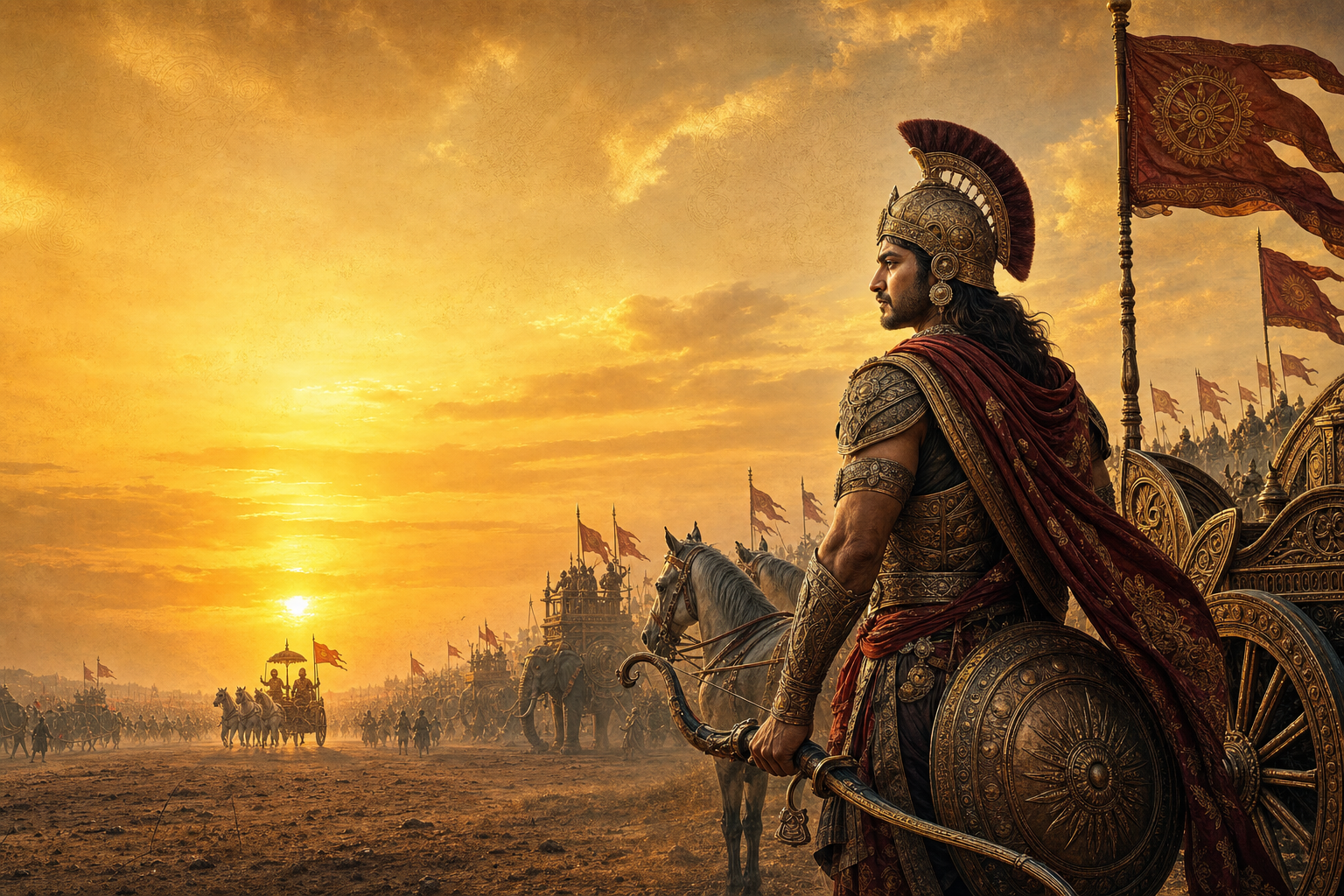
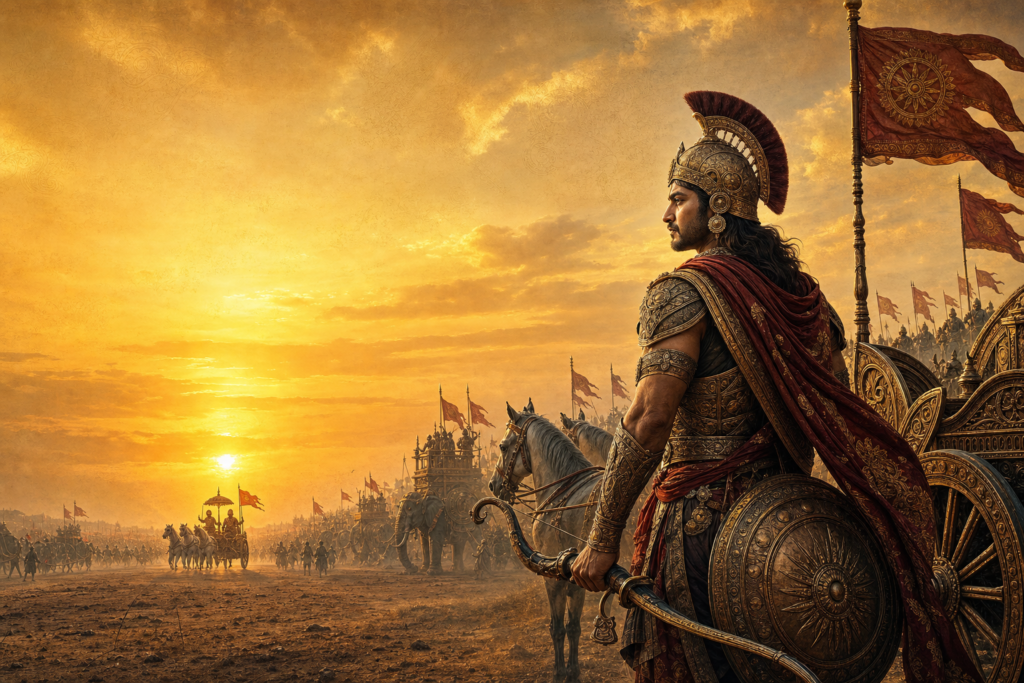
Achutayus in the Mahabharata is one of those battlefield figures whose presence is brief, yet morally significant. The epic does not give him the extended biography granted to Bhishma, Drona, Karna, Arjuna, or Krishna, but his appearance in the Kurukshetra War opens a valuable window into the violent momentum of the fourteenth day, the psychology of vengeance, and the tragic cost of loyalty in a collapsing moral order.
The name is also encountered in variant transliterations such as Achyutayus or Acyutayus. This variation is common when Sanskrit names move across manuscripts, regional retellings, and English translations. In a careful reading, the safest approach is to treat Achutayus as a Kaurava-side warrior remembered primarily through his encounter with Arjuna during the intense campaign to protect Jayadratha.
The relevant narrative setting belongs to the Drona Parva, especially the Jayadratha-vadha portion of the Mahabharata. This is the section in which Arjuna, shattered by the death of his son Abhimanyu, vows to kill Jayadratha before sunset. That vow transforms the battlefield into a race against time. Drona organizes the Kaurava forces to shield Jayadratha, while Krishna guides Arjuna through layers of resistance, delay, and moral danger.
Achutayus appears within this pressure-filled chain of opposition. He is not presented as a philosophical teacher or royal strategist, but as a warrior who stands in the path of Arjuna’s advance. That placement matters. In the logic of the Kurukshetra War, to face Arjuna and the Gandiva bow was to step into one of the most dangerous zones of the battlefield. Even a short mention therefore implies courage, obligation, and a warrior identity shaped by allegiance.
The Mahabharata repeatedly reminds readers that war does not consist only of famous heroes. It is also made of lesser-known kings, sons, brothers, charioteers, elephant riders, foot soldiers, and allies whose names pass quickly through the narrative. Achutayus belongs to this larger human field. His role is small in narrative length, but not small in meaning, because the epic uses such figures to show how an entire civilization is drawn into the consequences of adharma.
The fourteenth day is essential for understanding him. Abhimanyu’s killing inside the Chakravyuha creates a moral and emotional rupture. Arjuna’s vow against Jayadratha is not merely tactical; it is born from grief, paternal love, and outrage at what the Pandavas regard as an unjust killing. Yet the epic does not romanticize vengeance without caution. It shows how grief can clarify duty, but also how easily it can intensify destruction.
In this setting, Achutayus becomes part of the Kaurava effort to delay Arjuna. The defensive objective is simple: if Jayadratha survives until sunset, Arjuna’s vow fails. The military objective is therefore inseparable from psychological warfare. Every warrior placed before Arjuna is not only fighting him; he is consuming time, exhausting horses, drawing arrows, and testing Krishna’s strategic guidance.
From a technical military perspective, the episode shows the sophistication of epic battlefield narration. Chariot warfare, protective formations, elephant divisions, cavalry pressure, and layered command decisions all operate together. The Mahabharata’s war scenes are not random descriptions of violence. They are structured accounts of mobility, formation, morale, exhaustion, weapon deployment, and battlefield timing.
Achutayus is often read in connection with other warriors who resist Arjuna during this sequence, including figures such as Srutayus, Sudakshina, and others in the wider defense of Jayadratha. The exact emphasis can vary by translation and recension, but the core narrative function remains stable: Arjuna must pass through a chain of formidable resistance before reaching his target.
This is why Achutayus should not be dismissed as a marginal name. The Mahabharata’s narrative economy often works through compression. A warrior may receive only a few lines, but those lines place him inside a vast moral architecture. The briefness of the account becomes part of its emotional force: on Kurukshetra, even brave lives can disappear almost instantly.
There is also a deeper dharmic lesson in the way the epic frames such warriors. Achutayus fights on the Kaurava side, but the Mahabharata rarely allows a simplistic division between pure heroes and pure villains. Many Kaurava allies are bound by duty, patronage, friendship, kingdom obligations, or warrior codes. Their deaths reveal the tragic complexity of social loyalty when leadership turns away from dharma.
The story therefore asks readers to distinguish between personal bravery and the righteousness of the cause being served. A warrior may be courageous, disciplined, and loyal, yet still stand within a destructive order. This distinction is one of the most important Mahabharata lessons for political life, family life, and ethical decision-making: virtue in action must be joined to clarity about the larger moral direction.
The cycle of vengeance is the central emotional theme surrounding Achutayus. Abhimanyu’s death leads to Arjuna’s vow. Arjuna’s vow leads to mass mobilization for Jayadratha’s protection. That mobilization brings warriors like Achutayus into Arjuna’s path. Each death then creates new grief, new anger, and new vows. The Mahabharata shows how violence multiplies when injury is answered only through retaliation.
At the same time, the epic does not preach weakness. It recognizes that dharma sometimes requires confrontation, protection, and decisive action. Arjuna’s pursuit of Jayadratha is not presented as ordinary anger. It arises in a war already declared, after a grave violation of martial ethics. Yet Krishna’s presence remains crucial because power without discernment can become another form of blindness.
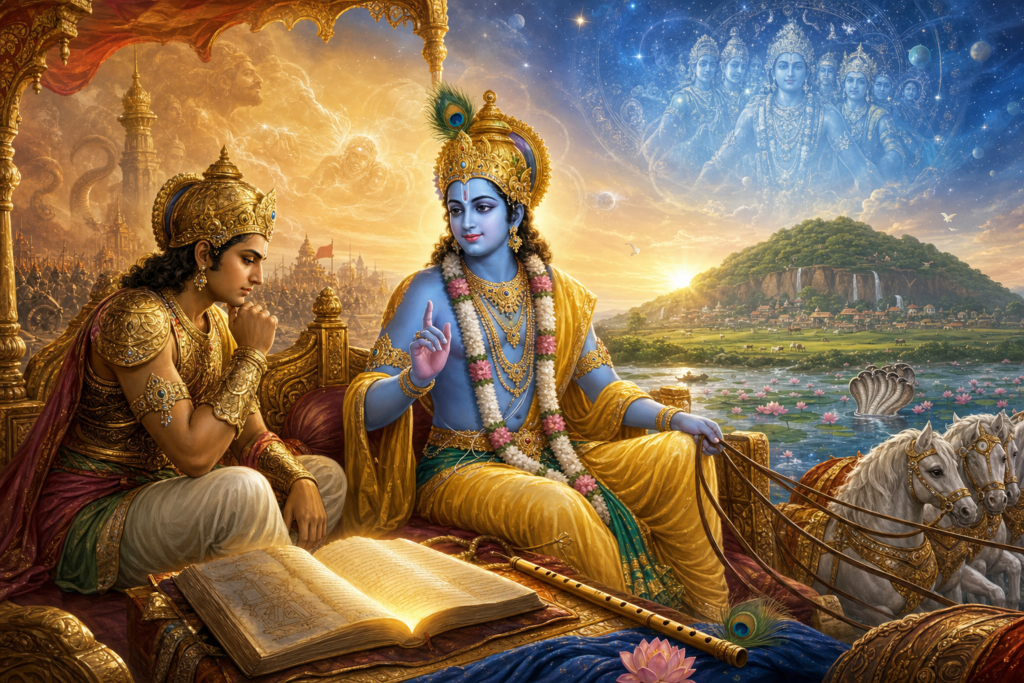
Krishna’s role in this episode is especially important. He is not merely a charioteer in the physical sense. He is the voice of timing, restraint, strategic intelligence, and cosmic perspective. Arjuna has skill, grief, and weapons; Krishna gives direction. This partnership shows that even the most capable warrior needs guidance rooted in dharma rather than impulse.
Achutayus, by contrast, represents the warrior caught within the machinery of a larger decision. His courage is visible, but his agency is limited by the command structure of the Kaurava army. That is one of the most sobering features of the Kurukshetra War. Individuals act with bravery, yet the collective direction of the war pulls them toward ruin.
The Drona Parva as a whole is marked by the erosion of war ethics. Earlier ideals of dharma-yuddha become strained as grief, desperation, and revenge deepen. The deaths of Abhimanyu, Jayadratha, Ghatotkacha, and Drona belong to the same broad arc of intensification. Achutayus stands within this arc as one of the many warriors consumed by a conflict that has moved beyond ordinary political dispute.
For readers of Hindu scriptures and Indian epics, this episode remains relevant because it speaks to a recurring human problem: how communities remember injury without becoming imprisoned by revenge. Families, societies, and nations often carry old wounds. The Mahabharata does not deny the reality of pain, but it warns that unexamined anger can keep reproducing the very suffering it seeks to answer.
This lesson resonates across dharmic traditions. Hindu thought emphasizes karma, dharma, self-mastery, and the danger of adharma. Buddhist traditions examine craving, anger, and the suffering generated by attachment. Jain philosophy gives special importance to restraint, non-violence, and the careful weighing of harm. Sikh teachings uphold courage, justice, and disciplined resistance without hatred. Together, these traditions encourage ethical strength rather than blind retaliation.
Such a unified dharmic reading does not erase the Mahabharata’s specific Hindu setting. Rather, it brings out the wider civilizational insight that power must be governed by conscience. Achutayus becomes meaningful not because he delivers a sermon, but because his fall demonstrates what happens when vast systems of rivalry, pride, and revenge overpower the duties that preserve social order.
The name Achutayus itself invites reflection, though caution is necessary. In Sanskritic terms, Achyuta can carry the sense of the unfailing or the unfallen and is also a revered name of Vishnu and Krishna, while ayus relates to life. Epic names, however, should not be reduced to literal etymology alone. Their meaning emerges through narrative placement, action, and moral consequence.
Seen this way, the irony is powerful. A warrior whose name evokes endurance appears in a scene where life is fragile and uncertain. The battlefield of Kurukshetra overturns human confidence. Rank, training, lineage, and courage can all vanish in a moment. The Mahabharata repeatedly uses this contrast to humble the reader before the law of impermanence and the seriousness of moral choice.
Achutayus also helps correct a common reading habit. Many readers approach the Mahabharata by focusing only on the Pandavas and Kauravas, or only on Krishna’s teaching in the Bhagavad Gita. Yet the epic is much larger. It preserves a dense moral world in which even minor figures contribute to the texture of history, memory, and dharma.
This broader reading is especially useful for students of Mahabharata characters. Minor warriors often function like ethical markers. They show the scale of destruction, the reach of political alliances, and the way personal destiny becomes entangled with collective conflict. Achutayus is one such marker: a warrior remembered because he stood at a decisive point in Arjuna’s terrible march toward Jayadratha.
His story also reveals the epic’s emotional realism. On one side is Arjuna, a grieving father with a vow. On another side is Jayadratha, marked for death. Between them stand many warriors, including Achutayus, who may have had their own families, loyalties, and hopes. The epic does not pause to narrate all of those lives, but their implied presence gives the war its tragic depth.
In contemporary terms, Achutayus can be understood as a reminder that history is not made only by celebrated leaders. It is also carried by those whose names survive in fragments. Their fragments deserve careful attention because they reveal the human cost hidden beneath grand narratives of victory and defeat.
The academic value of studying Achutayus lies in this balance between textual restraint and interpretive depth. The available narrative does not support an invented biography, so responsible interpretation should avoid exaggeration. Yet the context in which he appears is rich enough to support serious reflection on war ethics, vengeance, loyalty, and the collapse of dharmic order.
Therefore, Achutayus in the Mahabharata should be remembered as more than a name in a battle list. He represents the countless warriors who entered Kurukshetra under banners of duty and emerged as evidence of war’s devastating moral arithmetic. His brief appearance strengthens one of the epic’s central teachings: when adharma governs public life, even courage can become fuel for tragedy.
The final lesson is not despair, but discernment. The Mahabharata preserves Achutayus so that readers may see how vengeance expands, how loyalty can be misdirected, and how dharma must guide strength. In that sense, his story remains valuable for anyone seeking to understand the Kurukshetra War not only as an ancient battle, but as a profound study of human responsibility.
Inspired by this post on Hindu Blog.


Leave a Reply
You must be logged in to post a comment.