
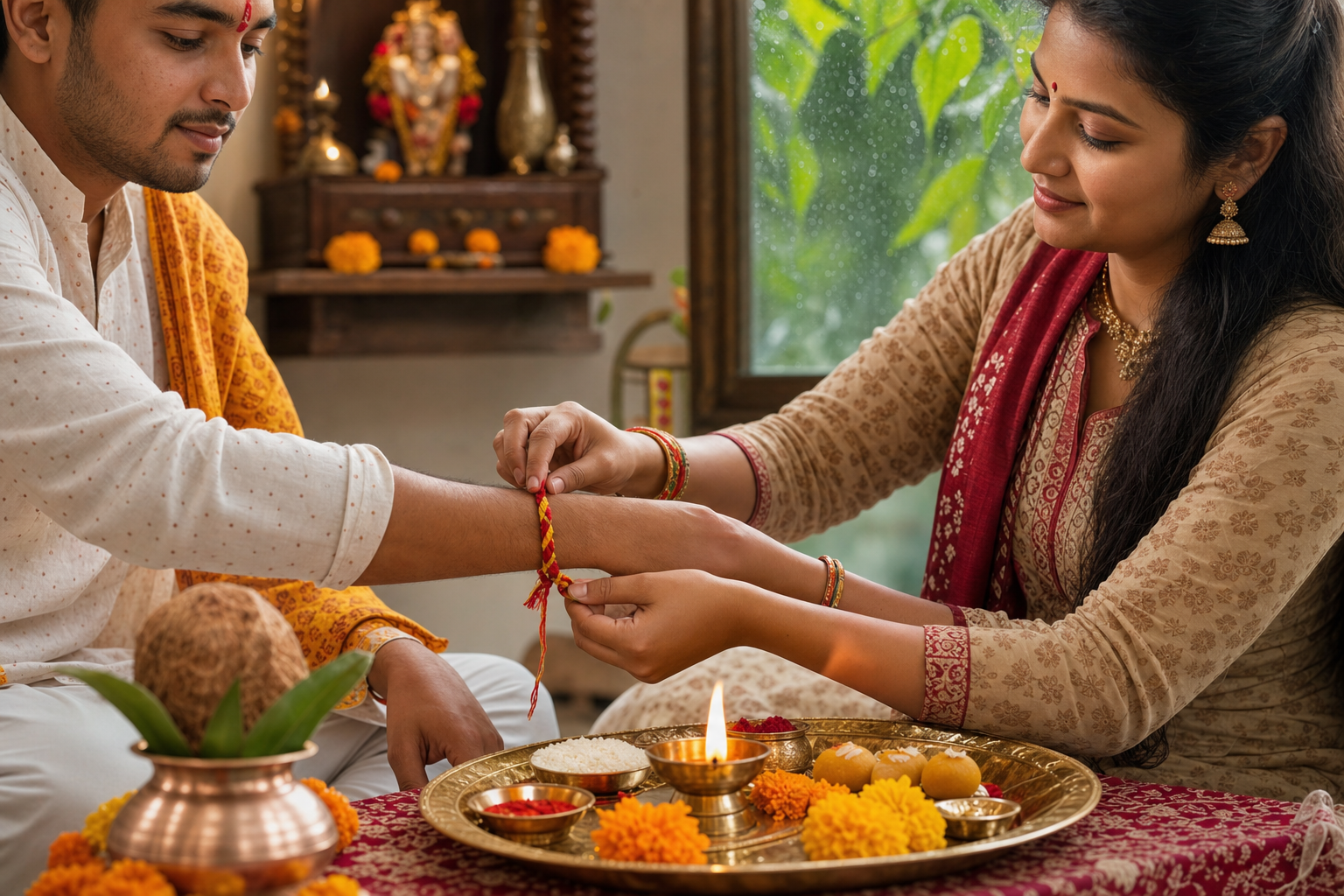
Vir Pasli vrat, also written as Veer Pasali festival, is a regional Hindu observance associated with Shravan month in Gujarat. In 2026, the commonly noted dates for Veer Pasali vrat are August 15, August 16, or August 22, depending on local custom, family tradition, and the panchang followed by the household. The variation is important because the observance is linked not to a single universally standardized public festival day, but to a localized Gujarati practice that is generally kept on the first or second Saturday of Shravan, while some families observe it on the first Sunday of Shravani maas.
The festival deserves careful attention because it preserves a quieter form of the same emotional and ritual grammar found in Raksha Bandhan. Its central act is raksha dhaaran, the wearing or tying of a protective thread, through which a sister expresses affection and prayerful concern for her brother, and the brother affirms his responsibility toward her well-being. The ritual is simple, but its social meaning is profound: it transforms kinship into duty, affection into ethical responsibility, and memory into an annual act of renewal.
In many Gujarati homes, Vir Pasli is not observed with the wide public visibility of Raksha Bandhan. This is partly because its rituals are so similar to Rakhi that the more famous festival often absorbs public attention. Yet that relative quietness should not be mistaken for insignificance. Smaller regional vrats often carry the delicate texture of family life more clearly than large public festivals because they remain embedded in household memory, local speech, and inherited practice.
Shravan month provides the wider sacred frame for this observance. In Hindu calendar practice, Shravan falls during the monsoon season and is especially associated with devotion, fasting, vrata discipline, and worship of Lord Shiva. Gujarat, like several other regions of India, maintains its own living rhythm of Shravan customs, and Vir Pasli belongs to this regional ritual ecology. It is not merely a date on a calendar; it is part of the way communities organize sacred time around family, protection, restraint, and devotion.
The technical reason for date variation lies in the structure of the Hindu lunar calendar and in regional panchang usage. A vrata may be observed according to tithi, weekday, lunar month, local sunrise calculations, or inherited household convention. Vir Pasli is especially connected with the first or second Saturday in Shravan, and in some traditions with the first Sunday. For 2026, this explains why August 15, August 16, and August 22 are all relevant dates in different observance patterns.
August 15, 2026 falls on a Saturday and is therefore significant for families that observe Vir Pasli on the first Saturday of Shravan. August 16, 2026 falls on a Sunday and may be followed by those who preserve the first Sunday tradition. August 22, 2026 falls on the following Saturday and is relevant for households that observe the vrata on the second Saturday. Devotees should therefore confirm the exact observance with their family elders, local priest, or regional panchang before performing the vrata.
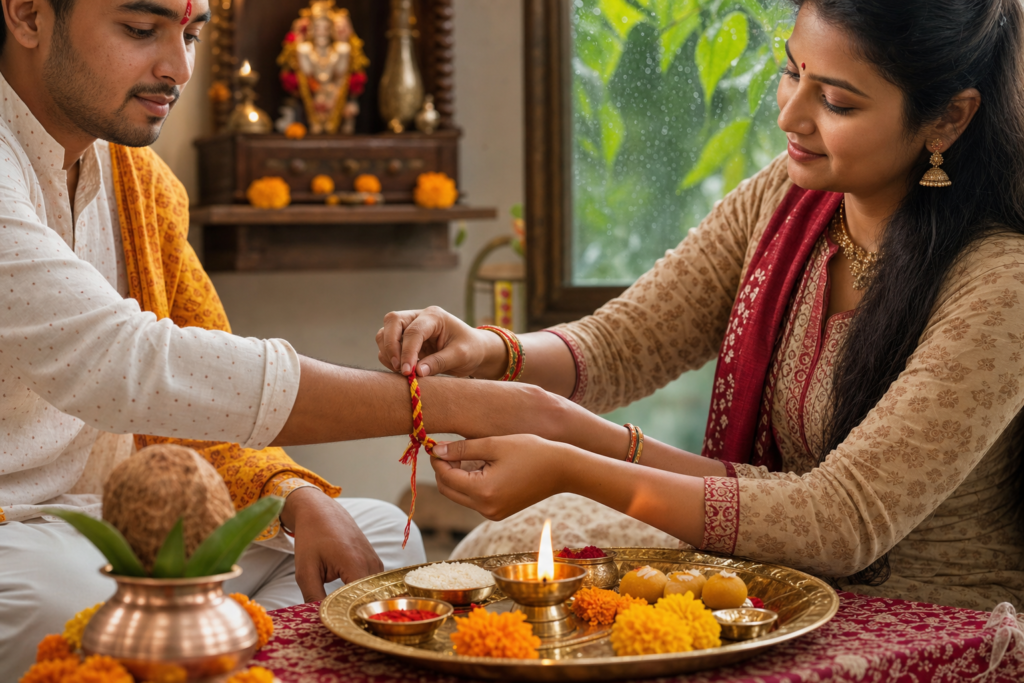
The main ritual, raksha dhaaran, resembles the tying of rakhi during Raksha Bandhan. A sister ties a sacred protective thread on her brother’s wrist, usually after simple worship, prayer, and auspicious preparation. The brother then promises to protect and support her. In a narrow sense, this is a sibling ritual; in a wider dharmic sense, it is a disciplined reminder that affection must be expressed through responsibility, steadiness, and mutual care.
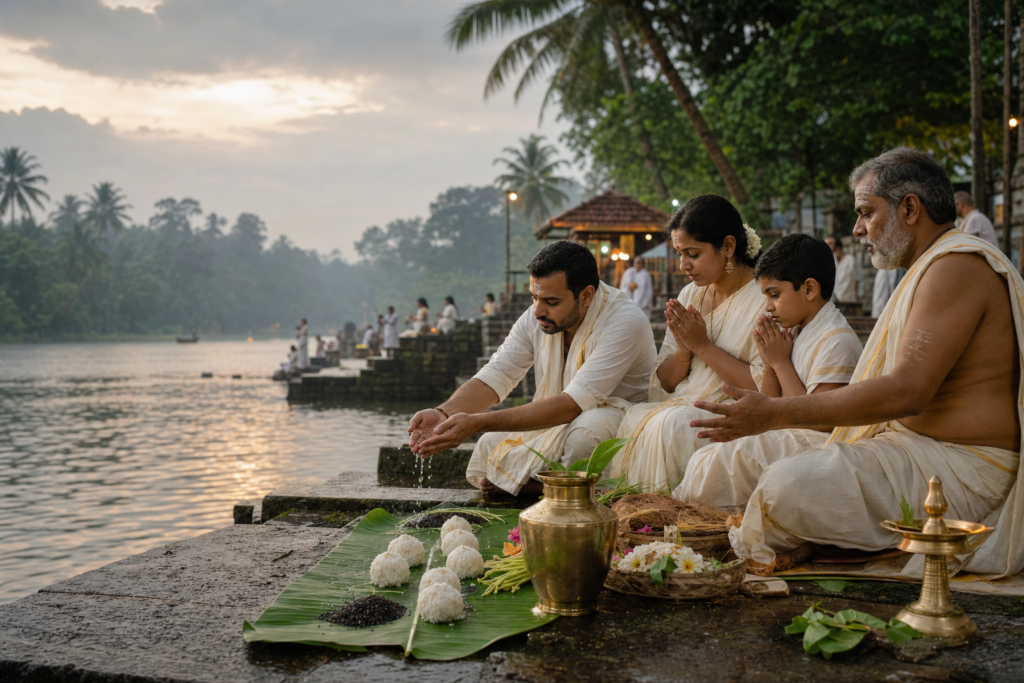
A typical household observance may include bathing early, cleaning the prayer space, preparing a small puja thali, lighting a lamp, offering prayers to the family deity, and then performing the thread-tying ceremony. The ritual may be accompanied by kumkum, rice grains, sweets, and blessings. These elements are familiar across many Hindu domestic rites, yet their arrangement in Vir Pasli gives them a specific emotional focus: the protection of the sibling bond.
The protective thread in such traditions is not a mere ornament. In dharmic ritual culture, a thread can mark sankalpa, blessing, obligation, and remembrance. Its material simplicity is part of its meaning. Cotton, color, knot, touch, and mantra can all become carriers of intention when placed within a sacred domestic act. Vir Pasli therefore belongs to the broader family of Hindu rituals in which everyday materials are elevated through devotion and ethical resolve.
The comparison with Raksha Bandhan is useful, but Vir Pasli should not be reduced to a duplicate of it. Raksha Bandhan is widely celebrated on Shravan Purnima, while Vir Pasli has a more localized Gujarati observance pattern connected with Saturday or Sunday in Shravan. Both share the symbolism of raksha, but their calendrical placement and regional memory differ. This distinction matters for readers who wish to understand Hindu festivals not as uniform events, but as layered traditions shaped by place, language, and lineage.
From an academic perspective, Vir Pasli illustrates how Hindu practice often operates through overlapping scales: pan-Indian themes, regional calendars, caste and community customs, family lineages, and individual devotion. A single ritual thread can therefore belong simultaneously to domestic affection, Gujarati cultural identity, Hindu festival practice, and the wider spiritual language of protection. This layered structure is one reason dharmic traditions remain both continuous and adaptable.
The festival also offers a meaningful social lesson. Protection should not be understood only as physical defense. In contemporary life, protection may include emotional support, respectful communication, financial responsibility, dignity in family relationships, and the willingness to stand beside one another in difficulty. Vir Pasli gives families an annual opportunity to renew these commitments in a form that is gentle, symbolic, and memorable.
For sisters, the act of tying the protective thread is a prayer for the brother’s well-being and a reminder of shared childhood, ancestry, and family continuity. For brothers, the vow of protection should be read as a moral obligation rather than a gesture of superiority. The most mature interpretation of the ritual is reciprocal: both siblings honor each other’s dignity, and both become responsible participants in the preservation of family harmony.
This interpretation is especially important for a modern audience. A dharmic festival remains alive when its symbolic core is preserved while its ethical meaning is understood with maturity. Vir Pasli can therefore be observed without reducing women to dependence or men to ritual formality. Its deeper message is that relationships require protection from neglect, ego, distance, and forgetfulness.
The vrata also reflects the broader Hindu idea that sacred life begins at home. Temples, pilgrimages, and public festivals have great importance, but domestic rituals shape daily character. A lamp lit before a family deity, a thread tied with sincerity, and a promise made before elders can carry quiet transformative power. Such practices transmit values not through lectures, but through repeated embodied acts.
Vir Pasli also contributes to cultural continuity in the Gujarati diaspora. Families living outside Gujarat or outside India may not always have access to the exact local environment in which the vrata developed. Yet the essential observance can still be preserved through a simple home puja, a video call between siblings, or the mailing of a raksha thread before the date. What matters most is not external grandeur, but the continuity of intention and remembrance.
In the wider context of dharmic unity, Vir Pasli offers a constructive example of how regional Hindu customs can be honored without creating division. Hinduism, Buddhism, Jainism, and Sikhism all preserve distinct forms of discipline, remembrance, ethical duty, and community bonding. While their theologies and practices differ, the value of mindful relationship, restraint, compassion, and responsibility is shared across dharmic civilization. A festival of protection can therefore be read as part of a larger culture of care.
The most practical guidance for 2026 is straightforward. Families that follow the first Saturday custom may observe Vir Pasli on August 15, 2026. Families that observe the first Sunday custom may choose August 16, 2026. Families that follow the second Saturday custom may observe it on August 22, 2026. Because Hindu observances can vary by locality and panchang, local confirmation is recommended before finalizing the household ritual.
Care should also be taken to preserve the simplicity of the vrata. The festival does not require excessive display or commercial pressure. A clean space, sincere prayer, a protective thread, respectful speech, and a meaningful vow are enough to carry the ritual’s purpose. In fact, the modest scale of Vir Pasli may be one of its strengths, because it keeps attention on the sacred bond rather than on performance.
Vir Pasli Festival 2026 is therefore best understood as a Gujarati Shravan vrata centered on protection, sibling affection, and ethical duty. Its relationship with Raksha Bandhan makes it familiar, while its regional calendar pattern makes it distinctive. For devotees, it is a chance to renew family bonds; for students of culture, it is a valuable example of how Hindu festivals preserve local diversity within a shared spiritual framework.
Reference consulted: the HinduPad calendar note on Vir Pasli Festival records the Gujarati Shravan context, the similarity with Raksha Bandhan rituals, the raksha dhaaran practice, and the pattern of observance on the first or second Saturday, with some families observing the first Sunday.
Inspired by this post on Hindu Pad.




Leave a Reply
You must be logged in to post a comment.