
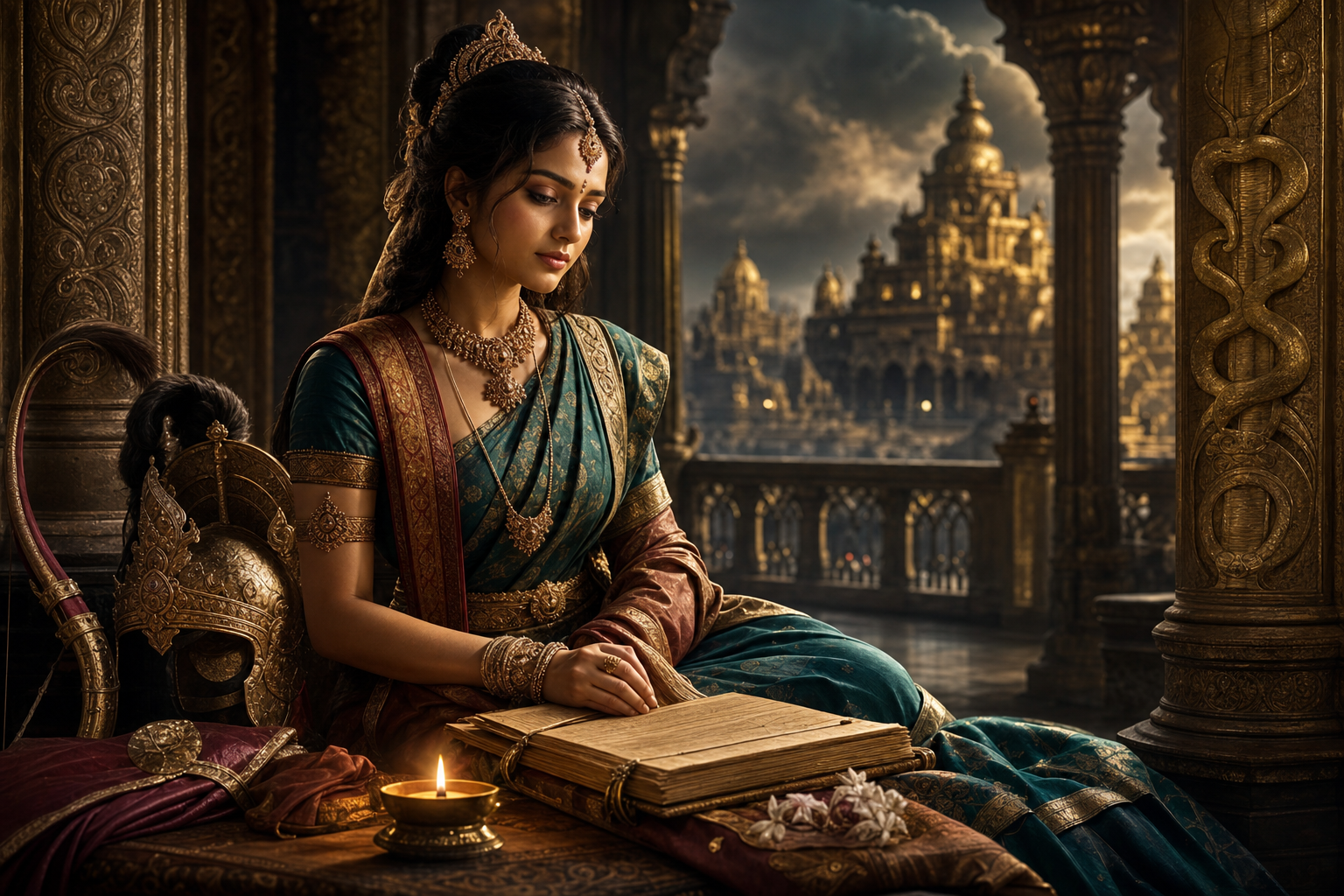
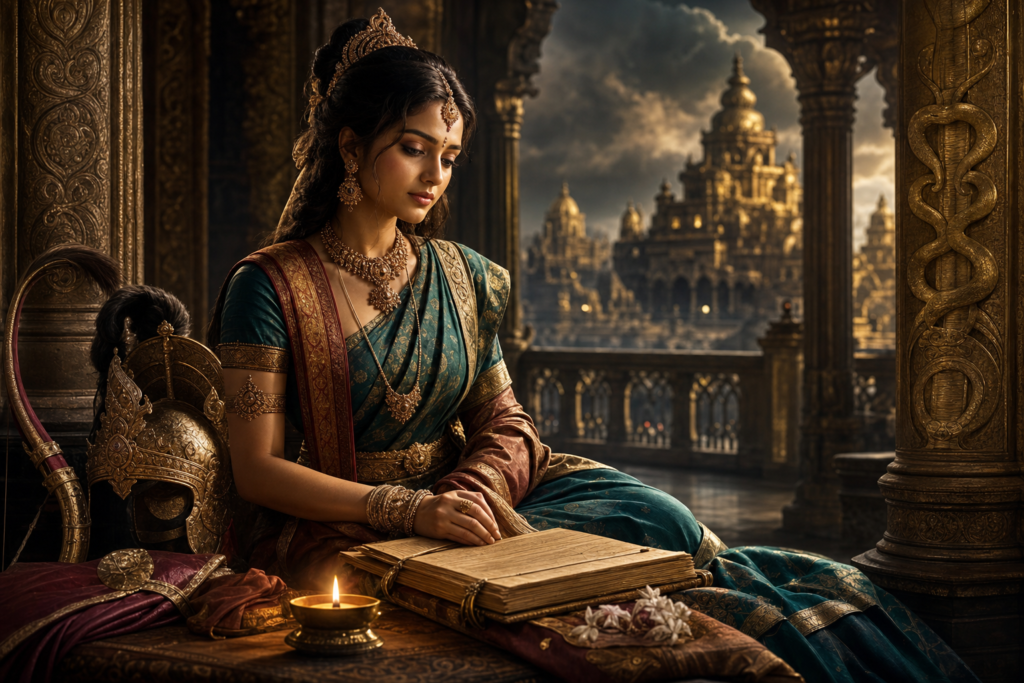
Sulochana occupies a quiet but emotionally powerful place in the wider Ramayana tradition. The central movement of the epic is usually understood through Sri Rama, Sita, Lakshmana, Hanuman, Ravana, and the great war in Lanka, yet the Ramayana is also a vast moral landscape shaped by many less-visible lives. Sulochana, remembered in later tellings as the devoted wife of Indrajit, stands among those figures whose significance lies not in battlefield victory but in conscience, restraint, loyalty, and the difficult intelligence required to recognize dharma even within a house ruled by adharma.
Her story must be approached with textual care. Sulochana is not a major developed character in the most familiar Valmiki Ramayana narrative. Her fuller presence emerges in later Ramayana traditions, regional retellings, devotional literature, folk performance, and oral memory. This distinction matters because the Ramayana has never lived as a single frozen text alone. It has moved across Sanskrit, Tamil, Telugu, Bengali, Hindi, Kannada, Malayalam, Thai, Javanese, and many other cultural worlds, carrying core ethical concerns while also allowing communities to contemplate characters who stand at the margins of the main action.
In that broader tradition, Sulochana is often presented as the wife of Indrajit, also known as Meghanada, the formidable son of Ravana. Indrajit is remembered as one of the most dangerous warriors in the Ramayana: a conqueror of Indra, a master of astras, and a defender of Lanka whose martial brilliance is matched by his tragic attachment to Ravana’s cause. Sulochana’s narrative power comes from her proximity to this conflict. She belongs to Lanka’s royal household, yet her moral sensibility is frequently shown as more refined than the political culture surrounding her.
The name Sulochana itself carries meaning. Derived from Sanskrit elements often understood as “beautiful-eyed” or “one with auspicious eyes,” the name suggests more than physical beauty. In epic literature, sight is rarely only biological. To see clearly is to discern truth. Sulochana’s symbolic function is therefore deeply appropriate: she is remembered as one who sees the moral danger that others refuse to see. Her wisdom becomes a form of inner vision, and that vision makes her one of the quiet ethical witnesses of the Lanka episode.
Some later traditions describe Sulochana as connected to the naga lineage, occasionally identifying her as the daughter of Shesha or Vasuki. Such associations deepen her symbolic profile. The naga world in Hindu sacred literature often represents hidden knowledge, subterranean strength, cosmic support, and continuity beneath visible events. If Sulochana is read through this lens, she becomes not merely a royal bride in Lanka but a figure of restrained power: steady, observant, and bound to dharma even when surrounded by violence.
Her husband Indrajit is one of the most complex figures on the side of Ravana. He is not portrayed as weak, foolish, or cowardly. On the contrary, his strength makes the tragedy sharper. A warrior may possess extraordinary skill and still be morally misdirected. This is one of the Ramayana’s enduring lessons: power without dharma becomes self-destructive. Sulochana’s role, as preserved in later memory, is to reveal that even within Lanka there were voices capable of recognizing this danger.
In many retellings, Sulochana does not oppose her husband through rebellion or anger. Her strength lies in counsel. She understands the duties of a wife, but she also understands that loyalty is not the same as moral blindness. This distinction is essential. Dharma does not demand passive approval of wrongdoing. It asks for truthfulness, responsibility, self-restraint, and alignment with a higher moral order. Sulochana’s wisdom therefore becomes Indrajit’s conscience, even when that conscience cannot finally turn him away from the path of war.
The emotional force of her story comes from this tension between affection and truth. She loves Indrajit, but love does not erase discernment. She belongs to Ravana’s household, but kinship does not abolish moral judgment. She is placed inside a world where power, pride, and vengeance dominate public action, yet she represents the quieter voice that asks what victory is worth when righteousness has already been abandoned. This is why her character continues to speak to readers beyond the epic setting.
The Ramayana repeatedly contrasts outer strength with inner clarity. Ravana has learning, kingship, wealth, and military force, yet he lacks restraint. Vibhishana has far less visible power, yet he recognizes dharma and chooses Sri Rama’s side. Mandodari, Ravana’s queen, also warns against the destructive consequences of abducting Sita. Sulochana belongs to this moral pattern. Like Mandodari and Vibhishana, she demonstrates that Lanka is not a simplistic realm of evil individuals but a society caught in the consequences of one ruler’s adharma.
This is an important academic and spiritual point. The Ramayana does not merely divide the world into communities of virtue and communities of vice. It examines choices. Dharma and adharma operate through decisions, desires, loyalties, and failures of self-command. Sulochana’s presence helps prevent a crude reading of the epic. She shows that moral insight can arise even in the household of Ravana, and that righteousness is recognized not by birth, location, or political identity alone, but by conduct and clarity.
Indrajit’s tragedy is that he remains bound to filial duty in a distorted form. As Ravana’s son, he fights with unmatched courage for Lanka. Yet dharma is not fulfilled merely by serving one’s father or ruler. In Hindu ethics, duties exist within a larger hierarchy. Loyalty to family, kingdom, and teacher must remain aligned with truth, justice, and cosmic order. When a father becomes the agent of grave wrongdoing, the son’s duty becomes morally complex. Sulochana’s counsel, in later tradition, brings this conflict into intimate focus.
Her character also invites reflection on the role of women in the Ramayana. The epic’s women are not decorative figures. Sita embodies endurance, purity, courage, and uncompromising dignity. Mandodari represents political wisdom and grief. Tara in the Kishkindha episode displays strategic intelligence and moral counsel. Shabari represents devotion beyond social hierarchy. Urmila embodies silent sacrifice. Sulochana, though less widely discussed, belongs to this wider constellation of women whose strength often appears through insight rather than public authority.
In modern readings, Sulochana can be understood as a figure of ethical intimacy. Her sphere is domestic, but her concern is civilizational. What happens in the home of a warrior affects the fate of a kingdom. What a wife sees in the heart of her husband may reveal the moral direction of an entire political order. The Ramayana repeatedly teaches that dharma is not limited to temples, forests, courts, or battlefields. It begins in speech, counsel, restraint, and the courage to tell loved ones the truth.
The relationship between Sulochana and Indrajit also raises the question of conscience within loyalty. Many people across generations have faced a similar moral dilemma in less dramatic forms: whether to support a loved one unconditionally, or whether true support sometimes requires warning, disagreement, and painful honesty. Sulochana’s story suggests that love without dharma becomes attachment, while dharma without compassion becomes harshness. Her greatness lies in holding both together.
Her silence is therefore not emptiness. It is the silence of a person whose moral presence is felt even when the epic stage is dominated by warriors. In many traditional societies, such figures were remembered precisely because they represented the conscience of the household. Sulochana does not need to defeat anyone in combat to become significant. She reveals that one person’s clarity can illuminate the ethical failure of an entire political order.
Indrajit’s death at the hands of Lakshmana is one of the decisive moments of the Yuddha Kanda tradition. The fall of Ravana’s greatest son signals the approaching collapse of Lanka’s military confidence. In later narratives that include Sulochana’s grief, this moment becomes not only a strategic turning point but a domestic catastrophe. The warrior who terrified the devas and vanaras is also a husband whose death devastates a wife. The epic’s grandeur is thus brought back to the human scale.
This movement from battlefield to household is one of the Ramayana’s most profound literary features. War is never presented as an abstraction. Every act produces grief. Every arrow has consequences beyond the warrior it strikes. Sulochana’s mourning, as remembered in later tellings, humanizes even the enemy camp without excusing Ravana’s wrongdoing. This balance is central to dharmic storytelling: compassion does not require moral confusion, and moral clarity does not require cruelty.
Sulochana’s grief also reveals the cost of adharma to those who did not create it. Ravana’s abduction of Sita sets in motion a chain of destruction that consumes his family, his warriors, and his city. Indrajit dies because he chooses to fight for that order. Sulochana suffers because she is bound to him through love and marriage. The Ramayana thereby shows that unrighteous action rarely harms only the person who commits it. Adharma spreads through relationships, institutions, and generations.
Yet Sulochana is not only a victim of circumstance. Her dignity lies in her awareness. She understands the moral structure of events. In some retellings, she recognizes the greatness of Sri Rama and the inevitability of Ravana’s fall. Such recognition is not betrayal; it is discernment. A person may love those on the losing side and still understand why that side must fall. This mature ethical intelligence makes Sulochana especially relevant for readers interested in dharma, responsibility, and moral courage.
Her story also contributes to the dharmic ideal of unity without uniformity. The Ramayana has been cherished across many Hindu sampradayas and has also influenced Buddhist, Jain, Sikh, and wider Asian narrative traditions in different forms. The purpose of studying figures like Sulochana is not to create sectarian division but to deepen shared ethical reflection. Her character speaks across traditions because she represents a universal question: how does one remain truthful when surrounded by pressure, pride, and inherited loyalty?
In Hindu thought, dharma is not a slogan. It is a disciplined way of perceiving reality and acting within it. It includes duty, justice, compassion, truth, restraint, gratitude, and responsibility. Sulochana’s life, as preserved in devotional memory, illustrates dharma at the level of emotional difficulty. It is easy to speak of righteousness when there is no personal cost. It is far harder when righteousness requires seeing the flaws of one’s own household.
For this reason, Sulochana may be read alongside Mandodari. Both women stand within Lanka’s palace, and both are associated with insight that the ruling men fail to honor fully. Mandodari warns Ravana; Sulochana is remembered as a wise presence beside Indrajit. Their tragedy is not lack of understanding but the refusal of power to listen. The Ramayana repeatedly shows that when rulers and warriors ignore truthful counsel, destruction becomes inevitable.
The figure of Sulochana also complicates the idea of heroism. In epic literature, heroism is often associated with combat, endurance, vows, and sacrifice. Yet there is also a quieter heroism: the courage to remain morally awake, to speak gently but truthfully, and to grieve without hatred. Sulochana’s strength belongs to this second category. She does not dominate the narrative, but she deepens it.
Her portrayal can also be understood through the dharmic idea of pativrata, though this term should not be reduced to mere obedience. At its highest, pativrata dharma involves spiritual seriousness, fidelity, self-discipline, and sacred commitment. Sulochana’s devotion to Indrajit does not make her morally passive. Rather, her devotion sharpens the tragedy, because she sees the noble qualities in her husband while also standing near the shadow cast by his allegiance to Ravana.
This makes Indrajit himself more complex. He is not a simple villain. He is brave, disciplined, and devoted to his father and kingdom. But the Ramayana insists that virtues become dangerous when placed in service of adharma. Courage without righteousness becomes violence. Loyalty without discernment becomes bondage. Intelligence without humility becomes pride. Through Sulochana’s presence, the audience is invited to see what Indrajit might have been had his strength been guided by a clearer moral compass.
The phrase “a wife’s wisdom becomes Indrajit’s conscience” therefore captures the deepest significance of Sulochana’s role. She represents the conscience that exists before catastrophe, the warning that arises before collapse, and the sorrow that remains after pride has spent itself. Such figures are essential in sacred literature because they remind society that ethical failure is rarely sudden. It is usually preceded by ignored counsel, dismissed warnings, and the silencing of those who see clearly.
From a literary perspective, Sulochana also shows how later Ramayana traditions expand emotional and ethical possibilities within the epic world. The core narrative gives the framework of dharma-yuddha, exile, devotion, kingship, and restoration. Later tellings often pause over interior lives: the wife who waits, the mother who grieves, the friend who doubts, the enemy who recognizes truth too late. These expansions do not necessarily replace the older narrative; they offer reflective windows into it.
Such retellings are part of the living nature of Hindu literary culture. The Ramayana has been recited in temples, performed in villages, sung in homes, discussed by scholars, and adapted by poets for centuries. A character like Sulochana survives because communities found in her a meaningful lesson. Her story allowed listeners to contemplate grief, marriage, loyalty, and the cost of unrighteous leadership without losing sight of Sri Rama’s central embodiment of dharma.
In contemporary terms, Sulochana’s relevance is striking. Families, institutions, and nations still struggle when loyalty is confused with silence. People still hesitate to speak when those they love or depend upon move in harmful directions. Sulochana’s example suggests that dharmic counsel may be gentle, but it must not be hollow. It must arise from love, self-control, and a commitment to truth greater than personal comfort.
Her story also encourages a more humane reading of conflict. The Ramayana does not ask readers to hate everyone on Ravana’s side. It asks them to understand the consequences of adharma and the necessity of restoring righteousness. Sulochana’s grief allows readers to feel compassion without losing moral clarity. This is one of the most refined features of dharmic ethics: the ability to oppose wrongdoing while still recognizing the humanity of those caught within its consequences.
For students of Ramayana literature, Sulochana also offers an entry point into the study of variant traditions. Her prominence differs across tellings, and this variation should be studied with respect rather than confusion. The epic tradition is not weakened by such diversity. It is enriched by the many ways communities have meditated upon dharma. When carefully understood, these variations reveal the depth of Indian literary memory and the subtle ways in which sacred stories continue to guide ethical imagination.
Sulochana’s life is therefore best understood not as a marginal anecdote but as a moral lens. Through her, the grandeur of the Ramayana becomes intimate. The fall of Lanka is not only the defeat of Ravana; it is the sorrow of Mandodari, the death of Indrajit, the grief of Sulochana, and the collapse of a world that refused righteous counsel. Her presence reminds readers that dharma must be guarded not only by kings and warriors but also by those who speak truth in private rooms.
The enduring lesson of Sulochana is that wisdom does not always stand on a throne or command an army. Sometimes it waits beside a warrior, sees the danger before he does, and grieves the consequences of choices it could not prevent. In the Ramayana’s vast moral universe, such wisdom is not small. It is one of the silent pillars that helps readers understand why dharma matters, why conscience must be honored, and why even the quietest voices in sacred literature deserve careful remembrance.
Inspired by this post on Hindu Blog.






Leave a Reply
You must be logged in to post a comment.