
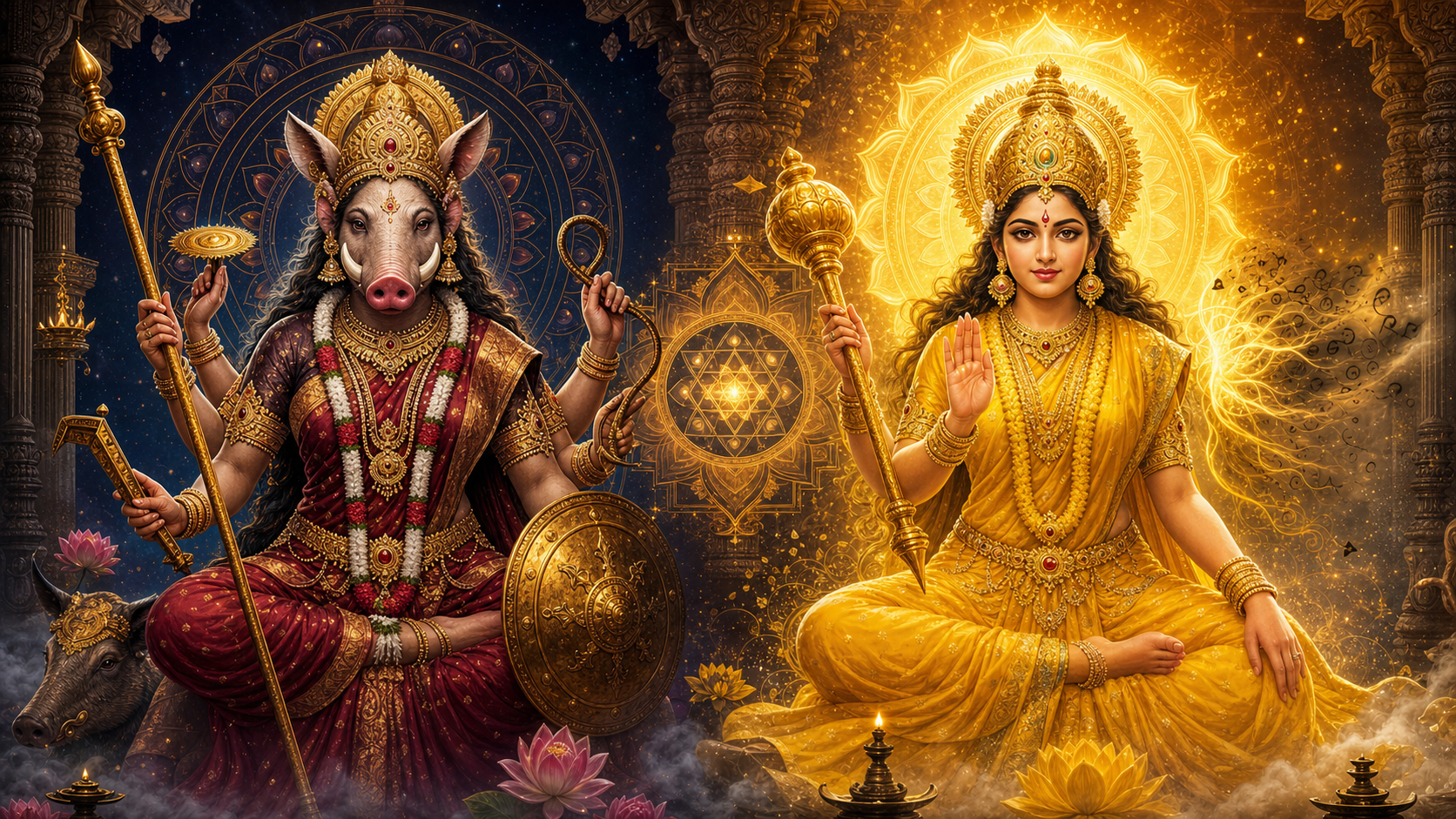
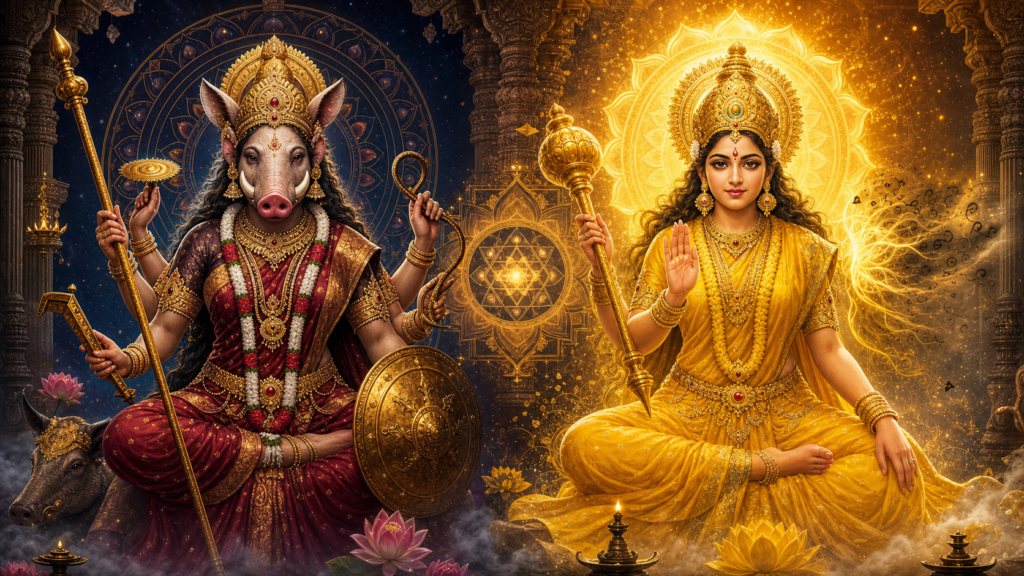
Goddess Varahi and Goddess Bagalamukhi occupy a powerful and highly specialized place within Hindu tantra, Shakta theology, temple iconography, mantra-sadhana, and the wider spiritual imagination of Sanatana Dharma. Both are revered as fierce manifestations of Devi, the Supreme Feminine Reality, yet their fierceness is not a crude symbol of violence. It represents cosmic intelligence acting with precision when dharma, inner stability, speech, discipline, and spiritual courage are threatened.
In traditional Hindu understanding, such goddesses are not merely mythological figures or isolated cultic forms. They are theological maps of energy, consciousness, protection, restraint, and transformation. Varahi and Bagalamukhi are distinct deities with their own mantras, yantras, iconographic conventions, temples, ritual disciplines, and scriptural associations. Yet they share a deep cosmic connection because both reveal how Devi protects the devotee by subduing disorder, whether that disorder appears as fear, harmful speech, egoic aggression, confusion, injustice, or spiritual inertia.
Varahi is most widely known as one of the Sapta Matrikas, the Seven Divine Mothers, and is connected to Varaha, the boar incarnation of Lord Vishnu. Her boar-faced form places her within a profound symbolic field. Varaha rescues Bhumi Devi, the Earth, from cosmic waters and restores stability to the universe. Varahi, as the Shakti associated with this power, embodies the feminine force that lifts consciousness from heaviness, protects sacred ground, and confronts forces that attempt to pull life into darkness or disorder.
Bagalamukhi, by contrast, is one of the Dasha Mahavidyas, the Ten Great Wisdom Goddesses of the Shakta-tantric tradition. She is often called Pitambara Devi because of her strong association with the color yellow, turmeric, radiance, and the power of focused intelligence. Her most famous iconographic image shows her restraining the tongue of a hostile being while holding a club. In theological terms, this image is not an invitation to cruelty. It is a dramatic visualization of stambhana, the power to arrest destructive momentum, silence falsehood, and neutralize harmful intent before it can manifest as greater damage.
The connection between Varahi and Bagalamukhi becomes clearer when their functions are studied together. Varahi represents grounded force, martial protection, hidden sovereignty, and the night-side of spiritual discipline. Bagalamukhi represents paralysis of negativity, command over speech, reversal of hostile energy, and the stilling of chaos. One can be understood as the power that charges into the field of disorder and restores sacred order; the other as the power that stops the disorder at its root by immobilizing its movement, voice, and intention.
Both goddesses belong to the broader universe of Shakti worship, where the Divine Feminine is not limited to gentleness, fertility, beauty, or nurturing alone. Hindu traditions preserve a far more complete understanding of motherhood and feminine divinity. The mother feeds, shelters, teaches, forgives, and blesses, but she also guards the threshold, disciplines the arrogant, and destroys whatever threatens the well-being of her children. Varahi and Bagalamukhi therefore express the protective and corrective dimensions of the Sacred Feminine.
Varahi’s iconography is especially rich. She may be depicted with a human body and the face of a boar, often bearing weapons such as the danda, plough, discus, sword, noose, shield, or pestle depending on the textual and regional tradition. Her vahana is often described as a buffalo, though other depictions connect her to a boar, lion, Garuda, Shesha, or even a corpse in tantric contexts. These variations are not contradictions in the casual sense. They show how Hindu iconography communicates layered metaphysical meanings through form, posture, weapon, vehicle, color, gesture, and ritual context.
The boar face of Varahi is central to her symbolism. In ordinary aesthetic terms, the boar may seem unusual or even unsettling, but in sacred iconography it conveys the capacity to dig beneath surfaces, uncover what is hidden, and rescue what has been buried. Varahi’s energy is earthy, subterranean, protective, and fearless. She is not distracted by appearances. She reaches into the lower, obscured, and forgotten layers of existence to recover stability, dignity, and spiritual force.
In the Devi Mahatmya and related Puranic traditions, the Matrikas arise as powers of the gods and as expressions of the Supreme Goddess during cosmic battle. Varahi appears among these divine mothers as a power associated with Varaha. The Sapta Matrikas collectively represent the mobilization of divine energies when ordinary forms of protection are insufficient. Their presence in temples, sculptural panels, and ritual traditions shows that Hindu spirituality has long recognized both benevolent and fierce modes of grace.
Within Sri Vidya and certain Shakta traditions, Varahi is honored as Dandanayika or Dandanatha, the commander of Lalita Tripurasundari’s forces. This role is theologically important. It presents Varahi not only as a battlefield goddess but also as a principle of sacred administration, command, discipline, and cosmic governance. She represents the power by which divine order is enforced. In this sense, her danda is not merely a weapon; it is the rod of authority, justice, and dharmic alignment.
Bagalamukhi’s iconography is equally precise. She is usually described as golden or yellow in complexion, dressed in yellow garments, adorned with yellow ornaments, and worshipped with yellow offerings such as turmeric. Yellow, in this context, signifies auspiciousness, radiance, fertility, clarity, and concentrated intelligence. The stillness associated with Bagalamukhi is not passive silence. It is the charged stillness of a mantra held with discipline, the pause before speech becomes harmful, and the inner command that prevents scattered energy from becoming destructive.
Her association with the tongue is one of the most misunderstood elements of her form. The tongue represents speech, taste, desire, public influence, argument, mantra, and the power of articulation. In dharmic thought, speech is sacred because vak is creative. Words can bless, teach, heal, preserve memory, and transmit scripture. They can also deceive, wound, inflame conflict, and distort truth. Bagalamukhi’s restraint of the tongue therefore symbolizes the arresting of false speech, malicious rhetoric, reckless argument, and the misuse of verbal power.
This makes Bagalamukhi especially relevant in an age of constant communication. The modern world is saturated with speech: debates, posts, accusations, slogans, advertisements, news cycles, and digital reactions. Her symbolism offers a disciplined spiritual reminder that not every impulse deserves expression and not every voice serves truth. The inner meaning of her worship points toward mastery over speech, restraint before reaction, and the transformation of verbal power into clarity rather than harm.
The shared cosmic field of Varahi and Bagalamukhi may be understood through three themes: protection, containment, and transformation. Varahi protects by confronting forces that destabilize the sacred order. Bagalamukhi protects by containing the energy of opposition before it expands. Varahi moves like a commander who clears the field; Bagalamukhi acts like a force that freezes the dangerous movement at its source. Together they reveal two complementary strategies of Devi: decisive action and decisive stillness.
The phrase destruction of enemies, often used in popular explanations of these goddesses, requires careful interpretation. In mature spiritual practice, the enemy is not reduced to a human opponent. The more enduring enemies are adharma, delusion, cruelty, uncontrolled anger, envy, arrogance, addiction, fear, harmful speech, and inner fragmentation. Traditional texts may speak in the language of battle because they address both cosmic and psychological conflict. The deepest reading turns the battlefield inward, where the devotee seeks victory over ignorance and bondage.
Varahi’s connection with night worship in several traditions also deserves attention. Night in tantric symbolism is not merely darkness; it is the realm of the hidden, the unconscious, the subtle, and the unexamined. A night goddess guides the practitioner into realities that ordinary daylight awareness avoids. Varahi’s fierce presence in this domain suggests courage before the unknown. She helps the devotee face what has been buried, whether in the individual mind, social memory, or spiritual journey.
Bagalamukhi’s stambhana is similarly subtle. To paralyze negativity is not to suppress truth or avoid responsibility. It is to interrupt destructive patterns long enough for dharma to reassert itself. In practical terms, this can be seen as the spiritual capacity to stop a harmful habit, pause before an angry reply, hold silence during provocation, and refuse to feed conflict with reactive speech. The metaphysical power of Bagalamukhi thus has a deeply ethical dimension.
Both goddesses are also associated with mantra, yantra, and disciplined sadhana. Their worship traditionally requires seriousness, purity of intention, guidance, and respect for lineage. This is particularly important because tantric deities are not decorative symbols to be approached casually. Their mantras are treated as living forms of divine presence. Their yantras are not merely geometric diagrams but ritual bodies of consciousness. Their worship calls for humility, ethical restraint, and alignment with dharma.
In temple culture and devotional practice, however, the reverence for Varahi and Bagalamukhi is not limited to esoteric ritual specialists. Devotees approach them for protection, courage, resolution of obstacles, relief from fear, clarity in disputes, and strength during periods of crisis. Their worship reflects a deeply human need: the need to feel that the universe contains not only compassion but also justice, not only tenderness but also the power to restrain harm.
The emotional appeal of these goddesses lies precisely in this balance. Many devotees experience life as a field of pressures: social conflict, professional uncertainty, family responsibilities, hostile speech, legal disputes, illness, anxiety, or inner exhaustion. Varahi and Bagalamukhi speak to such moments because they do not offer sentimental comfort alone. They represent the strength to stand firm, the wisdom to remain silent when silence is powerful, and the courage to act when action is required.
Their forms also challenge narrow assumptions about spirituality. A purely soft image of religion can leave little room for moral courage, disciplined resistance, and the confrontation of injustice. Hindu goddess traditions preserve a broader spectrum. Lakshmi nourishes prosperity, Saraswati illuminates knowledge, Parvati embodies devotion and power, Durga defeats oppression, Kali dissolves time-bound ego, Varahi commands and protects, and Bagalamukhi arrests destructive speech and intent. Together these forms show that Shakti is total, not partial.
The relationship of Varahi to Vaishnava symbolism and Bagalamukhi to the Mahavidya tradition also demonstrates the integrative nature of Hindu spirituality. Varahi draws from the Varaha avatara of Vishnu while being honored in Shakta and Shaiva contexts. Bagalamukhi belongs to the Mahavidyas yet is also connected in legends with Vishnu’s austerity and Devi’s intervention to calm cosmic disorder. Such fluidity reveals the unity of dharmic traditions, where sectarian boundaries are often less rigid than later interpretations assume.
This integrative vision is essential for contemporary readers. Hinduism, Buddhism, Jainism, and Sikhism all preserve disciplined approaches to speech, self-mastery, compassion, courage, and the conquest of inner enemies. While their metaphysical systems differ, their ethical seriousness often converges. Bagalamukhi’s restraint of destructive speech can be placed in conversation with Buddhist right speech, Jain care in verbal non-violence, and Sikh emphasis on truthful living. Varahi’s protective courage can similarly be understood alongside dharmic ideals of defending righteousness without hatred.
In this sense, the study of Varahi and Bagalamukhi need not become a narrow sectarian exercise. It can become an opportunity to understand how dharmic traditions cultivate inner strength. The fierce goddess is not a license for aggression. She is a warning against weakness before adharma and against carelessness with power. Her presence asks whether the devotee’s speech is truthful, whether courage is disciplined, whether protection is rooted in compassion, and whether spiritual practice is aligned with the welfare of all beings.
Varahi’s weapons and Bagalamukhi’s club are therefore symbolic instruments of consciousness. The plough can represent cultivation of the inner field. The danda can represent discipline. The noose can represent the binding of scattered impulses. The discus can represent sharp perception. The act of holding the tongue can represent control of speech. The golden color of Bagalamukhi can represent concentrated awareness. The boar face of Varahi can represent fearless recovery of truth from the depths. These symbols invite reflection, not superstition.
The cosmic connection between the two goddesses is also visible in their relation to order and disorder. Varahi is linked to the restoration of ground, sovereignty, and sacred protection. Bagalamukhi is linked to the suspension of chaos, especially chaos carried through speech and hostile intention. Both intervene at moments when the normal flow of life has been disrupted. One restores the field; the other stops the force that corrupts the field. Their powers are complementary aspects of Mahadevi’s guardianship.
On a psychological level, Varahi may be contemplated as the courage to face buried fear, inherited pain, social pressure, and moral confusion. Bagalamukhi may be contemplated as the capacity to pause, restrain, and redirect the mind before it becomes destructive. These contemplative interpretations do not replace traditional worship, but they make the symbolism accessible to thoughtful readers. They show how ancient iconography can still illuminate modern ethical and emotional life.
On a ritual level, both goddesses remind practitioners that power must be handled with purity. The quest for siddhi, victory, influence, or protection becomes spiritually dangerous if separated from humility and dharma. The deepest worship of Varahi and Bagalamukhi is not motivated by vengeance but by the desire for alignment with cosmic order. Their grace is best understood as the power to overcome fear, confusion, harmful speech, and injustice without losing one’s inner balance.
Academic study of these goddesses also reveals the sophistication of Hindu sacred art. Their iconography encodes theology in visual form. Their postures, colors, weapons, mounts, and gestures are not arbitrary. They function as a visual scripture through which devotees and scholars can read ideas about protection, speech, power, time, fear, discipline, and liberation. To study Varahi and Bagalamukhi is therefore to study a refined symbolic language developed across centuries of worship, temple building, poetry, mantra, and philosophical reflection.
The fierce beauty of Varahi and Bagalamukhi ultimately points back to the same truth: Devi is not limited by human expectations of what divinity should look like. She may appear as mother, queen, warrior, teacher, silence, speech, radiance, darkness, command, compassion, and cosmic force. When approached with reverence and discernment, these goddesses do not deepen fear; they transform it. They teach that protection and wisdom are inseparable, and that the highest spiritual power is always bound to dharma.
Varahi and Bagalamukhi remain deeply relevant because they address perennial human struggles. People still need protection from external harm and internal weakness. Societies still need restraint in speech, courage in defense of truth, and disciplined force against disorder. Individuals still need the strength to recover what has been buried and the wisdom to stop what should not be allowed to continue. In these two goddesses, Hindu tantra and iconography preserve a profound vision of Shakti as both action and stillness, both command and silence, both fierce protection and liberating grace.
Inspired by this post on Hindu Pad.



Leave a Reply
You must be logged in to post a comment.