
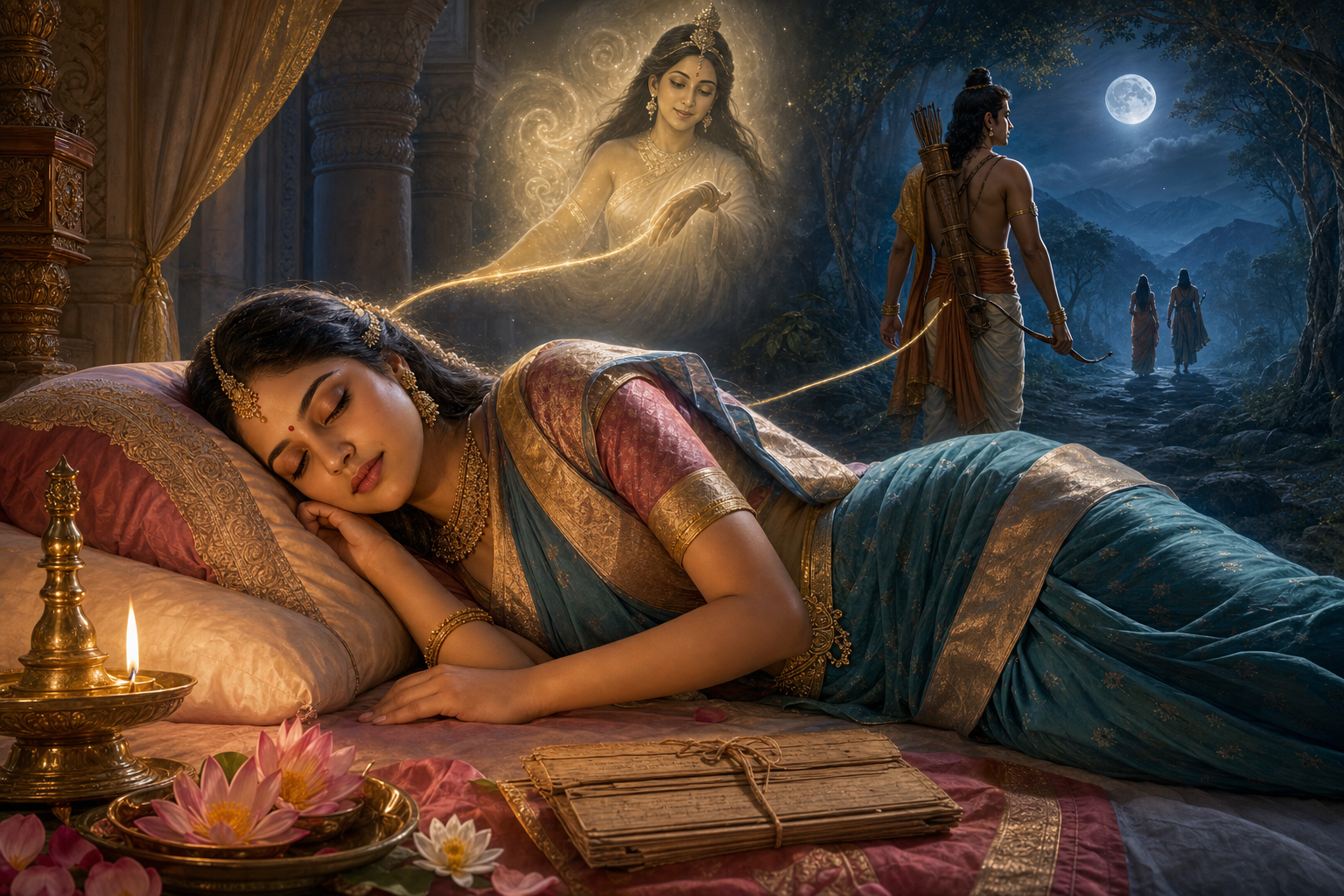
The story of Urmila in the Telugu Ranganatha Ramayanamu occupies a remarkable place in the wider Ramayana tradition because it shifts attention from visible heroism to silent endurance. Rama’s exile, Sita’s companionship, Lakshmana’s service, Bharata’s renunciation, and Hanuman’s devotion are widely remembered as pillars of dharma. Yet Urmila, the wife of Lakshmana and the younger sister of Sita, represents a quieter form of sacrifice: the discipline of remaining unseen while still sustaining the moral order of the epic.
Ranganatha Ramayanamu, also known as Sri Ranganatha Ramayanamu, is one of the important Telugu retellings of the Ramayana. It is traditionally associated with Gona Budda Reddy and is composed in the dwipada metre, a lyrical couplet form that made the epic accessible for recitation, singing, and public memory. Unlike a purely courtly Sanskrit composition, this Telugu Ramayana belongs to a living literary culture in which sacred narrative, regional imagination, devotional emotion, and ethical instruction move together.
Within this context, Urmila’s story should not be treated as a minor domestic episode. It belongs to the ethical architecture of the Ramayana. The epic does not present dharma only through kings, warriors, sages, or public vows. It also presents dharma through those who bear grief without proclamation, protect family continuity, and accept painful duties when circumstances demand restraint rather than action.
Urmila was born in Mithila, the daughter of King Janaka and Queen Sunayana, and she is remembered as the sister of Sita. When Sita married Rama, Urmila married Lakshmana, joining the house of Janaka with the house of Dasharatha. The marriages of Rama and Sita, Lakshmana and Urmila, Bharata and Mandavi, and Shatrughna and Shrutakirti formed more than a family alliance. They joined two dharmic lineages through trust, duty, affection, and shared responsibility.
The crisis begins when Rama is sent into exile for fourteen years. Sita chooses to accompany him, not merely as a wife following her husband but as a moral partner who refuses royal comfort separated from dharma. Lakshmana also chooses exile, dedicating himself to the protection and service of Rama and Sita. In many retellings, Lakshmana’s decision appears as an act of pure loyalty. Urmila’s grief, however, reveals the human cost hidden behind that loyalty.
Urmila’s sacrifice is distinctive because she does not accompany Lakshmana into the forest. At first glance, this absence can be misunderstood as passivity. A deeper reading shows the opposite. Her remaining in Ayodhya becomes a disciplined act of dharma. She accepts separation from her husband so that Lakshmana can serve Rama without emotional distraction, while she remains connected to the responsibilities of the royal household and the grieving elders of Ayodhya.
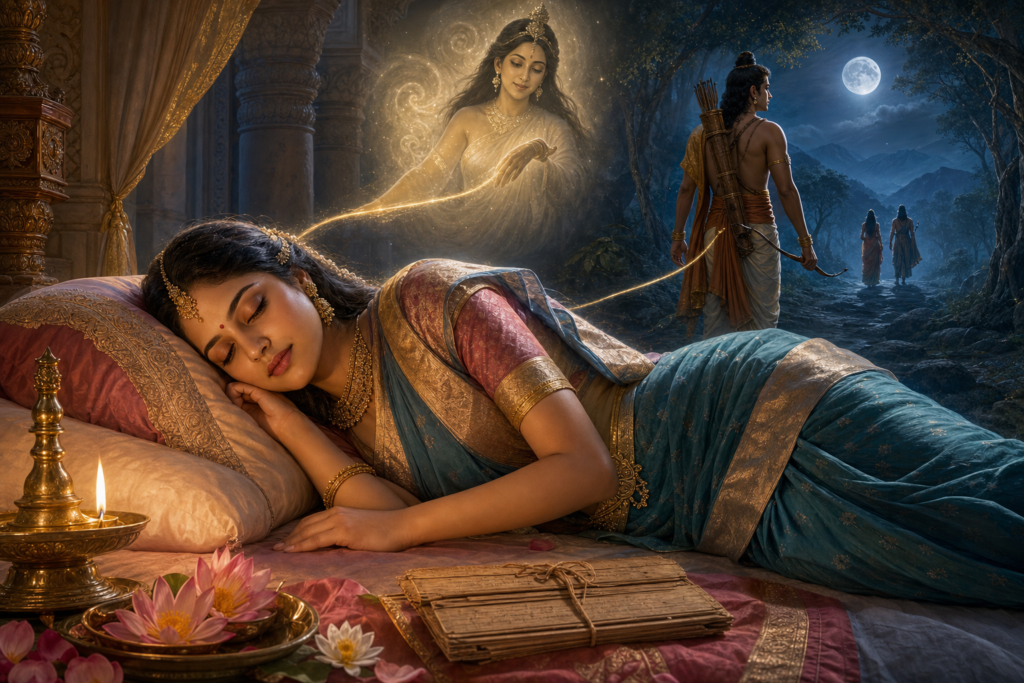
The celebrated tradition of Urmila Nidra explains this sacrifice through a powerful symbolic episode. On the first night of exile, Lakshmana resolves to remain awake for fourteen years so that he can guard Rama and Sita. Nidra Devi, the goddess of sleep, appears and indicates that such wakefulness requires balance: if Lakshmana is to renounce sleep, another must bear the burden of his sleep. Urmila accepts that burden and sleeps for fourteen years, allowing Lakshmana to remain vigilant throughout the exile.
This episode is not simply a miraculous tale about sleep. It is a theological and psychological metaphor. Sleep here represents more than physical rest. It signifies the unseen cost of duty, the transfer of suffering within relationships, and the hidden labour that makes visible heroism possible. Lakshmana’s alertness in the forest is sustained by Urmila’s silence in Ayodhya. The battlefield and the bedroom, the forest path and the inner chamber, become linked through dharma.
In literary terms, Urmila Nidra expands the moral imagination of the Ramayana. The epic is often remembered through dramatic public actions: Rama leaving Ayodhya, Sita crossing into the forest, Hanuman leaping across the ocean, and the war in Lanka. Urmila’s story asks readers to consider a different form of greatness. It asks whether endurance without witness can be as sacred as courage before the world.
The Ranganatha Ramayanamu is especially important for such reflection because Telugu literary culture has long preserved emotional nuance in devotional storytelling. The dwipada style allows the narrative to be sung, remembered, and interpreted by communities rather than confined to formal scholarship. Through such regional Ramayana traditions, characters who appear briefly in one telling can gain ethical depth in another. Urmila becomes one of the clearest examples of this process.
It is important to distinguish between textual layers. Valmiki Ramayana gives the foundational structure of the epic, but later Sanskrit, Telugu, Tamil, Kannada, Hindi, Jain, Buddhist, and folk retellings develop different emphases. The story of Urmila sleeping for fourteen years is not always central in every Ramayana version, yet it became influential because it answers an emotional and ethical question left open by the main narrative: what happened to Lakshmana’s wife when he left for the forest?
That question matters because the Ramayana is not only a story of divine incarnation; it is also a study of relationships under pressure. Every major character is tested by separation. Dasharatha is separated from Rama and cannot survive the grief. Bharata is separated from Rama and rules only as a trustee of the sandals. Sita is separated from Ayodhya, then later from Rama. Lakshmana is separated from Urmila. Urmila’s separation is one of the least visible, but it is among the most emotionally demanding.
Urmila’s silence should not be confused with weakness. In dharmic literature, silence can mean discipline, contemplation, restraint, and strength. Her sleep is not ordinary escape; it is a vow-like participation in Lakshmana’s service. The story therefore refuses a narrow definition of agency. Urmila acts by consenting to a burden. She serves by staying. She protects by withdrawing. She participates in the forest exile while physically remaining in Ayodhya.
This interpretation also brings emotional realism to the Ramayana. Many people understand duty not through grand public gestures but through private responsibilities: caring for family, accepting delay, bearing loneliness, supporting another person’s path, or allowing a necessary duty to take priority over personal desire. Urmila’s life speaks to such experiences. Her sacrifice is relatable because it resembles the unseen sacrifices that sustain households, communities, institutions, and spiritual traditions.
The ethical beauty of Urmila lies in the absence of resentment. She does not compete with Sita’s sacrifice, nor does she obstruct Lakshmana’s devotion to Rama. She does not diminish the duty of another in order to assert her own pain. Instead, her story reveals a dharmic principle: true sacrifice does not always demand recognition, but a mature society must learn to recognize it.
Urmila’s relationship with Lakshmana also deserves careful attention. Lakshmana is often remembered as the embodiment of fraternal devotion. He follows Rama into exile, guards the forest dwelling, confronts dangers, and fights in the war against Ravana. Yet his capacity for such service is intensified by Urmila’s consent. The story therefore presents marriage not merely as emotional companionship but as a partnership in dharma, where one person’s visible vow may depend on the other person’s hidden strength.
From a theological perspective, the story also reflects the dharmic idea of balance. Lakshmana cannot simply reject sleep without consequence. Cosmic order requires compensation. Nidra Devi’s presence indicates that even heroic discipline operates within rita, the moral and cosmic order. Urmila’s acceptance restores balance. She becomes the one who absorbs the denied rest, allowing Lakshmana’s tapas-like wakefulness to remain aligned with dharma rather than become an impossible violation of nature.
The symbolism of fourteen years is equally significant. In the Ramayana, fourteen years is not a short interruption but a full cycle of testing. It covers the collapse of royal expectation, the death of Dasharatha, Bharata’s trusteeship, the forest life of Rama and Sita, the abduction of Sita, the alliance with Sugriva, Hanuman’s mission, the war in Lanka, and the return to Ayodhya. Urmila’s sleep spans this entire moral drama. Her stillness runs parallel to the movement of the epic.
This parallel structure gives Urmila a profound literary role. Rama moves through exile; Sita moves through trial; Lakshmana moves through service; Hanuman moves through devotion; Bharata moves through renunciation. Urmila, by contrast, enters sacred stillness. Her journey is inward. The epic thus includes both action and interiority, both public dharma and private tapas.
In the broader Indian literary tradition, Urmila has often inspired poets, novelists, dramatists, and modern interpreters because her story raises enduring questions about recognition. Why do some sacrifices become famous while others disappear into the background? Why are certain forms of service celebrated while others are treated as expected? The Ramayana tradition, especially through regional retellings, gives space to revisit these questions without rejecting the sacredness of the main narrative.
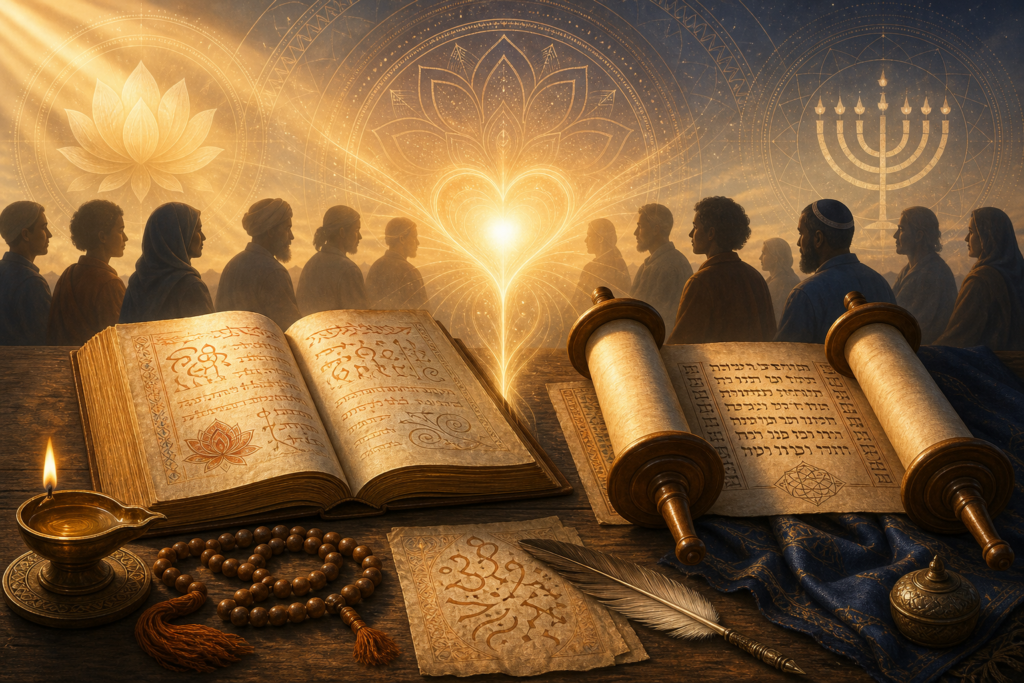
Urmila’s story also contributes to the unity of dharmic traditions. Hindu, Jain, Buddhist, and Sikh thought all preserve, in different forms, respect for self-discipline, compassion, restraint, truthfulness, and service. Urmila’s sacrifice can be understood within this wider dharmic vocabulary. She embodies seva without spectacle, tapas without pride, and love without possessiveness. These values are not sectarian; they are civilizational.
There is also a social dimension. Traditional narratives often preserve the contributions of those who maintain continuity during crisis. When kings go to war, when seekers go to forests, when reformers begin difficult work, someone must hold the home, preserve memory, care for elders, and endure uncertainty. Urmila represents that sustaining force. Her story dignifies domestic resilience without reducing women to domesticity. It shows that the inner life of a household can be as consequential as the outer life of a kingdom.
The Telugu Ranganatha Ramayanamu, by belonging to a regional devotional and literary environment, helps readers see the Ramayana as a many-voiced tradition. The Ramayana is not weakened by such retellings; it is enriched by them. Each version, when approached respectfully, illuminates a different ethical angle. The story of Urmila does not compete with Rama, Sita, or Lakshmana. It deepens the understanding of all three.
For Rama, Urmila’s sacrifice reveals the cost borne by the wider family for his adherence to truth. For Sita, it reveals the pain of a sister whose own marriage is suspended in service of a larger dharma. For Lakshmana, it reveals that his heroic wakefulness is not solitary. Behind his service stands Urmila’s consent, trust, and surrender. The greatness of one character becomes inseparable from the sacrifice of another.
The phrase “She Who Slept for Dharma” captures the paradox of Urmila’s role. Sleep normally suggests inactivity, but in this story it becomes an active vow. It is a sacred burden, a chosen discipline, and an offering. Urmila’s sleep is not forgetfulness; it is remembrance in another form. She remembers Lakshmana through surrender, remembers Rama through loyalty to the family’s dharma, and remembers Sita through sisterly love.
Modern readers can approach Urmila without imposing simplistic categories on the past. Her story need not be reduced either to passive suffering or to modern rebellion. Its power lies in a more subtle space. Urmila shows that consent, sacrifice, grief, duty, and strength can coexist. She does not erase herself; she expands the meaning of service. Her silence is not absence from the Ramayana, but a different mode of presence.
This is why Urmila remains important for contemporary study of the Ramayana. In a world that often measures value through visibility, productivity, and public affirmation, her story asks whether unseen moral labour can be honoured. It invites reflection on caregivers, spouses, siblings, parents, teachers, monks, householders, and quiet community workers whose sacrifices may never become public stories but still sustain dharma in practical life.
Urmila’s return to wakefulness at the end of the exile also carries deep emotional force. When Rama returns to Ayodhya and the order of the kingdom is restored, Urmila’s long sleep ends. The reunion with Lakshmana is not merely the reunion of husband and wife. It is the completion of a vow. The vigilance of the forest and the stillness of Ayodhya meet again. What had been divided for the sake of dharma becomes whole.
The story therefore ends not with loss but with recognition. Urmila’s sacrifice teaches that dharma is sustained through interdependence. Rama’s truth, Sita’s courage, Lakshmana’s service, Bharata’s renunciation, Hanuman’s devotion, and Urmila’s hidden endurance are all part of one moral universe. The Ramayana becomes most complete when the visible and invisible sacrifices are remembered together.
In the Ranganatha Ramayanamu and the wider Ramayana tradition, Urmila stands as a luminous example of quiet strength. She slept, but her sacrifice awakened a deeper understanding of dharma. She remained unseen, yet her unseen service made visible heroism possible. She spoke little in the popular imagination, yet her story continues to speak to anyone who has carried responsibility in silence, loved without possession, and served without demanding applause.
Inspired by this post on Hindu Blog.




Leave a Reply
You must be logged in to post a comment.