

Bhagavad Gita 6.24 offers one of the clearest technical instructions for spiritual practice in the entire Yoga tradition. The verse does not romanticize meditation as an instant experience of peace, nor does it reduce yoga to posture, mood, or occasional inspiration. It presents yoga as a disciplined, intelligent, and gradual process in which the practitioner learns to withdraw the mind from desires born of imagination and regulate the senses from every direction. In this sense, the phrase slowly but surely captures the heart of the teaching: genuine inner transformation may proceed quietly, but when guided by determination, it becomes stable, measurable, and deeply humane.
The Sanskrit of Bhagavad Gita 6.24 is traditionally rendered as follows: sa nischayena yoktavyo yogo anirvinna-cetasa; sankalpa-prabhavan kamams tyaktva sarvan asesatah; manasaivendriya-gramam viniyamya samantatah. The verse may be understood as an instruction that yoga must be practiced with firm determination and an undespairing mind; all desires arising from mental speculation should be abandoned completely, and the whole group of senses should be restrained by the mind from all sides. This teaching belongs to the sixth chapter of the Bhagavad Gita, often known as Dhyana Yoga, where Lord Krishna explains the discipline of meditation, the training of the mind, and the gradual ascent from distraction to self-mastery.
The first technical point in this verse is nischaya, firm determination. In the Gita, determination is not stubbornness, rigidity, or emotional force. It is a clarified commitment rooted in knowledge. A practitioner does not merely decide to meditate because meditation feels pleasant on certain days. Rather, practice continues because the nature of the mind has been studied, the goal of life has been contemplated, and the value of spiritual discipline has become intellectually and morally compelling. This is why Bhagavad Gita teachings remain relevant across time: they do not depend on sentiment alone, but on a refined understanding of human psychology.
The second phrase, anirvinna-cetasa, is equally important. It indicates a mind that does not become discouraged. This is an exceptionally realistic instruction. The Gita does not assume that the mind will become steady immediately. It acknowledges that spiritual practice involves repetition, correction, relapse, recovery, and renewed effort. In daily life, many practitioners experience this directly. One may begin japa, meditation, scriptural study, seva, or prayer with enthusiasm, only to encounter fatigue, distraction, emotional heaviness, or the resurfacing of old habits. Bhagavad Gita 6.24 responds with practical kindness: continue without despair.
This undespairing quality is not a small matter. In many modern discussions of spirituality, discouragement is treated as failure. The Gita offers a more mature view. Discouragement is a mental condition to be observed and transcended, not an identity to be accepted. When the mind says that progress is impossible, Krishna’s instruction is to continue the practice with steadiness. The practitioner’s task is not to manufacture dramatic mystical experiences, but to cooperate with a process that purifies consciousness gradually. The emotional power of this teaching lies in its patience. It recognizes struggle without glorifying it and encourages discipline without harshness.
The verse then identifies the roots of distraction: sankalpa-prabhavan kamams, desires born from mental constructions. This is a highly technical psychological insight. Desire does not arise only from external objects. It is often generated by inner projection. The mind imagines a future pleasure, decorates it with emotional significance, repeats the image, and then begins to experience the imagined object as a necessity. In this way, sankalpa becomes the seed of kama. The object may be wealth, recognition, sensual pleasure, social approval, victory in argument, control over others, or even a spiritual status that feeds pride. The Gita asks the practitioner to examine the mental story behind desire.
This diagnosis has striking relevance for contemporary life. Digital culture constantly stimulates sankalpa. Images, notifications, comparisons, advertisements, and public performances of success intensify the mind’s habit of constructing desires. A person may not have wanted something an hour earlier, but repeated exposure creates the impression of lack. Bhagavad Gita 6.24 therefore speaks directly to modern anxiety, overthinking, and compulsive consumption. It teaches that freedom begins not merely by rejecting objects, but by understanding how the mind manufactures dependence upon them.
The instruction tyaktva sarvan asesatah, abandoning them completely, must be read carefully. It does not require hatred of the world, contempt for the body, or neglect of responsibility. In the broader framework of Sanatana Dharma, the problem is not the existence of objects, relationships, duties, or social life. The problem is bondage to imagined necessity. Renunciation in the Gita is therefore an inner reordering. Desires that obstruct dharma, disturb meditation, weaken compassion, or conceal the presence of the Divine must be relinquished. Duties may remain, relationships may remain, and service may deepen, but possessive craving is gradually released.
The next technical movement in the verse concerns the senses: manasaiva indriya-gramam viniyamya samantatah. The group of senses is to be regulated by the mind from all sides. This is a precise model of yogic discipline. The senses move outward toward their objects; the mind coordinates sensory experience; intelligence evaluates meaning; and the self, when covered by ignorance, identifies with this movement. Krishna’s instruction is not repression for its own sake. It is governance. The senses are not enemies, but unregulated senses can pull the mind into fragmentation. Yoga restores hierarchy: the senses serve the mind, the mind serves purified intelligence, and intelligence serves the realization of dharma and devotion.
In Krishna consciousness, this regulation becomes especially meaningful because the senses are not merely silenced; they are spiritualized. The tongue chants the holy names and honors prasadam. The ears hear kirtan, Bhagavad Gita, Srimad Bhagavatam, and the words of saints. The eyes behold the Deity, sacred texts, devotees, and the beauty of creation as connected to Lord Krishna. The hands serve, the feet walk toward satsanga and seva, and the mind learns to remember the Supreme. This devotional redirection gives Bhagavad Gita 6.24 a living form. Sense control becomes less about emptiness and more about higher engagement.
The phrase slowly but surely is therefore not a casual slogan. It describes the architecture of spiritual progress. A sincere practitioner may not notice immediate transformation, yet small acts of discipline accumulate. One more attentive round of japa, one restrained reaction, one thoughtful reading of scripture, one moment of humility, one choice to forgive, one decision to avoid unnecessary agitation: each becomes part of the inner training. The Bhagavad Gita does not measure progress only by external achievement. It values the subtle strengthening of consciousness, the quiet reduction of impulsiveness, and the gradual emergence of spiritual steadiness.
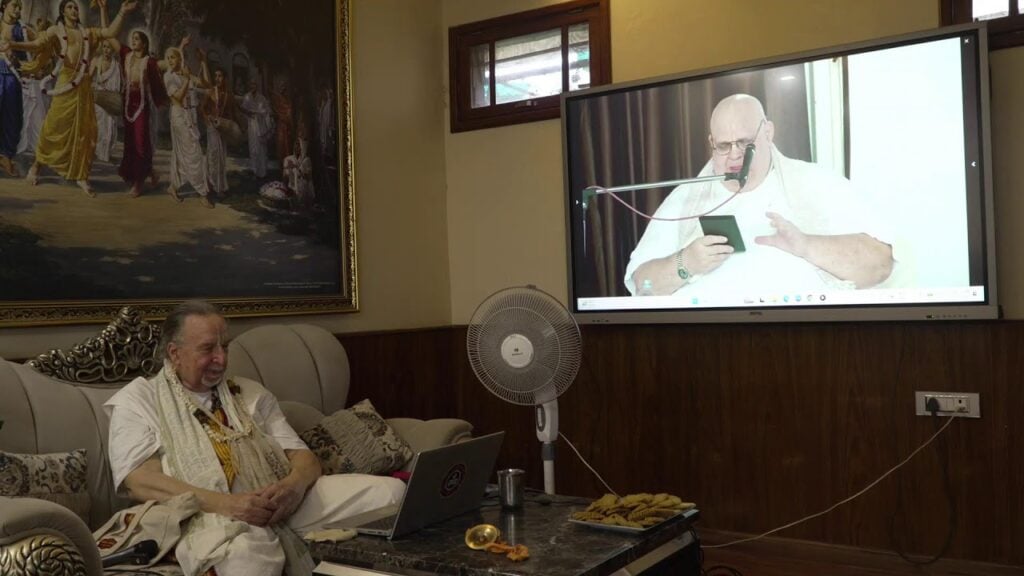
This has deep implications for the role of the guru and the community. In traditions such as ISKCON and the broader Vaishnava sampradaya, spiritual practice is not treated as an isolated private experiment. Guidance, association, discipline, and accountability matter. A teacher such as Svayam Bhagavan Keshava Maharaja, speaking within a temple setting such as ISKCON Central New Jersey, represents a living pedagogical tradition in which scriptural instruction is connected to practice. The value of such teaching lies not simply in explanation, but in helping practitioners translate the Gita into daily life: how to chant when the mind wanders, how to serve when tired, how to regulate desire without becoming bitter, and how to continue when results seem distant.
Bhagavad Gita 6.24 also contributes to unity among dharmic traditions. Hindu, Buddhist, Jain, and Sikh paths differ in theology, metaphysics, ritual forms, and historical development, yet they share a profound concern with disciplined consciousness, ethical restraint, inner purification, and liberation from compulsive desire. Buddhist teachings analyze craving and mental construction with great subtlety. Jain traditions emphasize self-discipline, restraint, and purification of karmic bondage. Sikh teachings call for remembrance of the Divine, ethical living, and freedom from ego-centered impulses. The Gita’s instruction on steady practice and sense regulation can therefore be appreciated as part of a wider dharmic conversation about self-mastery and spiritual freedom.
At the same time, the specific devotional voice of the Bhagavad Gita remains distinct. Krishna does not teach meditation as a merely psychological technique. He situates it within a sacred relationship between the individual self and the Supreme. The mind is not trained only to become calm; it is trained to become fit for remembrance, service, wisdom, and love. This distinction is essential. A calm mind may still be self-centered, but a purified mind becomes receptive to divine purpose. The verse therefore points beyond stress reduction toward spiritual realization.
The practical method implied by the verse can be organized into four movements. First, establish clear determination through study and reflection. Second, refuse despair when the mind resists. Third, identify desires that arise from imagination and repeated mental projection. Fourth, regulate the senses through purposeful engagement. These steps are not completed once and then forgotten. They repeat daily. The practitioner studies, falls short, returns, observes, redirects, and continues. This cyclical discipline is not a weakness of the path; it is the path.
From a philosophical perspective, Bhagavad Gita 6.24 stands against both indulgence and nihilism. It does not say that every desire should be obeyed, nor does it say that human life has no meaningful aim. It teaches that desire must be examined according to truth. Some desires bind the self to anxiety, pride, and repeated dissatisfaction. Other aspirations, such as the desire for wisdom, service, devotion, compassion, and liberation, elevate consciousness. The verse asks for the abandonment of desires born from speculative mental fantasy, not the abandonment of dharma or divine aspiration.
The emotional realism of this teaching becomes especially clear in moments of personal struggle. When a person is anxious, the mind creates scenarios. When lonely, it constructs imagined solutions. When wounded, it rehearses retaliation or self-protection. When ambitious, it multiplies images of recognition. These mental formations can feel powerful because they appear intimate. Yet the Gita reveals that intimacy is not the same as truth. A thought may be close, repetitive, and emotionally charged, but still misleading. Yoga begins when consciousness learns to witness these movements without becoming enslaved by them.
For this reason, sense control must be joined with compassion. A practitioner who tries to regulate the senses through self-hatred often becomes tense, judgmental, or unstable. The Gita’s model is firmer and more balanced. The mind is trained because the self is valuable. Discipline is undertaken because human life is sacred. Restraint is meaningful because consciousness can awaken to a higher taste. In the Vaishnava understanding, that higher taste is found in devotion to Lord Krishna, in the company of devotees, and in service that gradually softens the heart.
Bhakti adds warmth to the technical discipline of yoga. Determination becomes loyalty to the Divine. Sense regulation becomes offering. Patience becomes trust in Krishna’s mercy. Study becomes hearing. Meditation becomes remembrance. Community becomes sangha. The practitioner no longer sees spiritual life as a private battle of willpower alone, but as a relationship supported by grace, scripture, guru, and sincere effort. This is why the Gita can speak with such authority across generations: it combines rigorous psychology with devotional intimacy.
The phrase slowly but surely also protects practitioners from the modern impatience for instant transformation. Spiritual maturity cannot be forced into the speed of entertainment, consumer delivery, or social media visibility. A seed grows according to its nature when given soil, water, light, and time. Similarly, consciousness matures through repeated contact with sacred sound, ethical action, disciplined attention, and divine remembrance. A day may feel ordinary, yet ordinary days are often where the deepest training occurs.
There is also a social dimension to this verse. A person governed by unexamined desire becomes easier to manipulate, whether by markets, ideologies, sectarian anger, or personal insecurity. A person trained in self-restraint becomes more capable of fairness, patience, and responsible action. Thus, Bhagavad Gita 6.24 is not only about private meditation. It supports dharmic society by forming individuals who are less reactive, less consumed by craving, and more available for service. Inner governance becomes the foundation for outer responsibility.
In this light, the verse is deeply relevant to families, students, professionals, community leaders, and spiritual aspirants alike. Parents need steadiness when raising children. Students need control over distraction. Professionals need ethical clarity amid ambition. Community servants need humility and patience. Monastics and householders alike need the capacity to continue spiritual practice without despair. The Gita does not confine yoga to a cave or forest. It brings yoga into the psychology of every serious human life.
The final lesson is simple but demanding: the mind can be trained, desire can be purified, and the senses can be guided toward a higher purpose. None of this happens by accident. It requires nischaya, firm determination; anirvinna-cetasa, freedom from discouragement; tyaga, intelligent relinquishment; and viniyama, disciplined regulation. Bhagavad Gita 6.24 therefore offers a complete spiritual method in a compact form. It teaches that progress may be gradual, but gradual does not mean weak. When grounded in dharma, guided by guru, nourished by bhakti, and sustained through practice, the journey becomes slowly but surely transformative.
Inspired by this post on Dandavats.









Leave a Reply
You must be logged in to post a comment.