
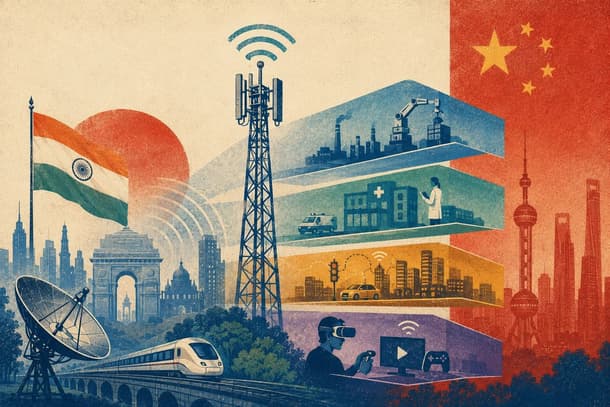
Network slicing has moved from telecom white papers into Bharat’s everyday digital life. The significance of Bharti Airtel’s Priority Postpaid launch in May 2026 is not merely that it offers a premium postpaid feature, but that it marks the first commercial appearance of 5G network slicing for Indian consumers. In practical terms, it acknowledges a problem millions already understand: the network may show strong signal bars, yet still fail when too many people compete for the same radio and core-network resources.
The examples used around the launch were striking because they were so familiar. A client call from traffic, video streaming at a packed concert, and booking a cab in a crowded market are not abstract telecom scenarios. They describe Bengaluru’s Outer Ring Road, Mumbai’s stadium crowds, Delhi’s market congestion, Diwali shopping rushes, airport queues, political rallies, religious gatherings, and railway stations where digital access becomes most necessary precisely when the network is most stressed.
That is the real importance of network slicing. It is not only about speed; it is about predictability. Traditional mobile broadband is usually sold as a single best-effort service. When the cell is empty, everyone enjoys high throughput. When the cell is congested, all users experience degradation, and critical activity such as payments, navigation, enterprise calls, logistics tracking, or emergency coordination may suffer alongside entertainment traffic. Network slicing changes this model by allowing a telecom operator to create virtual, policy-controlled partitions of the same physical 5G infrastructure.
A network slice can be understood as a logically separate network created over shared radio access, transport, and core-network assets. Each slice may have its own quality-of-service profile, security policy, latency target, bandwidth allocation, traffic priority, and operational rules. One slice may support ordinary mobile broadband. Another may support enterprise video conferencing. A third may support industrial automation, hospital connectivity, emergency services, or public safety communication. The engineering achievement lies in making these slices behave as if they are purpose-built networks, while still using common infrastructure efficiently.
This is why standalone 5G matters. Non-standalone 5G, which depends heavily on existing 4G core architecture, can improve radio speeds but cannot fully express the service-based architecture envisioned for 5G. Standalone 5G brings the cloud-native 5G core, service-based interfaces, policy control, network exposure functions, and more granular quality-of-service management. Without standalone 5G, slicing remains limited. With it, slicing can become a programmable foundation for Digital Infrastructure, enterprise transformation, and nationally important services.
Bharat’s first commercial step therefore deserves serious attention. Airtel’s Priority Postpaid appears to bring a consumer-facing version of priority connectivity into the market. Its value proposition is simple: when the network is crowded, the subscriber should still receive a more stable connection. The product’s deeper significance is that Indian telecom is beginning to move beyond the old vocabulary of data packs, unlimited plans, and headline download speeds. The next phase will be about service assurance.
China’s 5G trajectory offers a useful comparison, though it should not be copied uncritically. Around the same period, China Mobile, OPPO, and Ericsson announced a more advanced test involving consumer-grade user-equipment-level and application-level slicing on a live commercial standalone 5G network in Dezhou, Shandong. The distinction is important. A broad priority plan gives a category of users better treatment. Device-level and application-level slicing can allow the network, device, and specific application to coordinate much more precisely.
In a mature slicing environment, a video meeting application, an augmented-reality service, a cloud gaming session, a telemedicine consultation, or an enterprise security application could request or be assigned a suitable slice. The handset may recognise the application requirement, the operator network may enforce the correct policy, and the user may experience a service that feels consistent even under load. This is a different order of sophistication from merely selling more data. It treats connectivity as a managed digital utility rather than a commodity pipe.
China’s advantage has come from scale, coordination, manufacturing depth, and rapid standalone 5G deployment. Its telecom operators, device makers, equipment vendors, cloud platforms, and application ecosystems often move in a tightly aligned manner. That alignment can accelerate commercial trials and shorten the distance between laboratory capability and market deployment. For a technology such as network slicing, which requires cooperation across the radio network, core network, device software, operating system, application layer, billing systems, and policy engines, coordination is not optional; it is the product.
Bharat can learn from this systems approach. Network slicing will not flourish if it remains only an operator feature buried inside premium plans. It needs handset support, application programming interfaces, enterprise integration, clear service-level agreements, and regulatory certainty. Indian device makers, global handset brands, telecom operators, cloud providers, fintech platforms, hospitals, logistics companies, factories, and public agencies must be able to test slice-aware services in realistic environments. The technology becomes meaningful only when the ecosystem can build on it.
At the same time, Bharat should not imitate the Chinese model where it conflicts with India’s democratic, plural, and market-driven strengths. The lesson is not centralised control for its own sake. The lesson is disciplined coordination around strategic infrastructure. Bharat’s approach must preserve openness, competition, user choice, privacy, lawful oversight, and vendor diversity. A resilient Indian 5G strategy should avoid both extremes: a fragmented market where every participant waits for others to move, and an over-centralised model that weakens transparency and civil trust.
The regulatory question is especially delicate because network slicing sits near the boundary between innovation and net neutrality. If slicing is used to guarantee emergency services, industrial safety, remote healthcare, digital payments, disaster response, or enterprise-grade communication, it can serve public welfare and economic productivity. If it becomes a tool for arbitrary discrimination, anti-competitive prioritisation, or opaque throttling, it can undermine the open internet. The policy challenge is to distinguish specialised services with measurable technical requirements from paid favoritism disguised as engineering.
India’s telecom regulators and policymakers therefore need a framework that is both innovation-friendly and rights-aware. Operators should be able to offer slices for defined use cases, but they should also disclose performance characteristics, eligibility rules, traffic treatment, and consumer implications. Enterprise slices should have clear service-level commitments. Consumer priority plans should explain what is being prioritised and under what conditions. Public-interest slices for emergency and civic infrastructure should be governed by transparent norms rather than ad hoc arrangements.
The most valuable early use cases may not be glamorous. Digital payments in crowded mandis, dependable connectivity for ambulance networks, secure communication for disaster-response teams, remote diagnostics in district hospitals, logistics tracking at ports, railway station crowd management, smart-grid monitoring, and industrial safety systems could all benefit from assured connectivity. These are the contexts in which Bharat’s 5G investment can produce social value beyond urban entertainment and premium consumer convenience.
There is also a civilisational dimension to how digital infrastructure should be judged. Bharat’s public technology successes, including Digital Public Infrastructure, have mattered because they touched ordinary lives at scale. A technology that helps only a narrow elite will remain commercially interesting but socially limited. A technology that improves reliability for farmers, small businesses, students, pilgrims, commuters, healthcare workers, artisans, and local administrations can become part of national capacity. The dharmic principle of social responsibility is not opposed to advanced technology; it asks technology to serve a wider moral purpose.
For India’s enterprises, slicing can become a practical bridge between connectivity and productivity. Manufacturing plants can use private or semi-private 5G slices for robotics, sensors, machine vision, and worker safety. Hospitals can separate critical clinical traffic from guest connectivity. Universities can support research networks and immersive learning. Media companies can transmit live video from congested venues. Financial institutions can demand secure and resilient mobile access for field operations. These use cases require more than marketing claims; they require measurable latency, jitter, uptime, authentication, and isolation guarantees.
The technical foundations are demanding. Operators must automate slice lifecycle management, map service requirements to network functions, orchestrate resources across cloud and edge infrastructure, monitor performance in real time, and prevent one slice from harming another. Billing systems must understand differentiated services without becoming confusing. Customer support teams must diagnose service issues that may involve the handset, application, radio access network, transport network, edge node, or 5G core. In other words, network slicing is not a switch that can simply be turned on; it is an operational discipline.
Security must also be built into the design. A slice used by a hospital, factory, port, or government agency cannot be treated like ordinary consumer traffic. Authentication, encryption, identity management, lawful access procedures, audit trails, vendor risk management, and incident response must be planned from the beginning. Bharat’s strategic concern should not be limited to whether Chinese telecom systems are ahead in deployment. The larger question is whether India can build trusted, secure, and scalable telecom capability across equipment, software, standards, testing, and operations.
This is where domestic research and standards participation become crucial. Indian engineers, startups, universities, and public institutions should not remain passive consumers of global telecom architecture. Work on Open RAN, indigenous 5G core systems, edge computing, telecom security, spectrum efficiency, rural connectivity, and application-aware networking must be aligned with actual operator deployments. Bharat’s ambition should be to shape the technology stack, not merely subscribe to it.
China’s 5G revolution shows what scale and execution can achieve. It also warns against treating technological progress as a purely infrastructural race. A society may deploy advanced networks rapidly and still face questions about surveillance, market access, data governance, and individual freedom. Bharat should study Chinese execution with clear eyes, but its own model must rest on democratic accountability, plural institutions, entrepreneurial energy, and civilisational confidence. The goal is not to become another China. The goal is to become a technologically sovereign Bharat.
The launch of Priority Postpaid should therefore be viewed as a beginning, not a destination. It signals that Indian telecom is entering the age of differentiated service quality. The next test will be whether such offerings mature into transparent, interoperable, application-aware, and socially useful network slicing. If Bharat gets this right, 5G will no longer be judged only by speed tests. It will be judged by whether a payment succeeds in a crowded bazaar, whether a doctor can consult reliably from a district hospital, whether a factory floor remains safe, and whether citizens can trust the network when it matters most.
The deeper lesson is simple: network slicing is not just a telecom upgrade; it is a governance, industry, and social-capacity challenge. Bharat should absorb the seriousness of China’s coordinated 5G execution while refusing any model that compromises openness or trust. The coming decade will reward nations that treat connectivity as strategic infrastructure. Bharat has the talent, market scale, public digital experience, and civilisational ethic to make network slicing serve both innovation and society.
Inspired by this post on Hindu Post.











Leave a Reply
You must be logged in to post a comment.