
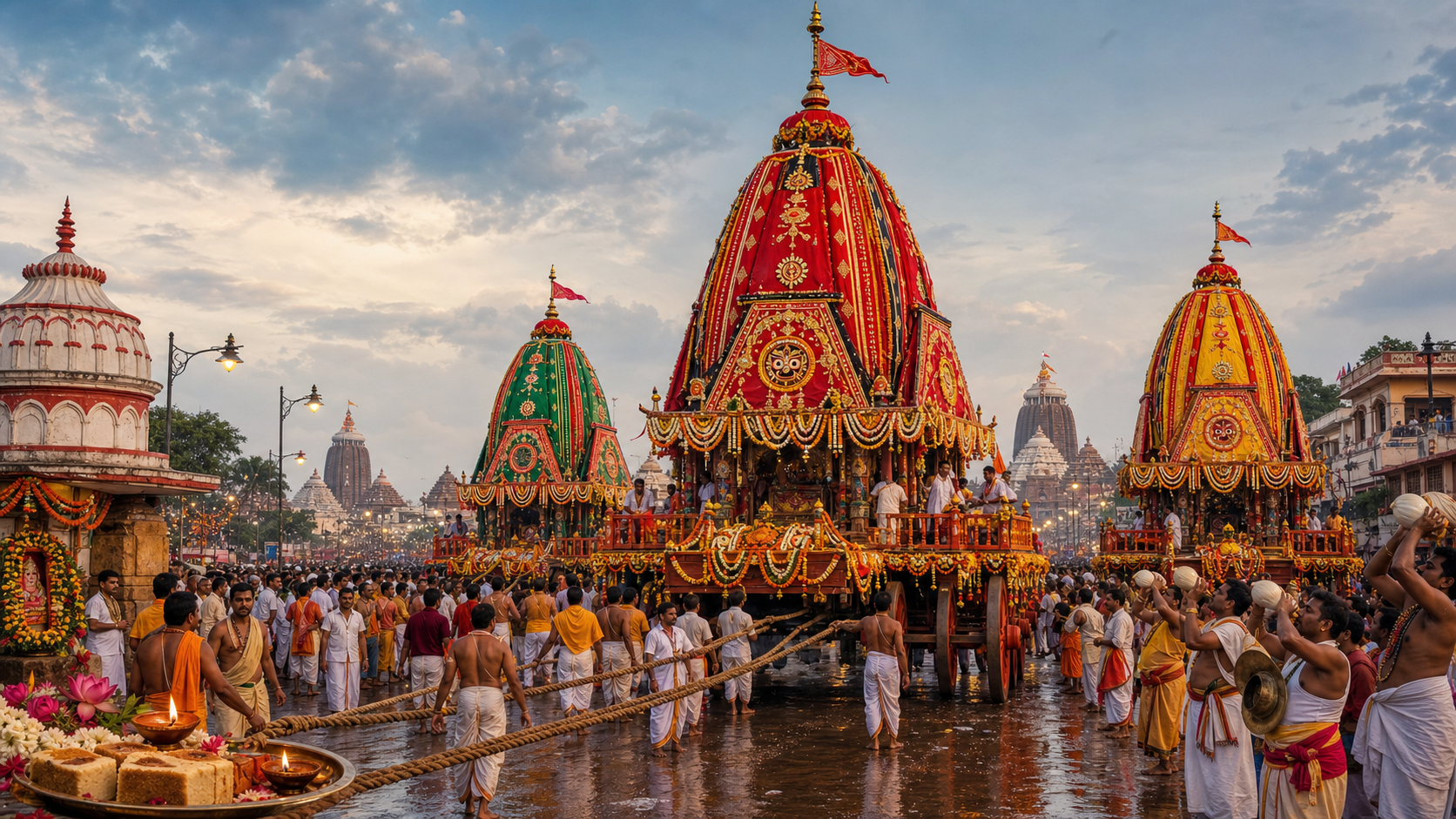
Bahuda Yatra 2026, also known as Bahuda Jatra or Ulta Rath Yatra, falls on July 24, 2026. It is the sacred return journey of Lord Jagannath, Lord Balabhadra, Devi Subhadra, and the Sudarshana Chakra from Gundicha Temple back toward the Puri Srimandir. Within the larger cycle of Puri Jagannath Rath Yatra, Bahuda Yatra marks the emotional and ritual turning point: the public journey that began with departure from the main temple moves toward reunion, restoration, and return.
The 2026 Puri Rath Yatra begins on July 16, 2026, on Ashadha Shukla Dwitiya, and Bahuda Yatra is observed on the ninth day of the festival cycle, traditionally aligned with Ashadha Shukla Dashami. This date is important not only for pilgrims planning travel to Puri, Odisha, but also for devotees across India and the global Hindu diaspora who follow the Jagannath tradition through temple observances, community Rath Yatra processions, livestreams, and household worship.
In the structure of the festival, the deities first travel from the Jagannath Temple to Gundicha Temple along the Bada Danda, the Grand Road of Puri. After remaining at Gundicha Temple for several days, the return procession begins. This homeward movement is Bahuda Yatra. The term carries a direct ritual meaning: “Bahuda” refers to return, and “Yatra” refers to journey. The event therefore represents the return festival of the chariots, but its theological depth is far greater than a simple reversal of route.
For many devotees, Bahuda Yatra is one of the most moving moments in the Puri Ratha Yatra calendar because it combines public devotion with the intimacy of homecoming. The deities are not imagined as distant divine figures confined to an inaccessible sanctum. They travel, rest, receive offerings, meet devotees, and return. This rhythm gives the festival its unusually human and relatable character. It allows the sacred to be encountered in movement, in sound, in community, and in the shared emotion of waiting for the Lord’s return.
The three principal chariots are among the most recognizable symbols of Jagannath Puri. Lord Jagannath’s chariot is called Nandighosha, Lord Balabhadra’s chariot is called Taladhwaja, and Devi Subhadra’s chariot is called Darpadalana or Devadalana. These wooden rathas are reconstructed annually, making the festival a living example of ritual craftsmanship, hereditary knowledge, sacred engineering, and community service. The chariots are not merely vehicles; they are temporary moving shrines built according to inherited proportions, iconographic conventions, and ritual discipline.
During Bahuda Yatra, the chariots begin their return from Gundicha Temple toward the Puri Jagannath Temple. The procession is accompanied by the sound of conches, cymbals, devotional singing, traditional dance, and the disciplined participation of temple servitors. The atmosphere is both festive and solemn. Crowds gather for darshan, but the ritual center remains the journey of the deities and the continuity of an ancient temple tradition that has shaped the religious identity of Odisha for centuries.
One of the best-known features of Bahuda Yatra is the halt near the Mausi Maa Temple. The temple is traditionally associated with the aunt of Lord Jagannath. At this stop, the deities are offered Poda Pitha, a baked delicacy deeply rooted in Odia culinary culture. This offering gives the return journey a tender domestic quality. The divine procession pauses not for grandeur alone, but for a food offering associated with affection, kinship, and regional memory.
Poda Pitha is more than a ritual sweet. In the Jagannath tradition, food is theology in edible form. Mahaprasad, temple offerings, and festival foods express the idea that devotion is not separate from daily life. Through Poda Pitha at Mausi Maa Temple, Bahuda Yatra preserves a cultural grammar in which hospitality, family bonds, local cuisine, and sacred presence are woven together. This is one reason the festival continues to speak powerfully to both scholars of Hindu traditions and ordinary devotees.
Bahuda Yatra also reinforces the inclusive spirit associated with Lord Jagannath. The Jagannath tradition has historically drawn together Vedic, Puranic, tribal, Vaishnava, Shakta, Shaiva, and regional devotional streams. This layered heritage makes Puri Srimandir a major center of Hindu pilgrimage and a symbol of cultural integration. In the wider dharmic context, the festival demonstrates how diverse practices can remain distinct while participating in a shared sacred imagination.
The ritual cycle around Rath Yatra is often interpreted as a journey from the temple to the people and back again. During the main Ratha Yatra, the deities leave the sanctum and become visible to the public on the Grand Road. During Bahuda Yatra, they return toward the temple, carrying with them the devotion of countless pilgrims. This movement has a powerful philosophical resonance: the divine is both transcendent and accessible, both enthroned and mobile, both sovereign and lovingly present among the community.
The public nature of Bahuda Yatra is central to its importance. In many temple traditions, darshan is mediated by architecture, distance, and access. In Puri Rath Yatra, the deities come out onto the road, allowing people from different regions and social backgrounds to witness them. The chariot festival therefore expresses an old and enduring principle of Hindu spirituality: sacred grace is not limited to a narrow space, but can move outward into public life.
From a historical perspective, the Rath Yatra of Puri is among the most widely documented Hindu festivals. The chariot procession has been associated with the Jagannath Temple for many centuries, and the scale of the event made it one of the earliest Indian religious festivals noticed by foreign travelers. Yet its continuity cannot be understood only through external records. Its deeper strength lies in the uninterrupted devotion of temple servitors, artisans, cooks, pilgrims, singers, dancers, administrators, and families who sustain the festival year after year.
Bahuda Yatra 2026 is expected to draw significant attention because Puri Rath Yatra remains one of the world’s largest public devotional gatherings. Pilgrims who plan to attend should remember that the festival occurs during the monsoon period in Odisha. Practical preparation matters: accommodation should be arranged early, official advisories should be followed, and crowd movement near Bada Danda, Gundicha Temple, Mausi Maa Temple, and the Jagannath Temple should be approached with patience and discipline.
For those unable to travel to Puri, Bahuda Yatra can still be meaningfully observed through prayer, recitation of the names of Lord Jagannath, study of the festival’s significance, participation in local Jagannath temple events, and respectful viewing of official broadcasts where available. The spiritual value of the day does not depend only on physical proximity. The emotional center of Bahuda Yatra is remembrance: the devotee remembers the Lord’s journey, the Lord’s return, and the deeper movement of the soul toward its sacred home.
In contemporary cultural terms, Bahuda Yatra also serves as a bridge between generations. Elders often remember earlier pilgrimages, younger devotees encounter the grandeur of the chariots through digital media, and families transmit stories of Lord Jagannath through food, song, and ritual. This continuity is especially important in an age when many traditions risk becoming reduced to calendar dates. Bahuda Yatra resists that reduction by remaining embodied, communal, and emotionally vivid.
The festival’s message is especially relevant for a dharmic civilizational outlook that values unity without uniformity. Lord Jagannath’s tradition does not erase difference; it gathers difference into devotion. The presence of multiple deities, multiple ritual roles, multiple forms of offering, and multiple cultural memories gives Bahuda Yatra its richness. In that sense, the return journey is also a reminder that Hindu traditions thrive through plurality, shared reverence, and disciplined continuity.
Bahuda Yatra 2026, therefore, should be understood as more than the concluding stage of Puri Jagannath Rath Yatra. It is a theological drama of return, a cultural celebration of Odisha, a public expression of bhakti, and a living archive of Hindu ritual knowledge. On July 24, 2026, as the chariots turn back toward the Puri Srimandir, the journey will once again affirm a simple but profound truth: the divine path is not only outward toward darshan, but inward toward reunion, humility, and homecoming.
Inspired by this post on Hindu Pad.
