
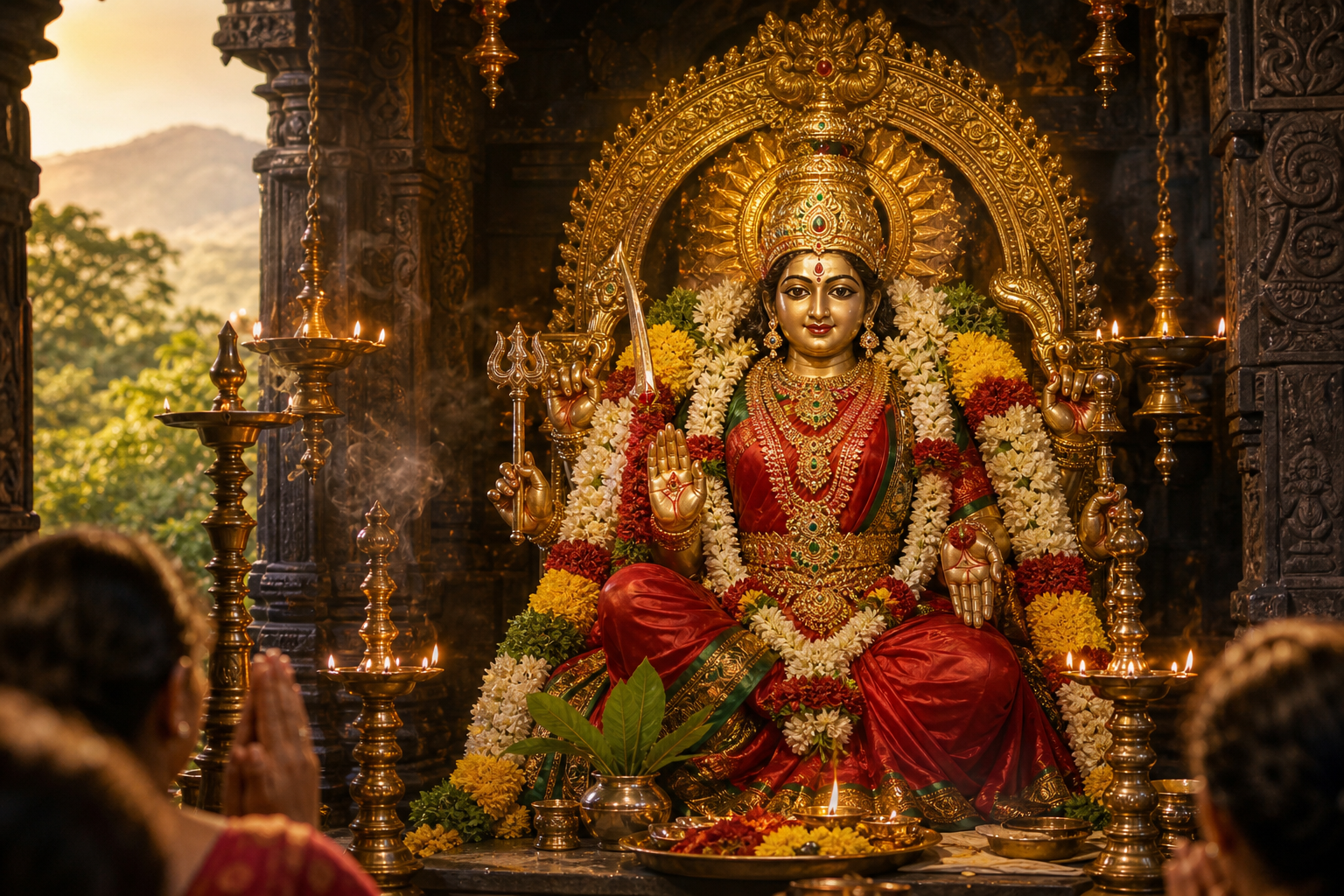
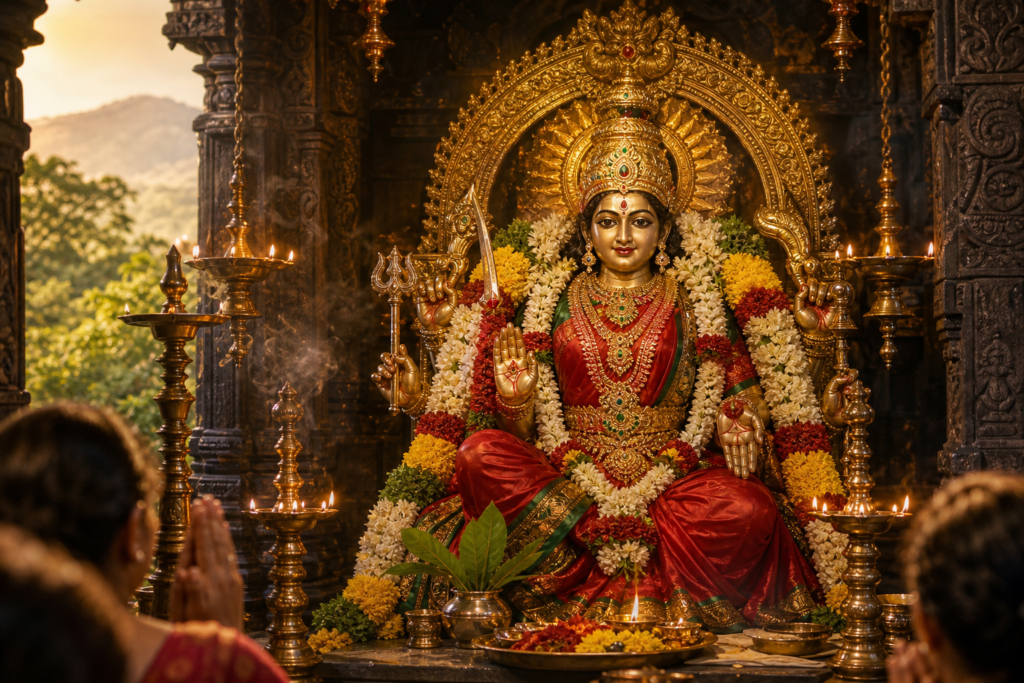
The sacred idol of Bannari Amman stands within a long and deeply layered Hindu understanding of divine form, where an image is not treated as a mere artistic object but as a living focus of worship, philosophy, ritual presence, and community memory. In this tradition, form becomes theology. The eyes, posture, ornaments, weapons, gestures, and placement of the deity are read as a visual scripture, communicating ideas that are often too subtle for ordinary language. The idol is therefore not only seen; it is approached, contemplated, served, and experienced through darshan.
Bannari Amman, worshipped with great devotion in Tamil Nadu, belongs to the expansive and diverse world of Devi worship in Hinduism. She is understood as a manifestation of Shakti, the divine feminine power that sustains, protects, nourishes, and transforms the universe. Her shrine at Bannari, near Sathyamangalam in the Erode region, is especially significant because it brings together temple ritual, regional devotion, agrarian memory, forest-edge sacred geography, and the living faith of generations of devotees.
In Hindu iconography, an idol is never random. Traditional texts such as the Agamas, Shilpa Shastras, and regional temple traditions give importance to proportion, expression, symbolic attributes, consecration, and ritual usability. These principles do not reduce the deity to a technical diagram. Rather, they protect the sanctity of worship by ensuring that the divine form becomes a disciplined medium through which devotees can relate to the infinite. The idol becomes a meeting point between metaphysics and intimacy.
The iconography of Bannari Amman is best understood through the broader grammar of Amman worship in South India. The word “Amman” itself carries the emotional force of motherhood. It does not merely identify a goddess; it expresses relationship. Devotees approach her as mother, protector, healer, guardian, and sovereign presence. This maternal dimension is central to the spiritual meaning of the idol, because the fierce and compassionate aspects of the goddess are not separate contradictions. They are two expressions of the same protective Shakti.
The face of a goddess idol often holds the first theological message. A calm face may reveal assurance, a direct gaze may indicate awakened presence, and a powerful expression may communicate protection against disorder. In the experience of devotees, the gaze of Bannari Amman is not decorative; it is relational. Darshan is a reciprocal act in which the devotee sees the deity and is also seen by the deity. This feeling of being seen explains why temple worship often produces emotional steadiness, humility, and a renewed sense of moral direction.
The idol as a living symbol also depends on consecration. In Hindu temple practice, the transformation of a sculpted form into a worshipful presence is associated with ritual processes such as Pran Pratishtha and continuous puja. Through mantra, offering, abhishekam, alankaram, deepa, naivedya, and daily worship, the deity is not treated as an inert object. The idol becomes the ritual body of the divine presence, cared for with the same reverence that a royal guest, beloved mother, and cosmic principle would receive.
This understanding is essential for interpreting Bannari Amman’s sacred form. The idol is not meaningful only because of its visual beauty, though beauty is important in Hindu worship. Its deeper significance lies in the disciplined union of symbol, ritual, memory, and faith. Ornaments are not merely ornaments. Flowers are not merely decoration. Kumkum, turmeric, sandal paste, lamps, silk, and garlands become part of a sacred language through which devotees express gratitude, surrender, hope, and reverence.
Turmeric and kumkum are especially significant in many Amman traditions. Turmeric is associated with auspiciousness, protection, fertility, purification, and healing. Kumkum signifies Shakti, marital auspiciousness, sacred energy, and the presence of the goddess. When these substances are offered to Bannari Amman, the ritual action carries a meaning far beyond external ceremony. It expresses the longing for well-being, family harmony, courage, and protection from visible and invisible forms of suffering.
The divine feminine in Hinduism cannot be reduced to softness alone. Devi is also force, sovereignty, and moral power. The spiritual meaning of Bannari Amman’s idol therefore includes both nurturing grace and protective intensity. In village and regional goddess traditions, the mother protects the boundaries of the community, guards the vulnerable, disciplines arrogance, and restores balance when human life becomes unstable. This is why Amman worship often feels immediate and personal, while still carrying profound philosophical depth.
The location of the Bannari Amman Temple adds another layer of meaning. Situated near the Sathyamangalam forest region and historically connected with routes of movement, trade, pilgrimage, and rural settlement, the temple reflects the sacred geography of Tamil Nadu. Temples in such regions often function as spiritual anchors for communities living close to land, weather, animals, agriculture, and seasonal uncertainty. The goddess is therefore approached not only as a metaphysical principle but also as a guardian of everyday life.
This relationship between deity and place is one of the most important features of Hindu temple culture. A shrine is not simply a building that contains a deity. It is a sacred field shaped by story, ritual repetition, pilgrimage, memory, and local experience. Bannari Amman’s idol gathers these layers into one visible center. For many devotees, the journey to the temple, the sight of the sanctum, the sound of bells, the fragrance of camphor, and the moment of darshan become part of the same spiritual event.
The idol also reveals the Hindu principle that the divine may be approached through many forms without fragmenting ultimate truth. Shakti may be worshipped as Durga, Kali, Mariamman, Meenakshi Amman, Kamakshi, Bhagavathi, or Bannari Amman, depending on region, lineage, family tradition, and spiritual temperament. This plurality is not theological confusion. It is a refined recognition that the infinite becomes accessible through countless names, forms, moods, and sacred relationships.
This inclusive vision is especially important for unity among Dharmic traditions. Hinduism, Buddhism, Jainism, and Sikhism differ in theology, practice, metaphysics, and institutional history, yet they share a civilizational respect for disciplined spiritual practice, ethical living, reverence for teachers, inner transformation, and liberation from ego-centered existence. Bannari Amman’s idol belongs specifically to Hindu Shakti worship, but the deeper principle of sacred form as a support for devotion, remembrance, and ethical refinement resonates across the wider Dharmic world.
In temple worship, iconography and practice cannot be separated. A devotee does not study the idol only as an art historian might study a sculpture. The devotee stands before the goddess with worry, gratitude, illness, family concerns, vows, memories, and aspirations. This human vulnerability gives temple iconography its emotional power. The idol becomes a sacred language for experiences that are difficult to express: fear before uncertainty, trust in divine protection, and the quiet strength that emerges after prayer.
Theologically, Bannari Amman’s form can be read as an expression of the Shakti doctrine that energy and consciousness are inseparable in lived reality. Hindu philosophy often describes the universe as sustained by an underlying intelligence and power. Devi worship gives this truth a relational form. The goddess is not an abstract concept distant from human life. She is the dynamic power through which protection, creation, nourishment, correction, and grace become visible to the devotee.
The sacred idol also teaches the importance of embodiment. Spiritual life is sometimes misunderstood as a rejection of the material world. Hindu temple traditions offer a more integrated view. Stone, metal, color, fragrance, sound, food, water, fire, and human gesture all become vehicles of sacred awareness. The idol of Bannari Amman shows that matter is not spiritually empty when consecrated and approached with reverence. It can become a vessel of presence, discipline, and transformation.
Alankaram, the ritual adornment of the deity, plays a major role in this transformation. Each adornment renews the relationship between devotee and deity. Silk garments, flowers, jewels, lamps, and sacred substances create a changing visual theology. The goddess appears in different moods and ritual contexts, yet remains the same divine presence. This dynamic quality reflects a profound insight: the eternal can be encountered through changing forms without losing its essence.
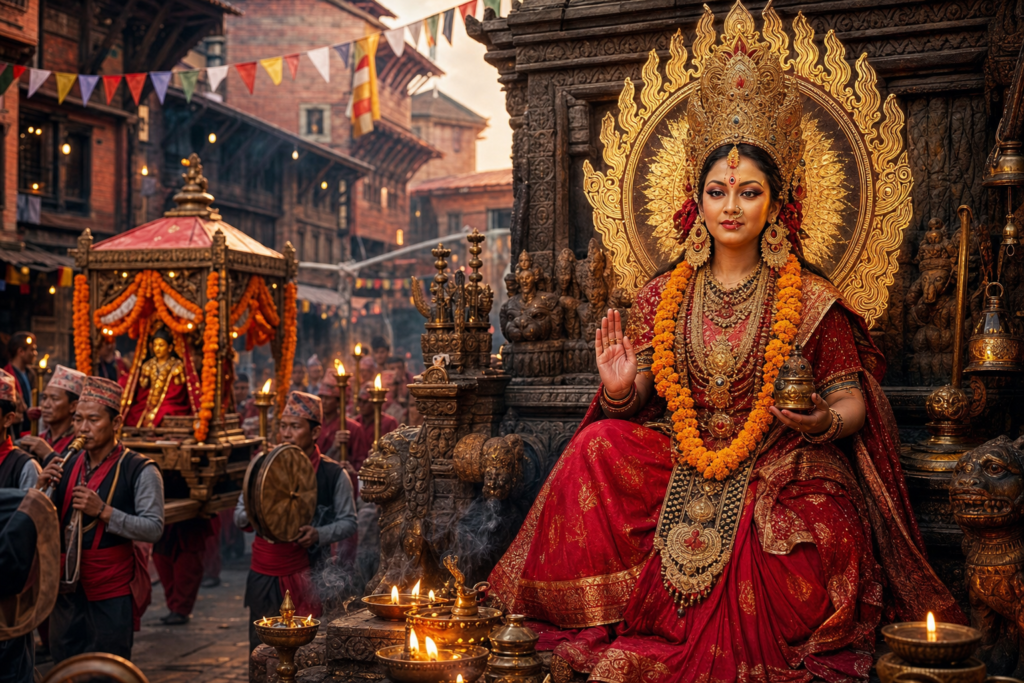
The experience of festivals further expands the meaning of the idol. During major celebrations, the deity’s presence moves beyond the inner sanctum into the wider community through processions, collective worship, vows, music, offerings, and shared participation. The idol then becomes a public center of cultural memory and social cohesion. Devotion is no longer only private; it becomes communal, binding families, villages, pilgrims, and generations into a shared rhythm of faith.
Bannari Amman worship also illustrates how Hindu traditions preserve continuity without becoming static. The same goddess who is worshipped through ancient ritual patterns continues to be approached by modern devotees facing contemporary anxieties: health, employment, family stability, migration, education, and emotional exhaustion. The idol remains relevant because it does not belong only to the past. It continues to organize hope, discipline, gratitude, and identity in the present.
From an academic perspective, the idol may be studied through iconography, anthropology, theology, ritual studies, Tamil cultural history, and the sociology of pilgrimage. From within the devotional world, however, these categories are secondary to lived experience. A mother praying for her child, a farmer seeking seasonal blessing, a traveler pausing before the goddess, or a family returning after a fulfilled vow encounters the idol not as theory but as presence. The strength of Hindu temple culture lies in holding both dimensions together.
The symbolism of Bannari Amman also highlights the importance of protection in religious life. Protection does not mean hostility toward others; in Dharmic thought, it means the preservation of dharma, harmony, health, dignity, and sacred order. The goddess protects by restoring balance. She reminds devotees that compassion without strength becomes fragile, while strength without compassion becomes harsh. The mother-goddess unites both qualities in a single sacred form.
This balance is central to Shakti worship. Devi is tender enough to receive tears and powerful enough to confront disorder. The idol’s spiritual meaning therefore cannot be confined to aesthetic appreciation. It shapes an ethical imagination. Devotees are encouraged to cultivate courage, restraint, gratitude, service, and reverence for life. The temple becomes a place where inner disorder is gradually reorganized through ritual rhythm and devotional focus.
The idol further reveals the Hindu understanding that sacred knowledge is transmitted through more than books. Scriptures, mantras, oral traditions, festivals, temple architecture, family vows, and visual forms all participate in the preservation of dharma. A devotee who may not read technical Agama texts can still receive theological insight through darshan, ritual participation, and inherited practice. This is not a lesser form of knowledge. It is embodied knowledge sustained by community and repetition.
In this sense, Bannari Amman’s idol is a sculptural scripture. It teaches that the divine is near, that the mother protects, that power and compassion belong together, and that place-based traditions carry profound philosophical meaning. It also teaches that Hindu spirituality is not only speculative but practical. It speaks to illness, fear, fertility, livelihood, travel, family, ecological dependence, and the moral need for protection.
The spiritual meaning of the idol becomes clearest when it is seen as a living relationship rather than a static object. Devotees return repeatedly because the goddess is experienced as responsive, familiar, and powerful. The sanctum becomes a place where personal burdens are placed within a larger cosmic order. Even when prayers are silent, the act of standing before Bannari Amman can become a disciplined surrender of anxiety into trust.
Bannari Amman’s sacred iconography therefore deserves careful attention not only as religious art but as a complete spiritual system. It unites Agamic principles, Tamil devotional culture, Shakti theology, sacred geography, ritual practice, and emotional life. The idol is a living symbol because it continues to gather meaning through worship. Its power lies not only in what it represents, but in what it awakens: reverence, courage, belonging, and the recognition that the divine mother remains present in the ordinary struggles of human life.
Inspired by this post on Hindu Blog.






Leave a Reply
You must be logged in to post a comment.