
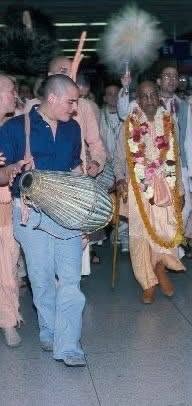
The brief notice that Tranakarta Das Ognibene has “left his body” carries a meaning that is deeper than a conventional announcement of death. In the vocabulary of ISKCON, Krishna consciousness, and the wider Vaishnava tradition, this phrase expresses a theological view of the person as an eternal spiritual being whose embodied life is temporary, meaningful, and accountable to dharma. The available source, a Facebook post attributed to Swarup Hebel, identifies him as a godbrother and states simply: “Tranakarta Das Ognibene left his body.” Because the public information supplied is limited, any responsible remembrance must avoid embellishment while still honoring the spiritual significance of such a departure.
In Hindu spirituality, and especially within the Gaudiya Vaishnava current represented by Srila Prabhupada’s Hare Krishna movement, death is not treated merely as biological termination. The Bhagavad Gita repeatedly distinguishes the atman from the body, teaching that the embodied self passes through childhood, youth, old age, and then another condition beyond the present body. This does not erase grief. Rather, it gives grief a framework: the community mourns separation, remembers seva, chants the holy names, and prays for the departed soul’s continued spiritual progress.
The name Tranakarta Das itself deserves reverent attention. In Vaishnava communities, initiated names are not casual labels; they are devotional identities that orient a practitioner toward service. The suffix “Das” means servant, and it signals the foundational bhakti principle that the soul’s fulfillment lies not in domination, possession, or self-display, but in loving service to Bhagavan. When such a devotee is remembered, the emphasis is therefore not on worldly status alone, but on the relationship between spiritual aspiration, community memory, and the discipline of devotional life.
The reference “ACBSP” is commonly associated in ISKCON contexts with His Divine Grace A. C. Bhaktivedanta Swami Prabhupada, the founder-acharya of the International Society for Krishna Consciousness. Where the abbreviation appears beside a devotee’s name, it often indicates a connection to Srila Prabhupada’s disciplic family. In the absence of fuller verified biographical details, the most careful reading is that Tranakarta Das Ognibene is being remembered within that devotional lineage. That lineage is not merely institutional; it is rooted in guru-shishya parampara, sacred sound, Vaishnava conduct, scriptural study, prasadam, kirtan, and lifelong service.
A spiritually mature tribute must hold two truths together. First, the community has lost the visible association of a godbrother, friend, and servant of Krishna. Second, the philosophical foundation of Sanatana Dharma teaches that the soul is not destroyed when the body ceases to function. This balance is one reason the phrase “left his body” is so meaningful. It acknowledges the reality of departure without reducing the person to physical matter. It speaks with tenderness, but also with metaphysical clarity.
For many devotees, hearing that a godbrother has left his body becomes a moment of introspection. It asks whether daily life is being lived with seriousness, humility, and remembrance of Krishna. It asks whether relationships within the sangha are being nourished before time removes the opportunity. It asks whether chanting, service, forgiveness, and study have remained central or have been pushed aside by distraction. In this sense, a devotee’s passing becomes not only a moment of sorrow, but also a call to return to essentials.
Within the bhakti tradition, remembrance is itself a form of service. To remember a devotee respectfully is to affirm that spiritual effort matters, that association shapes consciousness, and that no sincere act of seva is lost. A simple life of chanting, temple service, prasadam distribution, book distribution, teaching, cooking, cleaning, encouraging younger devotees, or quietly maintaining faith can leave impressions that are difficult to measure but deeply real. Some contributions are recorded publicly; many are preserved only in the hearts of those who received kindness, instruction, correction, or friendship.
The use of the word “godbrother” is also significant. In ordinary social language, fraternity is often biological or organizational. In Vaishnava language, godbrotherhood is spiritual kinship formed through shared shelter, shared discipline, and shared reverence for guru and Krishna. It implies a bond that extends beyond age, nationality, profession, and social category. Such a bond is one of the great strengths of dharmic traditions: it forms communities of practice where people are joined by sadhana, sacred learning, and service rather than merely by bloodline or geography.
This remembrance also reflects the broader purpose of dharmic unity. Hinduism, Buddhism, Jainism, and Sikhism each approach the mystery of life, death, discipline, liberation, and compassion through distinct philosophical and spiritual vocabularies. Yet all preserve a serious understanding that human life should be lived with ethical restraint, spiritual inquiry, and reverence for truth. A Vaishnava tribute, therefore, need not become sectarian. It can strengthen respect for all dharmic paths by showing how one tradition faces mortality with dignity, prayer, and philosophical depth.
In Vaishnava theology, the final transition of life is closely connected with consciousness. The holy name of Krishna, the presence of devotees, the sound of kirtan, the remembrance of guru, and the mood of surrender are all considered spiritually protective. This is why communities often respond to such news with chanting rather than mere commentary. The maha-mantra, “Hare Krishna Hare Krishna Krishna Krishna Hare Hare Hare Rama Hare Rama Rama Rama Hare Hare,” becomes a prayer, a shelter, and a way of accompanying the departed soul through remembrance.
At the same time, an academic and factual tribute must remain clear about what is known and what is not known. The supplied source does not provide a detailed biography, date of departure, place of departure, family information, temple affiliations, or specific services performed by Tranakarta Das Ognibene. Therefore, this article does not invent those details. Its purpose is to preserve the announcement respectfully, explain its devotional meaning, and situate it within the spiritual culture of ISKCON and the wider Hindu tradition.
Such restraint is important because sacred remembrance should not become speculation. In dharmic writing, accuracy is itself a form of respect. When a devotee leaves the world, the temptation may arise to fill silence with assumptions. A more disciplined approach is to honor what has been received, invite verified memories from those who personally knew him, and allow the community’s lived experience to complete the portrait over time. Truthfulness, or satya, is not separate from devotion; it is one of devotion’s supports.
The passing of Tranakarta Das Ognibene also invites reflection on the legacy of Srila Prabhupada’s movement. ISKCON carried Gaudiya Vaishnava teachings across continents, creating communities where people from many backgrounds adopted Sanskrit names, learned Vaishnava practices, worshiped Sri Sri Radha Krishna, studied Bhagavad Gita and Srimad Bhagavatam, and organized their lives around devotional service. Every devotee in that movement, whether widely known or quietly dedicated, becomes part of a larger historical story of Hindu spirituality taking root in a global setting.
For those who did not personally know Tranakarta Das Ognibene, the news can still carry spiritual value. It teaches that a human life is not evaluated only by public recognition. Dharmic traditions repeatedly emphasize inner cultivation: humility, self-control, compassion, remembrance, truthfulness, and surrender. The unseen disciplines of a devotee’s life may be more spiritually consequential than public visibility. A short announcement can therefore become a long meditation on what it means to live in a way that prepares the consciousness for departure.
There is also an emotional dimension that should not be dismissed. Devotees are not expected to be indifferent when someone leaves the body. Separation from Vaishnavas is painful because association is cherished. Shared kirtan, shared prasadam, shared festivals, shared struggles, and shared remembrance of Krishna create bonds that are both human and sacred. Grief, when held within bhakti, becomes softened by gratitude. It does not deny loss; it places loss before Krishna with trust.
In practical terms, the most fitting response to such a notice is prayerful remembrance. Devotees may chant the holy names, offer prasadam, read from Bhagavad Gita, remember Srila Prabhupada’s instructions, and speak truthfully about the departed devotee’s association. Where verified memories are available, they should be preserved with care. Where details are absent, silence should remain dignified. This approach protects both the devotee’s memory and the integrity of the community record.
The phrase “left his body” therefore becomes a doorway into several core teachings: the distinction between body and soul, the importance of guru-parampara, the value of devotional service, the responsibility of community remembrance, and the urgency of spiritual practice. It reminds the living that time is limited and that spiritual life should not be postponed. It also reminds the community that honoring a Vaishnava is not merely a social courtesy; it is part of preserving a sacred culture.
May Tranakarta Das Ognibene be remembered with dignity by those who knew him, and may the community respond in a way consistent with Vaishnava compassion, dharmic unity, and devotion to Krishna. May the news of his departure deepen remembrance rather than despair, seriousness rather than sentimentality, and gratitude rather than forgetfulness. In that spirit, this tribute stands as a respectful acknowledgment of a devotee’s passing and a reminder that the soul’s journey is central to the wisdom of Sanatana Dharma.
Inspired by this post on Dandavats.




Leave a Reply
You must be logged in to post a comment.