
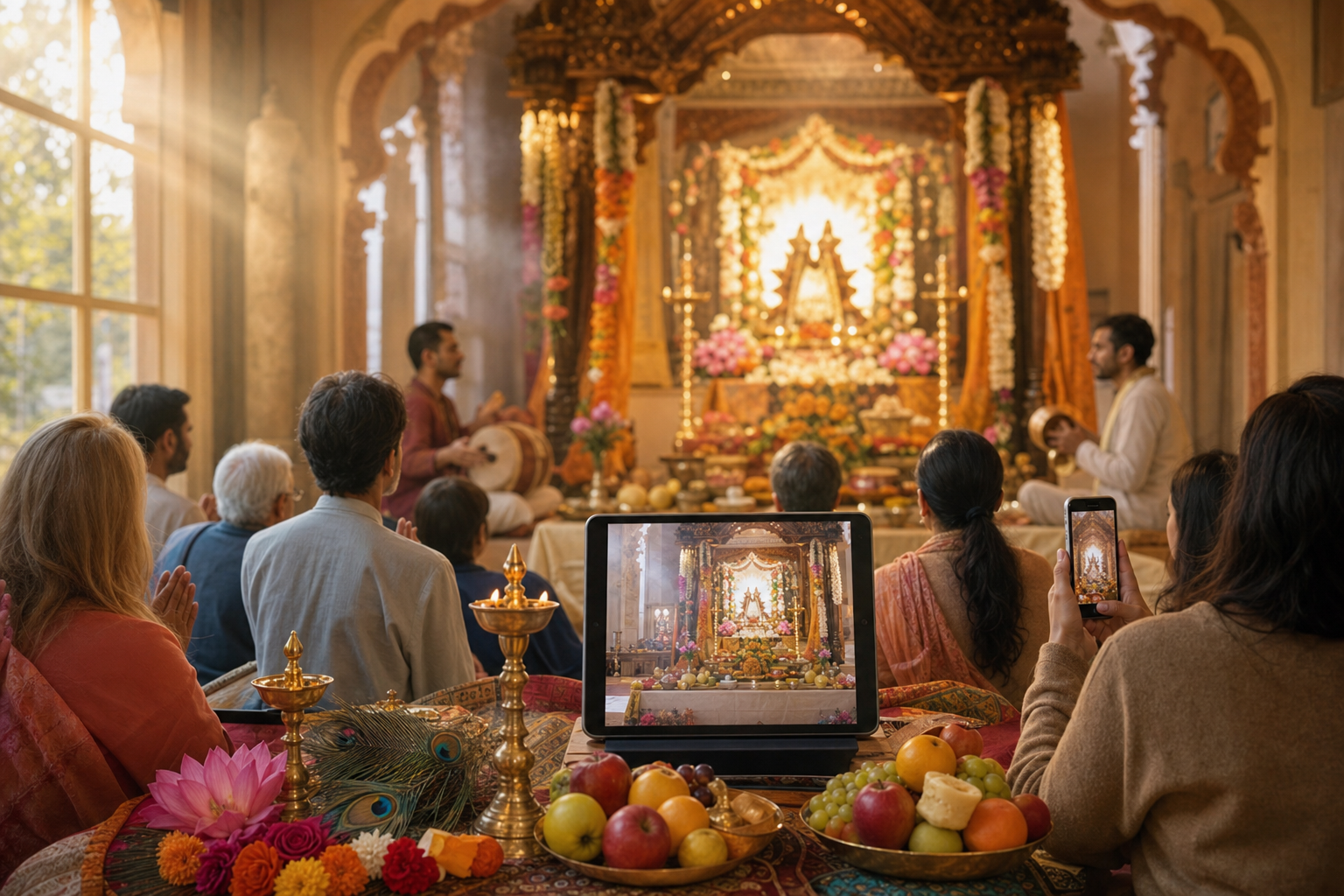
ISKCON Dallas, formally known as the home of Sri Sri Radha Kalachandji, offers more than a temple live stream. It presents a living example of how bhakti, ritual discipline, diaspora community building, vegetarian ethics, and digital media now meet in one shared devotional space. For viewers who cannot physically enter the temple at 5430 Gurley Avenue in East Dallas, the live broadcast functions as a window into darshan, kirtan, worship, and the quiet continuity of Gaudiya Vaishnava practice in North America.
The significance of ISKCON Dallas is not limited to a camera feed or a daily schedule. The temple belongs to the wider International Society for Krishna Consciousness, a global Vaishnava movement founded by His Divine Grace A.C. Bhaktivedanta Swami Srila Prabhupada in 1966. Within that broader history, the Dallas center emerged in the early 1970s as one of the important early Krishna temples in North America, shaped by Prabhupada’s direct guidance and by the labor of disciples who carried bhakti-yoga into new cultural environments.
At the center of this institution are Sri Sri Radha Kalachandji. According to the temple’s own historical account, the Deities were connected with Jaipur, India, in 1972. An ancient Deity of Krishna, described by the temple as more than five hundred years old, was brought to America along with a newly carved Deity of Srimati Radharani. Upon Their installation in Dallas, Srila Prabhupada named Them Sri Sri Radha Kalachandji, establishing Them as the presiding Deities and spiritual heart of the community.
The name Kalachandji is commonly explained as the beautiful moon-faced one. In devotional culture, this naming is not merely descriptive; it expresses a theology of beauty, relationship, and loving service. The Deity is not treated as a symbolic object but as the focus of daily worship, food offerings, music, prayer, adornment, and community life. This distinction is essential for understanding why a temple live stream matters to devotees. It is not simply religious video content; it is mediated participation in a daily rhythm of sacred presence.
Darshan, in the Hindu temple context, is often described as seeing and being seen by the Divine. The live stream extends that experience across distance, time constraints, health limitations, and geography. A student in a dormitory, an elder at home, a parent managing household responsibilities, or a traveler away from a familiar temple can still pause before the altar and enter a devotional frame of mind. The technology is modern, but the impulse behind it is ancient: to remember, to behold, and to reconnect.
This technological extension of darshan should be understood carefully. A live stream does not replace the embodied temple experience, where one hears the collective singing, smells incense, receives prasadam, observes the gestures of worship, and stands among other devotees. Yet digital access can deepen continuity. It helps maintain daily sadhana when physical attendance is impossible. In that sense, ISKCON Dallas Temple Live belongs to a broader transformation in Hindu temples abroad, where digital infrastructure has become part of community resilience.
The temple’s practice is rooted in Krishna consciousness, also known as bhakti-yoga. The philosophical foundation emphasizes that the living being is not reducible to the body, but is the conscious self within the body. From this starting point, devotion is not presented as sentiment alone. It becomes an integrated discipline of mantra meditation, scriptural study, ethical conduct, service, food culture, music, and the cultivation of loving relationships with God, other beings, and nature.
Several values associated with the Dallas temple reflect this larger dharmic vocabulary: equal vision, ahimsa, humility, choice, teaching by example, and affection. These values matter because they connect temple ritual to social conduct. A temple that sings the names of Krishna but neglects compassion would fail its own philosophical premise. A temple that teaches ahimsa but forgets humility would weaken its ethical credibility. The integrity of bhakti lies in the union of worship and character.
The live stream therefore becomes a pedagogical tool as much as a devotional one. Viewers may observe the structure of arati, the aesthetics of altar decoration, the centrality of kirtan, and the disciplined care with which offerings are made. For those new to Hindu traditions, this visual access can reduce misunderstanding. For those already formed by dharmic culture, it can preserve continuity across generations. In the diaspora, where children may grow up far from the sacred geographies of India, such visibility helps translate inherited tradition into lived memory.
ISKCON Dallas is also important because it shows how a temple can function as a layered institution. It is a place of worship, but also a site of education, food ethics, community gathering, and cultural transmission. The Sunday program, with kirtan, a spiritual talk, and vegetarian dinner, follows a recognizable model of communal devotion. It gathers people not only around belief but around rhythm: singing, listening, eating, serving, and returning.
The food culture associated with the temple is especially significant. Kalachandji’s, connected with the Dallas temple campus, has served vegetarian meals since 1982 and is known locally as Dallas’ longest-serving vegetarian restaurant. Its cuisine reflects the temple’s lacto-vegetarian tradition while also identifying vegan options. In dharmic terms, food is not merely nutrition or hospitality. When prepared as an offering and shared as prasadam, it becomes part of a moral ecology linking body, mind, community, and devotion.
The technical details of this food practice reveal a serious ethical structure. The kitchen tradition avoids meat, fish, eggs, onion, and garlic, and emphasizes fresh ingredients. Such discipline is not a random dietary preference. It emerges from Vaishnava ideas about sattva, purity, compassion, and consciousness. A visitor may first encounter the tradition through flavor, but the deeper lesson concerns the transformation of everyday acts. Cooking, serving, eating, and cleaning can all become forms of seva.
This is where the Dallas temple offers an instructive model for the wider Hindu diaspora in the United States. Temples abroad often carry a heavier burden than temples in India, because they must preserve worship while also explaining culture, language, ritual, and philosophy to younger generations and to non-Hindu neighbors. ISKCON Dallas stands within that reality. Its live stream, Sunday talks, kirtan programs, school connections, food initiatives, and public-facing media all participate in the same project: making bhakti intelligible and accessible without stripping it of depth.
Academically, ISKCON Dallas may be viewed as an example of transplanted sacred culture. A Deity connected to Jaipur becomes the center of worship in Texas. A Sanskritic and Bengali Vaishnava theological world is expressed through English-language talks, American nonprofit structures, YouTube media, school programs, and local neighborhood participation. This does not make the tradition less authentic. Rather, it demonstrates a classic feature of dharmic civilization: continuity through adaptation.
Such adaptation should not be confused with dilution. The core practices remain recognizable: nama-sankirtana, arati, prasadam, Bhagavad Gita study, Srimad Bhagavatam study, Vaishnava etiquette, and devotional service. What changes is the medium through which people gather. The temple room continues to matter, but the digital screen now extends the temple’s reach. The courtyard and dining hall continue to matter, but so do newsletters, recorded talks, and live video. The sacred center remains stable while the channels of participation expand.
From the perspective of dharmic unity, ISKCON Dallas also offers a constructive case study. While its theology is specifically Gaudiya Vaishnava and centered on Krishna bhakti, its ethical language overlaps with wider Hindu, Buddhist, Jain, and Sikh concerns: compassion, disciplined practice, self-transformation, service, reverence, and community responsibility. Ahimsa resonates deeply across Hindu and Jain traditions. Seva is central in Sikh life as well as Vaishnava practice. Meditation and self-discipline are shared across many dharmic paths. These convergences do not erase difference; they allow difference to coexist with mutual respect.
This point is especially relevant for public writing on temples and religious identity. The goal should not be sectarian competition, but careful understanding. A Vaishnava temple can be appreciated on its own terms while also being situated within the larger family of Sanatana Dharma and dharmic civilization. When presented responsibly, the live stream of ISKCON Dallas becomes not a narrow institutional artifact but a resource for understanding how devotional Hindu traditions continue to nourish plural societies.
The image associated with the original post appears to come from a video thumbnail for ISKCON Dallas Temple Live. Even from such sparse source material, the subject opens into a much larger discussion. A thumbnail points to a stream; a stream points to a temple; a temple points to a lineage; a lineage points to centuries of worship, migration, memory, and renewal. This layered reading is necessary because sacred institutions are rarely understood through a single frame.
The Dallas temple’s story is emotionally powerful because it carries the feeling of continuity after displacement. A Deity once associated with India is established in a new land, and devotees organize around worship, food, song, education, and service. For many families in the Dallas-Fort Worth area, such a temple is not only a place to visit on festivals. It becomes part of childhood, marriage, grief, celebration, language learning, moral formation, and spiritual recovery.
In modern life, where attention is fragmented and loneliness is common, temple live streams can quietly reintroduce rhythm. A person may open the broadcast for a few minutes and remember that life need not be governed only by deadlines, consumption, and noise. The sight of the altar, the sound of kirtan, or the memory of prasadam can shift the inner atmosphere. Such experiences are personal, yet they are supported by a highly structured tradition of ritual time, community labor, and theological meaning.
There is also a public educational benefit. Many misunderstand Hindu temple worship because they approach it through categories that do not fit. Deity worship is often misread when observers ignore the philosophical framework of presence, offering, relationship, and consecration. A live stream, when accompanied by thoughtful explanation, can correct superficial assumptions. It allows viewers to see regularity, care, beauty, and devotion rather than reducing the tradition to exotic imagery.
ISKCON Dallas Temple Live should therefore be understood as both a devotional service and a cultural archive in motion. It records how a community worships, how aesthetics change with the liturgical calendar, how festivals intensify participation, and how a diaspora temple sustains continuity across decades. The stream may look simple, but it carries institutional memory. Every broadcast implicitly testifies that bhakti is not confined to geography. It can be practiced in Vrindavan, Jaipur, Dallas, or a small room where a devotee watches with folded hands.
The temple’s ongoing relevance lies in this combination of depth and accessibility. It does not ask modern technology to replace sacred tradition. Instead, it uses technology to point back toward the altar, the mantra, the community, and the discipline of service. For students of Hinduism, it offers a living example of Gaudiya Vaishnava practice in the American context. For devotees, it offers connection. For the broader dharmic world, it offers a reminder that unity is strengthened when each tradition preserves its own integrity while honoring the shared pursuit of truth, compassion, and spiritual realization.
Inspired by this post on Dandavats.





Leave a Reply
You must be logged in to post a comment.