
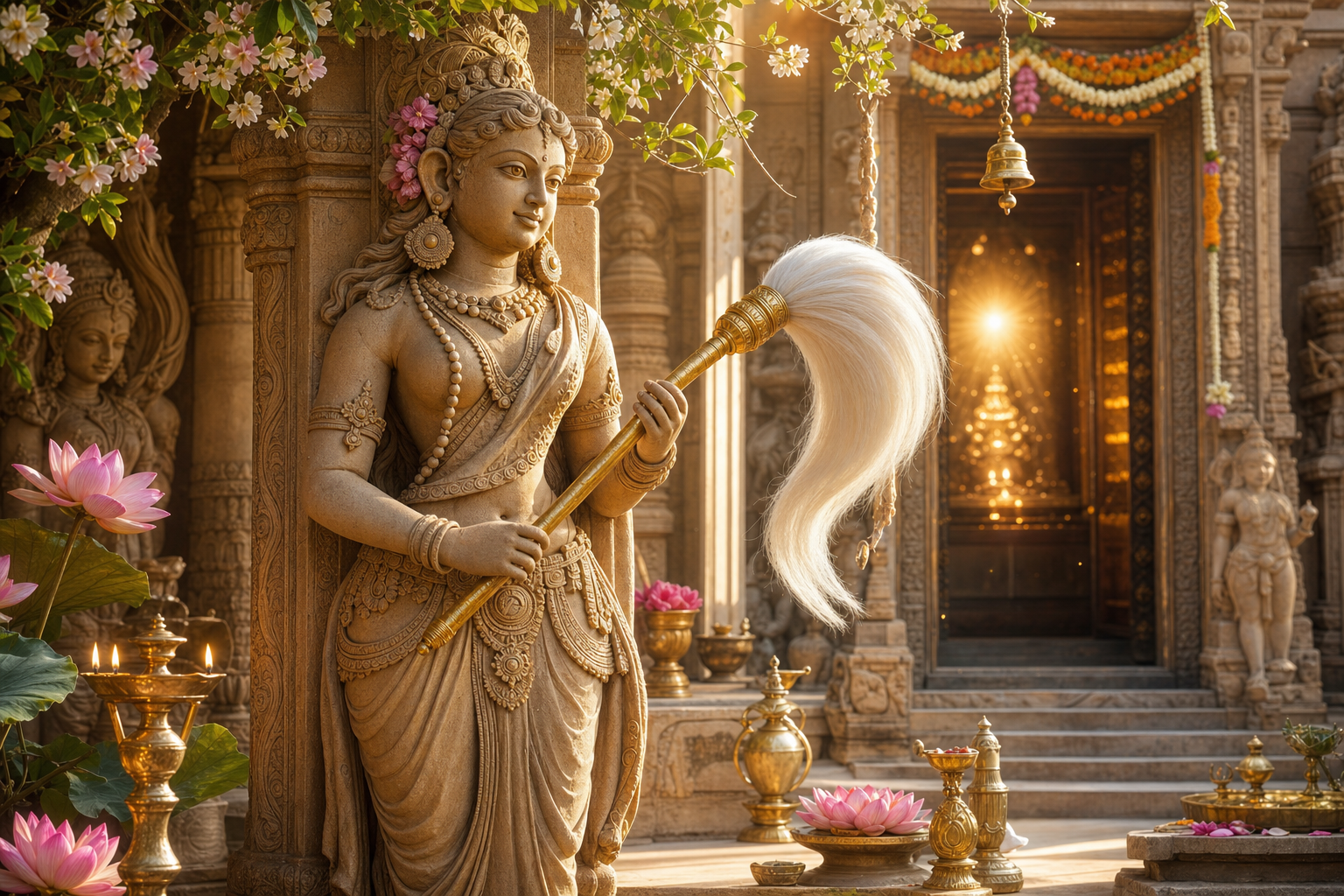
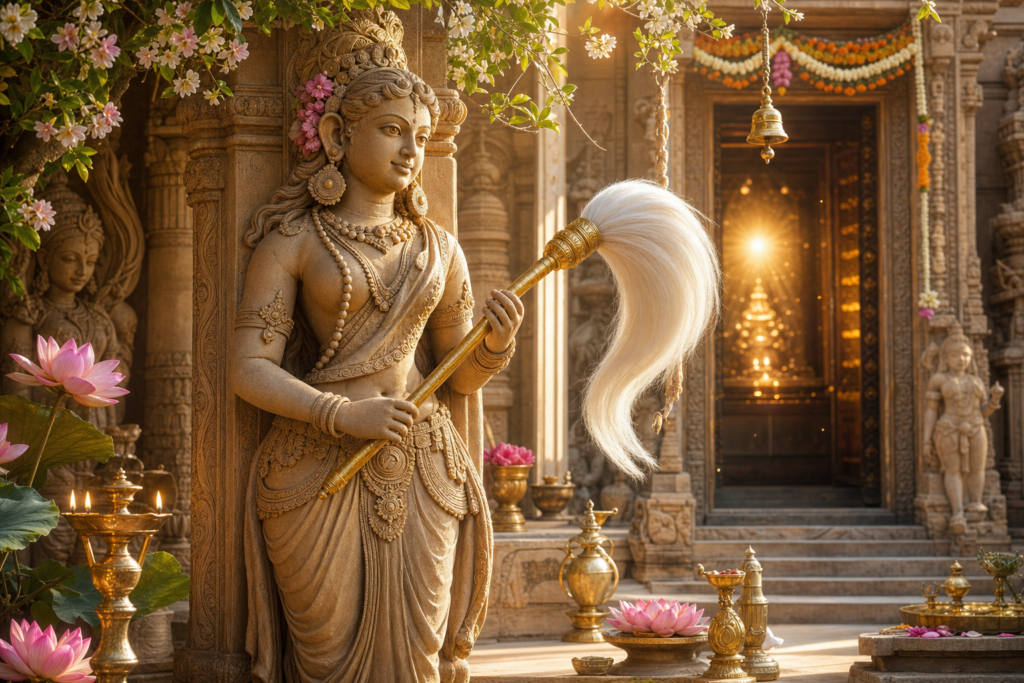
In Hindu sacred art, the cauri, or fly-whisk, is far more than an ornamental object held by a graceful attendant. It is a ritual instrument, a royal emblem, a sign of reverence, and a visual bridge between the earthly and the divine. When placed in the hands of a Yakshini, the cauri becomes especially meaningful, because the Yakshini herself stands at the meeting point of fertility, abundance, protection, beauty, and sacred presence.
Yakshinis occupy a luminous place in the religious imagination of the Indian subcontinent. They are feminine counterparts of the Yakshas, beings associated with nature, trees, water, minerals, fertility, treasure, and hidden powers of the earth. Their presence in Hindu iconography is not accidental decoration; it reflects an older and deeply rooted understanding that divinity is not confined to the heavens, but also pulses through forests, rivers, flowering trees, fertile soil, and the generative mystery of life itself.
The cauri-bearing Yakshini therefore invites a layered reading. On one level, she appears as an attendant serving a deity, king, saint, or sacred presence. On another level, she embodies the auspicious energies that make such a presence worthy of worship: beauty, prosperity, coolness, refinement, protection, and dignity. In this sense, her gesture of service is not servility; it is ritual participation in the maintenance of sacred order.
The fly-whisk itself has a long history in South Asian ritual culture. Commonly made from the hair of the yak or other fine materials, it was used to fan and honor revered persons, to keep insects away, and to create an atmosphere of purity around a sacred or royal body. In temple worship, such an action belongs to the grammar of seva, the devotional service offered to the divine with care, discipline, and inward humility.
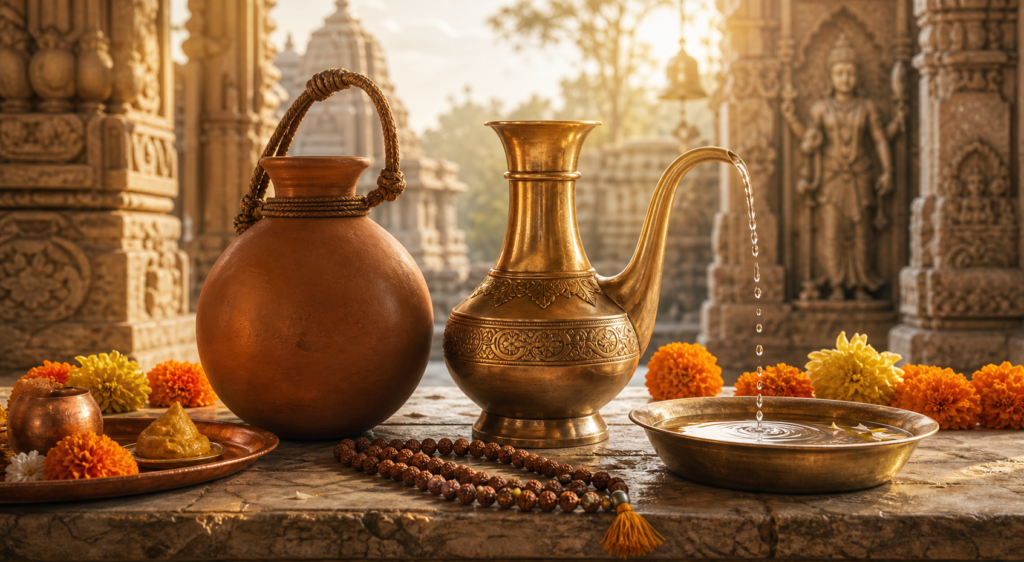
In Hindu temples, objects such as lamps, bells, vessels, garlands, umbrellas, fans, and fly-whisks are never merely functional. They participate in a symbolic world where the deity is treated as a living sovereign, beloved guest, cosmic ruler, and inner presence. The cauri belongs to this world of refined honor. Its movement suggests cooling, cleansing, protection, and attention. It marks the space around the deity as charged, dignified, and ritually alive.
When this object appears with the Yakshini, the symbolism expands into the realm of the Sacred Feminine. Hindu tradition does not reduce the feminine principle to a single role or image. It appears as mother, queen, warrior, river, earth, wisdom, speech, prosperity, hunger, compassion, and transformative power. The Yakshini belongs to this wider symbolic field of Shakti, not always as the supreme Goddess herself, but as one of the many radiant expressions through which sacred feminine power becomes visible.
Early Indian art frequently presents Yakshinis with sensuous vitality, full bodily presence, and strong association with vegetation. The famous tree-and-woman motif, often discussed in relation to the shalabhanjika, expresses a visual theology of fertility: the touch or nearness of the feminine being brings forth flowering, fruitfulness, and abundance. The body is not treated as an obstacle to spirituality in these images; rather, it becomes a sign of life, auspiciousness, and the generative force of prakriti.
This is one reason the Yakshini should not be read through a narrow modern lens that separates beauty from sanctity. In classical Indian aesthetics, beauty can be a carrier of rasa, presence, and meaning. A beautifully carved Yakshini at a gateway, railing, pillar, or shrine does not simply decorate architecture. She transforms the threshold into a place of blessing. She announces that entry into sacred space is also entry into a universe nourished by abundance and guarded by subtle powers.
The cauri in her hand deepens that threshold symbolism. The fly-whisk is moved around the honored being, but the gesture also shapes the surrounding atmosphere. It marks the boundary between ordinary space and consecrated space. It suggests that sacred presence must be approached with attentiveness, refinement, and reverence. In lived religious experience, this is immediately understandable: even a simple act performed with devotion can transform the mood of a room, a shrine, or a heart.
Historically, the cauri also carried royal associations. Kings and great personages were attended with fly-whisks and parasols as signs of authority. Hindu sacred art often adapts royal symbols for divine worship because the deity is understood as the true sovereign. When a Yakshini bears the cauri near a divine figure, the image communicates majesty without needing an inscription. The deity is not only adored; the deity reigns.
This royal dimension is important because Hindu iconography often joins sovereignty with dharma. Divine kingship is not merely power; it is power ordered toward protection, balance, generosity, and cosmic stability. The cauri-bearing attendant therefore participates in the visual language of dharmic order. Her presence quietly proclaims that the sacred center is worthy of service because it sustains the wider world.
At the same time, the Yakshini is not only an attendant. Across Hindu, Buddhist, and Jain artistic traditions, Yakshas and Yakshinis appear as guardians, fertility beings, local deities, protective spirits, and companions of higher spiritual figures. This shared presence across Dharmic traditions reveals a remarkable cultural continuity. Rather than belonging exclusively to one sectarian boundary, these beings demonstrate how Indian religious art often absorbed, refined, and elevated regional sacred forms into broader theological frameworks.
In Jainism, Yakshas and Yakshinis are associated with Tirthankaras as attendant deities, often functioning as protectors and devotional focal points. In Buddhism, Yakshas appear as powerful beings who may protect the Dharma after being transformed by wisdom and discipline. In Hindu contexts, they are closely linked with Kubera, fertility, nature, and prosperity. This shared symbolic world helps strengthen the larger unity among Dharmic traditions while allowing each tradition to preserve its own philosophical and ritual distinctiveness.
The cauri itself also crosses religious boundaries in meaningful ways. In Hindu temples it honors the deity. In Jain worship it appears in reverential service. In Sikh tradition, the chaur sahib is waved over the Guru Granth Sahib as a profound sign of respect for the living Guru embodied in scripture. These parallels do not erase theological differences; they show how sacred gestures can carry a shared civilizational vocabulary of reverence, humility, and devotion.
Such continuity is especially valuable in a time when symbols are often flattened into political labels or aesthetic curiosities. The cauri-bearing Yakshini asks for a more careful reading. She belongs to a symbolic language in which the feminine is powerful, nature is sacred, service is dignified, and beauty can be a vehicle of metaphysical insight. Her image resists the assumption that ritual art is merely decorative or that ancient religious forms are simple relics of the past.
The association of Yakshinis with treasure should also be understood in a broad sense. In many traditions, Yakshas are connected with wealth and hidden riches, especially through their relationship with Kubera. Yet the treasure implied by Yakshini symbolism is not only material. It includes fertility, protection, emotional nourishment, artistic refinement, and the hidden abundance of the earth. A society that sees trees, rivers, soil, and feminine power as sacred is being taught to recognize wealth in more than coins and possessions.
The cauri, with its gentle motion, introduces another dimension: the sacred value of care. It is not a weapon, scripture, or crown. It does not dominate the image. Its power lies in service. This is one of the subtler teachings of Hindu symbolism: acts that appear quiet or secondary may sustain the entire ritual universe. The person who lights the lamp, sweeps the temple floor, prepares flowers, rings the bell, or waves the cauri participates in a discipline of attention.
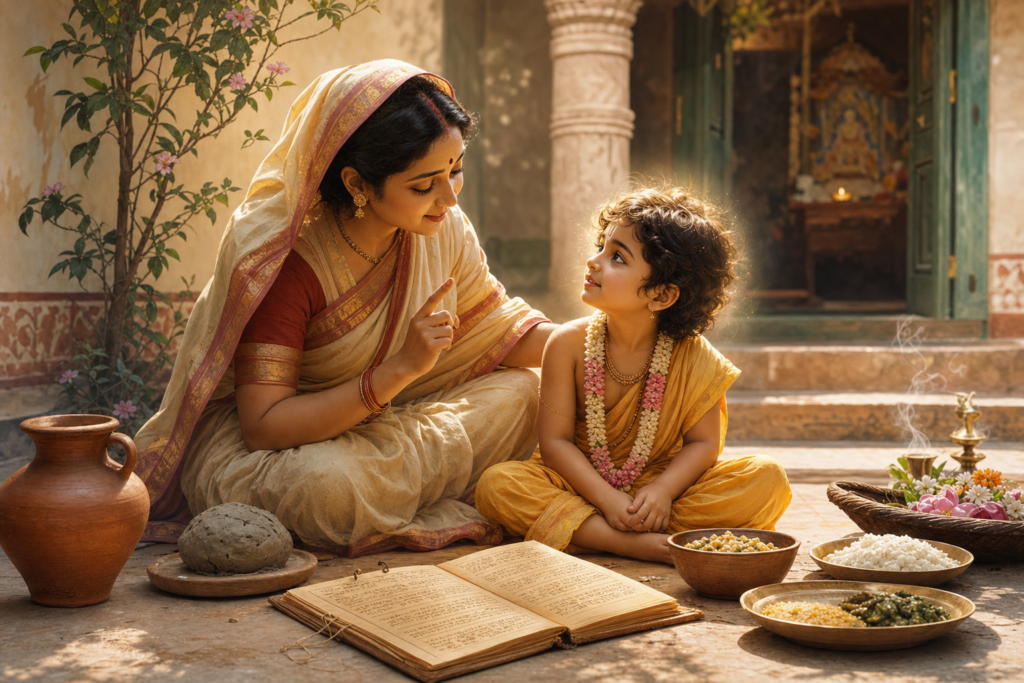
In this way, the cauri-bearing Yakshini becomes relatable even beyond formal art history. Many devotees recognize that sacred life is built through small gestures repeated with sincerity. A shrine becomes meaningful because someone cleans it. A festival becomes luminous because hands prepare offerings. A family tradition survives because elders teach children how to bow, how to offer, how to remember. The Yakshini’s gesture gives artistic form to this often-unseen labor of reverence.
There is also a psychological depth to the image. The cauri clears the air around the sacred presence. Symbolically, this can be understood as the clearing of distraction, agitation, and impurity from the mind. The devotee approaching such an image may see in it a visual reminder that inner worship requires refinement. Just as the sanctum is honored externally, the mind must be made fit internally through attention, discipline, gratitude, and humility.
Hindu philosophy frequently moves between outer ritual and inner realization. A visible action can become an inward practice. The waving of the cauri around the deity may be read as the offering of breath, thought, and intention. The Yakshini holding the fly-whisk becomes a mirror for the devotee: what is being cleared, what is being honored, and what kind of presence is being protected within the heart?
The feminine dimension of this image deserves particular care. The Yakshini is not a passive figure inserted into art for visual appeal. Her abundance, posture, ornamentation, and association with nature convey auspicious force. In Hindu art, the auspicious feminine often marks beginnings, thresholds, prosperity, and continuity. She is the sign that life is not barren, that the world is capable of renewal, and that sacred power can be nurturing as well as majestic.
This symbolism has ecological implications as well. Yakshinis are inseparable from trees, groves, water, and fertility. Their imagery belongs to a worldview in which nature is not inert matter but a living field of presence. Modern readers may find in this a powerful corrective to exploitative attitudes toward the environment. The sacred feminine in such art teaches reverence for the earth not through abstract theory alone, but through beauty, story, and ritual memory.
The cauri’s material history reinforces this connection. Whether made from yak hair or other traditional materials, it comes from the natural world and enters sacred practice through human craftsmanship. It is an object shaped by ecology, culture, and devotion. Its use in worship shows how Hindu ritual often transforms ordinary materials into vehicles of meaning. Nothing is spiritually neutral when placed within a disciplined field of reverence.
Iconographically, the cauri-bearing figure also helps viewers identify hierarchy within a sacred composition. Attendants, guardians, musicians, dancers, and celestial beings often surround a central deity or enlightened figure. These surrounding figures do not weaken the focus; they intensify it. They show that the divine center is so powerful that the whole cosmos gathers around it in service, celebration, and protection.
Yet the surrounding figures also preserve an important theological balance. Hindu sacred art rarely presents divinity as isolated. The divine is relational: attended, praised, loved, served, witnessed, and approached through many forms. The Yakshini with the cauri belongs to this relational universe. Her presence suggests that sacred reality is not lonely abstraction, but living fullness.
This fullness is one reason Hindu symbols require patient interpretation. A modern viewer may see a fly-whisk and think only of a courtly object. A more careful reading recognizes layers of royal honor, ritual purity, feminine auspiciousness, natural abundance, and devotional service. The same object can speak simultaneously to theology, aesthetics, social history, and spiritual psychology.
The cauri-bearing Yakshini also challenges simplistic divisions between folk religion and classical religion. Yaksha and Yakshini traditions likely draw from ancient local cults of nature, fertility, and place-based divinity. Over time, these forms became integrated into temple architecture, Puranic imagination, Jain devotional systems, Buddhist protective traditions, and broader Indic art. This integration is not evidence of confusion; it is evidence of cultural depth and religious adaptability.
Such adaptability is central to Sanatana Dharma and to the wider Dharmic family. Sacred forms are not always discarded when new philosophical systems develop. They are reinterpreted, disciplined, and brought into conversation with higher metaphysical ideas. The Yakshini remains connected to fertility and nature, but she can also serve as a bearer of sacred honor, a guardian of thresholds, and a visual expression of Shakti.
The emotional power of the image lies in its quietness. There is no need for dramatic battle or cosmic destruction. The Yakshini stands, holds, serves, and blesses. The cauri moves in a gesture of care. This restrained symbolism can be deeply moving because much of spiritual life is also quiet. It is made of attention, repetition, offering, remembrance, and the willingness to place the sacred at the center.
For contemporary Hindu communities and for readers interested in Indian art, this image offers a valuable lesson in cultural literacy. To understand Hindu symbols, one must move beyond surface description. The question is not only, “What is this object?” but also, “What world of meaning makes this object sacred?” The cauri becomes intelligible only when seen within a worldview where service, sovereignty, purity, beauty, and divine presence are woven together.
The Yakshini, likewise, becomes intelligible only when the feminine is understood as a sacred principle rather than a decorative theme. Her form communicates abundance, but not merely sensual abundance. It points to the overflowing nature of life itself: vegetation, wealth, fertility, creativity, devotion, and auspicious continuity. She is a reminder that the Divine Feminine in Hindu tradition is not marginal; it is foundational to the experience of sacred reality.
Seen in this way, the fly-whisk and the Yakshini together form a compact theology of reverence. The cauri honors what is divine. The Yakshini embodies the auspicious power that makes life flourish. Their union in sacred art teaches that true spirituality is not only meditation or doctrine, but also beauty, service, embodied respect, ecological sensitivity, and the disciplined cultivation of sacred atmosphere.
This symbolism remains relevant because it speaks to enduring human needs. Communities still need rituals that teach reverence. Families still need symbols that connect children to memory and meaning. Societies still need reminders that wealth without sacred responsibility becomes empty. Individuals still need ways to clear inner restlessness and stand in the presence of what is higher. The cauri-bearing Yakshini offers all of this through a single image.
The deeper meaning behind the fly-whisk in Hindu sacred art is therefore not limited to a museum label or iconographic note. It belongs to the living language of Hindu spirituality and to the shared heritage of Dharmic traditions. In the hand of the Yakshini, the cauri becomes a sign of service infused with power, beauty joined with discipline, and feminine abundance placed in the service of sacred order. It is a small object with a vast symbolic life.
Inspired by this post on Hindu Blog.





Leave a Reply
You must be logged in to post a comment.