
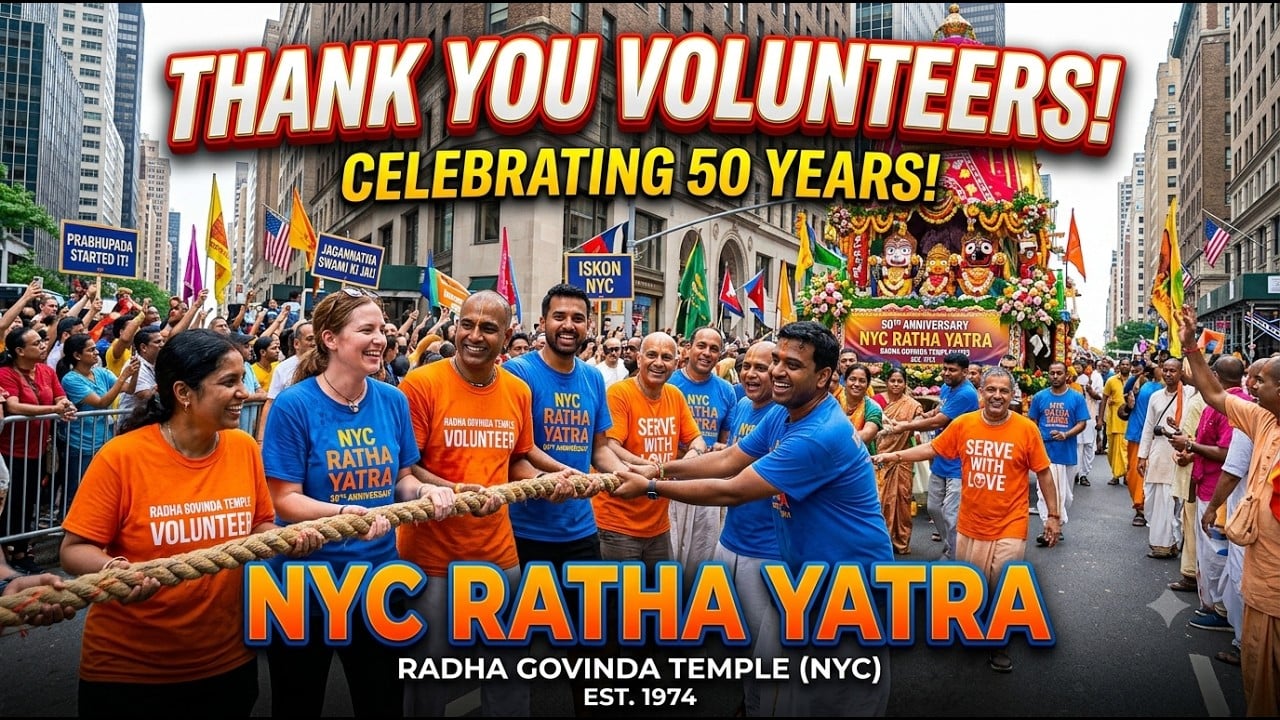
The 2026 NYC Ratha Yatra Volunteer Appreciation, shared through ISKCON NYC TV, is more than a simple acknowledgement of logistical help. It represents a public moment of gratitude toward the many hands that make a major dharmic festival visible, orderly, hospitable, and spiritually meaningful in a dense urban setting. In the language of the Vaishnava tradition, this labor is best understood as seva: service offered with devotion, discipline, humility, and care for the wider community.
Ratha Yatra, often translated as the Chariot Festival or Festival of Chariots, centers on the public procession of Lord Jagannath, Lord Balabhadra, and Devi Subhadra. Its most famous form is associated with Puri in Odisha, where the deities are ceremonially drawn in large chariots during the bright half of the lunar month of Ashadha. Public references on Ratha Yatra and the Festival of Chariots note both its religious meaning and its modern global expression through ISKCON communities. The Puri Ratha Yatra date for 2026 is listed as July 16, 2026, while diaspora celebrations may be scheduled according to local temple calendars, civic permissions, and community capacity.
The New York celebration carries a special historical resonance because ISKCON itself was founded in New York in 1966 by A. C. Bhaktivedanta Swami Prabhupada. A Ratha Yatra in New York is therefore not merely an Indian festival transplanted into another city; it is also part of the living history of Krishna consciousness in the West. The presence of chariots, kirtan, prasadam, sacred images, devotional music, and public participation transforms the city street into a temporary sacred corridor where spiritual memory and civic life meet.
Volunteer appreciation is important because the visible procession is only the final layer of a much larger system. Before a chariot rolls, volunteers coordinate schedules, communicate with city agencies, organize supplies, prepare offerings, support stage programs, manage crowd flow, assist guests, distribute prasadam, clean public spaces, transport equipment, decorate vehicles, care for senior devotees, and welcome newcomers. The festival may appear spontaneous to a first-time visitor, but its smoothness depends on months of planning and many hours of quiet labor.
In a technical sense, a large Ratha Yatra resembles a complex civic-religious operation. Route management, public safety, accessibility, food hygiene, sound systems, volunteer deployment, emergency communication, waste handling, weather contingency planning, and post-event restoration all require careful coordination. The dharmic principle of seva does not remove the need for professional discipline; rather, it gives that discipline a moral and spiritual purpose. Good organization becomes a form of devotion when it protects people, preserves dignity, and allows participants to focus on darshan, kirtan, reflection, and community.
The volunteer is therefore not peripheral to Ratha Yatra. In many ways, the volunteer is one of the festival’s primary carriers of meaning. A person guiding pedestrians, offering water, arranging chairs, sweeping after the crowd, or calmly answering questions participates in the same devotional ecosystem as the musicians, priests, speakers, and chariot pullers. The public may remember the chariot first, but the experience is shaped by the tenderness and competence of those who serve without seeking attention.
This is why appreciation matters. Gratitude is not ornamental in dharmic life; it is a social ethic. When volunteers are seen and thanked, the community affirms that sacred work is not limited to ritual specialists or visible leaders. The person setting up barricades, the student folding programs, the family cooking, the elder advising younger teams, and the devotee arriving early to decorate the altar all become part of a shared offering. Recognition strengthens continuity because it teaches the next generation that responsibility is honorable.
The emotional force of such appreciation comes from a familiar human experience: service often becomes meaningful only after fatigue has been endured. Volunteers may stand for long hours, adjust to weather, answer repeated questions, miss parts of the program, or continue working after the crowd has gone home. Yet many describe these acts not as burdens but as privileges, because the service connects them to Lord Jagannath, to the Vaishnava sampradaya, and to the broader Hindu tradition of public devotion.
Ratha Yatra also offers a model of dharmic unity. Although rooted in the Jagannath and Vaishnava traditions, its public form invites participation across linguistic, regional, and cultural lines. Devotees from different Hindu communities, admirers of Indian culture, interfaith neighbors, and curious passersby can all encounter the festival through music, movement, prasadam, and hospitality. This inclusive character is especially significant for a blog committed to harmony among Hinduism, Buddhism, Jainism, and Sikhism, because it highlights a shared civilizational ethic: sacred life is expressed through service, compassion, discipline, and community care.
The chariot itself is a powerful symbol. In the Ratha Yatra tradition, the deities come out from the temple and move among the people. This public movement communicates accessibility: divinity is not confined only to a sanctum but enters the social world. For volunteers, this symbolism becomes practical. They help create the conditions in which sacred presence can be encountered safely and respectfully by thousands of people, including those who may know little about Jagannath, Krishna consciousness, or Hindu festivals.
The New York setting intensifies this meaning. A metropolis is often defined by speed, anonymity, and fragmentation. A Ratha Yatra interrupts that rhythm with collective singing, shared food, visible devotion, and non-commercial hospitality. Volunteers become cultural translators in this environment. Their conduct explains the festival as much as any formal speech. A calm smile, patient guidance, clean serving area, respectful answer, and well-managed procession all communicate that dharma is not abstraction alone; it is lived conduct.
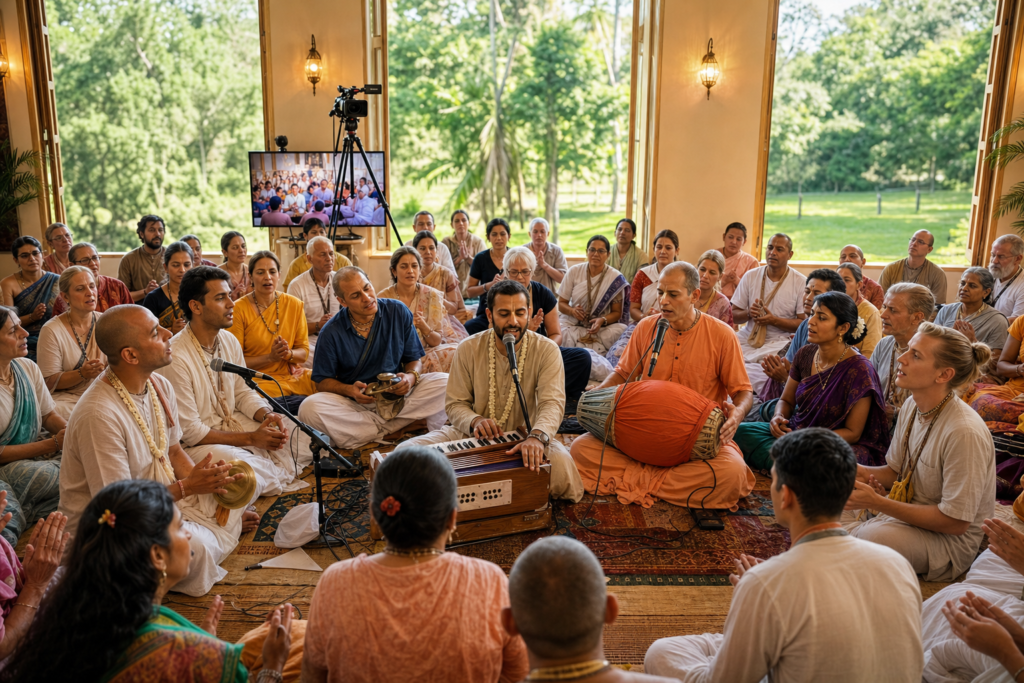
ISKCON’s global Festival of Chariots tradition has made kirtan, prasadam distribution, and public devotional celebration recognizable in many major cities. Yet each local festival depends on its own community infrastructure. The 2026 NYC Ratha Yatra Volunteer Appreciation can therefore be read as a record of local commitment. It preserves the memory of people who translated inherited tradition into practical action within a contemporary American civic space.
From a cultural heritage perspective, such volunteer networks are essential to preservation. Festivals survive not simply because texts describe them, but because communities repeat them with care. Chariots must be built or maintained, songs must be learned, kitchens must function, children must be included, newcomers must be welcomed, and public authorities must be engaged. Heritage becomes durable when it is embodied in recurring, disciplined, joyful action.
There is also an educational dimension. A well-run Ratha Yatra teaches without coercion. It introduces observers to Lord Jagannath, the meaning of yatra, the practice of kirtan, the value of vegetarian prasadam, the role of sacred sound, and the importance of community service. The volunteer’s task is therefore pedagogical as well as practical. Every interaction can either clarify or confuse the tradition. This makes training, courtesy, and cultural literacy significant components of seva.
The appreciation of volunteers also reminds communities to avoid a narrow understanding of spirituality. In many dharmic traditions, inner devotion and outer conduct are not separate. Bhakti is expressed through chanting and worship, but also through sweeping, cooking, organizing, protecting, and serving. Karma Yoga, seva, and bhakti converge when action is performed with selflessness and dedication to a higher purpose. The Ratha Yatra volunteer stands at this intersection.
For younger participants, the event can become a formative experience in leadership. A festival teaches planning, punctuality, teamwork, communication, conflict resolution, and resilience. It also teaches humility, because much of the work must be done without applause. The strongest volunteer cultures are those that combine spiritual intention with practical competence, allowing youth to inherit not only identity but responsibility.
For elders, volunteer appreciation carries another meaning: continuity. Many senior devotees and community members have spent years building institutions, teaching practices, hosting programs, and maintaining relationships. Public gratitude acknowledges that the 2026 event rests on earlier sacrifices. No annual festival exists in isolation. It is the visible fruit of accumulated faith, memory, training, and persistence.
The appreciation also has a healing social function. Modern communities can easily become transactional, with people noticed only when something goes wrong. A culture of gratitude reverses this tendency. It recognizes effort before exhaustion becomes invisible. It builds trust across teams and reduces the risk of burnout. In the long term, sincere appreciation is not merely polite; it is a form of community sustainability.
In the context of Hindu diaspora life, the 2026 NYC Ratha Yatra also demonstrates how tradition adapts without losing its center. The festival remains anchored in Lord Jagannath, Lord Balabhadra, Devi Subhadra, kirtan, prasadam, and devotional service, while operating within the regulatory and cultural realities of New York City. This combination of fidelity and adaptation is one reason dharmic traditions have endured across centuries and continents.
The most compelling lesson of the volunteer appreciation is therefore simple but profound: a sacred festival is sustained by ordinary people doing necessary work with extraordinary intention. The chariot may draw the eye, the kirtan may carry the heart, and the prasadam may nourish the body, but the volunteers hold the structure together. Their seva turns aspiration into event, devotion into hospitality, and inherited culture into a shared public experience.
The 2026 NYC Ratha Yatra Volunteer Appreciation deserves attention because it honors this hidden architecture of devotion. It reminds the community that Lord Jagannath’s journey through the city is also a journey through many acts of service. Each volunteer, whether visible or unseen, contributes to a collective offering that strengthens Krishna consciousness, Hindu cultural heritage, and the broader dharmic commitment to unity, gratitude, and compassionate public life.
Inspired by this post on Dandavats.


Leave a Reply
You must be logged in to post a comment.