
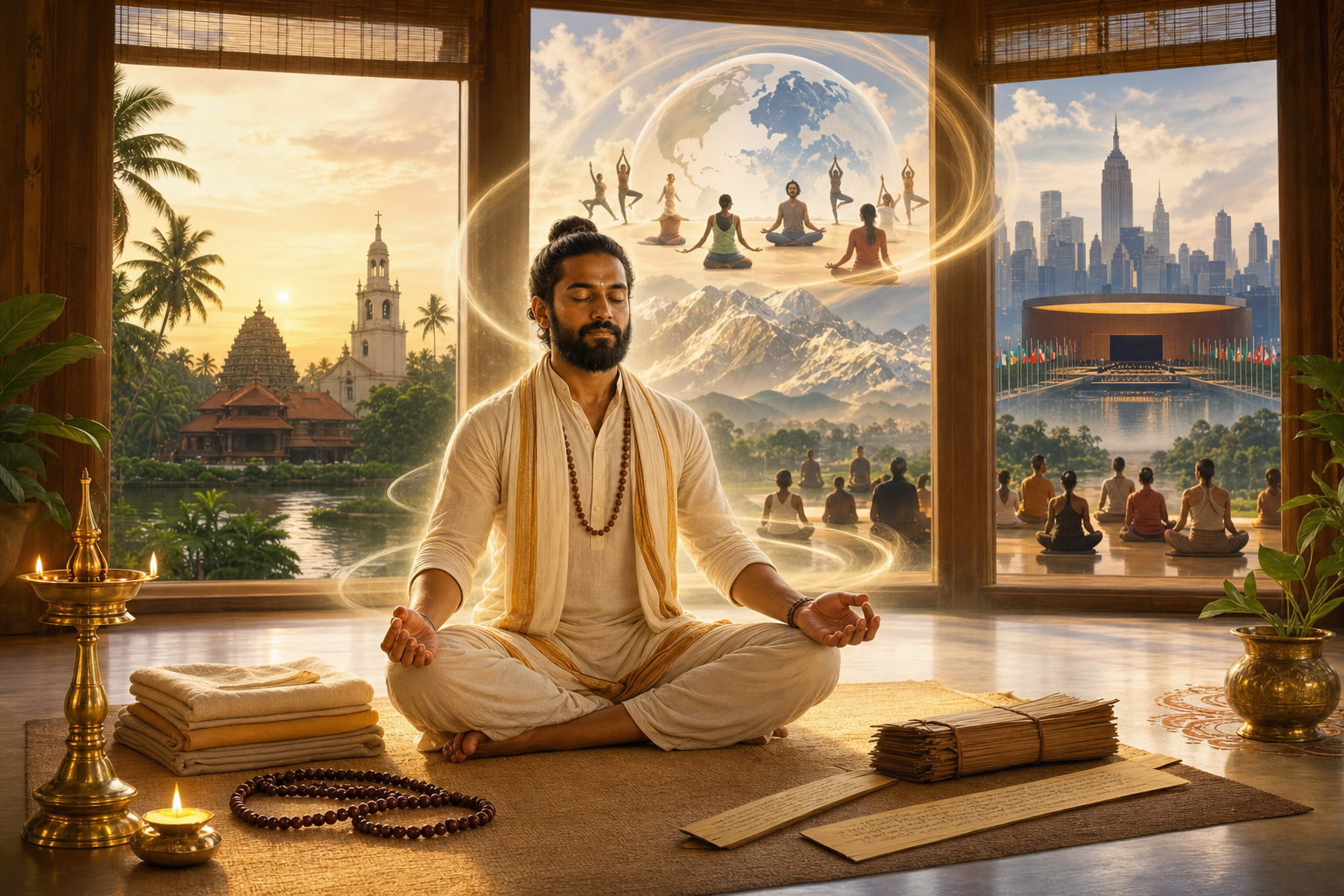
International Yoga Day is now familiar as a global observance, yet its public visibility can obscure the quieter human stories that helped carry yoga from intimate practice halls to international institutions. The life of Dileep Kumar Thangappan, widely known as Yogi Dileep or Guruji, offers one such story. His journey moves from Kerala’s layered religious and cultural landscape to New York, the Himalayas, interfaith spaces, and the United Nations, while remaining grounded in a simple proposition: yoga is not spectacle, branding, or performance, but disciplined integration of body, mind, breath, conduct, and consciousness.
This account, based on the Indica Today conversation published on June 21, 2026, is significant because it places International Yoga Day within a lived civilizational continuum rather than treating it as a diplomatic event alone. The United Nations General Assembly adopted Resolution A/RES/69/131 on December 11, 2014, proclaiming June 21 as the International Day of Yoga. The first observance followed on June 21, 2015. That institutional milestone is historically important, but it becomes more meaningful when examined through lives that worked patiently before global recognition arrived.
Yogi Dileep’s biography begins in Kerala, a region where temples, churches, ancestral memory, maritime exchange, local healing systems, and plural forms of devotion have long interacted. His father came from a Christian background, while his mother belonged to a Hindu family. Their marriage crossed community boundaries and faced resistance, yet it became a formative example of commitment under pressure. This household did not train him in hostility toward religious difference. Instead, it exposed him early to the possibility that reverence can take more than one cultural form while still pointing toward shared ethical and spiritual concerns.
That early interfaith environment is central to understanding his later public philosophy. He grew up moving between church and temple without seeing the two spaces as mutually exclusive. Theologically, this does not mean that all traditions are identical in doctrine, ritual, or metaphysics. Academically, it suggests something more precise: his childhood normalized respectful encounter. That normalization later informed his emphasis on interfaith dialogue, religious coexistence, and the dharmic idea that truth can be approached through multiple disciplines, temperaments, and forms of worship.
Another formative element was community care. As the youngest child in a working household, he was often looked after by neighbours, friends, and extended social networks. Such upbringing creates a practical understanding of interdependence before it becomes philosophy. In yogic terms, this resembles a lived education in connection: the individual is shaped by household, locality, conduct, food, memory, discipline, and protection. Later language such as Vasudhaiva Kutumbakam gains credibility when it grows from experience rather than slogan.
One childhood incident gave his inner life a more painful depth. At about three and a half years old, he was caught in a fire after a rented building was reportedly set ablaze in a dispute connected to property and rent. Amid the panic, he was left behind until his sister returned and pulled him to safety. The event, as he later recalled, became a lasting psychological image. It raised questions about greed, cruelty, survival, and the human capacity to harm others for material advantage. These questions are not separate from yoga; they belong to the ethical field in which yoga becomes necessary.
Modern discussions often reduce yoga to asana, flexibility, or stress relief. Yogi Dileep’s life points toward a wider framework. Classical yoga is not merely a set of postures but a disciplined path involving yama, niyama, asana, pranayama, pratyahara, dharana, dhyana, and samadhi, as articulated in the Yoga Sutras of Patanjali. This eightfold structure links physical steadiness with breath regulation, sense discipline, concentration, meditation, and ethical refinement. A person carrying childhood trauma, questions about violence, and a deep search for meaning would naturally encounter yoga as a total method rather than a fitness category.
His parents were his earliest teachers in this broader sense. His mother reportedly suffered from a serious heart condition, and the family turned toward yoga, dietary discipline, homeopathic support, and restraint in food habits. She lived for many years after that intervention, and Dileepji was born after this transformation. In his family memory, yoga was not introduced as an exotic spiritual technique. It was embedded in daily life as care, healing, observation, breath, simplicity, and resilience.
This distinction matters technically. Traditional yoga functions through cumulative regulation. Asana improves steadiness and bodily awareness; pranayama influences breath rhythm and nervous system balance; dhyana trains attention; ethical disciplines reduce internal agitation caused by dishonesty, excess, violence, and attachment. Contemporary research often studies yoga through measurable outcomes such as stress reduction, cardiovascular markers, mobility, sleep, and mental well-being. Classical practice, however, also insists that health is inseparable from conduct and consciousness.
Dileepji’s later training was broad rather than sectarian. He engaged with magnetotherapy, nature-cure traditions, Vivekananda Kendra in Kanyakumari, Sivananda Ashram programmes, and teachers such as Dr. H.R. Nagendra. He also taught, served, travelled, and helped build institutions in practical ways. This range is important because it reflects a dharmic model of learning: the guru principle may be encountered in parents, saints, texts, places, discipline, service, and even hardship. It avoids the narrowness of personality cults while still preserving reverence for genuine teachers.
The account also places three spiritual figures at the threshold of his birth. According to the conversation, when his mother was pregnant and the family faced financial strain, Sathya Sai Baba, Guru Nithyanidhi, and Prabhaakara Siddha Yogi independently conveyed that the child should be allowed to live. The remembered instruction from Sathya Sai Baba was: “Do not kill this child. He will become a yogi.” Such testimony belongs to the domain of personal spiritual memory, but its biographical importance is clear. Dileepji understood his life as protected by grace before it became defined by public work.
His association with Swami Bua adds another important dimension. Swami Bua was remembered as an extraordinary hatha yogi linked to the broader Sivananda milieu and known for remarkable longevity, discipline, travel, and teaching. Dileepji first encountered him in childhood in Tripunithura and later met him again in the United States. In 2008, Swami Bua gave him formal sanyasa initiation in New York. This event connected Dileepji’s global work with a traditional renunciatory current, while also showing how Indian yoga lineages adapted to transnational settings.
The early public work was not glamorous. In the late 1980s and early 1990s, yoga did not always enjoy the broad social acceptance it has today. Dileepji reportedly pasted handwritten notices in Tripunithura to announce classes, only to see them torn down. This detail is historically valuable because it shows that the global celebration of yoga was preceded by local suspicion, slow trust-building, and repeated grassroots effort. Cultural diplomacy at the United Nations became possible partly because many teachers first created credibility in small rooms with ordinary students.
His teaching strategy was pragmatic. Rather than beginning with metaphysics, he emphasized health benefits and experiential practice. People were invited to practise first, notice the effect, and then ask deeper questions. This approach is pedagogically sound. Embodied traditions are often best understood through disciplined participation. Breath awareness, postural steadiness, relaxation, and concentration can make abstract ideas tangible. Once a practitioner experiences calmness, improved attention, or physical ease, philosophical inquiry becomes less forced.
The United Nations phase of the story emerged after years of such work. While teaching in New York, Dileepji began to imagine yoga receiving formal global recognition through the UN system. He reached out to supporters and public figures, including D.R. Karthikeyan and Dr. H.R. Nagendra. The idea later found decisive political expression when Prime Minister Narendra Modi proposed an International Day of Yoga during his first address to the UN General Assembly in September 2014. The resolution that followed received unusually wide support, with 177 member states co-sponsoring it, and was adopted without a vote.
June 21 was symbolically appropriate because it coincides with the summer solstice in the Northern Hemisphere, a day associated with light, transition, and cosmic rhythm in many cultures. In the Indian civilizational imagination, this seasonal marker also resonates with cycles of sadhana, knowledge transmission, and the movement toward Guru Purnima. Thus, the date allowed a universal calendar observance to carry deeper Indic meaning without making participation exclusive to any single community.
International Yoga Day should therefore be understood as both soft power and civilizational offering. It is soft power because it enhances India’s global cultural presence through a non-coercive practice associated with health, balance, and inner development. It is a civilizational offering because yoga comes from ancient Indian knowledge systems while being adaptable across nations, languages, and religious backgrounds. Its strength lies precisely in this combination of rootedness and openness.
Dileepji’s work in the West reflects this adaptable quality. He conducted yoga sessions in gyms, churches, cathedrals, public institutions, and interfaith environments. The point was not to erase religious identity or flatten doctrine, but to create a shared field of disciplined breathing, bodily awareness, and ethical reflection. In such spaces, yoga becomes a practical bridge: participants do not need to abandon their inherited traditions in order to experience stillness, restraint, gratitude, and inner clarity.
This bridge-building is especially relevant to dharmic unity. Hinduism, Buddhism, Jainism, and Sikhism differ in theology, textual authority, ritual culture, and metaphysical emphasis, yet they share deep concerns with self-discipline, compassion, non-harm, meditation, service, liberation from egoic bondage, and refinement of consciousness. Yoga, when presented with intellectual honesty, can become a meeting ground for these traditions. It can honour Hindu roots while also recognizing related streams of meditation, tapas, seva, ahimsa, and inner transformation across the dharmic family.
At the same time, academic clarity requires avoiding careless universalism. Not every tradition says the same thing in the same way. Sanatana Dharma, Buddhist anatta, Jain ahimsa, Sikh seva, Vedantic atman, and yogic samadhi each have distinct conceptual contexts. Unity does not require sameness. A mature dharmic approach allows dialogue without erasure, reverence without appropriation, and shared practice without intellectual laziness. Dileepji’s emphasis on universal spirituality is strongest when read through this disciplined pluralism.
His criticism of rigid monopoly over truth should also be understood in that spirit. When any institution claims exclusive possession of the sacred, interfaith life often becomes competitive and defensive. By contrast, dharmic traditions have historically allowed multiple paths according to temperament, qualification, lineage, and stage of life. This does not mean all claims are equally rigorous, but it does create space for humility. In yoga, humility is not merely social politeness; it is a technical requirement for learning.
The setting of Yogabhavan in Kochi captures the essence of this life. It is described not as a place of pomp, but as a lived space where hospitality, practice, conversation, and instruction flow together. The image of a sunlit hall used for yoga classes is more than decorative. It represents a central principle: yoga survives when it is practised daily, taught patiently, and embodied in ordinary conduct. Grand platforms may amplify the message, but they cannot replace the discipline of the mat, the breath, the teacher, and the community.
There is also a social lesson in his simplicity. Modern wellness culture often turns spiritual practices into lifestyle products. Clothing, retreats, photography, and branding can overshadow tapas, study, ethics, and service. Dileepji’s example suggests another model: influence built through perseverance rather than display. The teacher’s credibility comes from consistency, not spectacle. The practitioner’s progress comes from steadiness, not public performance.
The technical content of yoga supports this restrained model. Pranayama, for example, is not simply deep breathing. It involves attention to rhythm, retention, subtle energy, and the relationship between breath and mind. Asana is not merely physical pose-making; it is the cultivation of steadiness and comfort. Dhyana is not casual relaxation; it is refined continuity of attention. When these limbs are separated from ethics, diet, sleep, speech, and social conduct, yoga loses coherence. Dileepji’s teaching returns the practice to wholeness.
His environmental message follows naturally from this wholeness. To protect the body while exploiting nature is contradictory. To seek inner peace while ignoring social fragmentation is incomplete. Yoga, in its wider dharmic sense, trains perception until the practitioner recognizes interdependence. The earth is not a resource warehouse alone; it is the field in which life, duty, and consciousness unfold. This is why ecological responsibility, simple living, and respect for community belong within any serious discussion of yoga philosophy.
International Yoga Day has now become a recurring global event, but its future value depends on depth. Mass participation is useful when it introduces people to practice. Diplomatic recognition is useful when it protects civilizational memory from neglect. Public health framing is useful when it encourages regular discipline. Yet the deeper promise of yoga lies beyond annual observance. It asks whether individuals and societies can become less restless, less violent, less fragmented, and more capable of truthful living.
Yogi Dileep’s journey from Kerala to the United Nations is therefore not only the story of one teacher. It is a case study in how civilizational knowledge travels: through family resilience, community care, teachers, trauma, service, migration, public institutions, and quiet conviction. His life shows that yoga’s global rise did not occur only through policy or publicity. It grew through people who taught before recognition, served before applause, and carried India’s spiritual heritage into spaces where it could be experienced rather than merely explained.
The central lesson is clear. Yoga remains most powerful when it is rooted in Sanatana Dharma yet offered with generosity; when it honours the guru-shishya tradition yet welcomes sincere seekers; when it speaks to science without surrendering spirituality; and when it builds bridges among Hindu, Buddhist, Jain, Sikh, and wider human communities without diluting truth. In that balance, International Yoga Day becomes more than a date on the United Nations calendar. It becomes a reminder that disciplined inner transformation can serve public harmony.
Inspired by this post on Hindu Post.




Leave a Reply
You must be logged in to post a comment.