
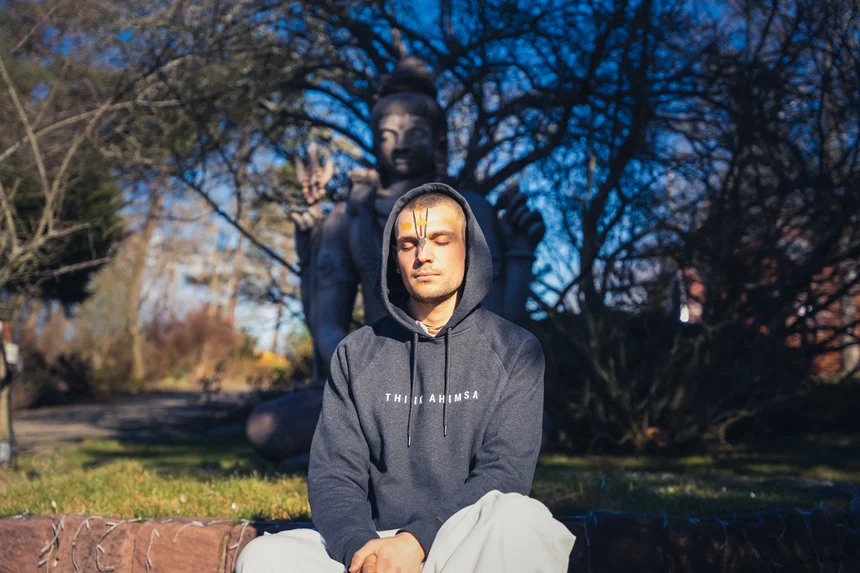
Mantra meditation as a disciplined path to inner peace
A daily mantra practice is one of the most accessible disciplines within Yoga, bhakti, and the wider family of Dharmic Traditions. At its simplest, a mantra is a sacred sound, phrase, or Divine Name repeated with attention, reverence, and steadiness. At a deeper level, mantra meditation is a method of training the mind, refining emotion, and orienting consciousness toward what is sacred. It does not require intellectual complexity to begin, yet its philosophical depth reaches into Sanskrit, Vedic wisdom, Yoga philosophy, bhakti, japa, and the lived devotional practices of Hinduism and other dharmic paths.
The word mantra is commonly explained through the Sanskrit roots associated with manas, meaning mind, and tra, meaning instrument, protection, or liberation. In this sense, a mantra may be understood as an instrument that protects and transforms the mind. This traditional explanation is not merely poetic. It points to the psychological and spiritual function of mantra: repeated sacred sound gradually interrupts scattered thinking, steadies attention, and gives the heart a dignified object of contemplation.
Modern life makes this practice especially relevant. Many people appear outwardly productive while inwardly carrying worry, fatigue, overstimulation, and emotional fragmentation. Phones, screens, deadlines, social comparison, and unprocessed grief can keep the mind in a state of restlessness. Mantra meditation offers a practical counter-discipline. It gives the wandering mind a sound to return to, the breath a rhythm to settle into, and the heart a sacred center around which life can become less reactive.
In academic terms, mantra meditation can be described as a contemplative repetition practice. In devotional terms, it is a prayer of the heart. In everyday language, it is a way of coming home to oneself. These perspectives are not opposed. The same practice may calm the nervous system, cultivate concentration, awaken devotion, and deepen spiritual identity. This is one reason mantra has remained a durable practice across centuries of Hindu spirituality, Yoga, Sikh Naam Simran, Buddhist mantra and recollection traditions, and Jain recitation practices such as the Namokar Mantra.
How mantra meditation works on the mind
The human mind is rarely still by command alone. It tends to move by association: one thought leads to another, a memory stirs a worry, a worry becomes a story, and the story reshapes the mood of the entire day. Mantra meditation does not fight this movement through force. It offers a stable, sacred pattern that gradually reorganizes attention. Each repetition becomes an invitation to return from distraction to presence.
This process reflects a key insight of Yoga philosophy: the mind becomes shaped by what it repeatedly holds. Patanjali’s Yoga Sutras describe yoga as the stilling of the fluctuations of the mind. Mantra is one practical means toward that stillness. When repeated with sincerity, the mantra gives the mind a single point. Over time, this one-pointedness reduces mental agitation and strengthens the capacity to remain centered even when external circumstances remain difficult.
From a practical psychological perspective, mantra repetition can reduce rumination by replacing uncontrolled mental loops with intentional sacred sound. This does not mean that mantra is a substitute for medical care, therapy, ethical responsibility, or social support. Rather, it functions as a spiritual and contemplative discipline that can support mental clarity, emotional balance, and peace of mind. The practice is gentle, but its cumulative effect can be profound.
For many practitioners, the first noticeable benefit is not mystical experience but a small reduction in inner noise. A few minutes of chanting may not remove every problem, yet it can change the inner posture from panic to steadiness. This matters. A calmer mind listens more carefully, speaks more responsibly, and reacts less impulsively. Inner peace is therefore not an escape from the world; it becomes a foundation for wiser participation in it.
The heart of mantra: sound, meaning, and devotion
In many Yogic and Hindu traditions, Sanskrit mantras are not treated as ordinary affirmations. They are understood as sacred sound-forms whose value lies not only in dictionary meaning but also in rhythm, lineage, intention, and devotion. A mantra may be translated, but its full significance is carried by practice. This is why traditional teachers often emphasize pronunciation, repetition, purity of intention, and respectful connection to the tradition from which a mantra arises.
At the same time, mantra meditation should not become narrow or sectarian. Dharmic traditions contain a remarkable diversity of sacred names, forms, methods, and philosophies. A Shaiva practitioner may turn naturally to om namah shivaya. A Vaishnava may feel drawn to om namo narayanaya, Hare Krishna, or Sri Ram Jai Ram Jai Jai Ram. A Shakta practitioner may revere mantras connected with the Divine Mother. Sikh practice emphasizes remembrance of the Divine Name. Buddhist and Jain traditions also preserve powerful sound and recitation disciplines. The unifying principle is not sameness but reverence: sacred sound becomes a vehicle for purification, humility, compassion, and liberation.
The devotional dimension is especially important. A mantra is not merely repeated to produce calm, though calm may arise. It is repeated to cultivate relationship with the Divine, with dharma, and with the deepest possibility within human life. When the mantra is approached as sacred, chanting becomes more than a stress-management technique. It becomes bhakti, remembrance, surrender, and disciplined love.
Why consistency matters more than intensity
A daily mantra practice grows through regularity. The mind is trained by repetition, just as the body is trained by repeated movement and the intellect by repeated study. Sporadic intensity may inspire a practitioner for a short time, but consistent practice builds depth. A person who chants for ten focused minutes every day often develops more stability than someone who chants for an hour once and then abandons the discipline.
Traditional teachers often compare spiritual practice to digging a well. If many shallow holes are dug in different places, water may never be reached. If one place is chosen and dug deeply, the source is eventually found. The same principle applies to mantra. Choosing one mantra and remaining faithful to it allows the sound to become familiar, intimate, and inwardly powerful. The mantra begins as something repeated; with time, it becomes a refuge.
This does not mean that learning about many mantras is wrong. Study has its place. Cultural literacy has its place. But practice requires commitment. A mantra chosen with sincerity should be given time to work upon the mind and heart. In daily life, this may mean chanting in the morning before beginning work, at night before sleep, during a walk, or quietly during moments of stress. The practice becomes strong when it becomes ordinary enough to be repeated and sacred enough to be respected.
Choosing a mantra with care
The best mantra is not necessarily the most famous mantra. It is the mantra that aligns with a practitioner’s spiritual aspiration, tradition, temperament, and capacity for steady repetition. Some choose a mantra given by a guru. Some choose a mantra connected with a beloved deity. Some begin with a widely known mantra that has been cherished across generations. In all cases, the choice should be respectful rather than casual.
om namo narayanaya is often presented as a powerful mantra for peace, surrender, and devotion. It is traditionally associated with Lord Narayana and may be translated in the spirit of reverence toward the Divine who pervades all things and contains all things. In Vaishnava traditions, it is honored as a maha-mantra and is connected with liberation, especially when received within a living lineage of practice. Its rhythm is simple enough for beginners, yet its theological depth is immense.
Other widely known Sanskrit mantras include om, the primordial sound often chanted at the beginning and end of meditation; om bhur bhubah suvah / tat savitur varenyam / bhargo devasya dhimahi / dhiyo yo nah pracodayat, the Gayatri mantra invoking divine illumination; hare rama, hare rama, rama rama, hare hare / hare krishna, hare krishna, krishna krishna, hare hare, a devotional maha-mantra centered on the Divine Names; om namo bhagavate vasudevaya, a mantra of surrender to Lord Krishna; and ugram viram maha-vishnum jvalantam sarvato mukham / nrisimham bhishanam bhadram mrityur mrityum namamy aham, traditionally associated with Lord Narasimha and protection.
Other cherished mantras include om hrim srim maha laksmiyai namah, dedicated to Goddess Lakshmi; Vitthala, a Divine Name connected with Lord Vishnu and the devotional culture of Maharashtra; Sri Ram Jai Ram Jai Jai Ram, a Rama mantra associated with righteousness and devotion; om namah shivaya, a Shaiva mantra of surrender to divine consciousness; Radhe Radhe, a loving invocation of Radha; and sri vitthala giridhari parabrahmane namaha, a devotional mantra composed of sacred Divine Names.
These examples should be approached with humility. A mantra is not a collectible item or a decorative phrase. It belongs to a living spiritual universe of meaning, practice, ethics, and reverence. Pronunciation, intention, and conduct all matter. The goal is not to use sacred sound as an ornament but to allow sacred sound to discipline the ego, refine the heart, and guide the mind toward dharma.
The story of Ramanujacharya and the generosity of sacred knowledge
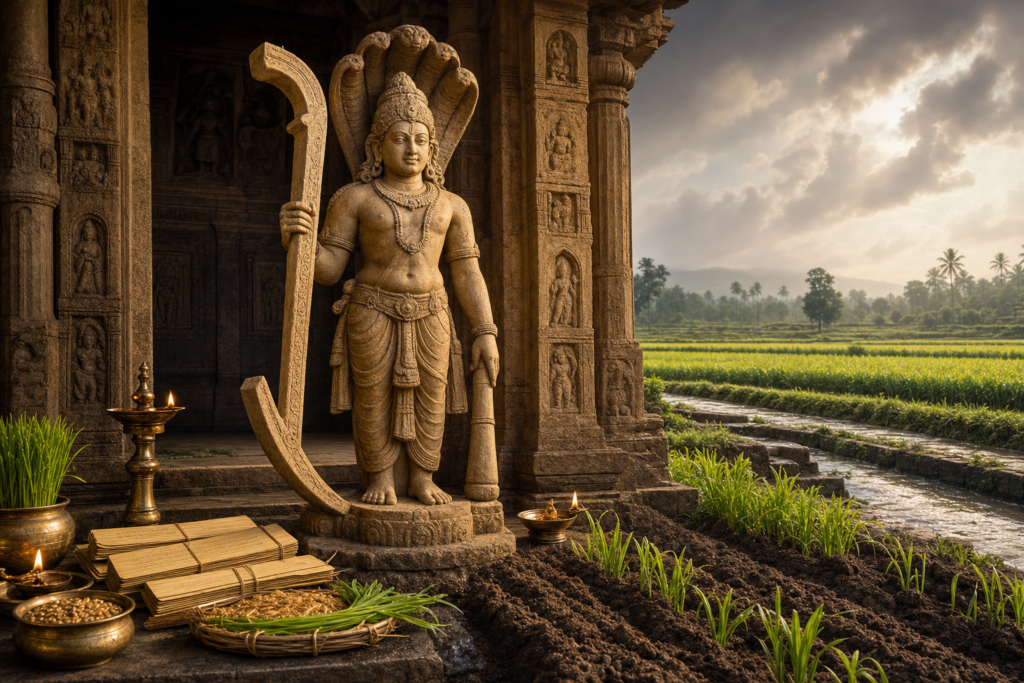
The history of om namo narayanaya is often linked with Ramanujacharya, the great Vaishnava philosopher and devotional teacher who lived from 1017 AD to 1137 AD. He is revered for his systematic exposition of Vishishtadvaita Vedanta and for emphasizing devotion, grace, and the accessibility of spiritual life. The traditional narrative of Ramanujacharya receiving and sharing the mantra illustrates a central dharmic tension: sacred knowledge requires reverence, yet compassion urges that liberating wisdom should benefit all sincere seekers.
According to the devotional account, Ramanujacharya approached his teacher Gosthipurna many times to receive initiation into a sacred mantra. After repeated refusals, his persistence and humility moved the teacher, who finally gave him the mantra with the instruction that it should not be disclosed casually. The mantra was considered so spiritually potent that it was to be guarded with seriousness.
Ramanujacharya then reflected on the suffering of ordinary people and the liberating promise of the mantra. In an act remembered for its radical compassion, he is said to have gathered people and openly shared om namo narayanaya. When challenged for disobeying the condition of secrecy, he reportedly accepted the possibility of personal consequence if even one soul could benefit. The ethical force of the story lies in this willingness to place the welfare of others above personal spiritual security.
Whether read as sacred history, theological memory, or moral teaching, the episode reveals an important principle: mantra practice is never only about private serenity. True inner peace expands into compassion. If chanting makes the mind calmer but the heart narrower, its purpose has not been fulfilled. A mature mantra practice should make a person more patient, more truthful, more humble, and more capable of recognizing the Divine presence in others.
How to begin a daily mantra meditation practice
The beginning should be simple. A practitioner may choose one mantra, select a clean and quiet space, and set a realistic daily period of practice. Five to fifteen minutes is enough for a sincere beginning. A fixed time helps the mind form an association: morning practice can establish clarity for the day, while evening practice can help release accumulated tension before sleep. The chosen place need not be elaborate. A corner with a seat, a small altar, a lamp, or a simple image of the Divine can create a sense of sacred continuity.
Posture should be steady but not strained. The spine may be kept upright, the shoulders relaxed, and the breath natural. The mantra can be repeated aloud, whispered, or silently. Each method has a legitimate place. Loud japa can be useful when the mind is restless or heavy. Whispered japa can help refine attention as the mind becomes calmer. Silent japa is subtle and powerful when concentration has developed, because the mantra is then heard inwardly without external sound.
Beginners should not be discouraged by distraction. Wandering attention is not failure; it is the condition that practice is meant to train. Each time the mind drifts and returns to the mantra, the discipline is strengthened. The return is the practice. Over time, the mantra may begin to accompany ordinary activities: walking, waiting, cooking, traveling, or sitting quietly after a difficult conversation. In this way, mantra meditation gradually moves from a scheduled practice into a continuous undercurrent of remembrance.
The role of japa mala and embodied attention
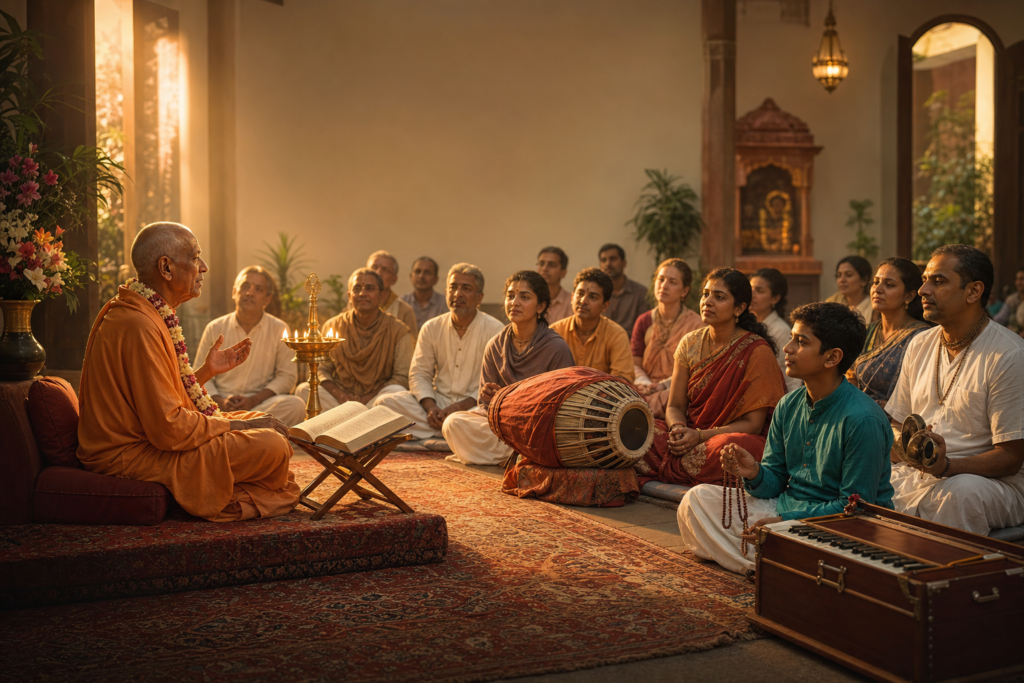
A japa mala, traditionally a string of beads used for counting repetitions, can support focus and discipline. The tactile movement from bead to bead gives the body a simple role in meditation. This matters because attention is not only mental; it is embodied. The fingers, breath, voice, ears, and heart can all participate in the practice. A mala also helps create a measurable structure without turning the practice into mere counting.
However, the mala is a tool, not the essence. The essence is attentive repetition with reverence. A practitioner without beads can chant sincerely. A practitioner with beads can still become mechanical. The quality of mantra meditation depends on awareness, devotion, and consistency. The tool should support the practice rather than replace the inner work.
Mantra, family, and community
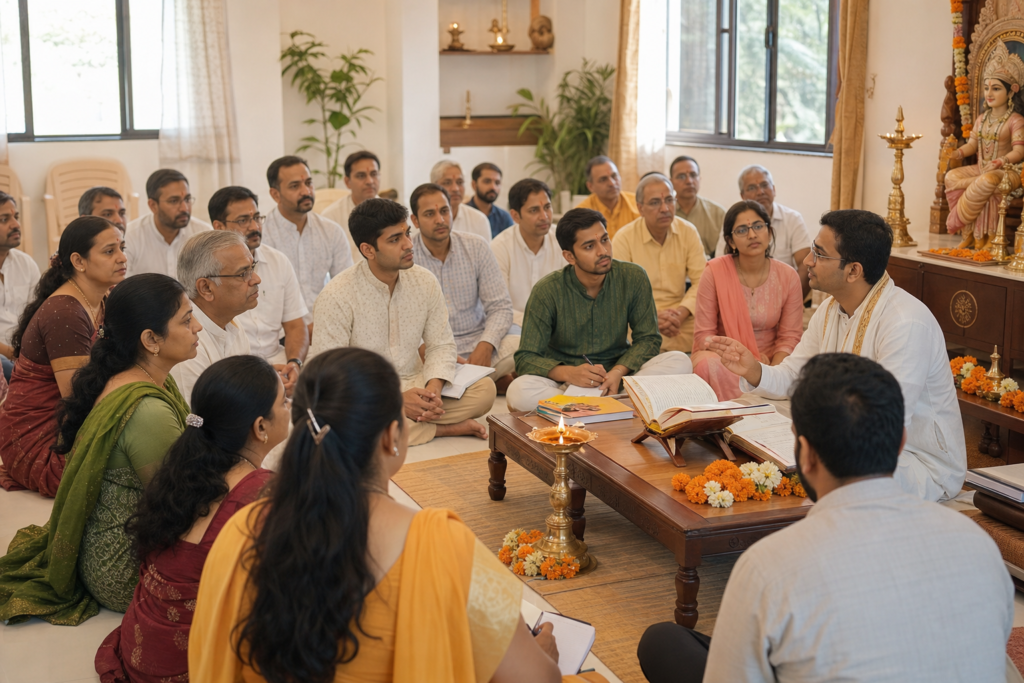
Although mantra meditation is often practiced individually, group chanting has an important place in many traditions. Collective recitation can create a shared field of attention and devotion. Families that chant together, even briefly, may discover a gentler rhythm in the home. Communities that gather for kirtan, nama-japa, or shared recitation often experience a sense of unity that does not require uniformity of personality, language, or background.
This is especially relevant for the unity of dharmic traditions. Hinduism, Buddhism, Jainism, and Sikhism preserve distinct metaphysical frameworks and practices, yet all recognize the moral and contemplative power of disciplined remembrance, sacred sound, ethical refinement, and inner transformation. A respectful approach to mantra can therefore become a bridge rather than a boundary. It can honor difference while recognizing a shared aspiration toward peace, wisdom, compassion, and liberation.
Common misunderstandings about mantra meditation
One common misunderstanding is that mantra meditation is merely positive thinking. Positive affirmations may have psychological value, but traditional mantra is not reducible to optimism. It is a sacred sound discipline rooted in lineage, metaphysics, and practice. Its purpose is not simply to make the ego feel better; it is to purify, steady, and elevate the mind.
Another misunderstanding is that one must already be calm to chant effectively. In reality, mantra is often most useful when the mind is unsettled. A restless mind may begin with loud chanting. A grieving heart may chant slowly. An anxious person may coordinate the mantra with the breath. The practice meets the practitioner where life actually is, not where life appears in idealized spiritual imagery.
A third misunderstanding is that mantra produces instant transformation. Some people do experience immediate peace, but the deeper fruits usually appear through time. The nervous system softens, speech becomes more measured, anger loses some of its force, and gratitude becomes more natural. These changes may be subtle, but they are significant. Spiritual growth often appears first as a change in how one responds to ordinary situations.
Inner peace as a dharmic responsibility
Inner peace should not be understood as private comfort alone. In dharmic thought, the state of the inner life influences conduct. A mind dominated by agitation easily contributes to conflict, harsh speech, and poor judgment. A mind trained by mantra is more capable of restraint, compassion, and clarity. This is why meditation benefits are not only personal but social. The person who becomes less reactive becomes easier to live with, work with, and trust.
Mantra meditation also helps restore the dignity of attention. In a culture that often treats attention as a commodity to be captured, sacred repetition returns attention to the practitioner as a moral and spiritual power. To decide what the mind will dwell upon is a serious act. Choosing a mantra is therefore a choice to let the mind be shaped by sacred sound rather than by fear, resentment, distraction, or endless consumption.
The mature aim of mantra practice is not withdrawal from responsibility but a steadier participation in life. Work still has to be done. Families still require care. Society still presents difficulty. Yet the practitioner who carries a mantra inwardly may move through these duties with more patience and less fragmentation. Peace becomes less dependent on perfect circumstances and more rooted in disciplined remembrance.
A practical daily framework
A balanced daily framework may begin with three commitments: choose one mantra, practice at the same time each day, and keep the duration realistic. The practitioner may sit quietly, take a few natural breaths, and begin repeating the mantra aloud or softly. When the mind wanders, attention returns gently to the sound. At the end, a moment of silence allows the effect of the practice to settle before ordinary activity resumes.
As steadiness develops, the duration may be increased. Some may move from five minutes to fifteen, from fifteen to thirty, or from thirty to a full mala of japa. Progress should be measured not only by time but by sincerity, ethical refinement, and continuity. A shorter practice performed with attention is spiritually healthier than a long practice performed with vanity or impatience.
It is also helpful to connect mantra with conduct. After chanting a mantra of peace, one may consciously speak more gently. After chanting a mantra of surrender, one may release the need to control every outcome. After chanting a mantra of devotion, one may serve others with less expectation. In this way, mantra becomes embodied dharma rather than isolated ritual.
The enduring power of daily mantra meditation
Daily mantra meditation remains powerful because it addresses a timeless human problem: the mind’s tendency to scatter, cling, fear, and forget its sacred center. The practice does not demand dramatic display. It asks for repetition, humility, and sincerity. A mantra may be spoken softly in a small room, whispered during a difficult day, sung in community, or remembered silently in the heart. In each form, it offers the same essential invitation: return to the Divine, return to steadiness, return to the deepest truth of being.
In a fragmented age, this simplicity is not a weakness. It is the strength of the practice. Mantra gives the mind a sacred refuge, the heart a devotional orientation, and daily life a rhythm of remembrance. When practiced with respect for tradition and openness toward the wider dharmic family, it becomes both personal discipline and cultural wisdom. It protects the mind, opens the heart, and helps transform inner peace from an occasional feeling into a cultivated way of living.
Inspired by this post on Bhakti marga blog.








Leave a Reply
You must be logged in to post a comment.