
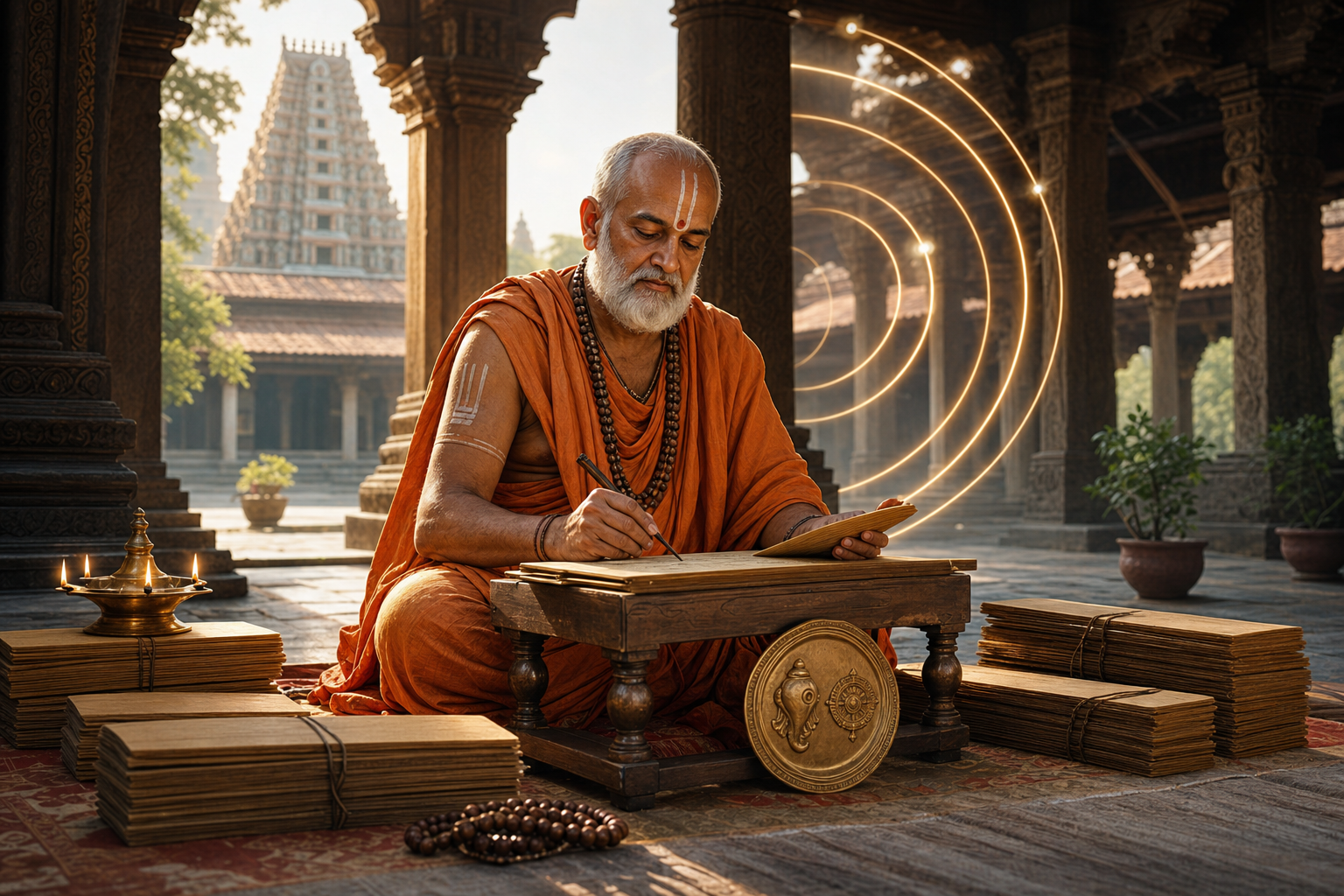
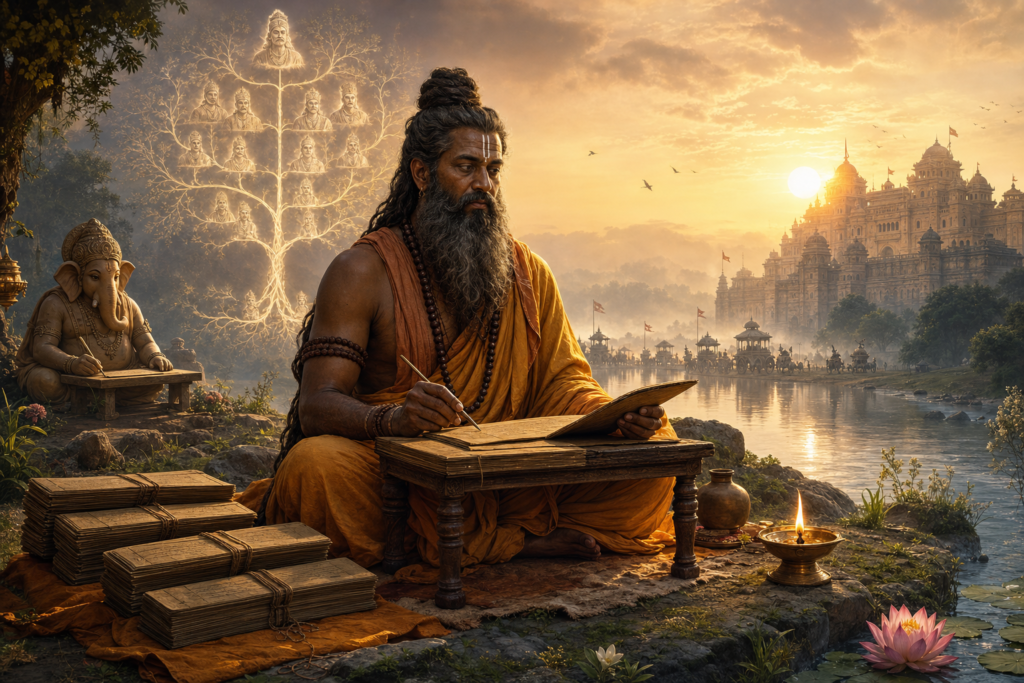
Vijayīndra Tīrtha, also written as Vijayendra Tīrtha, occupies a commanding place in the intellectual history of Dvaita Vedanta. Usually dated to c. 1517-c. 1614, he is remembered as a Hindu saint, philosopher, dialectician, Sanskrit scholar, and pontiff whose life bridged rigorous metaphysics, devotional discipline, institutional leadership, and public debate. In the Madhva tradition, he is not merely treated as one learned monk among many; he is remembered as a figure who helped preserve and strengthen the Dvaita school in South India at a time when Vedantic debate was intense, refined, and consequential.
The importance of Vijayendra Tirtha becomes clearer when his work is placed within the larger world of Indian philosophy. Dvaita Vedanta, systematized by Madhvacharya, teaches a realist and theistic vision of existence: Vishnu or Narayana is the independent supreme reality, while individual souls and the material world are real but dependent realities. This view differs from Advaita Vedanta, which emphasizes non-duality, and from Vishishtadvaita, which articulates qualified non-duality. Vijayendra Tirtha inherited this philosophical lineage and defended it through disciplined argument rather than mere sectarian assertion.
Traditional accounts identify his birth name as Vitthalacharya and associate him with a Kannada-speaking Madhva Brahmin background. Much of what is known about his early life comes through hagiographical literature, inscriptions, and later scholastic memory rather than modern biographical documentation. This does not diminish his historical importance; it simply requires a careful reading of the available material. His career belongs to a period when saints and scholars often left their deepest record not through autobiography but through manuscripts, debates, institutional lineages, disciples, and enduring ritual memory.
Vijayendra Tirtha is associated with the great Dvaita master Vyāsatīrtha, also known as Vyasaraja, whose intellectual influence shaped the development of Dvaita after Madhvacharya and Jayatirtha. Vyāsatīrtha’s works, especially in logic, polemics, and Vedantic reasoning, created a powerful platform for later scholars. Vijayendra Tirtha continued that legacy by commenting upon, extending, and defending the Dvaita position with a remarkable range of learning. His formation also reflects the older Indian model of scholarship, where philosophy, grammar, logic, ritual hermeneutics, poetics, drama, and devotional practice were not isolated compartments but interconnected disciplines.
One of the striking features of Vijayendra Tirtha’s reputation is his breadth. Tradition credits him with mastery over multiple fields and sometimes describes him through the honorific ideal of comprehensive learning. He is said to have engaged with Vedanta, Nyaya, Mimamsa, Kavya, Natya, and Alankara. This technical range matters because Dvaita Vedanta was never only a devotional assertion; it required exact argument about perception, inference, scripture, language, causality, difference, ritual obligation, and liberation. Vijayendra Tirtha’s intellectual life shows how deeply classical Indian philosophical traditions depended on shared methods of reasoning, even when their conclusions differed.
His move to Kumbakonam is especially significant. Kumbakonam, in present-day Tamil Nadu, was an important religious and scholastic center in South India. Under the influence of the Thanjavur Nayaks and the broader post-Vijayanagara cultural world, the region became a meeting ground for Sanskrit scholarship, temple-centered devotion, sectarian debate, and royal patronage. Vijayendra Tirtha’s association with the pontifical seat at Kumbakonam gave Dvaita Vedanta an institutional center in the Tamil region and helped extend Madhva thought beyond its earlier Karnataka heartland.
The title Sarvatantrasvatantra is often associated with him, indicating an extraordinary command over many systems of knowledge. Such titles should be read both devotionally and historically. They express reverence, but they also preserve a memory of the kind of scholarship expected from a major premodern acharya: he needed to understand his own school deeply, represent rival schools accurately, respond to objections, and speak in a language recognized by other intellectual communities. In that sense, Vijayendra Tirtha belonged to a culture where debate demanded both conviction and competence.
His philosophical identity is inseparable from Dvaita’s doctrine of real difference. Dvaita maintains distinctions between God, individual souls, and matter, and it famously emphasizes a fivefold difference: between God and soul, God and matter, soul and matter, one soul and another, and one material entity and another. For Vijayendra Tirtha, this was not an abstract formula. It formed the foundation for devotion, ethics, ritual practice, liberation, and human humility. If God is independent and the soul is dependent, then knowledge is not an act of self-glorification; it is a disciplined movement toward right understanding and right relationship with the divine.
The technical strength of Vijayendra Tirtha’s work lies in his ability to defend Dvaita through the tools of Indian logic and hermeneutics. Vedantic disagreement was not simply a dispute over preferred deity, temple custom, or devotional mood. It involved questions such as how scripture should be interpreted, whether difference is ultimately real, how error occurs, whether the world is ontologically valid, how liberation is possible, and what kind of relationship exists between the individual self and Brahman. Vijayendra Tirtha entered these debates with a disciplined command of inherited argumentation.
He is traditionally credited with as many as 104 works, though not all are extant and many remain difficult to access outside specialist circles. This large attributed corpus reflects both his productivity and the scholastic need of his period. A Dvaita master had to comment on foundational texts, summarize difficult arguments, defend earlier acharyas, clarify doctrinal points, respond to rival thinkers, and train successors. Even when individual works are lost, the memory of such a corpus indicates the scale of his intellectual authority within the Madhva sampradaya.
Among the works associated with him are texts such as Laghu Amoda, Tattvaprakasika Tippani, Nyayamauktikamala, Yuktiratnakara, Pramana Paddhati Vyakhyana, Chakra Mimamsa, Bhedavidyavilasa, Upasamhara Vijaya, and other treatises connected to Vedanta, Mimamsa, and polemical theology. These titles show that he did not write only for general devotional instruction. Much of his work was directed toward advanced students of Sanskrit philosophy who were expected to follow dense arguments about pramana, scriptural interpretation, metaphysical categories, and the limits of rival positions.
Laghu Amoda is remembered as a commentary connected with Vyāsatīrtha’s Nyayamruta, one of the most important Dvaita polemical works. The Nyayamruta had already played a major role in challenging Advaita interpretations and stimulated responses from Advaita scholars. Vijayendra Tirtha’s engagement with this intellectual inheritance shows his role as both commentator and defender. He did not treat tradition as static memory; he treated it as a living discipline requiring explanation, preservation, and renewed articulation.
His Tattvaprakasika Tippani is associated with the Dvaita exegetical tradition around Madhvacharya’s interpretation of the Brahma Sutras. In Vedanta, the Brahma Sutras are a central text, but every major school reads them through its own interpretive lens. For Dvaita, the task is to demonstrate that the Upanishads, Bhagavad Gita, and Brahma Sutras support a realist theism in which the supreme Lord, individual souls, and the world are not dissolved into an undifferentiated absolute. Vijayendra Tirtha’s scholastic work strengthened that interpretive framework.
His interest in Mimamsa is especially important. Mimamsa, with its sophisticated theory of ritual interpretation and scriptural authority, deeply shaped Indian intellectual life. By writing works that explored the compatibility of Dvaita with Mimamsa principles, Vijayendra Tirtha demonstrated that Dvaita Vedanta could engage not only with other Vedantic schools but also with the older disciplines of Vedic exegesis. This technical contribution helped show that devotion to Vishnu, scriptural realism, and ritual reasoning could be brought into a coherent philosophical structure.
Chakra Mimamsa, traditionally described as a defense of mudradharana from a Mimamsa perspective, illustrates how philosophy and lived religious practice intersected. In many Indian traditions, marks on the body, ritual disciplines, and sectarian symbols are not external decorations alone; they express theological identity and embodied commitment. A philosopher like Vijayendra Tirtha could therefore treat such practices as worthy of rigorous defense. The result is a form of scholarship in which ritual, body, scripture, and metaphysics are examined together.
Vijayendra Tirtha’s relationship with Appayya Dikshita is one of the most discussed aspects of his intellectual life. Appayya Dikshita was a major Advaita and Shaiva scholar of the sixteenth century, renowned for his own vast output and subtle learning. Traditional accounts describe Vijayendra Tirtha and Appayya Dikshita as major debate partners, sometimes rivals and sometimes treated with a degree of mutual respect. Their exchanges should be understood in the context of a sophisticated South Indian intellectual culture where disagreement could be sharp, technical, and public, yet still part of a shared Sanskritic world.
It is important to avoid reducing these debates to hostility between Hindu traditions. The broader dharmic landscape has always contained vigorous disagreement, but disagreement did not necessarily mean civilizational fracture. Advaita, Dvaita, Vishishtadvaita, Shaiva Siddhanta, Mimamsa, Nyaya, Jain, Buddhist, and Sikh traditions each developed distinctive vocabularies of truth, discipline, liberation, devotion, and ethics. Vijayendra Tirtha’s debates can be read as an example of intellectual seriousness within a plural sacred culture, not as an invitation to contempt.
This point is essential for contemporary readers. The modern mind often assumes that unity requires flattening difference. Classical Indian traditions suggest a more demanding possibility: unity can coexist with disciplined distinction. Vijayendra Tirtha defended Dvaita strongly because he believed its vision of reality was true. Yet his very participation in debate presupposed shared respect for learning, grammar, scripture, logic, and the authority of disciplined inquiry. A dharmic culture becomes stronger when it can hold both conviction and civility.
The devotional dimension of Vijayendra Tirtha’s life should not be overshadowed by his dialectical brilliance. In the Dvaita tradition, knowledge is not merely conceptual mastery. It is ordered toward bhakti, surrender, service, and liberation through the grace of the supreme Lord. The scholar is not meant to become intellectually arrogant; the scholar is meant to become clearer about dependence on the divine. This makes Vijayendra Tirtha’s legacy spiritually instructive: rigorous thinking and deep devotion are not enemies in Hindu philosophy.
His institutional role also deserves attention. As a pontiff, Vijayendra Tirtha was responsible not only for writing and debate but also for maintaining a living community. A matha is not simply a residence for monks; it is a center of teaching, worship, manuscript preservation, ritual continuity, public guidance, and transmission of lineage. His leadership in Kumbakonam helped preserve Dvaita Vedanta in a region where several powerful intellectual and devotional currents interacted. The survival of a tradition often depends as much on such institutions as on individual brilliance.
The historical setting of his life was one of transition. The Vijayanagara world had shaped much of South Indian religious and intellectual life, and its political transformations affected patterns of patronage and religious authority. Scholars and pontiffs moved through networks of courts, temples, mathas, and regional centers. Vijayendra Tirtha is remembered as receiving recognition and support from influential rulers and patrons, including figures connected with the Vijayanagara and Thanjavur Nayak worlds. Such patronage helped sustain Sanskrit scholarship, public debate, and religious institutions.
Royal patronage, however, should not be mistaken for mere political dependence. In premodern South India, kings and regional rulers often supported scholars, temples, and mathas because religious authority contributed to social order, cultural prestige, and sacred legitimacy. At the same time, scholars gained the material stability required for teaching, writing, travel, and manuscript preservation. Vijayendra Tirtha’s career reflects this reciprocal relationship between intellectual authority and public religious life.
His legacy continued through the line of successors associated with the Kumbakonam matha, including Sudhindra Tirtha, who later became the guru of the celebrated Raghavendra Tirtha. This lineage is historically important because Raghavendra Swamy became one of the most widely revered Madhva saints, with Mantralayam serving as a major devotional center. Vijayendra Tirtha therefore stands not only as a scholar of his own generation but also as a crucial link in a chain of transmission that shaped later Dvaita devotion and philosophy.
The manuscripts associated with Vijayendra Tirtha are said to have been preserved in traditional centers such as Nanjangud, Mantralayam, and Kumbakonam. This detail is significant for the history of Indian knowledge systems. Many classical works survived not because of centralized libraries alone but because mathas, families of scholars, temple networks, and manuscript custodians preserved fragile texts across generations. The partial survival of his corpus reminds modern readers that Indian intellectual history still depends on manuscript research, editing, translation, and responsible preservation.
From a technical philosophical standpoint, Vijayendra Tirtha’s importance can be described through three major contributions. First, he consolidated earlier Dvaita arguments by commenting on and extending the work of Madhvacharya, Jayatirtha, and Vyāsatīrtha. Second, he responded to powerful rival arguments, especially from Advaita and related traditions. Third, he showed that Dvaita could engage disciplines beyond Vedanta, including Mimamsa and literary theory. These contributions made the school more intellectually resilient.
His work also clarifies the relationship between philosophy and identity. In Dvaita, the individual soul never becomes identical with God. This does not make the soul insignificant. Rather, it gives the soul a meaningful place within a divinely ordered universe. The soul’s dignity lies in its real existence, its capacity for knowledge, its dependence on divine grace, and its potential for devotion. This theological anthropology can still speak to readers who seek a spiritual framework that honors both humility and personhood.
There is also a practical lesson in Vijayendra Tirtha’s life for students of dharma today. He represents the discipline of studying before speaking. His tradition valued debate, but debate required preparation. It required grammar, logic, scriptural memory, knowledge of opposing views, and personal discipline. In a contemporary world of instant opinion, his legacy quietly argues for a slower and more responsible model of intellectual life: understand deeply, speak carefully, and defend truth without abandoning dignity.
The emotional appeal of such a figure lies in the harmony between austerity and service. A saint-scholar like Vijayendra Tirtha did not write dense treatises for personal fame in the modern sense. His work served a lineage, a community, a deity, and a vision of liberation. For devotees, this transforms scholarship into seva. For historians, it reveals a social world in which intellectual labor was woven into worship. For modern readers, it offers a model of knowledge anchored in responsibility.
His example also helps correct a common misunderstanding about Hindu spirituality. Hindu traditions are sometimes presented as purely mystical, symbolic, or ritualistic, as though they lacked analytical rigor. Vijayendra Tirtha’s career shows the opposite. Dvaita Vedanta developed through careful arguments about epistemology, ontology, language, causality, and scriptural interpretation. The same civilization that produced temple worship, bhakti poetry, pilgrimage, and sacred art also produced technically demanding philosophical systems of extraordinary precision.
At the same time, his life encourages respect for other dharmic paths. A Jain thinker may approach reality through anekantavada, a Buddhist philosopher may analyze impermanence and non-self, a Sikh teacher may center devotion to the One and ethical living, and a Hindu Vedantin may defend a specific interpretation of Brahman, soul, and world. These differences are real and should not be erased. Yet the larger dharmic ethos can honor disciplined inquiry, liberation from ego, compassion, truthfulness, self-control, and reverence for the sacred. Vijayendra Tirtha’s firmness in Dvaita can therefore be presented as part of a broader culture of principled plurality.
His passing is traditionally placed around c. 1614, and his brindavana at Kumbakonam remains connected with his memory. In many Hindu traditions, the resting place of a saint is not treated as a mere monument. It is a site of remembrance, reverence, and continuing spiritual relationship. The body of the saint may be gone, but the teaching, lineage, and devotional presence remain active in the life of the community.
Vijayendra Tirtha’s enduring significance lies in this union of philosophy, devotion, and institutional continuity. He defended Dvaita Vedanta with intellectual force, but his deeper legacy is not reducible to winning debates. He helped transmit a way of seeing reality in which God is supreme, the soul is real, the world is meaningful, scripture is authoritative, and disciplined knowledge serves devotion. That combination continues to make him one of the most important figures in the Madhva tradition and a vital subject for anyone interested in Hindu philosophy, Sanskrit scholarship, and South Indian religious history.
For modern seekers and scholars, Vijayendra Tirtha offers a demanding but valuable lesson: spiritual inheritance survives when it is studied, practiced, defended, and transmitted with integrity. His life shows that Hindu philosophy is not a museum of abstract doctrines but a living tradition of inquiry and devotion. In that sense, his legacy remains relevant not only to Dvaita followers but to the wider dharmic world that continues to seek unity without losing philosophical depth.
Inspired by this post on Hindu Pad.


Leave a Reply
You must be logged in to post a comment.