
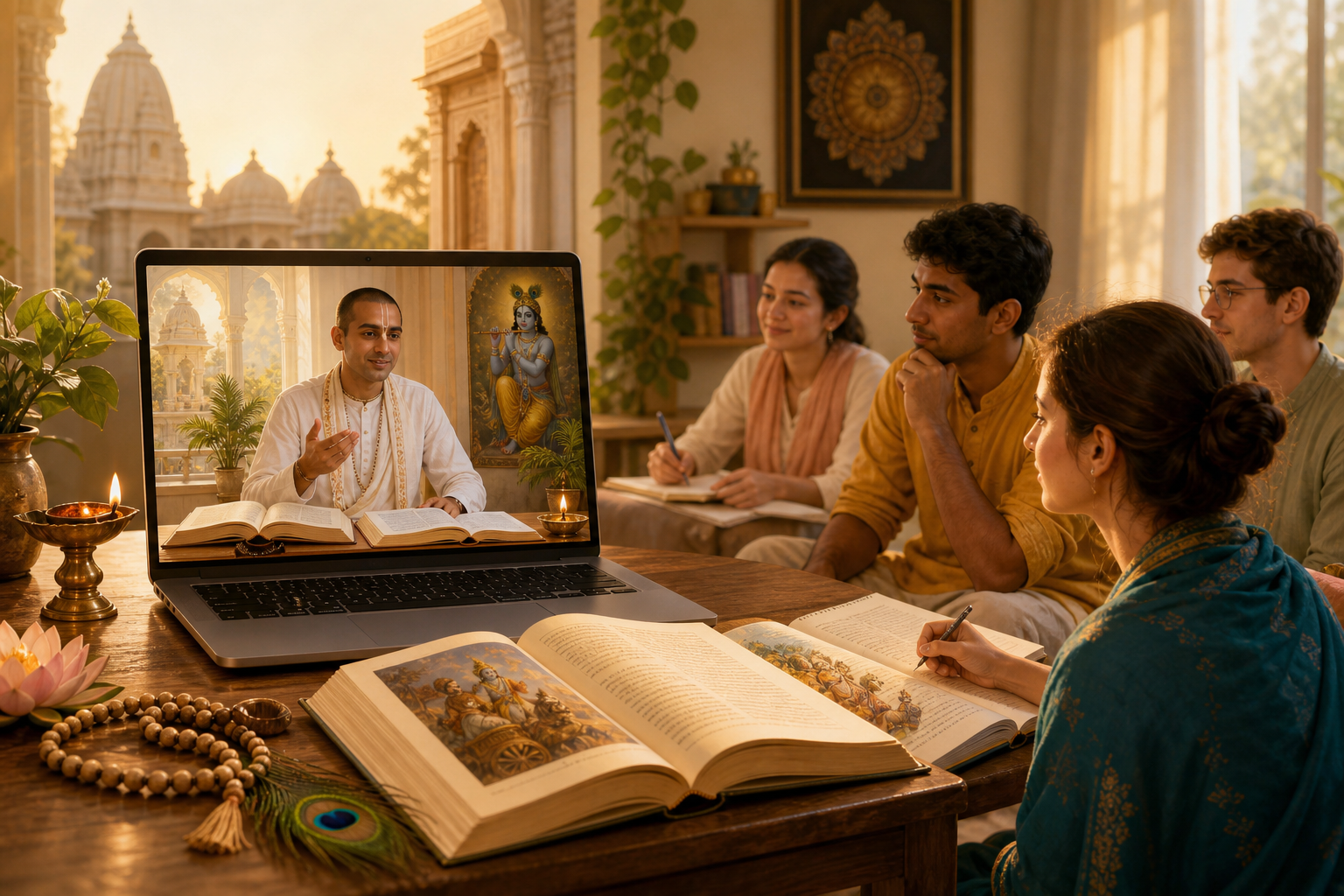
The announcement that “Bhurijana Dasa is live” may appear brief, yet it points toward a much wider spiritual and intellectual context: the living culture of scriptural study, satsang, and devotional reflection within the Vaishnava tradition. A live session by a respected spiritual teacher is not merely an online event; it becomes a temporary gathering place where seekers, students, householders, monks, and curious observers can pause ordinary routines and turn their attention toward Krishna, dharma, and the discipline of inner refinement.
Bhurijana Dasa is widely associated with the study and teaching culture of the Hare Krishna movement, also known as ISKCON, and with a mode of instruction that emphasizes careful engagement with sacred texts rather than superficial inspiration alone. Such teaching belongs to a larger tradition in which the Bhagavad Gita, Srimad Bhagavatham, and allied Vaishnava literature are not treated as relics of the past, but as living guides for ethics, consciousness, devotion, and human purpose.
The supplied source for this post contains only a live announcement and a video thumbnail, so no specific claims can responsibly be made about the exact lecture topic, transcript, date, or sequence of arguments in the session. What can be examined, however, is the significance of such a live devotional teaching in the broader landscape of Hindu spirituality, bhakti, and dharmic learning. That context is important because a short announcement often carries more cultural meaning than its few words suggest.
In the traditional Indian understanding of knowledge, sacred learning is not simply information transfer. It is a disciplined transformation of attention. The guru-shishya tradition places emphasis on listening, questioning, contemplation, repetition, and lived application. A live talk by a teacher such as Bhurijana Dasa therefore participates in an older rhythm of hearing and reflection, even when the medium is a modern digital platform rather than a temple hall, ashram classroom, or pilgrimage setting.
The technical term often used in bhakti traditions is shravana, or attentive hearing. In Vaishnava practice, shravana is not passive consumption. It asks the listener to bring humility, concentration, and moral seriousness to the act of hearing sacred subjects. A live stream can easily become another item in the endless flow of digital content, but when approached with discipline it can function as a genuine moment of satsang, association with truth-seeking people and sacred ideas.
This is especially relevant in an age of fragmented attention. Many people encounter religious and philosophical material through short clips, quotations, and algorithm-driven recommendations. Such access has value, yet it can also weaken patience for sustained study. The importance of teachers grounded in scripture is that they often restore proportion. They slow down the pace, return attention to source texts, and invite the listener to think in terms of practice, character, and responsibility rather than instant emotional stimulation.
Within the Vaishnava framework, bhakti is sometimes misunderstood as sentiment alone. A more accurate reading shows that bhakti joins emotion with discipline, devotion with philosophical clarity, and surrender with moral intelligence. The Bhagavad Gita presents devotion not as an escape from action, but as a reorientation of action. Work, speech, memory, desire, and relationships are gradually brought into alignment with a higher center. This is why live teachings on Krishna consciousness continue to attract practitioners who seek both spiritual warmth and intellectual structure.
Bhurijana Dasa’s name itself signals a devotional identity rooted in service. In many bhakti communities, the term “Dasa” expresses the principle that the self finds dignity not through domination, but through service to the Divine. This idea has deep philosophical implications. It challenges the modern assumption that freedom means limitless self-assertion. In the bhakti view, freedom matures when desire becomes purified, ego becomes softened, and the individual learns to act in harmony with dharma.
For many listeners, a live discourse is meaningful because it brings sacred study into the immediacy of daily life. A person may be sitting in an apartment, commuting, resting after work, or gathering with family, yet the sound of scriptural reflection creates a bridge to a larger civilizational memory. The emotional connection comes from this recognition: dharma is not distant. It can enter ordinary rooms, ordinary schedules, and ordinary struggles when attention is consciously offered.
Academic discussions of Hindu traditions often focus on texts, institutions, historical development, and ritual systems. Those are necessary categories, but they can miss the lived texture of devotion. In a live bhakti session, philosophical vocabulary is usually tied to experience: anxiety, pride, gratitude, discipline, family duty, spiritual practice, and the human need for meaning. This union of doctrine and life is one reason the Bhagavad Gita remains influential across generations and geographies.
The digital format also deserves attention. Live spiritual teaching through video platforms has expanded the reach of Hindu, Buddhist, Jain, and Sikh learning communities. It allows diaspora audiences to remain connected with teachers and traditions that might otherwise feel geographically distant. At the same time, it requires discernment. Digital access should not reduce sacred learning to entertainment; it should strengthen the listener’s commitment to study, humility, ethical conduct, and respect for all dharmic paths.
The goal of dharmic unity does not require erasing differences among Hinduism, Buddhism, Jainism, and Sikhism. Rather, it asks for a mature recognition that these traditions share a serious concern for self-discipline, liberation from ego, ethical living, compassion, and the refinement of consciousness. A Vaishnava live teaching can therefore be appreciated not only as a sectarian event, but also as part of a wider dharmic ecosystem that values inner transformation over material distraction.
In this sense, a Krishna-centered discourse can be placed alongside broader dharmic concerns: the training of the mind, the purification of intention, the dignity of service, and the relationship between knowledge and conduct. Buddhist mindfulness, Jain ahimsa, Sikh seva, and Hindu bhakti each articulate these concerns through distinct theological and philosophical languages. Responsible presentation of any one tradition should deepen respect for the others rather than create rivalry.
The best use of a live session is therefore not merely to watch it, but to receive it with method. A serious listener may note the scriptural references, identify the central argument, reflect on one practical application, and return later to the source text. This approach transforms an online moment into spiritual education. It also protects the listener from the common habit of collecting religious impressions without allowing them to reshape conduct.
For students of Hindu philosophy, such talks can serve as entry points into more systematic study. The Bhagavad Gita introduces categories such as atman, karma, yoga, guna, bhakti, jnana, and dharma. Srimad Bhagavatham develops a narrative and theological world in which devotion becomes the organizing principle of knowledge. Vaishnava teachers often work through these themes not as abstractions, but as frameworks for decision-making, emotional discipline, and spiritual aspiration.
The announcement also reminds readers that spiritual tradition remains alive through persons, voices, and communities. Books preserve teachings, but teachers help interpret them within changing circumstances. Temples preserve ritual continuity, but satsang creates shared attention. Digital platforms preserve access, but sincere practice preserves meaning. When these elements come together, a simple live event can become an important doorway into Sanatana Dharma and its devotional heritage.
There is also a quiet emotional value in seeing teachers and communities remain active. Many practitioners experience modern life as spiritually noisy: crowded with deadlines, opinions, conflicts, and distractions. A live devotional gathering can restore a sense of orientation. It can remind listeners that sacred learning is not a luxury reserved for retreat settings; it is a necessary discipline for living with steadiness, gratitude, and moral clarity.
From an educational standpoint, the strongest devotional teaching usually combines three elements: fidelity to scripture, clarity of explanation, and practical application. Fidelity prevents distortion. Clarity prevents confusion. Application prevents philosophy from remaining theoretical. When a teacher brings these together, the listener receives more than religious language; the listener receives a structure for self-examination.
The phrase “Bhurijana Dasa is live” should therefore be read as more than a notification. It is an invitation to return to hearing, study, and reflection. It is a reminder that the dharmic traditions have always relied on living transmission, whether through recitation, commentary, dialogue, kirtan, meditation, seva, or disciplined inquiry. The platform may be modern, but the underlying principle is ancient: truth becomes transformative when it is heard with sincerity and lived with care.
For readers seeking a meaningful response, the most constructive step is to approach such a session with respect, attention, and intellectual honesty. Rather than treating it as passing content, it can be used as a prompt for deeper engagement with bhakti yoga, Krishna consciousness, Hindu scriptures, and the broader unity of dharmic traditions. In that spirit, the live announcement becomes a small but powerful reminder that spiritual learning remains available wherever there is sincere hearing.
Inspired by this post on Dandavats.









Leave a Reply
You must be logged in to post a comment.