
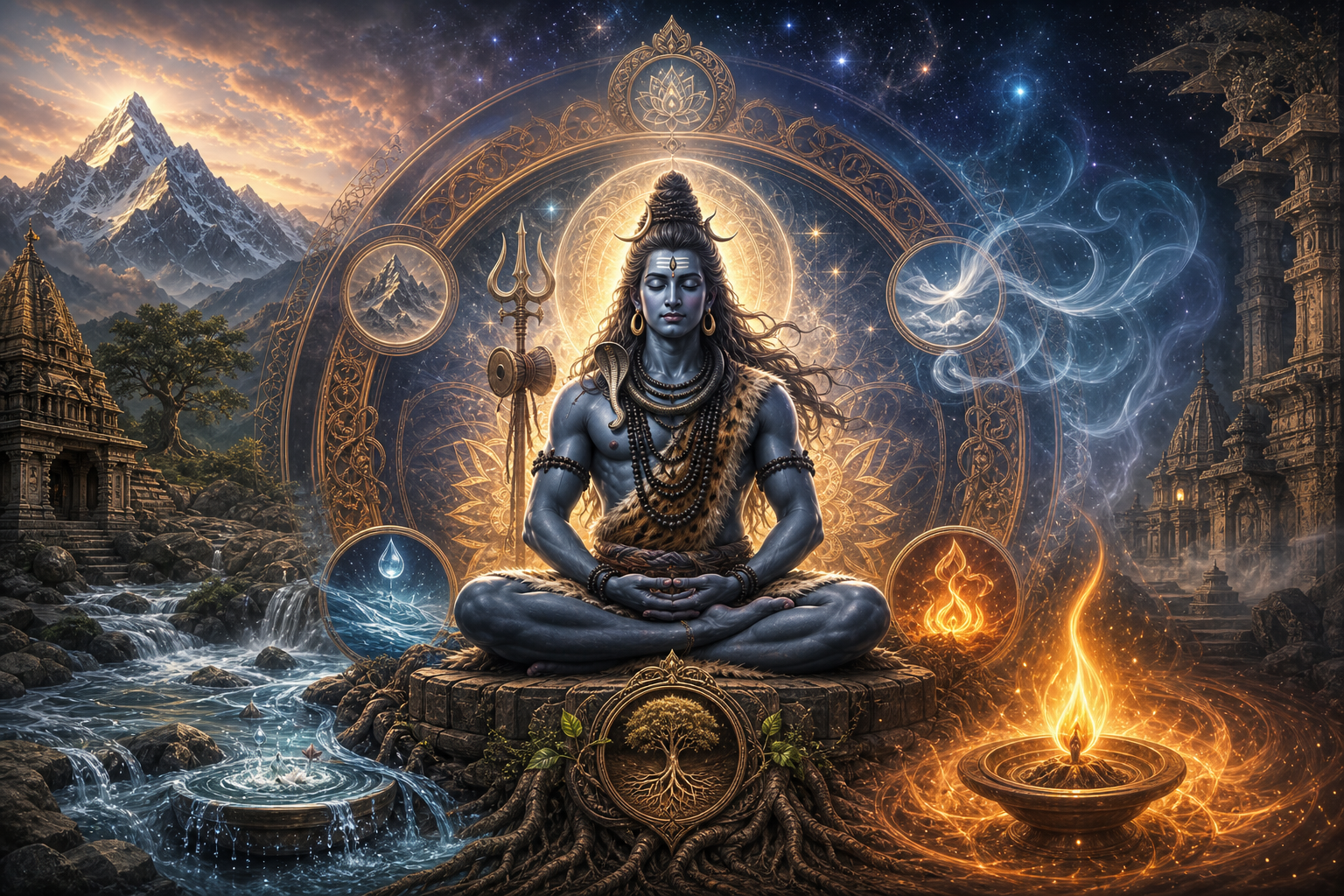
Bhootatmane Bhairava is a profound theological name from the 1008 Names of Bhairava, and it carries a dense philosophical meaning within the wider Shaiva understanding of reality. The term Bhootatmane may be understood as “the Atma or inner soul of all beings and elements.” In this interpretation, Bhairava is not approached only as a fierce manifestation of Shiva, but as the living consciousness that pervades, sustains, and illumines existence itself.
The word bhuta has several layers of meaning in Sanskrit thought. It can refer to beings, created entities, elemental realities, or that which has come into manifestation. Atman signifies the innermost Self, the animating principle, and the conscious essence underlying life. Bhootatmane Bhairava therefore points to Bhairava as the inner Self of all that exists, from the smallest organism to the vast cosmic order, from physical matter to subtle consciousness.
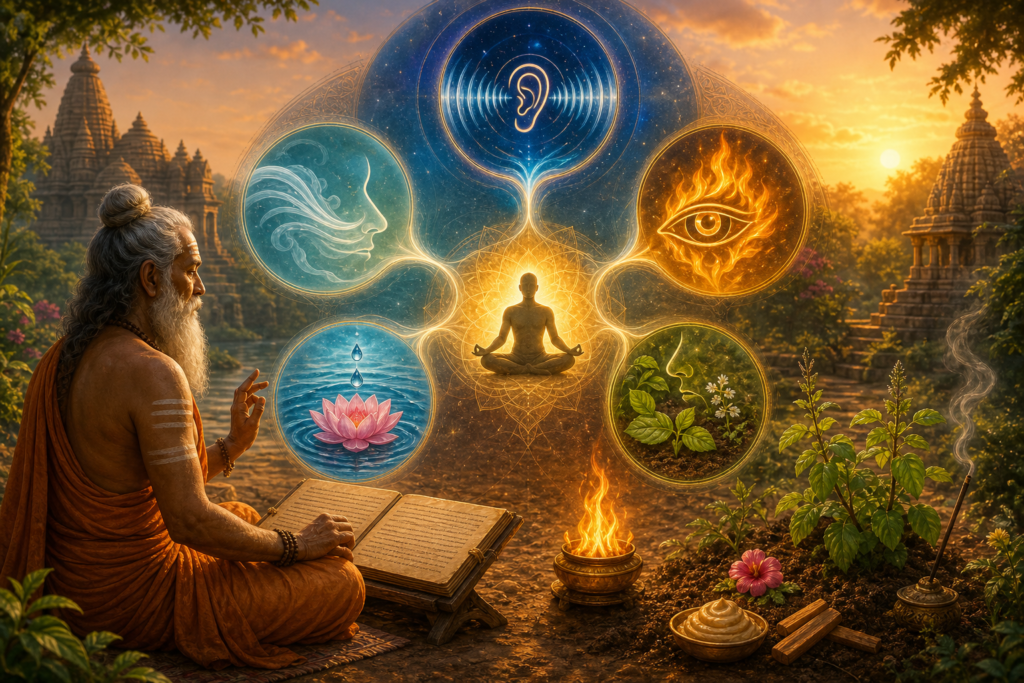
This name becomes especially meaningful when read through the framework of the Panchabhootas, the five great elements: earth, water, fire, air, and space. These elements are not merely physical substances in the modern chemical sense. In Hindu philosophy, Vedic wisdom, Yoga, Tantra, and Ayurveda, they represent the fundamental principles through which the universe becomes perceptible, embodied, and experienced. Bhootatmane Bhairava is the consciousness present within these principles.
Earth represents solidity, stability, structure, weight, endurance, and form. It is visible in mountains, soil, bones, temples, homes, and the patient rhythm of daily life. In a spiritual reading, the earth element reminds human beings that Dharma must be grounded. Faith that cannot become conduct, discipline, service, and responsibility remains incomplete. As Bhootatmane, Bhairava is the inner presence within this grounding force, the silent witness in all forms that appear firm and enduring.
Water represents flow, cohesion, nourishment, emotion, purification, and adaptability. It is present in rivers, rain, blood, tears, ritual offerings, and the sacred act of abhishekam. Water softens rigidity and connects separate forms into relationship. In the worship of Lord Shiva and Bhairava, water is not only a material offering; it is a symbol of surrender, humility, and inner cleansing. Bhootatmane Bhairava is contemplated as the consciousness that moves through this flow without being limited by it.
Fire represents transformation, digestion, perception, tapas, radiance, and the power to convert one state into another. In the body, fire is linked with metabolism and vitality; in ritual, it appears as Agni; in spiritual discipline, it becomes the heat of aspiration and self-purification. Bhairava’s fierce iconography is often misunderstood if separated from this principle of transformation. His intensity is not mere terror; it is the power that burns ignorance, inertia, and false identification.
Air represents movement, breath, circulation, life-force, communication, and subtle motion. The connection between breath and consciousness is central to Yoga and meditation. Every inhalation and exhalation quietly reminds the practitioner that life is sustained by forces not fully controlled by the ego. In this sense, Bhootatmane Bhairava may be understood as the inner awareness behind prana, the subtle intelligence that allows life to move, respond, and remain animated.
Space, or akasha, represents openness, sound, possibility, containment, and the subtle field in which all other elements operate. Without space, no form can appear, no sound can travel, no movement can occur, and no relationship can unfold. Space is the most subtle of the Panchabhootas, and it offers a powerful contemplative doorway into the nature of Bhairava. As Bhootatmane, Bhairava is the consciousness present not only in what is visible, but also in the vastness that allows visibility itself.
The theological significance of Bhootatmane Bhairava lies in its refusal to separate the sacred from the material world. The five elements are not treated as spiritually inferior substances to be rejected. They are understood as expressions of the divine order. This view is central to many streams of Sanatana Dharma, where liberation does not always mean contempt for the world, but a purified recognition of the divine presence within it.
In Shaiva traditions, Bhairava is often associated with immediacy, awareness, protection, time, dissolution, and the removal of fear. The name Bhootatmane deepens this understanding by presenting Bhairava as the soul of all beings and all elemental existence. He is not only worshipped in temples or invoked in mantras; he is also contemplated in the body, the breath, the senses, nature, and the moral structure of life.
This interpretation also offers an important bridge between devotion and philosophy. Devotion sees Bhairava as a living deity worthy of reverence, worship, and surrender. Philosophy examines the deeper principle indicated by his name. Spiritual practice brings both together. When the devotee offers water, lights a lamp, applies vibhuti, chants a name, or sits in silence, the ritual becomes a disciplined encounter with the elemental universe and the consciousness within it.
The name Bhootatmane also has ethical implications. If Bhairava is the inner essence of beings and elements, then the world cannot be reduced to an object of exploitation. Earth must be treated with restraint, water with gratitude, fire with responsibility, air with care, and space with reverence. This insight naturally supports environmental stewardship, mindful living, and the Hindu way of life in which nature is not merely a resource but a sacred field of relationship.
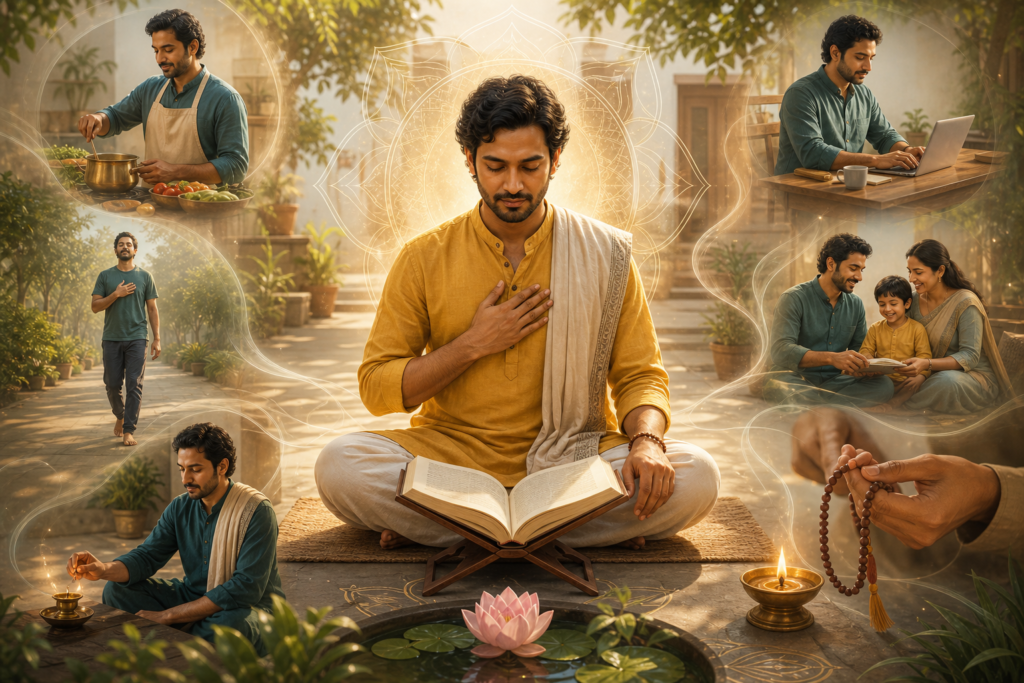
For many practitioners, the emotional power of this name comes from its intimacy. It suggests that the divine is not remote, abstract, or confined to extraordinary moments. The sacred is present in breath during anxiety, in water offered during puja, in the warmth of a lamp, in the firmness of the ground beneath the feet, and in the silence that follows prayer. Such a vision can make spiritual life more integrated and less fragmented.
Bhootatmane Bhairava also encourages unity among Dharmic traditions by emphasizing a shared reverence for consciousness, discipline, interdependence, and inner transformation. Hinduism, Buddhism, Jainism, and Sikhism differ in theology and metaphysics, yet all preserve serious reflections on self-mastery, compassion, ethical living, and liberation from ignorance. A respectful reading of Bhairava as the inner principle of existence can therefore contribute to dialogue rather than division.
Technically, the concept may be placed within a larger Indic philosophical grammar in which the gross and subtle dimensions of existence are interrelated. The Panchabhootas form the basis of embodied experience, while consciousness gives meaning to that experience. Without consciousness, earth, water, fire, air, and space remain unrecognized. Without the elements, embodied experience has no field in which to unfold. Bhootatmane Bhairava names this mysterious unity of consciousness and manifestation.
This is why the name is not merely poetic ornamentation within a sahasranama tradition. Names in such traditions function as contemplative formulas. Each name opens a specific theological insight. Bhootatmane invites meditation on Bhairava as the Atma of all bhutas: the Self within living beings, the essence within elemental nature, and the witness within the changing universe.
The worship of Bhairava is sometimes approached through fear, awe, or the desire for protection. Those dimensions have their place within traditional practice, especially in the context of overcoming danger, disorder, and inner weakness. Yet Bhootatmane reveals a more expansive dimension. Bhairava is not only the guardian at the boundary; he is also the inner reality of the boundary, the one who stands within the body, the elements, the mind, and the cosmos.
In practical contemplation, this name can be internalized through simple awareness. The firmness of posture may be linked with earth, the rhythm of saliva and blood with water, body heat with fire, breath with air, and inner silence with space. Such reflection is not a replacement for formal worship, scriptural study, or guidance from a qualified tradition. It is a way of recognizing that spiritual insight is not divorced from embodied life.
Bhootatmane Bhairava therefore presents a powerful synthesis of Shiva, Bhairava, Hindu philosophy, Vedic wisdom, and spiritual practice. It teaches that the five elements are not inert fragments of matter but sacred modes of manifestation. It affirms that consciousness is the deepest principle within beings and nature. Most importantly, it reminds seekers that the path to the divine may begin with reverence for the very world in which life is already unfolding.
To contemplate Bhootatmane Bhairava is to see existence as animated from within. The earth that supports, the water that nourishes, the fire that transforms, the air that sustains, and the space that contains are all read as expressions of a deeper consciousness. In this vision, Bhairava is not distant from creation. He is the living essence of the Panchabhootas, the inner soul of beings, and the luminous presence through which the sacred becomes recognizable in ordinary life.
Inspired by this post on Hindu Blog.




Leave a Reply
You must be logged in to post a comment.