
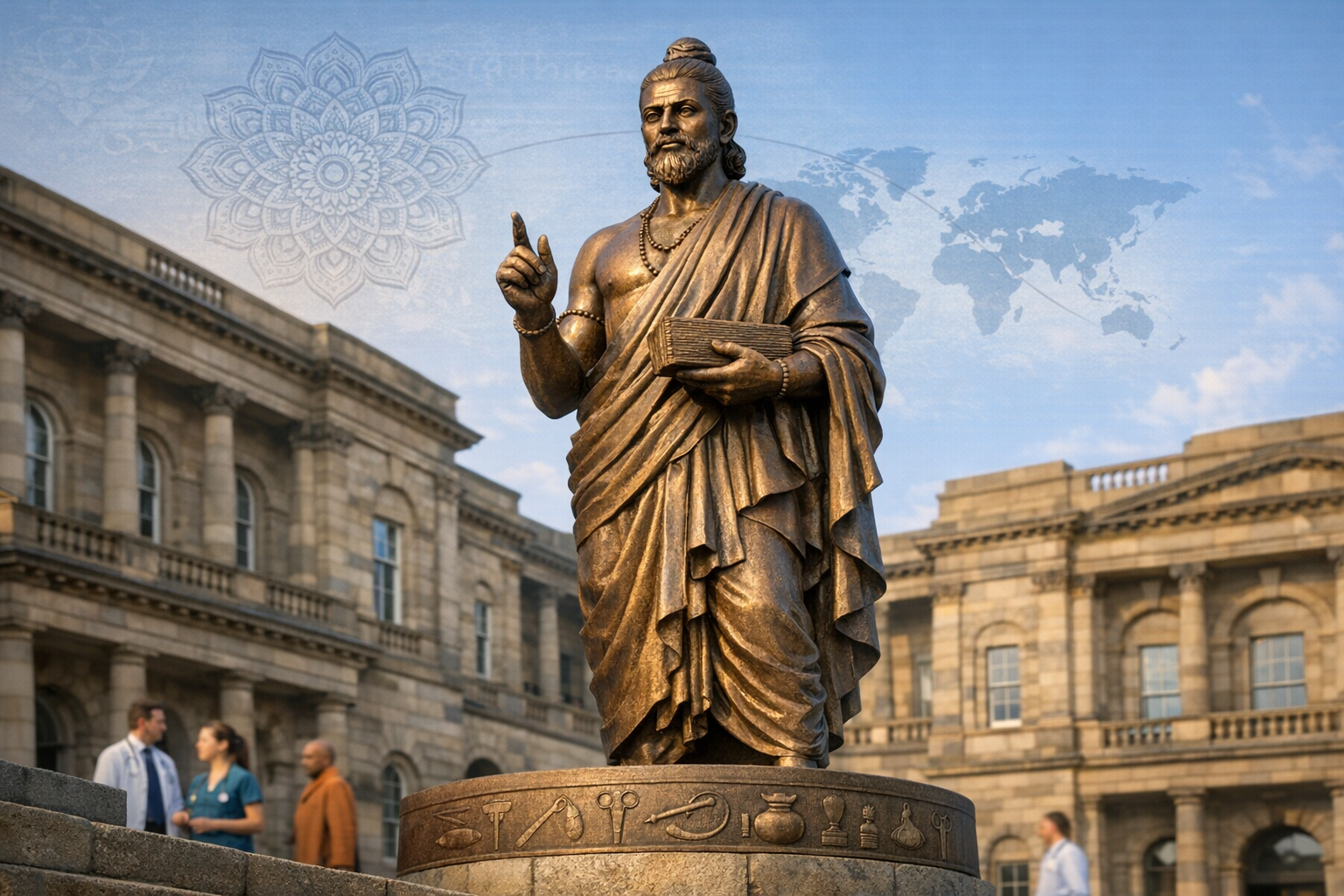
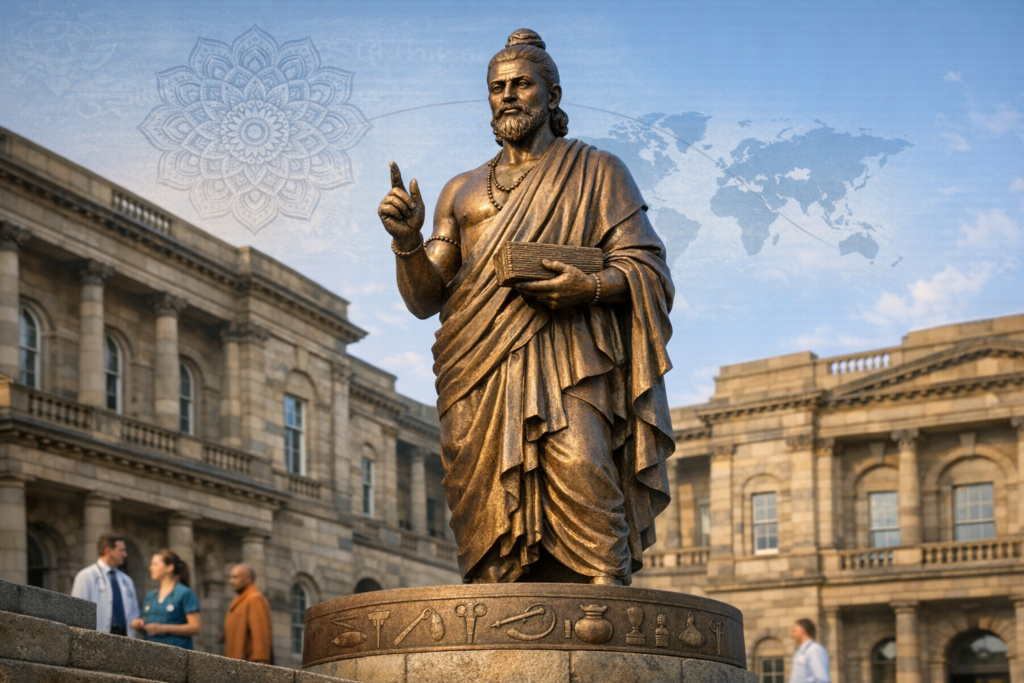
A bronze statue of Maharishi Sushruta now stands at the Royal College of Surgeons of Edinburgh (RCSEd), a powerful acknowledgment of India’s ancient medical heritage and the deep, evolving ties between Scotland and South Asia. The installation is both commemorative and forward-looking: it honours the Hindu sage widely regarded as the “Father of Surgery” while inviting contemporary surgeons, scholars, and students to re-examine the global, plural foundations of surgical knowledge.
Traditionally placed around 600 BCE, Sushruta is credited with compiling the Sushruta Samhita, a foundational text of Ayurveda and one of the world’s earliest systematic treatises on surgery. While scholars continue to debate precise dating and textual layers—some portions being attributed to later redactors such as Nagarjuna—the consensus is clear on Sushruta’s status as a seminal medical innovator whose work shaped clinical practice across centuries.
The Sushruta Samhita is organized into major sections (Sthanas) that integrate principles of anatomy, pathology, therapeutics, toxicology, and operative care. Notably, the Uttara-tantra extends the scope into ophthalmology, otolaryngology, dentistry, and paediatrics, underscoring the text’s breadth. Beyond disease taxonomies and pharmacopoeias, the compendium codifies operative techniques with unusual granularity for its era, addressing pre-operative preparation, intra-operative conduct, and post-operative care.
In shalya-tantra (surgery), Sushruta describes the ashta-vidha shastra-karma—eight categories of surgical intervention: Chedya (excision), Bhedya (incision), Lekhya (scarification), Vedhya (puncturing), Eshya (probing), Aharya (extraction), Vsraya (drainage), and Seevya (suturing). He catalogues over a hundred instruments—often cited as approximately 125—ranging from scalpels and forceps to needles and probes, many modeled on forms observed in nature for functional efficiency. The text also details suturing methods, ligatures, haemostatic strategies, and bandaging styles (traditionally enumerated as fourteen), revealing a sophisticated understanding of tissue handling and wound biomechanics.
Training protocols described in the Sushruta Samhita remain strikingly modern in spirit. Cadaveric dissection is advocated for direct anatomical observation, and simulation-based practice on fruits, vegetables, and animal tissues is prescribed to build manual dexterity before operating on patients. Ethical precepts—akin to an oath—emphasize self-discipline, compassion, honesty, and meticulous cleanliness, aligning surgical excellence with moral responsibility.
Sushruta’s reconstructive innovations are among the most celebrated. His techniques for nasal reconstruction (nasasandhana), commonly associated with the later so-called “Indian method” of rhinoplasty, employed pedicled skin flaps—often from the forehead—to restore nasal form and function. Centuries later, reports from the Indian subcontinent in the late eighteenth century inspired European surgeons and informed the work of pioneers in plastic surgery, demonstrating a direct lineage from ancient practice to modern reconstructive principles.
Beyond rhinoplasty, the compendium outlines early approaches to skin grafting, management of traumatic injuries, fracture reduction and immobilization, treatment of anal fistulae, dental extractions, and cataract couching (displacing the opaque lens to restore vision). Pre-operative analgesia and sedation with wine and plant-based formulations, antiseptic cleansing, careful haemostasis, and staged wound care illustrate a comprehensive operative ecosystem rather than a collection of isolated procedures.
Infection control and perioperative hygiene receive sustained attention. Sushruta prescribes cleanliness of the operative field and instruments, appropriate dressings and fumigations, dietary modulation, and staged rehabilitation. While framed in the idiom of Ayurveda, these recommendations display a practical logic—reduce contamination, control bleeding, support tissue healing—that resonates with later developments in antisepsis and surgical nursing.
The unveiling at RCSEd carries particular intellectual symbolism. Edinburgh’s surgical school has long been associated with standard-setting advances in operative care and training. Situating Sushruta within this heritage recognizes that the making of modern surgery is a polycentric story. Indian, Scottish, and other global traditions have intersected across time—through travelers, translations, case reports, and professional exchanges—to refine what now appears as a unified discipline.
Crucially, Sushruta’s legacy is also civilizational and ecumenical. The medical knowledge preserved and transmitted in the Indian subcontinent drew on and served communities across dharmic traditions—Hinduism, Buddhism, Jainism, and, in later centuries, Sikhism—through monastic infirmaries, scholarly networks, and practical care. Subsequent translations and commentaries in Persian and Arabic further integrated these insights into a wider Afro-Eurasian medical discourse, eventually filtering into European learning. The result is a shared human inheritance rather than a single-culture achievement.
The ceremony in Edinburgh also marked the release of a new scholarly compendium on Sushruta’s enduring impact. Such research, combining philology, history of science, clinical retrospection, and cross-cultural analysis, is vital to situating ancient Indian medicine within global medical historiography. It challenges linear, Eurocentric narratives and promotes a nuanced understanding of how surgical techniques—ranging from nasal reconstruction to ophthalmic interventions—evolved through dialogue between texts, teachers, patients, and places.
For practitioners and trainees encountering the statue, the moment is often reflective. It invites consideration of how today’s protocols in plastic surgery, reconstructive microsurgery, ENT, and ophthalmology echo foundational principles articulated millennia ago: precise anatomy, staged intervention, careful haemostasis, clean technique, and ethical commitment to the patient. It also encourages curricular inclusion of Ayurveda’s surgical tradition, not as an antiquarian curiosity, but as a rigorous, testable body of techniques and frameworks that influenced global practice.
By honouring Maharishi Sushruta, Scotland acknowledges the depth and durability of ancient India’s medical science while strengthening bonds with clinicians and scholars across the subcontinent and diaspora. More broadly, the statue—and the scholarship it invigorates—advances a unifying message: medical knowledge grows when cultures listen to one another. In celebrating Sushruta, a shared dharmic and humanistic ethos is affirmed—one that values inquiry, compassion, and the disciplined pursuit of healing.
Inspired by this post on Hindu Human Rights Blog.





Leave a Reply
You must be logged in to post a comment.