
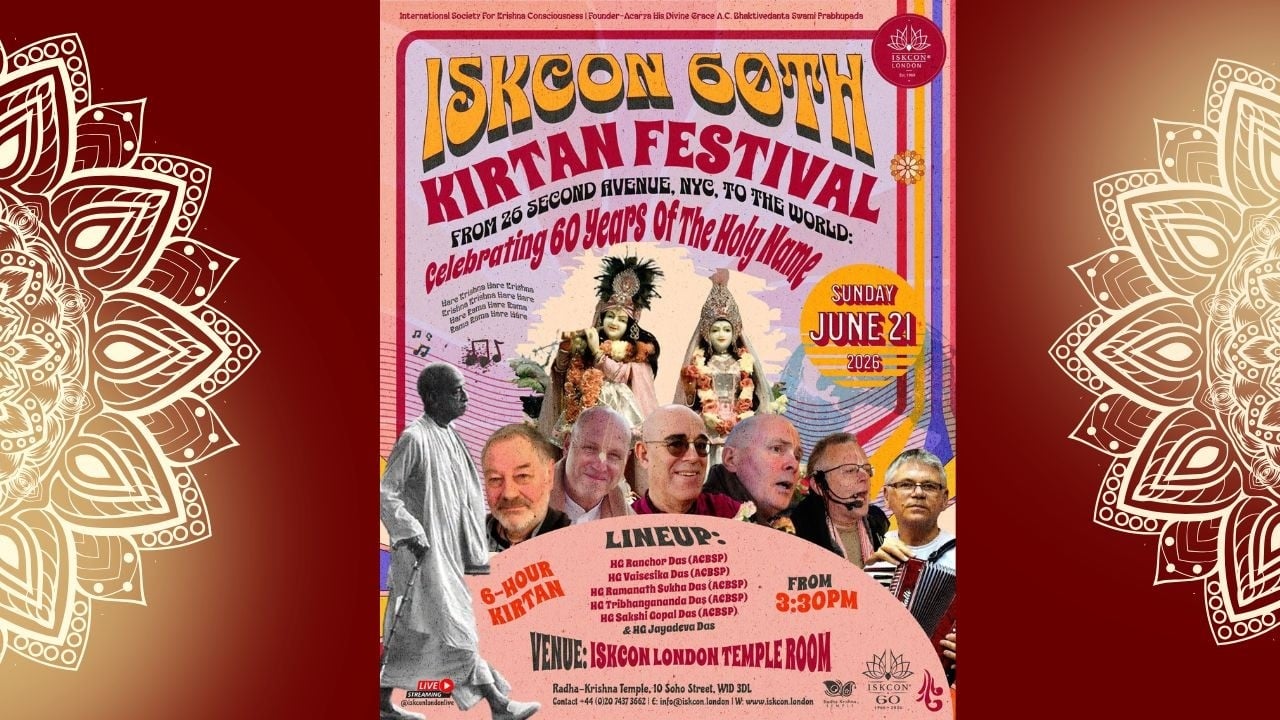
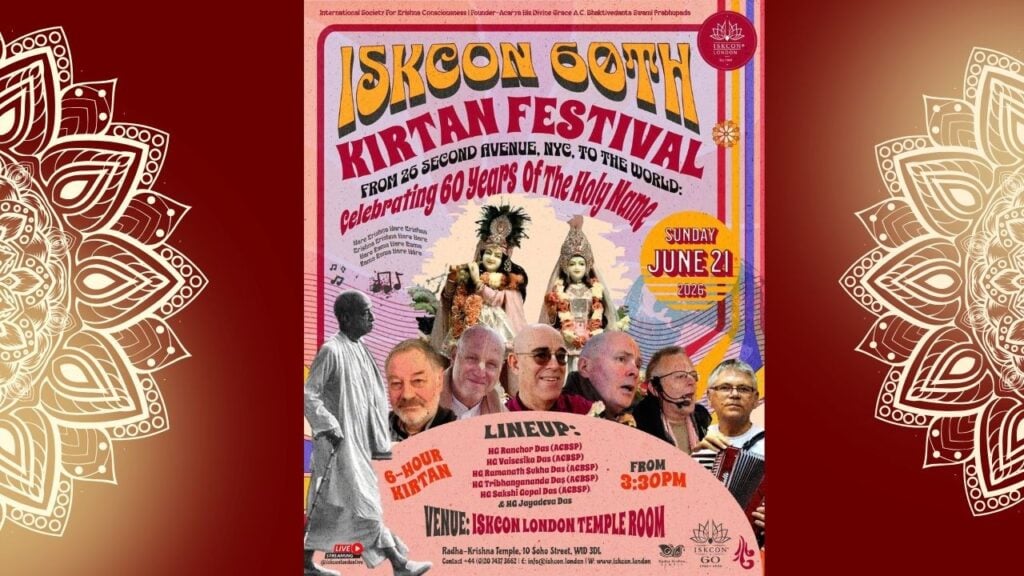
On Sunday, 21 June 2026, ISKCON London Radha-Krishna Temple marks the diamond jubilee of the International Society for Krishna Consciousness (1966–2026) with a 6-Hour Kirtan. This sustained, congregational chanting offers London’s diverse community a contemplative yet celebratory space to honor six decades of the Hare Krishna Movement’s cultural presence and spiritual service.
The timing aligns with International Yoga Day, highlighting a natural synergy between yoga’s inward discipline and kirtan’s outwardly expressive devotion. Both practices cultivate inner clarity, compassion, and collective well-being, demonstrating how embodied spirituality can be accessible, joyful, and deeply transformative in a communal setting.
Founded in 1966 by A.C. Bhaktivedanta Swami Prabhupada, ISKCON introduced the theology and practice of Gaudiya Vaishnavism to a global audience, including London’s multicultural milieu. Over the past sixty years, ISKCON’s temples and communities have woven devotional arts—music, dance, sacred food culture, and scriptural study—into the city’s cultural fabric. A 6-Hour Kirtan encapsulates that journey by bringing seekers, long-time practitioners, and well-wishers into a shared devotional rhythm.
In Gaudiya Vaishnavism, sankirtana—congregational chanting of the divine names—is a central mode of bhakti. The Bhagavata Purana extols kirtana as a spiritually efficacious practice in the present age, where the repetition of sacred names and narratives fosters remembrance (smarana), humility, and loving service (seva). This event builds on that scriptural inheritance, offering a sustained period during which musical devotion, meditation, and community converge.
The thematic heart of the 6-Hour Kirtan is the maha-mantra: Hare Krishna, Hare Krishna, Krishna Krishna, Hare Hare / Hare Rama, Hare Rama, Rama Rama, Hare Hare. In Gaudiya Vaishnava theology, the divine names are non-different from the divine presence, so intoning the names is regarded as direct communion. The sonic repetition, by design, gradually refines attention, settles the breath, and opens a pathway to contemplative absorption.
Musically, kirtan blends call-and-response singing with cyclical rhythms and evolving tempos. A kirtan leader sets melodic contours while the assembly responds in kind, creating an immersive soundscape. Traditional instrumentation such as mridanga and kartals often anchors the tala and laya (rhythm and tempo), with harmonium supporting the melodic line. Depending on the setting, auxiliary instruments like flute and tabla may add tonal color, though the congregational voice remains the principal instrument, allowing every participant to contribute to the devotional texture.
A 6-hour format enables distinct musical and devotional arcs. Softer, contemplative passages encourage interiority and steady breath, while energized crescendos invite movement, clapping, and meditative dance. This alternation is not merely aesthetic; it scaffolds sustained attention and vocal pacing, giving the voice intervals of rest and renewal and allowing the gathered assembly to remain both vibrant and grounded across a long devotional cycle.
From a psychoacoustic and contemplative perspective, extended group singing fosters entrainment—synchronization of breath, pulse, and movement—which many participants experience as an easing of mental chatter and an uplift in mood. Research on communal singing suggests reductions in perceived stress, enhanced social bonding, and improved well-being markers. In the kirtan context, these benefits align with the classical ideal of nada yoga, where sound becomes a disciplined means for focusing the mind and softening the heart.
The temple context provides a holistic devotional ecology. Participants typically arrive with a spirit of reverence—removing shoes, dressing modestly, and entering the kirtan space with attention to the sanctity of the Deities and altar. The flow often includes intervals of quiet reflection and, in many ISKCON settings, culminates with the sharing of sanctified vegetarian food (prasadam), symbolically extending the spirit of devotion into nourishment and fellowship. Specific timings and any temple-specific guidelines are communicated by the temple’s official channels.
While kirtan here reflects Gaudiya Vaishnava practice, the event’s inclusive spirit resonates across dharmic traditions. Sikh communities cherish Gurbani Kirtan; Buddhist traditions employ mantra recitation and melodic chanting for mindfulness and compassion; Jain communities sing stavans that honor the Jinas and ethical vows. These living practices share a reliance on sound, remembrance, and virtue cultivation, affirming dharmic unity in diversity. A London-based 6-Hour Kirtan thus becomes a cultural bridge, fostering mutual appreciation among Hindu, Buddhist, Jain, and Sikh practitioners and well-wishers.
Socially, ISKCON’s devotional arts have long served as an accessible portal into Indian cultural heritage for multi-generational and multi-ethnic audiences in the United Kingdom. Children, students, professionals, and elders find a common meeting ground in song and shared ritual. This intergenerational transmission sustains memory, language, and values—devotion (bhakti), service (seva), and nonviolence (ahimsa)—while remaining open to newcomers who may be encountering kirtan for the first time.
For first-time participants, kirtan requires no prior musical training. Joining the response lines, clapping gently in rhythm, and allowing the mind to follow the mantra’s cadence are sufficient to enter the devotional flow. Some may prefer to sit in reflective stillness, letting the sound wash over awareness; others may alternate between singing, quiet meditation, and soft movement. Over hours, this natural alternation supports endurance, comfort, and attentiveness.
Theologically, ISKCON follows achintya-bhedabheda, the Gaudiya Vaishnava doctrine articulated by Sri Chaitanya Mahaprabhu, which holds an inconceivable simultaneous oneness and difference between the divine and all beings. Kirtan operationalizes this insight: the assembly becomes sonically unified while each voice retains its uniqueness. That unity-in-plurality also mirrors London’s cosmopolitan character and the broader dharmic ethos of honoring many paths while nurturing shared ethical and spiritual aims.
The 6-Hour Kirtan also exemplifies the bhakti practice of sravanam-kirtanam—hearing and chanting—as described in the Bhagavata Purana. These practices are not merely ritual forms; they are cultivated disciplines that can reorient habits of speech, attention, and emotion toward patience, gratitude, and compassion. In contemporary urban life, such sustained collective practice offers a restorative counterpoint to fragmentation, helping participants re-establish continuity between intention, breath, and action.
ISKCON London Radha-Krishna Temple has, for decades, functioned as a cultural and spiritual anchor for the diaspora and the wider public. Through festivals, classes, and devotional arts, it has advanced an ethos akin to Vasudhaiva Kutumbakam—the world as one family. The 60-year commemoration reaffirms that ethos by foregrounding sound as a shared spiritual medium capable of bridging generations, communities, and traditions.
Ultimately, a 6-Hour Kirtan is both celebration and contemplative discipline. It honors the historical arc of ISKCON’s journey while inviting participants to experience the immediacy of devotion through voice, rhythm, and remembrance. For London’s dharmic and interfaith communities, the event serves as a living testament to unity in diversity—where many voices converge in a single intention: to nurture peace, dignity, and spiritual friendship through the sacred names of Radha-Krishna.
Inspired by this post on Dandavats.





Leave a Reply
You must be logged in to post a comment.