
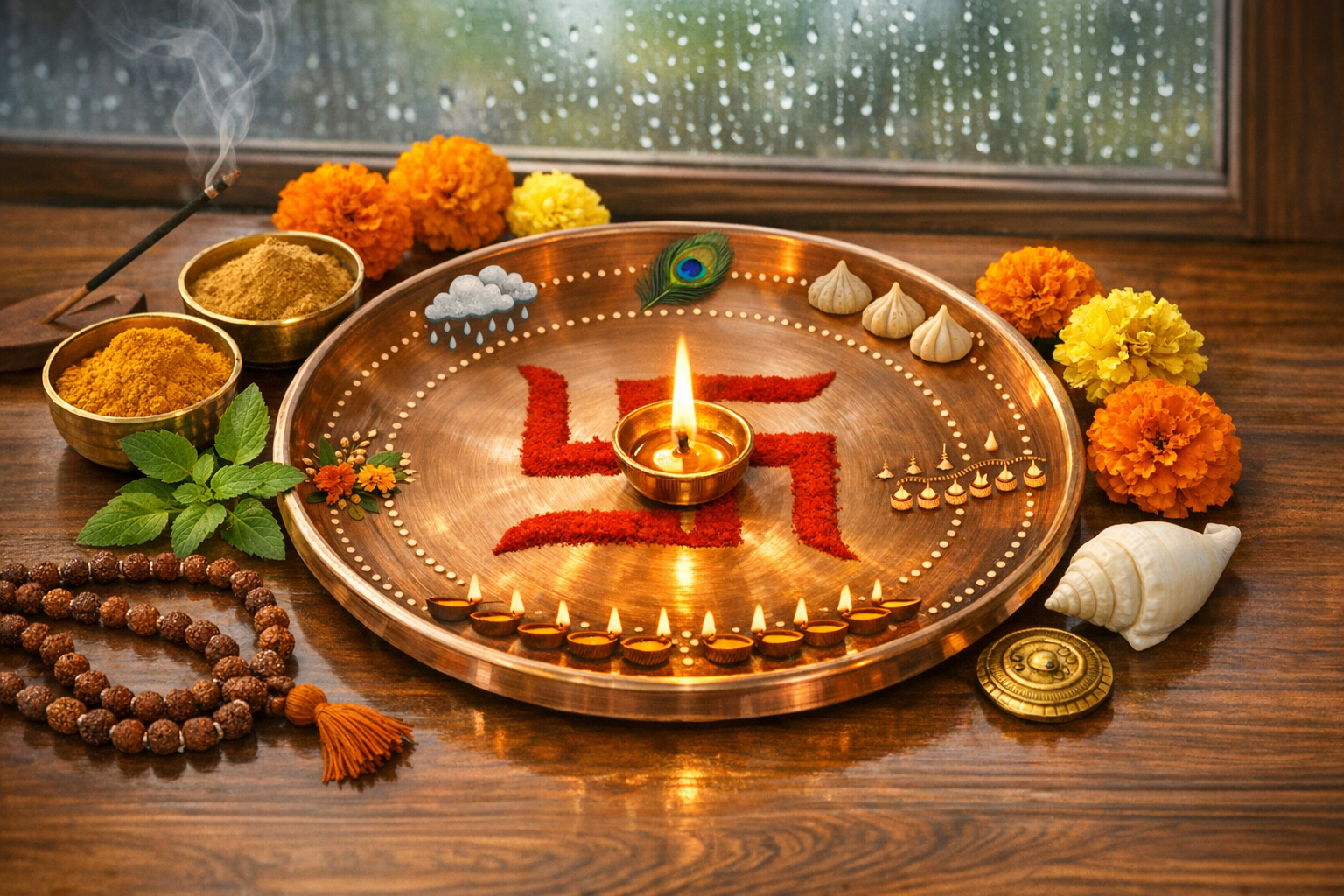
Observed across the four sacred months of Chaturmasya, the Swastika Vrata evolves from a simple daily gesture into a sustained, 120-day discipline of mindfulness, devotion, and ethical living. Timed from Devshayani Ekadashi in Ashadha to Prabodhini Ekadashi in Kartika, this vow invites unbroken steadiness in practice, linking personal transformation with the larger liturgical arc of the Hindu calendar.
Chaturmasya is traditionally understood as the period when Lord Vishnu enters yogic repose, symbolically turning human attention away from outward expansion toward interiority. The monsoon rhythmless travel, slower movement, and increased time indoorshistorically supported contemplative observances. Within this context, the Swastika Vrata functions as a daily anchor that stabilizes routine and nurtures nairantarya, the virtue of unbroken continuity.
The swastika itself is a dharmic symbol of auspiciousness and well-being that predates recorded history in South Asia. It appears in Vedic and post-Vedic ritual culture, thrives in temple iconography and household rites, and is embraced across Hinduism, Buddhism, and Jainism as a maṅgala-chinha. Sikh tradition, while not centered on the symbol, shares the dharmic emphasis on truthful living and seva that undergirds the spirit of this vow. It is essential to distinguish this ancient sign from the 20th-century European misappropriation; in dharmic contexts, the swastika is a sacred emblem linked to prosperity, right conduct, and cosmic order.
In the Swastika Vrata, devotees consecrate each day by drawing or installing a swastika and offering worship to the Suprememost commonly in a Vaishnava framework during Chaturmasya, though Smarta and other lineages also adopt it as a universal auspicious rite. The clockwise (right-handed) swastika is typically used for maṅgala purposes. While procedures vary by parampara, the shared intent is to stabilize the mind and cultivate sattva through a compact, repeatable liturgy.
Calendrically, the vrata begins on Devshayani Ekadashi (Ashadha Shukla Ekadashi) and concludes on Prabodhini Ekadashi (Kartika Shukla Ekadashi), spanning approximately 120 days. Local panchang differences (amanta versus purnimanta month reckoning) may slightly shift civil dates, so practitioners follow the regional calendar or the guidance of their guru, family tradition, or temple.
Chaturmasya commonly includes dietary and behavioral niyamas that complement the Swastika Vrata. Many Vaishnavas uphold Ekadashi fasting, reduce or avoid tamasic foods, and adopt month-wise abstinences (for example, avoiding leafy greens in Shravana, curd in Bhadrapada, milk in Ashvina, and certain pulsesoften uradin Kartika). Some adopt additional austerities such as simplified dress, reduced travel, or sleeping on a firm mat. Specifics rightly differ by sampradaya; fidelity to one’s lineage produces both coherence and inner clarity.
The daily observance typically begins with a clear sankalpaan intentional statement of commitment to maintain the vrata through Chaturmasya for inner purification and collective well-being. A simple altar is prepared with a clean base (wood, copper, or a sanctified plate). The swastika may be drawn with kumkum, turmeric paste, rice paste, or sandal paste, or presented as a carved or engraved emblem.
Worship proceeds with gandha (fragrant paste), pushpa (flowers), dhoopa (incense), deepa (lamp), and naivedya (a simple sattvic offering). A steady lamp at the center or just above the swastika’s navel point symbolizes consciousness illuminated. Many households quietly recite Om Namo Narayanaya, the Vishnu Sahasranama, or the Svasti-vachana (auspicious benedictions), followed by a brief meditation and a closing prayer for the welfare of all beings.
Japa discipline strengthens the vrata’s transformative edge. A widely accessible pattern is 108 repetitions of a chosen mantra daily during the four months, with Ekadashi days reserved for extended recitation, kirtana, or scriptural reading (for instance, selections from the Bhagavad Gita or the Bhagavata Purana). Some families synchronize the daily swastika worship with Tulasi puja, deepa-dana at dusk, or a short period of silent contemplation.
Ekadashi fasts during Chaturmasya serve as intensification points. Whether observed as nirjala, phalahara, or with moderated grains per one’s health and tradition, the intention is to lighten the system and deepen attentiveness. Many report that combining a gentle fast with the concise, repeatable swastika liturgy brings mental clarity, emotional balance, and a quieter breath cadence by evening arati.
The vow elegantly weaves through the season’s major festivals. In Shravana, the vrata coexists with Janmashtami austerities; in Bhadrapada, it harmonizes with Ganesh Chaturthi’s call to new beginnings; in Ashvina, it intersects with Navaratri’s inner shakti; and in Kartika, it culminates against a luminous backdrop of deepa-dana, Tulasi Vivaha, and the celebratory awakening of Vishnu on Prabodhini Ekadashi. Across Shaiva, Shakta, Vaishnava, and Smarta homesas well as in Jain and Buddhist contexts that venerate the swastikathe shared emphasis on restraint, reverence, and compassion underscores dharmic unity.
On Prabodhini Ekadashi, the udyapana (formal completion) acknowledges the grace that sustained the 120-day marathon of devotion. Households often offer a special deepa-dana, perform Tulasi archana, circumambulate the altar, distribute prasada, and conclude with acts of seva such as annadana or donations of lamps, scriptures, or study materials. The spirit of Vasudhaiva Kutumbakamone planetary familyguides the closing prayers.
From a psychological perspective, the Swastika Vrata cultivates ekagrata (one-pointedness) through a brief, consistent ritual that the mind readily anticipates and the senses recognize. Regular timing, repetitive motor sequences, and symbolic salience reduce decision fatigue and signal the nervous system toward safety and focus. Over weeks, this builds a durable habit scaffold that supports other observances of Chaturmasya and everyday ethical choices.
Physiologically, practitioners frequently observe steadier sleep-wake cycles (especially when the rite is paired with early rising or an evening lamp), calmer respiration, and improved dietary restraint in line with Hindu fasting norms. The small, daily investment of attention often spreads outward, subtly improving speech, interpersonal patience, and the quality of household spaces.
Communally, the vrata is notably inclusive. Children can help draw the symbol; elders may lead the mantra; those from diverse dharmic backgrounds can participate according to their comfort and tradition. While devotional nuances differ across Hinduism, Buddhism, Jainism, and Sikhism, the emphasis on truthfulness, non-harm, generosity, and contemplative steadiness provides a shared ethical platform and a unifying experience of sacred time.
Practical continuity matters more than perfection. During travel or illness, the swastika may be installed mentally, drawn on paper, or represented by a small copper emblem; a single lamp and a short mantra suffices. Missed days can be acknowledged with humility and resumed without self-reproach; the vratadharma values sincerity and resilience over rigor for its own sake.
Misunderstandings about the symbol sometimes arise in intercultural settings. Gentle, fact-based explanationsstressing the swastika’s antiquity in South Asia, its positive meaning in dharmic traditions, and its complete difference from the 20th-century European hakenkreuzpromote clarity and respect. In plural societies, communicating this heritage with patience both protects living traditions and fosters interfaith harmony.
Textually, the swastika’s liturgical use is attested in Grihya and Agamic streams and in the Shilpa Shastras as an auspicious emblem; however, a pan-Indian, uniform “Swastika Vrata” manual does not exist in a single canonical source. The practice is transmitted through sampradaya teachings, regional vratakathas, and household lineages. Accordingly, the soundest approach is to honor one’s family tradition or seek guidance from a trusted acharya while preserving the vrata’s core intentdaily auspicious worship linked to Chaturmasya discipline.
Safety and sustainability belong to the vrata’s ethic. Use stable, well-ventilated lamp placements; prefer natural materials for drawing the symbol; keep offerings sattvic and modest; and align all actions with ahimsa and ecological care. The symbolism of the swastika’s steady center invites equally steady choices in the home and neighborhood.
Devotees often describe the experience simply: the four-armed emblem becomes a compass for the heart. Lighting a single lamp at its center, reciting a familiar mantra, and pausing long enough to feel the breath smooth out can turn an ordinary evening into sacred time. Across 120 days, that small pause accumulates into ethical clarity, emotional resilience, and a felt sense of connection with all who walk dharma’s many paths.
In sum, the Swastika Vrata across Chaturmasya offers an academically grounded yet readily practicable path: a brief daily rite, harmonized with Ekadashi fasting and seasonal niyamas, culminating in Prabodhini’s joyful awakening. It strengthens household devotion, supports unity among dharmic traditions, and cultivates the inner steadiness required to carry auspiciousnesssvastibeyond the altar and into daily life.
Inspired by this post on Hindu Pad.
