
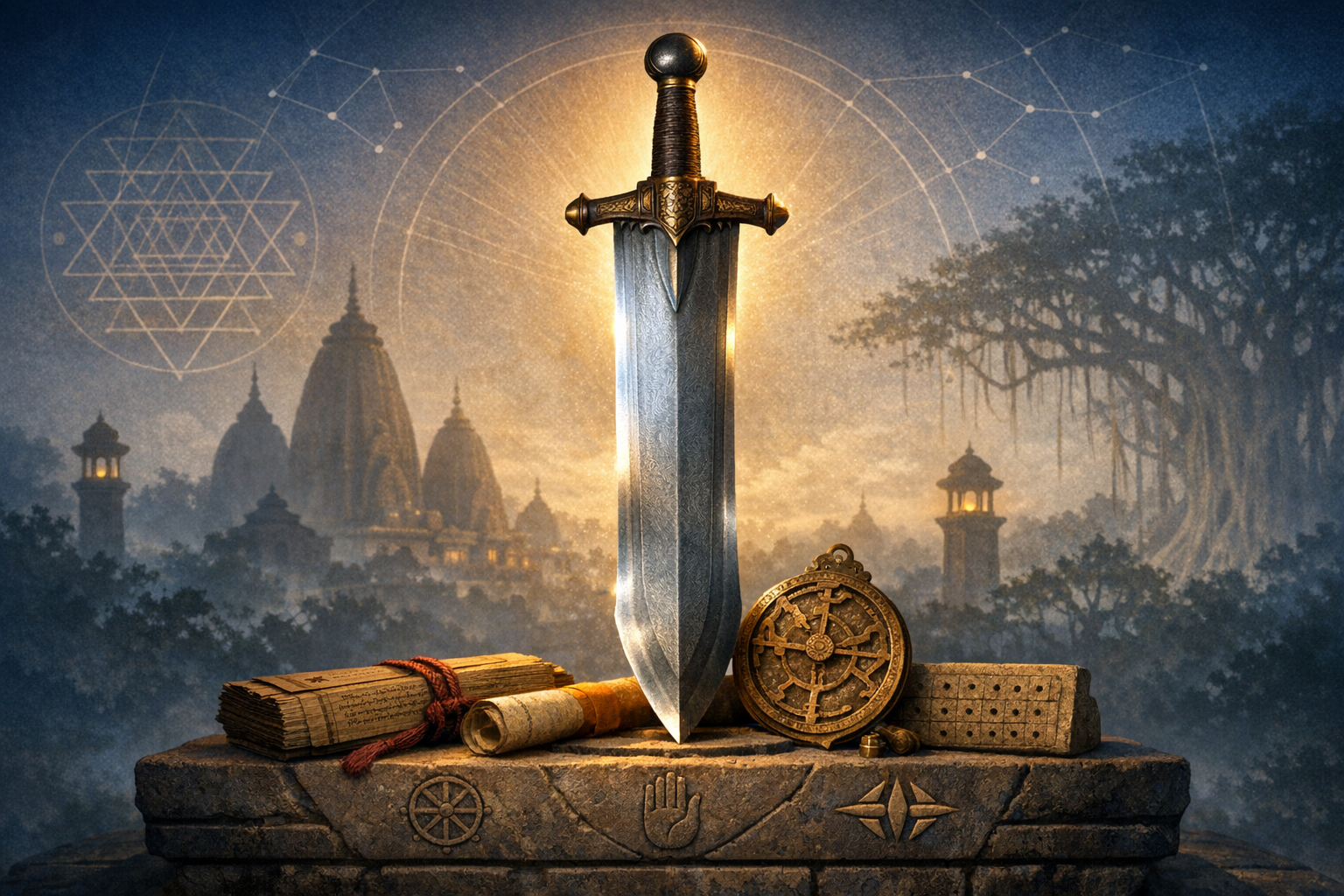
Across the Indian subcontinent, the name King Vikramaditya evokes an enduring synthesis of history, legend, and ethical statecraft. Among the many motifs associated with him, none is more compelling than the “divine sword”—a symbol of courage, moral clarity, and the uncompromising protection of dharma. Read together, ancient narratives and cultural memory present this sword not merely as a weapon of war, but as an emblem of responsibility, discernment, and unity across dharmic traditions.
Historically, “Vikramaditya” functions as an honorific title borne by exemplary rulers. The legendary king of Ujjain is often associated with the inception of the Vikrama Samvat (57 BCE), a calendar that shaped ritual life, seasonal observances, and social rhythms across North and Western India. Some scholarly discussions link the title to the Gupta emperor Chandragupta II (c. 375–415 CE), who also bore the epithet Vikramaditya, although the legendary persona consolidates far more than a single historical biography. In cultural consciousness, King Vikramaditya stands as the archetype of the just, generous, and fearless sovereign.
Texts compiled between the 11th and 18th centuries—such as Simhasana Dvatrimsika and the Vetala Panchavimshati cycles, often transmitted through the Kathasaritsagara tradition—deepened this archetype. They present Vikramaditya as the courageous custodian of truth, a patron of learning, and a ruler who embodied kshatra (martial valor) within the ethical bounds of rajadharma (righteous kingship). While historians maintain critical distance from literalist readings, the narratives themselves became vehicles for transmitting political ethics and social ideals to later generations.
The Vikrama Samvat’s diffusion illustrates the integrative power of this legacy. The calendar has long informed Hindu festival timings across North India and remains embedded in community life. Jain communities have preserved extensive narrative traditions about Vikramaditya and Gardabhilla in and around Ujjain. In large parts of the North and Northwest, Sikh communities historically referenced the related Bikrami calendar alongside their own evolving practices. The common thread is civilizational continuity—measured time, ritual cycles, and shared memory linking Hindu, Buddhist, Jain, and Sikh communities in a broad, dharmic conversation.
Equally enduring is the image of Vikramaditya as a scholar-king. Courtly lore often names nine luminaries (Navaratnas), with figures such as Kalidasa and Varahamihira frequently cited in tradition. Though the precise historical configuration of this “navaratna” court remains debated, the ideal it signifies is unambiguous: the ruler’s esteem for knowledge, literature, and science anchors justice and prosperity. This intellectual gravitas contextualizes the “divine sword” motif—not as brute force, but as a disciplined extension of wisdom.
In legend, the divine sword arrives as a boon of the Goddess—variously remembered in Ujjain’s sacred geography through Kalika, Harsiddhi, and other forms of Devi. The khadga (sword) conferred upon the king is both protection and pedagogy: a mandate to uphold dharma without fear, to cut through injustice with vigilance, and to guard the learned, the vulnerable, and the sanctity of social order. In this sense, the sword is a covenant—its “divinity” signifying a ruler’s accountability to something higher than personal ambition.
The Vetala Panchavimshati cycles place Vikramaditya in liminal terrains—cremation grounds, haunted groves—where he must repeatedly confront the Vetala’s riddles. The ever-returning spirit tests the king’s moral acuity and truthfulness; the sword in these episodes is less for combat and more a sentinel presence. It marks the edge between impulse and restraint, urging deliberation before decisive action. By framing sovereignty as a dialogue with conscience, the narratives teach that true valor rests in discernment.
From a technical perspective, the most historically plausible form of Vikramaditya’s “divine” blade would be the khadga/khanda, the classical straight, broad-bladed Indian sword. Distinguished from the later curved talwar, the khanda’s widening blade near the tip and its reinforced spine favor powerful, committed cuts. Its hilt and guard, often robust, enable a two-handed grip for controlled strikes. This form appears in early iconography and temple sculpture and endures as a ceremonial emblem in many regions.
Archaeometallurgical research further grounds the motif in material excellence. India’s crucible steel—commonly known as wootz—originated in the southern peninsula in the early centuries BCE and was widely exported across West Asia, eventually informing the famed “Damascus steel” tradition. High-carbon wootz exhibited distinctive carbide microstructures that balanced hardness and resilience, enabling sharp edges with remarkable edge retention. By the Gupta period, iron and steel craftsmanship were already sophisticated, as evidenced by enduring artifacts and inscriptions. In such a context, a ruler’s “divine sword” naturally connoted both superior metallurgy and superior mandate: the finest steel married to the finest statecraft.
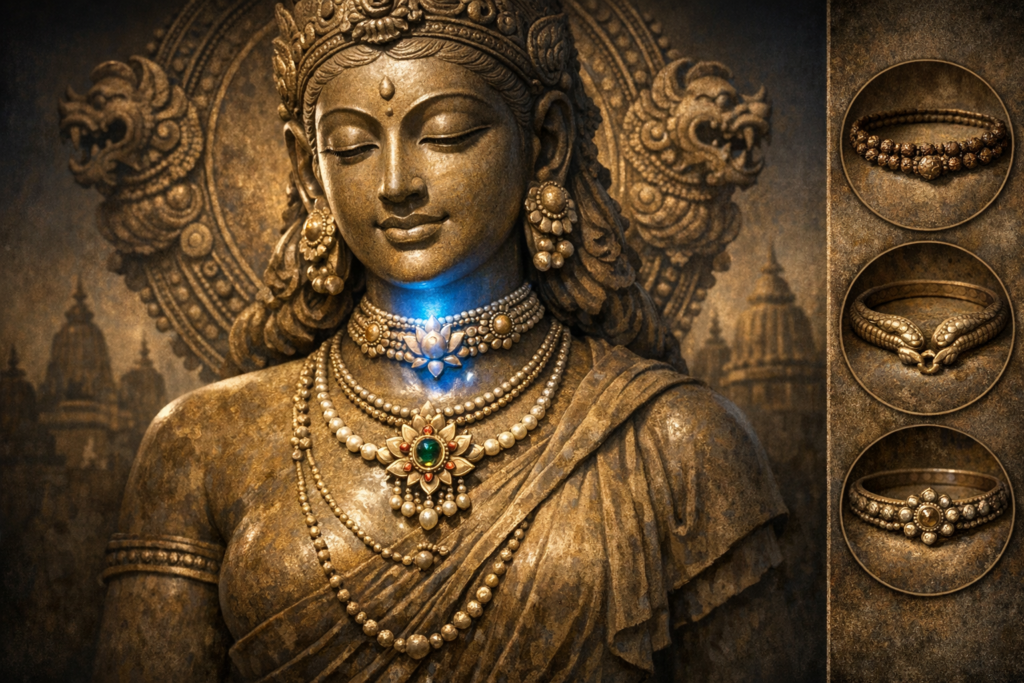
Iconographically, the sword’s sanctified role resonates across deities and traditions. Devi in her many forms wields the khadga against adharma; Vishnu’s Nandaka symbolizes discriminative knowledge; and the very posture of a deity with sword often encodes the triumph of satya (truth) and dharma (righteousness) over chaos. In Ujjain and its environs, this iconography intersects with Vikramaditya’s memory, weaving geography, worship, and rulership into a single civilizational tapestry.
Ethically, the sword aligns with Kshatra Dharma—the disciplined power that protects order, nurtures learning, and defends the innocent. Ancient Indian political thought, from the epics to the Dharmashastras, frames rajadharma as a balancing act: compassion without weakness, strength without cruelty. In this framework, Vikramaditya’s sword is the final arbitration against predation, mobilized only when counsel, law, and restoration have failed.
Strikingly, the symbolism of the sword as clarity and duty is pan-dharmic. In Buddhism, Mañjuśrī’s sword of prajñā severs ignorance; in Jain narratives of righteous kingship, the sovereign upholds order while renunciants embody ahimsa, together composing a complete ethical world; in Sikh tradition, the Khanda and the kirpan signify the saint-soldier ideal—spiritual depth fused with social responsibility. Across Hinduism, Buddhism, Jainism, and Sikhism, the blade becomes an ethical metaphor: the sharpened edge of wisdom and responsibility that restrains harm and restores balance.
Cultural memory keeps this synthesis alive. In countless households, elders narrate Vikram–Vetala tales to children as introductions to moral reasoning. In Ujjain, sacred sites and festivals encode layers of this legacy in everyday practice. The Vikrama Samvat continues to pace communal observances for millions, while inscriptions, folklore, and regional performances carry forward the king’s image as a paragon of courage and generosity.
Read with care, the legend of King Vikramaditya’s divine sword offers a holistic message. Sovereignty must be learned as much as earned; knowledge must guide strength; and strength must ultimately serve compassion. The blade’s “divinity” lies not in domination, but in disciplined service to dharma—an ethic that diverse dharmic traditions share, adapt, and celebrate.
Thus the narrative’s power endures. It extends beyond the question of whether a specific sword once flashed in a specific battle. It speaks to the responsibilities any society expects of its leaders, the courage individuals summon when confronting injustice, and the unity possible when communities center truth and compassion. In this light, the sword of Vikramaditya remains what it has always promised to be: an edge that cuts through ignorance, a guard for the vulnerable, and a reminder that the highest power is inseparable from the highest duty.
Inspired by this post on Hindu Pad.




Leave a Reply
You must be logged in to post a comment.