
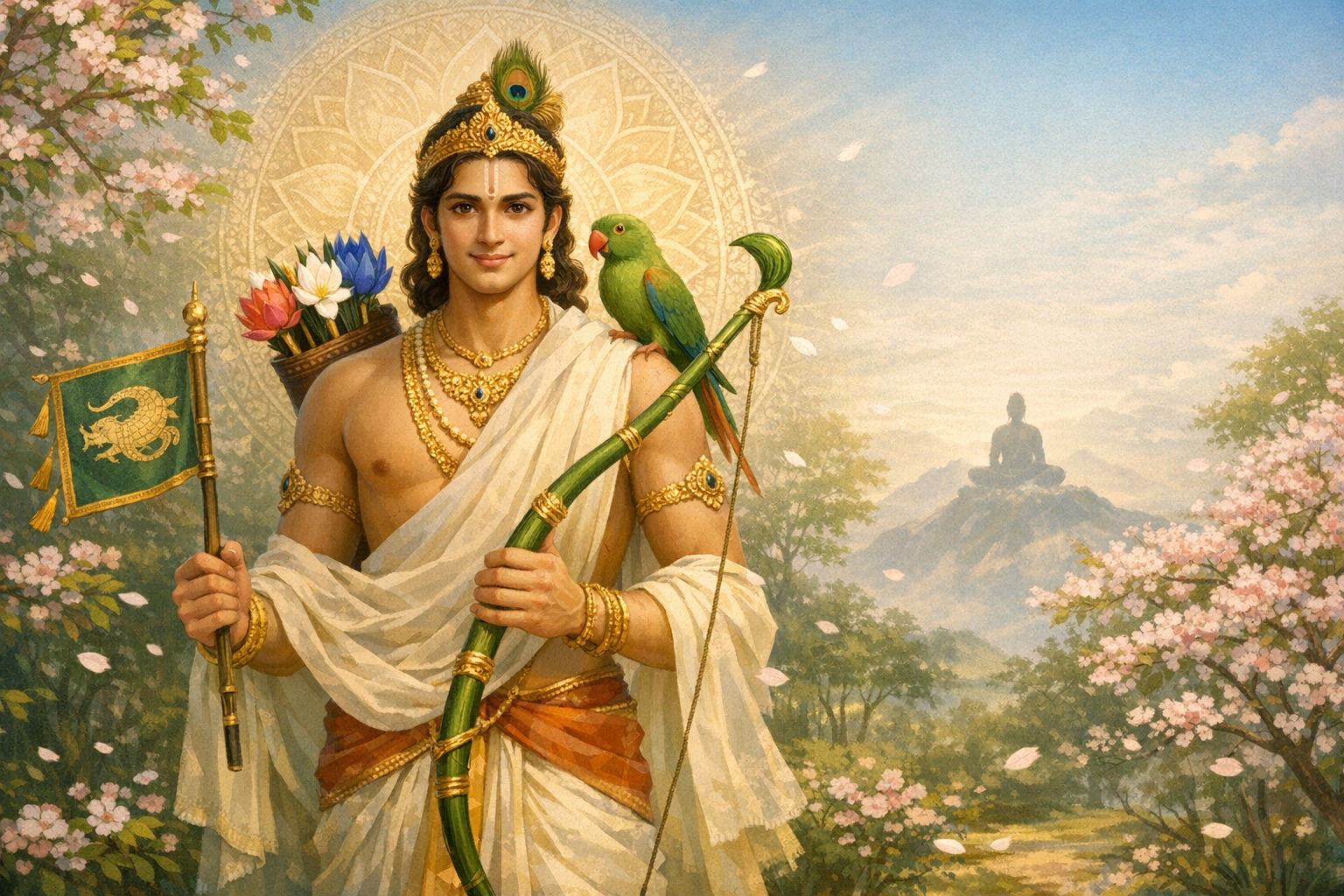
Kamadeva—revered across Sanskrit sources as Manmatha (the mind-churner), Kandarpa, Madana, and later Ananga (the bodiless)—is frequently reduced in popular culture to a Cupid-like caricature. In Hindu thought, however, he represents the refined and ethically governed power of love and creative desire, not unbridled lust. A careful reading of Vedic hymns, Purāṇic narratives, and classical aesthetics shows that Kamadeva embodies a generative principle that sustains life, social harmony, and spiritual maturation when aligned with dharma.
Vedic literature locates the origin of desire in the very dawn of cosmogenesis. The Nasadiya Sukta (Rigveda 10.129) frames desire (kama) as a primordial impulse, the first stirring of intention that seeds creation. In the Atharva Veda (often referred to through the Kama Sukta), kama is personified as a cosmic potency that catalyzes order and relation. This early placement of desire in the scaffolding of existence establishes a philosophical premise: desire is not morally suspect in itself; its direction and integration determine its quality.
Hindu ethics organizes human aims into the four purusharthas—dharma (moral order), artha (prosperity), kama (aesthetic/relational fulfillment), and moksha (liberation). Within this framework, kama denotes the pursuit of love, beauty, relational joy, and aesthetic refinement under the guidance of dharma. To equate Kamadeva with lust collapses this nuanced architecture. Lust is attachment disjoined from discernment; kama, rightly understood, is relational and aesthetic flourishing made luminous by moral purpose.
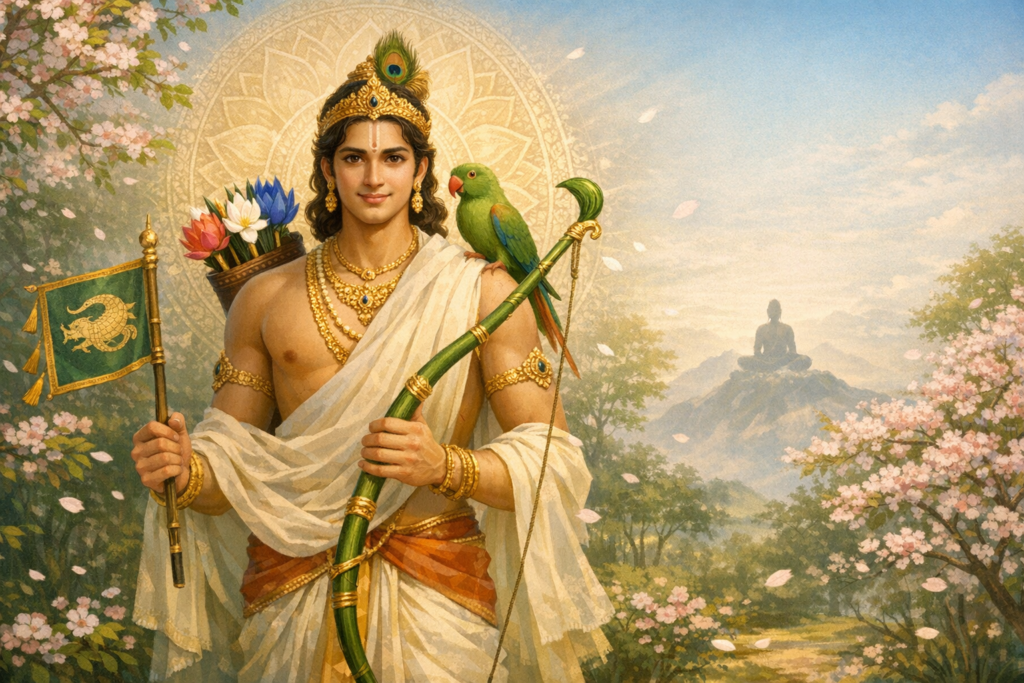
Iconography encodes this distinction with precision. Kamadeva’s sugarcane bow signifies sweetness and organic growth, not coercion. His five flower-arrows—commonly enumerated in classical sources as aravinda (lotus), aśoka, chūta (mango blossom), navamallikā (jasmine), and nīlotpala (blue lotus), with regional variations—suggest that love works through fragrance, memory, and gentle persuasion. The parrot (śuka) as vahana speaks to articulate, joyful communication, and his springtime companion, Vasanta, aligns his activity with renewal, not conquest. The epithet makara-dhvaja (whose banner bears the makara) further situates him in the cosmic symbolism of generativity and abundance.
Purāṇic narratives deepen this philosophical arc. In the well-known episode, the devas seek Kamadeva’s help to awaken Shiva for a world-restoring union with Pārvatī after the asura Tārakāsura’s rise. When Kamadeva directs the flower-arrow toward the meditating Shiva, he is consumed by the lord’s fiery gaze and becomes Ananga—disembodied, yet mysteriously more pervasive. In various accounts, his presence is later restored or echoed through Pradyumna, the son of Śrī Kṛṣṇa and Rukmiṇī (Bhagavata Purana), underscoring that ethically guided love cannot be eradicated; it returns refined, sanctified, and oriented to dharma.
Rati, Kamadeva’s consort, anchors the relational ethics at stake. Her lament and steadfast devotion, preserved in several Purāṇic tellings, function as a moral commentary on love’s responsibilities: fidelity, tenderness, reciprocity, and grief transformed into care. Together, Rati and Kamadeva symbolize the couple-ethic celebrated in Hindu household life (gṛhastha āśrama), where kama is cultivated as mutual uplift, not as predation or possession.
Hindu jurisprudence and classical treatises treat kama with equal seriousness. The Kāmasūtra—frequently misconstrued as a mere compendium of techniques—actually frames human striving as a triad (dharma, artha, kama) and repeatedly subordinates kama to ethical, social, and spiritual constraints. Consent, reciprocity, and contextual propriety are expected. By design, the text integrates pleasure with decorum, artistry, and the cultivation of character, showing that desire becomes refined when disciplined by dharma.
Classical aesthetics (alaṅkāra-śāstra) and rasa theory offer a complementary lens. Śṛṅgāra rasa—the aesthetic savor of love—encompasses not only eros but also affection, beauty, and devotion. Philosophers such as Abhinavagupta traced how aesthetic experience can lift the mind beyond egocentric craving toward contemplative joy. In this light, Kamadeva presides over a civilizing emotion: love as culture-shaping taste, empathy, and elegance, rather than appetite alone.
Ritual and festival cycles across the Indic world have historically honored this ethical-aesthetic vision. Medieval sources record Madanotsava, a spring festival celebrating love’s auspiciousness; in several South Indian regions, Madana-dahana commemorates the purifying lesson of the Shiva episode, often near Śivarātri or Holi. Where Holi enacts play, renewal, and social bonding, these observances frame love as simultaneously joyous and accountable.
The oft-repeated comparison of Kamadeva with Cupid and Eros obscures more than it clarifies. While cross-cultural analogies can be instructive, Kamadeva’s theology is distinctly woven into the purushartha system, the ethics of household life, and the metaphysics of creation. Flower-arrows, a sugarcane bow, and a parrot mount point to interior persuasion, conversation, and sweetness—far from the imagery of conquest that typifies martial or predatory desire.
A dharmic reading also clarifies a widespread confusion: the term kama appears among the arishadvargas (lust, anger, greed, delusion, pride, envy) when untethered from dharma; yet within the purusharthas, kama is the ethically pursued good of love and delight. The same energy is either dissipated as craving or elevated as relational wisdom. Kamadeva, as the deity of kama rightly guided, is the icon of the latter—love educated by responsibility.
Contemporary practitioners often describe a palpable difference between exploitative attraction and the cultivated warmth of companionship, service, and shared growth. The first narrows attention to acquisition; the second widens the heart to stewardship of one another’s well-being. Framed this way, Kamadeva becomes a guardian of relational ecology—relevant to family life, mental health, and community cohesion.
This ethic resonates across dharmic traditions. In Buddhism, kama-taṇhā (sensual craving) is recognized as a cause of suffering, while mettā (loving-kindness) is methodically cultivated to transmute self-centered desire into compassion. Jain thought foregrounds brahmacharya and ahiṃsā, directing energy away from harm and possessiveness toward friendship (maitrī-bhāva) and restraint. Sikh teachings list kaam among the five thieves that steal awareness, urging remembrance of the Divine Name and righteous conduct to discipline desire into love. Each tradition, in its own language, converges on a shared principle: desire is to be purified, not inflamed; love is to be deepened, not instrumentalized.
Bhakti traditions within Hinduism build directly upon this refinement. The mādhurya-bhāva of Kṛṣṇa devotion, the conjugal metaphors in Vaiṣṇava poetry, and the tender devotion of Śaiva and Śākta saints all pivot on channeling affect into surrendered love. Here, aesthetics, ethics, and theology converge: the sensory becomes a doorway to the sacred when illumined by remembrance, gratitude, and self-offering.
Even Kamadeva’s epithet Ananga—birthed from the Shiva episode—teaches a subtle lesson. Bodiless love suggests that presence, care, and moral imagination can operate beyond physicality. The narrative does not annul embodiment; rather, it warns against reducing love to embodied urge and commends the invisible fibers of trust, promise, and fidelity.
Read against this backdrop, modern “Cupidization” of Kamadeva—common in film and advertising—flattens a theological virtue into a marketing trope. What is lost is not only accuracy but guidance: the scriptural Kamadeva instructs how to cultivate affection, communicate with kindness (echoing the parrot vahana), time one’s emotions with seasons of life (Vasanta), and allow sweetness (sugarcane) rather than force to shape intimacy.
Practical implications follow. In the household sphere, love matures through truthful speech, shared vows, and patient attention—each a dharmic harness for kama. In community life, the same energy becomes hospitality, generosity, and the arts that humanize public space. Within spiritual practice, it ripens as devotion that warms the intellect and steadies the will.
Scholarly attention to sources strengthens these insights. The Rigvedic intuition of desire’s cosmic role, the Atharvavedic personification of Kama, the Purāṇic cycle of challenge and refinement (incineration and return), and classical treatises that subordinate pleasure to principle collectively define Kamadeva’s scope. Far from a marginal figure, he stands at the nexus of cosmology, ethics, aesthetics, and social life.
Thus, Kamadeva is best understood as Hinduism’s God of Love in the fullest sense: the sacred power that binds beings in mutuality and draws the mind toward harmony and creativity when disciplined by dharma. Lust, by contrast, is desire uneducated—a shadow that the scriptural Kamadeva continually dispels through symbol, story, and season. Re-centering this distinction not only restores textual fidelity; it also serves the wider dharmic family—Hindu, Buddhist, Jain, and Sikh alike—by reaffirming love as a shared civilizational value to be cultivated, not consumed.
Inspired by this post on Hindu Blog.








Leave a Reply
You must be logged in to post a comment.