
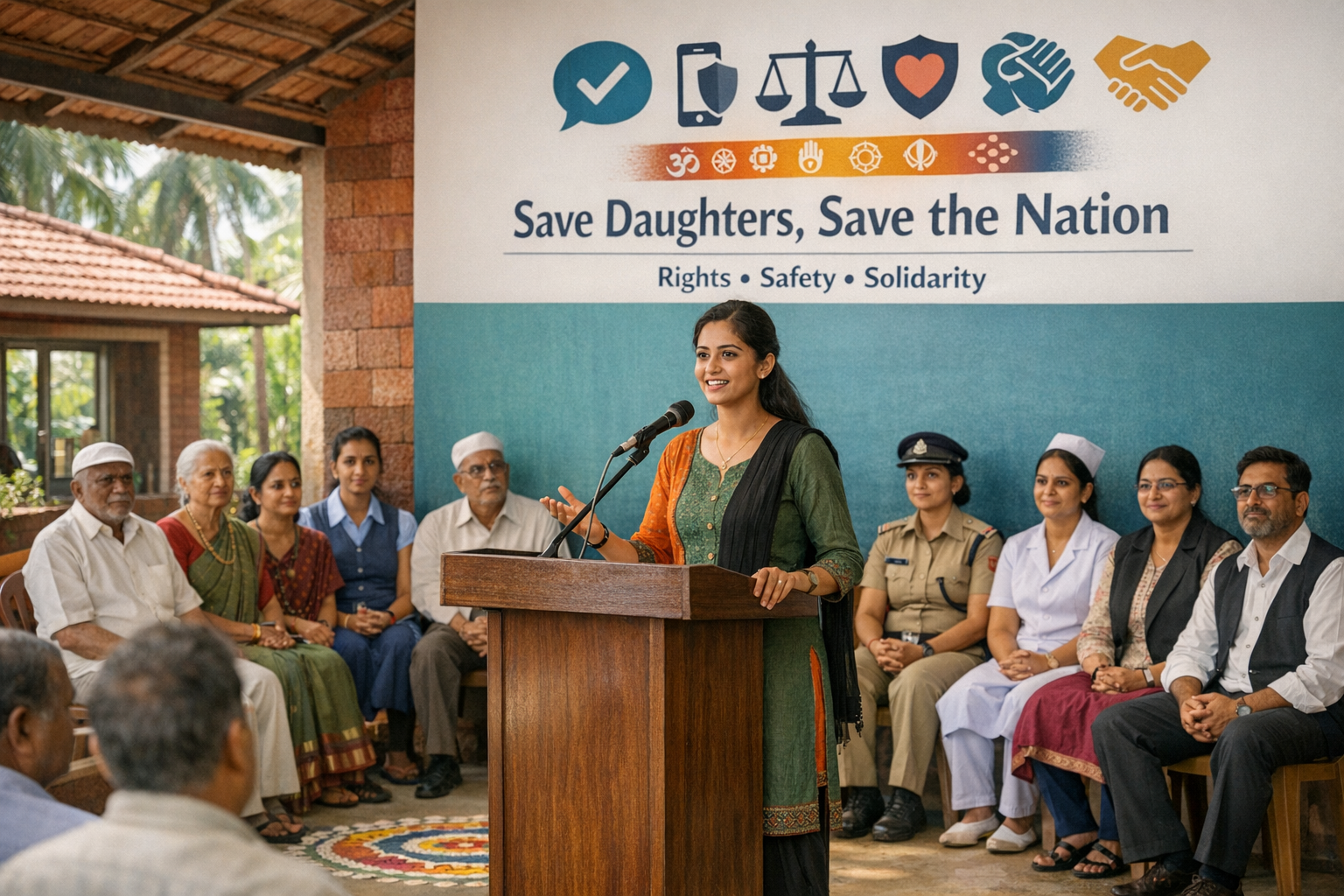
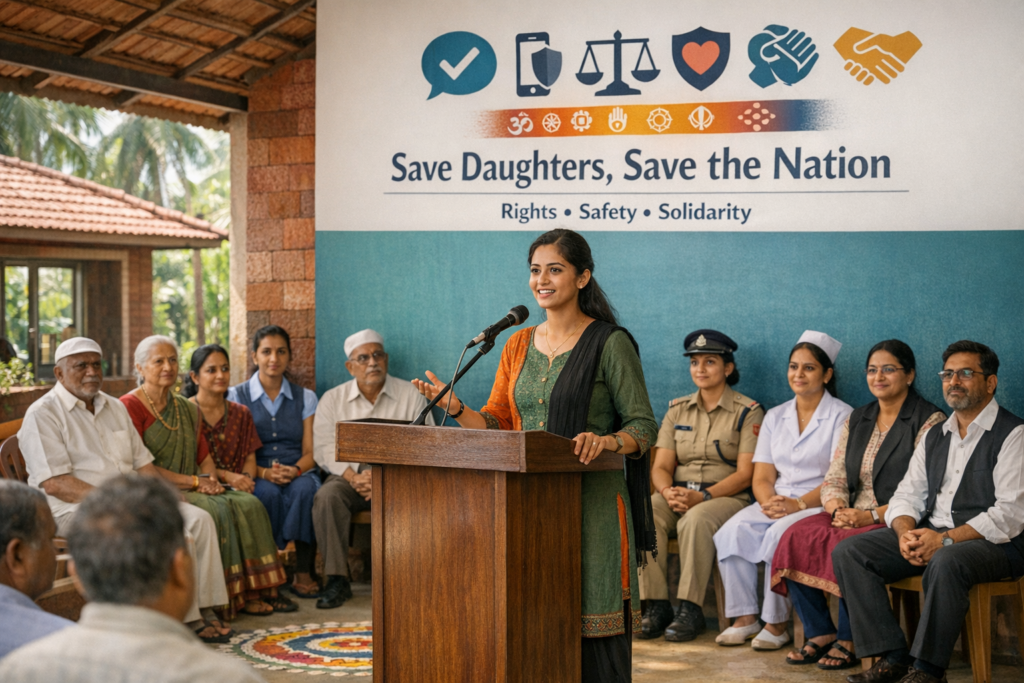
Hindu Janajagruti Samiti (HJS) launched the ‘Save Daughters, Save the Nation’ campaign at a programme in Kudal, Sindhudurg, with Shri. Ramesh Shinde urging citizens to deepen awareness around risks of coercive relationships—often described in public discourse as ‘Love Jihad’—and to collaborate across communities to safeguard young women’s rights, dignity, and well-being.
Presented in a district known for strong social bonds and civic engagement, the initiative positions women’s safety as a shared societal responsibility that transcends religious or cultural identity. The campaign’s emphasis is distinctly rights-based: it foregrounds informed consent, lawful conduct, and survivor-centered support, while explicitly advocating interfaith harmony and social cohesion across Hindu, Buddhist, Jain, and Sikh communities.
By situating the launch in Kudal, the programme recognized both local strengths—close-knit neighborhoods, active youth groups, and responsive institutions—and emerging vulnerabilities, including the expansion of social media, increased mobility, and evolving courtship patterns. The approach adopted is preventive and educational, encouraging communities to develop clear protocols that deter manipulation, grooming, trafficking, and other forms of exploitation, regardless of the identities of those involved.
Importantly, the campaign reframes charged terminology to align with constitutional values and the blog’s overarching objective of unity among dharmic traditions. While acknowledging community anxieties that are sometimes expressed through the phrase ‘Love Jihad’, the initiative concentrates on conduct rather than creed—focusing on deception, coercion, and violence, and rejecting stigma or collective blame. This shift enables constructive dialogue, enhances evidence-based action, and preserves interfaith trust.
At its core, the programme advances three principles: autonomy (the right of adult women to make informed choices), safety (proactive protection from force, fraud, and undue influence), and solidarity (cross-community support networks that respond quickly and compassionately to risks). These principles are operationalized through practical tools and partnerships that strengthen family, school, and institutional capacities across Sindhudurg and beyond.
A public-health and rule-of-law framework underpins the campaign design. It follows a three-tier model: primary prevention (awareness and resilience-building), secondary prevention (early identification and support in at-risk situations), and tertiary response (comprehensive care and legal recourse for survivors). This layered structure helps communities move from reactive, event-driven responses to continuous, systems-based protection.
Primary prevention focuses on literacy—legal, digital, and relational. Suggested modules include informed consent, recognizing grooming and gaslighting, cyber hygiene (privacy settings, safe sharing, and red flags in DMs), campus and workplace boundaries, and bystander intervention. School and college engagements can be complemented by parent–teacher dialogues, NSS and NCC-led outreach, and Self-Help Group (SHG) circles that localize content in culturally sensitive ways.
Secondary prevention emphasizes early help. Faculty counselors, peer mentors, and Mahila Police Volunteers can be trained to identify concern indicators—sudden isolation from support networks, financial extortion, threats around intimate media, or unexplained relocations—without profiling on the basis of religion or community. When concerns arise, a non-judgmental, confidential pathway to support is essential, ideally through district-level standard operating procedures (SOPs).
Tertiary support is survivor-centered and trauma-informed. In districts where available, One Stop Centres (Sakhi), District Legal Services Authorities (DLSA) clinics, women’s helplines, and the Emergency Response Support System can be integrated into clear referral maps. The emphasis remains on the survivor’s choices, safety planning, discreet documentation, and psychosocial care, with community mediators facilitating non-adversarial solutions where appropriate and lawful.
The legal literacy component references pertinent Indian laws, including: provisions of the Indian Penal Code on kidnapping, abduction, cheating, criminal intimidation, and assault; the Protection of Children from Sexual Offences (POCSO) Act, 2012; the Prohibition of Child Marriage Act, 2006; the Protection of Women from Domestic Violence Act, 2005; and relevant sections of the Information Technology Act, 2000 concerning cyber harassment and non-consensual circulation of intimate images. Awareness of due process and the presumption of innocence is stressed to prevent vigilantism and ensure justice.
Implementation requires partnerships: schools and colleges for curriculum integration; panchayats and urban local bodies for community forums; district police and cyber cells for rapid, rights-respecting response; SHGs and youth clubs for outreach; and faith-based organizations for dialogue that strengthens social trust. The inclusion of medical professionals, mental-health counselors, and legal-aid providers fortifies a continuum of care.
The interfaith and intercommunity dimension is explicit. Facilitated dialogues can surface shared values around dignity, mutual respect, and non-violence, while addressing misinformation that can inflame tensions. Structured, good-faith conversations—attended by community leaders, educators, and youth—help replace rumor with fact, fear with empathy, and suspicion with accountability to law and ethics.
Families frequently report uncertainty about balancing trust and vigilance. Practical checklists—verifying basic biographical claims, meeting wider friend circles, observing patterns of secrecy or coercion, setting digital boundaries, and maintaining independent support channels—offer concrete, non-intrusive steps. For minors, strict adherence to child-protection norms and school safeguarding policies is indispensable.
Educational institutions can adopt campus codes on respectful relationships, consent education, and safe reporting. Internal Complaints Committees (ICCs) under the Sexual Harassment of Women at Workplace (Prevention, Prohibition and Redressal) Act, 2013, can coordinate with counselors to ensure that students and staff understand procedures, confidentiality, and protections against retaliation.
The technology pillar highlights ‘Safety by Design’: privacy-first defaults, two-factor authentication, caution with geotagging, and robust responses to online extortion. Digital literacy sessions should include strategies for documenting evidence, safely reporting to platforms and law enforcement, and accessing cyber-legal aid when non-consensual content or impersonation occurs.
From a monitoring and evaluation standpoint, the campaign can track key indicators: number of awareness sessions, participant reach and demographic coverage, referrals to support services, response times, resolution pathways, and satisfaction scores. Mixed-method evaluations—combining anonymized case data with qualitative interviews—can ensure that the initiative remains adaptive, ethical, and effective.
Data protection is non-negotiable. Community volunteers should be trained in confidentiality, secure record-keeping, and the minimum-necessary principle when sharing information with authorities or care providers. Stigmatizing language and public identification of individuals or communities are avoided to protect privacy and prevent secondary harm.
To minimize rumor harm, communications adopt Crisis and Emergency Risk Communication basics: verify before sharing, cite primary sources, avoid speculative claims, and promptly correct misinformation. Community vigilance must never morph into vigilantism; the rule of law and the dignity of all communities are reaffirmed at every step.
Language matters. The phrase ‘Save Daughters’ resonates emotionally but can unintentionally sound paternalistic. The campaign’s materials therefore couple protection with empowerment: promoting decision-making skills, economic independence, and legal confidence. Safety and agency are framed as complementary, not competing, objectives.
The constitutional equilibrium is central. Article 21’s protection of life and personal liberty and Article 25’s freedom of conscience inform a balanced message: adults have the right to choose their partners; society has the duty to prevent force, fraud, and violence; and institutions must guarantee fair, timely access to justice. This balance nurtures both personal freedom and public safety.
In underscoring unity among dharmic traditions, the campaign draws on a shared civilizational ethic: ahimsa, satya, mutual respect, and duty toward the vulnerable. Women’s safety is presented not as a sectarian concern but as a universal imperative that strengthens families, fortifies communities, and advances national well-being.
The Kudal programme stands out for pairing community energy with institutional know-how. By channeling public concern into structured, evidence-informed action—awareness, early support, survivor-centric care, and interfaith dialogue—the ‘Save Daughters, Save the Nation’ campaign offers Sindhudurg a practical pathway to reduce coercion and harm while deepening social harmony.
As the initiative expands, periodic public briefings can share anonymized progress, elevate lessons learned, and invite constructive feedback. Sustained partnership among families, educators, community leaders, and public institutions will be decisive in transforming concern into measurable, lawful, and compassionate protection for every daughter—and, by extension, for the collective strength of the nation.
Inspired by this post on Hindu Jagruti Samiti.









Leave a Reply
You must be logged in to post a comment.