Five Urgent Challenges Facing the Sikh Community—and a Practical, Hopeful Roadmap
The Sikh community stands at a pivotal juncture, balancing fidelity to Gurmat with the demands of a rapidly changing world. Across Punjab and a far‑flung diaspora, families, institutions, and leaders are navigating economic uncertainty, digital disruption, and social polarization while seeking to deepen seva, chardi kala, and sarbat da bhala. This analysis presents a clear, evidence‑informed view of the contemporary five challenges before the Sikh Community and a realistic path forward that strengthens interfaith harmony among Hindu, Buddhist, Jain, and Sikh traditions within the broader dharmic family.
Grounded in the teachings of Guru Nanak—to remember Naam, earn honestly (Kirat Karni), and share (Vand Chhakna)—and the Khalsa discipline shaped by Guru Gobind Singh, Sikh social life has historically combined spiritual depth with public service and courage. Today, the same ethical core can guide collective renewal: building resilient livelihoods in Punjab, safeguarding youth well‑being, modernizing Gurdwara governance, transmitting Gurmukhi literacy and Sikh Rehat Maryada effectively, and defusing polarization while strengthening interfaith dialogue.
Five interlocking challenge clusters emerge repeatedly in policy reviews, community conversations, and field observations: socio‑economic and environmental stress in Punjab; public health and youth well‑being; institutional capacity and governance; identity, education, and transmission; and polarization, security, and interfaith relations. Each challenge has distinct drivers, cross‑sector impacts, and measurable solutions.
Challenge 1: Socio‑economic transformation and environmental stress in Punjab. The post–Green Revolution model—high input costs, paddy‑wheat monoculture, and an assured procurement architecture—delivered food security but also entrenched groundwater over‑extraction, soil fatigue, and vulnerability to climate variability. Independent assessments by water agencies over the past decade have repeatedly flagged a large share of Punjab’s administrative blocks as over‑exploited, underscoring the urgency of course correction.
Beyond ecology, the employment structure is shifting. Mechanization reduces on‑farm labor absorption, while manufacturing and services growth has been uneven. Youth increasingly pursue education abroad or internal migration, reshaping village demographics and intergenerational expectations. Families celebrate new opportunities even as they wrestle with separation, remittance dependence, and identity continuity in new cultural contexts.
A practical response centers on diversification (pulses, oilseeds, millets, and horticulture), climate‑smart practices (micro‑irrigation, direct‑seeded rice, soil health restoration), and value addition (cold chains, processing, cooperatives). Public finance can be re‑aligned toward outcomes—water saved per rupee, carbon intensity reduced per hectare, and farmer income stabilized through risk‑sharing instruments. A complementary skilling and apprenticeship pipeline—linking colleges, MSMEs, and Gurdwara‑anchored community hubs—can widen non‑farm pathways without breaking social ties.
Key indicators to track include groundwater levels by block, farmer net income volatility, diversification ratios beyond paddy and wheat, and female youth participation in new‑economy jobs. Regular, open dashboards maintained by state agencies and civil society would foster accountability and community problem‑solving.
Challenge 2: Public health and youth well‑being. Studies such as the Ministry of Social Justice & Empowerment–AIIMS “Magnitude of Substance Use in India” (2019) have consistently identified Punjab among the states with high opioid misuse prevalence. Substance use disorders intersect with mental‑health stressors, unemployment, and social stigma, eroding family stability and community confidence.
An evidence‑based strategy combines medication‑assisted treatment, counseling, and peer‑led recovery with dignified rehabilitation and reintegration. Gurdwaras can augment clinical systems by hosting recovery‑friendly congregational spaces and linking seva to sustained healing, while sports, arts, and kirtan programs provide protective routines for adolescents. Just as langar nourishes body and spirit, a “Recovery‑to‑Seva” model can transform care into community power.
Alongside substance use, digital overexposure and cyberbullying affect attention, sleep, and anxiety among students. School‑Gurdwara partnerships can bring digital well‑being curricula, parent training, and safe peer‑support groups, ensuring that technology remains a tool—not a trap—for learning and sangat.
Challenge 3: Institutional capacity and governance. The Shiromani Gurdwara Parbandhak Committee (SGPC), Delhi Sikh Gurdwara Management Committee (DSGMC), and thousands of local bodies steward sacred spaces, education trusts, and philanthropy. Their mandates are weighty; expectations are rising; and scrutiny—rightly—is intense. Periodic litigation, factionalism, and politicization can dilute focus on sangat‑centric service delivery.
Modern governance asks for transparent finances, independent audits, conflict‑of‑interest rules, and open data. Digital dashboards can publish real‑time income and expenditure by program, tender details, governance calendars, and project outcomes. Participatory budgeting with the sangat and social‑impact evaluations would align spending with measurable community needs—education access, elderly care, and health outreach.
Capacity also depends on people. Professional development for granthis, ragis, educators, and administrators—credentialed through continuous training in Sikh Rehat Maryada, child protection, ethics, and financial controls—can lift baseline quality everywhere. Increasing women’s and youth representation in boards strengthens intergenerational trust and innovation.
When disagreements arise, time‑tested Sikh processes—deliberation within sangat, a broad panthic lens, and humility—can prevent institutional drift. The goal is not centralization for its own sake but coherence of mission: to deepen devotion, advance learning, and expand seva, with the Gurdwara as a transparent, trusted anchor.
Challenge 4: Identity, education, and transmission. Sustaining Gurmukhi literacy, Gurbani comprehension, and daily Nitnem among children and youth—especially in the diaspora—is vital for living Sikhi rather than only inheriting it. Romanized scripts can assist beginners, yet durable fluency grows through Gurmukhi reading, kirtan training, and conversational Punjabi at home and in community schools.
Curricula that interweave Gurmat philosophy with contemporary themes—civic ethics, environmental stewardship, and digital citizenship—help learners apply teachings to daily life. Weekend Khalsa schools, university sabhas, and online platforms can collaborate on open‑licensed resources, teacher training, and credible assessments that reward understanding, not rote.
Legal and civic contexts also shape identity discourse. Article 25 of India’s Constitution, including its explanatory clause, has long been part of community conversations about recognition and rights. A constructive approach affirms the distinct Sikh identity while celebrating civilizational kinship across dharmic traditions—Hinduism, Buddhism, Jainism, and Sikhism—through shared values of satya, ahimsa/karuna, and seva. Such framing supports unity without erasing uniqueness.
Finally, information ecosystems matter. Algorithmic amplification can push sensational narratives and disinformation about Sikhs, the Khalsa Panth, or institutions. Community‑run fact‑checking, media literacy, and responsible content creation—grounded in Gurbani’s insistence on discernment—are essential defenses in the digital age.
Challenge 5: Polarization, security, and interfaith relations. Most Sikhs prioritize seva, kirtan, and community well‑being; yet a small number of polarized narratives—online and offline—can overshadow mainstream lived reality. Diaspora debates, sacrilege incidents, and geopolitical tensions can inflame emotions and harden echo chambers. Discussions related to the Khalistan Movement require fact‑based, rights‑respecting dialogue that rejects violence and protects civil liberties.
Security and dignity are not rivals. Due process, proportionate law enforcement, and transparent communication preserve trust, while community leaders help de‑escalate rhetoric. Early‑warning networks for communal tension, trained mediators, and rapid myth‑busting reduce the risk of spiral effects—especially when social media floods attention before facts are verified.
Interfaith cooperation is a strategic strength. Joint seva with Hindu, Buddhist, and Jain partners—blood‑donation drives, disaster relief, food security, and environmental clean‑ups—embodies sarbat da bhala and demonstrates the dharmic ethos of mutual respect. When communities solve practical problems together, abstract mistrust loses oxygen.
Media narratives should not define relationships. People‑to‑people bridges—interfaith dialogues hosted at Gurdwaras and temples, comparative ethics seminars in universities, and youth exchanges—allow difficult conversations to be held with dignity and empathy, anchored in facts and shared values.
A practical roadmap for renewal integrates these threads into ten priority moves: first, a Punjab Water‑Soil‑Income Mission that rewards diversification and efficiency; second, a Youth Apprenticeship and Service Year (Seva Year) linking students to MSMEs and social projects; third, a Recovery‑to‑Seva public‑health model scaling evidence‑based treatment and dignified reintegration; fourth, Gurdwara governance transparency through open‑data dashboards, participatory budgeting, and independent audits; fifth, formal representation targets for women and youth on boards and committees.
Sixth, a “Gurmukhi 2.0” pipeline—teacher fellowships, open digital content, and kirtan pedagogy—paired with assessments that certify literacy and comprehension; seventh, community media‑literacy labs and fact‑checking units to counter disinformation; eighth, a Dharmic Seva–Ahimsa–Satya Charter created with Hindu, Buddhist, and Jain partners to guide interfaith projects; ninth, a Diaspora Impact Fund that channels philanthropic and investment capital into education, health, and agro‑innovation in Punjab; and tenth, an annual Panth Progress Report tracking key indicators and inviting course correction.
Measurement is the engine of momentum. Publishing groundwater trends, treatment coverage, governance scorecards, and language‑learning outcomes creates a culture of continuous improvement. What gets measured gets managed; what is shared with the sangat is owned by the sangat.
Diaspora communities—from Surrey and Brampton to Southall and Melbourne—are uniquely positioned to catalyze this agenda by connecting expertise, capital, and mentorship with village‑level institutions in Punjab. Structured partnerships can convert goodwill into compounding benefits for families on both sides of the oceans.
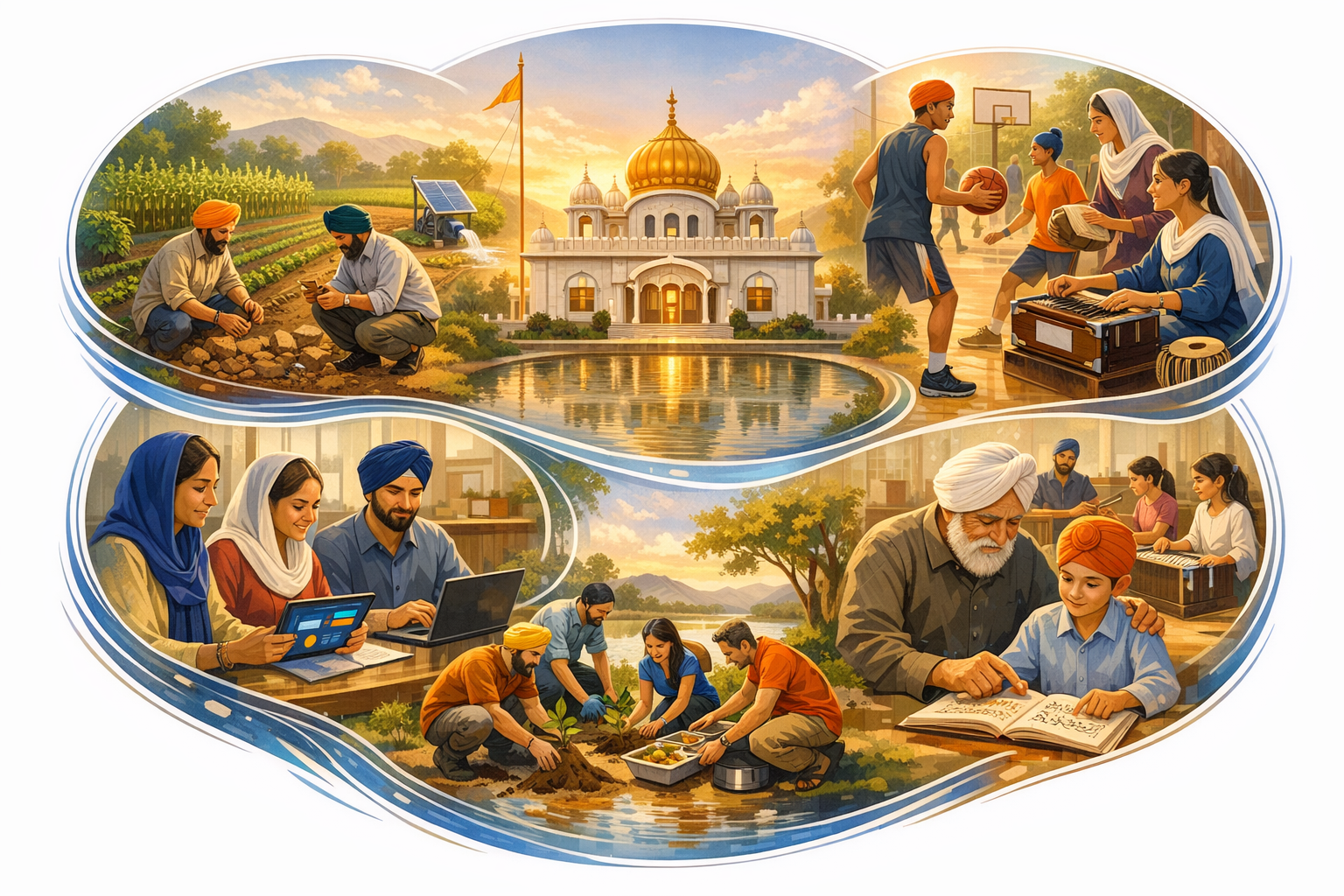
The lived texture of Sikh life—parents guiding children through Japji Sahib, farmers discussing water with neighbors after kirtan, youth teams organizing langar during crises—signals why a hopeful future is achievable. By aligning socio‑economic reform with Gurmat, modernizing institutions without losing soul, and embracing interfaith cooperation as a dharmic strength, the Sikh community can transform today’s pressures into tomorrow’s renewal.
In sum, confronting five urgent challenges with clarity, compassion, and competence will safeguard identity, widen opportunity, and deepen social trust. That is the path of chardi kala in public life: resilient, service‑oriented, and inclusive—faithful to the Khalsa spirit and generous to all.
What are the five interlocking challenges facing the Sikh community outlined in the article?
The article identifies five interlocking challenges: socio-economic and environmental stress in Punjab; public health and youth well-being; institutional capacity and governance; identity, education, and transmission; and polarization, security, and interfaith relations. Each challenge has distinct drivers and measurable solutions.
What practical strategies does the roadmap propose for Punjab's socio-economic and environmental challenges?
Strategies include diversification of crops beyond paddy and wheat, climate-smart practices like micro-irrigation and soil health restoration, and value addition through processing and cooperatives. Public finance should be realigned toward measurable outcomes, such as water saved per rupee and farmer income stabilization. A skilling and apprenticeship pipeline linking colleges, MSMEs, and Gurdwara hubs can widen non-farm opportunities while preserving community ties.
How can Gurdwaras support public health and youth well-being?
Gurdwaras can host recovery-friendly spaces and link seva to sustained healing; they can reinforce youth well-being with sports, arts, and kirtan programs.
What governance changes does the article advocate for Sikh institutions?
Transparent finances, independent audits, conflict-of-interest rules, and open data are proposed, with dashboards that publish real‑time program finances. Participatory budgeting with the sangat and social‑impact evaluations would align spending with community needs, and there is emphasis on greater women’s and youth representation on boards.
What role does interfaith cooperation play in the roadmap?
Interfaith cooperation is framed as a strategic strength, with joint seva with Hindu, Buddhist, and Jain partners. It shows how practical collaborations—blood donation drives, disaster relief, and environmental clean-ups—embody shared dharmic values and help reduce polarization.











Leave a Reply
You must be logged in to post a comment.