
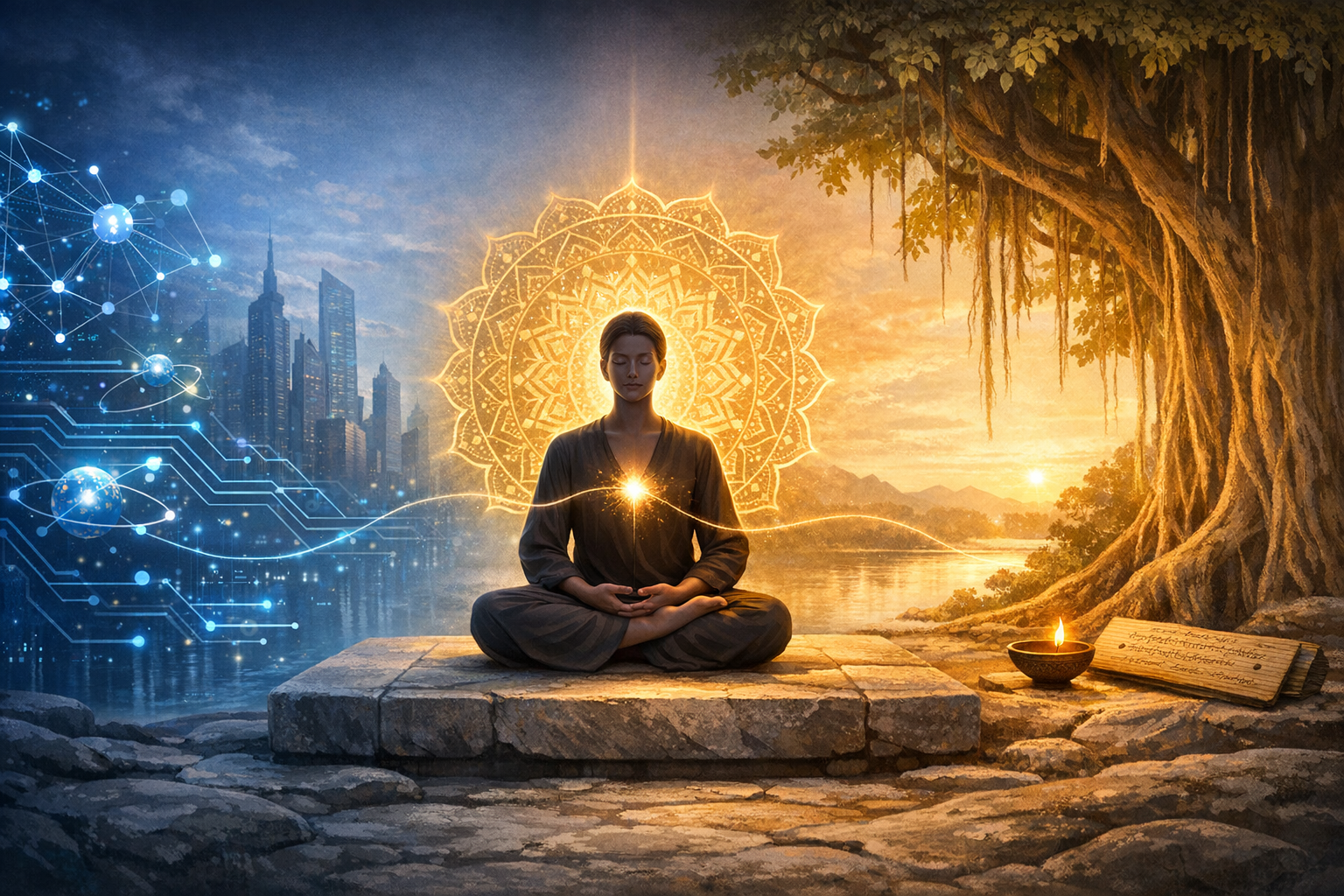
Across an age of artificial intelligence, quantum devices, and genomic engineering, certain questions continue to press upon human attention with undiminished urgency: What is consciousness? What is a good life? What finally liberates one from suffering? The Upanishads, the culminating wisdom of the Vedas and the wellspring of Vedanta, continue to address these questions at a depth modern science and technology do not claim to reach. Their insights remain relevant not in spite of technological progress, but precisely because progress exposes the limits of technique without resolving the meaning and purpose of being.
Dr S. Radhakrishnan framed this continuity with characteristic clarity: “The problems of human life and destiny have not been superseded by the striking achievements of science and technology. The solutions offered (in ancient classics like Upanishads), though conditioned in their modes of expression by their time and environment, have not been seriously affected by the march of scientific knowledge and criticism.” The persistence of these problems suggests a complementarity of domains: where science explains mechanisms and regularities, the Upanishads inquire into ultimacy, value, and liberation.
The thesis is straightforward yet profound: science and technology map the structures and functions of the world; the Upanishads interrogate the knower, the conditions of knowing, and the telos of life. No advancement in predictive power or engineering prowess can substitute for the discernment of Self (ātman) and reality (Brahman), or determine the goals of human existence (purushārthas: dharma, artha, kāma, moksha). These are distinct but mutually illuminating enterprises.
Clarifying the boundary of competence is essential. The scientific method excels at modeling third-person phenomena that can be intersubjectively observed, measured, and tested. Upanishadic inquiry specializes in first-person and second-person domains: the structure of awareness, the phenomenology of experience, the ethics shaping action, and the soteriological horizon of freedom. When these domains are conflated, scientism emerges—a philosophical overreach that wrongly assumes empirical methods are the only path to all knowledge. The Upanishads resist this by articulating a sophisticated theory of knowing.
Classical Indian epistemology names diverse pramāṇas (means of valid knowledge): pratyakṣa (perception), anumāna (inference), upamāna (comparison), arthāpatti (postulation), anupalabdhi (non-cognition), and śabda (reliable testimony). Science prominently deploys pratyakṣa and anumāna within controlled, repeatable contexts; the Upanishadic tradition, while never rejecting perception and inference, adds disciplined interiority and authoritative testimony as further sources of warranted cognition. Crucially, śabda here is not blind acceptance; it denotes tested insight passed down through a lineage in which teachings are to be practiced, interrogated, and realized. The result is not credulity, but an expanded, methodical epistemology that includes first-person replicability.
Nowhere is this complementarity clearer than in the contemporary “hard problem” of consciousness. Neuroscience can increasingly correlate brain states and reported experiences, but correlation is not identity and does not explain why or how subjective experience arises. The Upanishads proceed differently: they do not treat consciousness as a product—emergent or epiphenomenal—but as the precondition of all appearances. The mahāvākyas, such as “tat tvam asi” and “aham brahmāsmi,” point to identity-in-nonduality, where the witness of all states is not itself an object within any state. This is not a scientific hypothesis but a phenomenological and metaphysical disclosure accessed through disciplined inquiry.
Such inquiry is not vague; it is methodological. Practices of attention, ethical purification, and contemplative absorption are structured protocols aimed at stabilizing the mind and revealing the substratum of awareness. In contemporary terms, this resonates with neurophenomenology, which pairs first-person reports refined by training with third-person measurements. Studies of contemplative practice suggest that attention, emotion regulation, and self-referential processing can be systematically transformed. While science documents the correlates and effects, the Upanishads furnish the interpretive frame and telos: knowledge that is liberating (vidyā) rather than merely informative.
Technology, for all its power, is silent on ends. It can amplify, accelerate, and scale; it cannot tell whether to pursue more of the same, or whether restraint, reorientation, or renunciation are wiser. The Upanishads situate action within dharma and judge success not only by utility but by alignment with truth (satya), non-harm (ahimsā), and the ultimate aim of moksha. In the canonical Vedic vision, artha and kāma are not denied; they are subordinated to dharma and consummated in moksha. This ethical architecture is profoundly relevant to a world wrestling with climate risk, algorithmic bias, and biotechnology: problems produced by power without proportionate wisdom.
The Upanishads are also acutely aware of language’s limits. Through “neti, neti” (not this, not this), they mark the boundary of conceptual capture and steer the seeker from descriptive adequacy to direct realization. This is not anti-intellectualism; it is a meta-intellectual insight that distinguishes between a map and a journey. Science continually revises its maps with better data and models; Upanishadic teaching accepts the necessity of provisional concepts while directing attention to the one reality in which all maps arise and dissolve.
Some readers recognize this distinction experientially. Encounters with sudden beauty, grief, or awe often suspend explanatory reflexes and disclose an undivided presence more intimate than thought. Such moments do not invalidate science; they simply reveal that explanation and meaning occupy different registers. The Upanishads cultivate this recognition into stable knowledge, so that insight is not episodic but abiding.
Importantly, the dharmic traditions converge on this interior science while preserving distinctive insights that enrich a shared conversation. Buddhism interrogates the fiction of a permanent self (anātman) and discloses dependent origination and emptiness, safeguarding non-attachment and compassion. Jainism offers anekāntavāda, the doctrine of many-sidedness, inoculating discourse against dogmatism and inviting rigorous pluralism. Sikhism proclaims Ik Onkar, grounding devotion and service (seva) in a unitive reality that levels hierarchy and dignifies labor. Read together, these perspectives do not conflict with the Upanishadic project; they refine, temper, and universalize it, serving the blog’s aim of unity across Hindu, Buddhist, Jain, and Sikh pathways.
Consider concrete frontiers where this unity of wisdom and method matters. In artificial intelligence, the question is not only what machines can do, but what humans should do with machines. A dharmic ethics—rooted in satya (truthfulness), ahimsā (non-harm), aparigraha (non-grasping), and daya (compassion)—supplies normative constraints for alignment and governance beyond narrow notions of efficiency. Such values can inform incentives, data stewardship, and risk thresholds, shifting design from capability maximization to responsibility optimization.
Similarly, ecological stewardship benefits from the civilizational intuition summarized in “Vasudhaiva Kutumbakam”—the world is one family. Where modern policy debates fixate on emissions curves and technologies of abatement, the dharmic frame adds a transformation of desire: sufficiency over excess, relationship over extraction, and reverence over domination. The Upanishadic sense that all beings abide in Brahman fosters a practical ethic that links consumption to conscience, without which technical fixes remain perennially outpaced by appetite.
In health and well-being, contemplative practices long preserved by dharmic traditions are entering mainstream education, workplaces, and clinical settings. Science studies mechanisms and outcomes; the Upanishadic orientation clarifies intention: practices are not merely for stress reduction or productivity, but for self-knowledge and freedom from compulsive identification. Recontextualizing technique within telos prevents instrumentalization of the inner life while respecting empirical inquiry into benefits and boundaries.
Education is a decisive lever. An integrative curriculum can introduce students to Indian philosophy (darśanas), the pramāṇa framework, and comparative philosophy alongside laboratory science and data literacy. Such formation equips learners to navigate the digital age with cognitive flexibility, ethical clarity, and contemplative poise. The result is not a retreat from modernity, but a maturation of modernity—innovation under guidance.
Objections deserve careful hearing. One common critique insists that metaphysical claims unsupported by experiment have no cognitive status. The Upanishadic response is to expand, not collapse, the criteria of validity: first-person evidence, when collected under disciplined conditions and convergent across lineages, is not less evidence but differently situated evidence. Another critique warns of relativism in pluralistic traditions. Here the dharmic insight is precise: plurality of paths does not entail equivalence of claims; rather, it invites rigorous sādhanā (practice), dialogue, and humility to test what truly conduces to freedom from suffering and ignorance.
A forward-looking research agenda can therefore be articulated: pair contemplative training with neuroscientific measurement (neurophenomenology); examine dharmic ethics as a framework for AI alignment and governance; study the impact of aparigraha and contentment (santoṣa) on sustainable consumption; and develop public-policy heuristics that balance artha with dharma. Each thread preserves the strengths of science and technology while drawing on Upanishadic and dharmic insights to orient them toward the good.
In summary, science and technology are unsurpassed at modeling, predicting, and building. The Upanishads and the wider dharmic traditions are unsurpassed at revealing meaning, value, and liberation. The former answer how; the latter answer why and to what end. One without the other yields either power without wisdom or wisdom without application. Together, they point to a civilization of competence anchored in conscience. This is why the wisdom of the Upanishads is not displaced by progress; it is the measure by which progress becomes truly humane.
Inspired by this post on Hindu Blog.







Leave a Reply
You must be logged in to post a comment.