
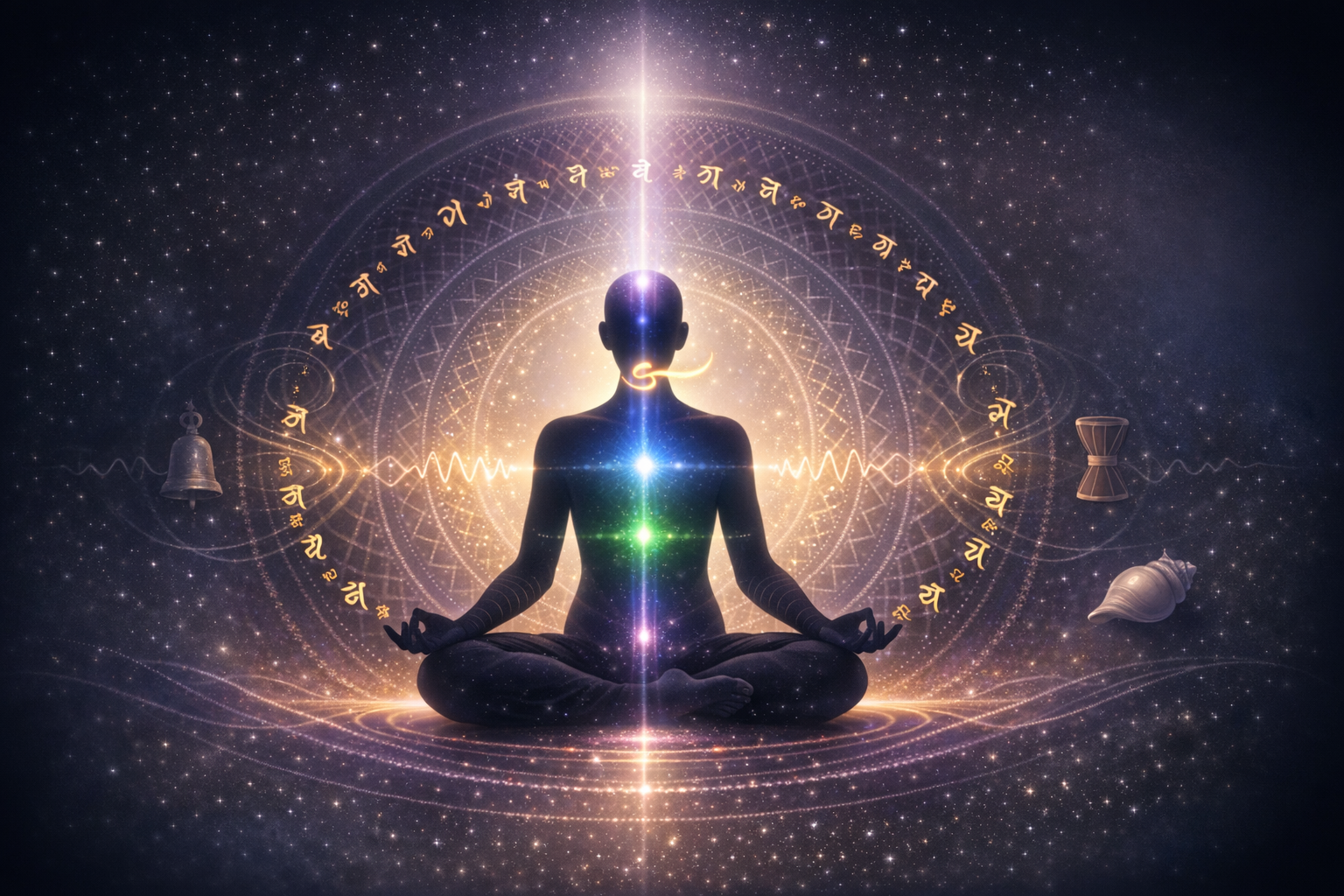
Before any atom stirred or galaxy spun, the Tantric vision situates reality in a primordial vibration—Sabda Brahman—described as the Absolute apprehended as Sound, a living resonance rather than a sensory noise. This idea is neither a metaphor nor a mere poetic flourish; it is a precise metaphysical claim that sound, as fundamental vibration, is an ontological principle pervading cosmos, consciousness, and the pathways of liberation across the Dharmic traditions.
Sabda Brahman identifies the Absolute as sound and aligns closely with the allied expression Nada Brahman, the cosmos as living vibration. Classical Indian thought distinguishes the audible from the suprasensory by rooting sound in consciousness itself. In Vedic and Tantric streams, sound does not begin in the ear; it begins in awareness, moves through subtle stages of manifestation, and culminates as articulated speech. Hence, sacred sound is considered not only devotional or ritualistic but epistemic and transformational.
A pivotal framework across Tantra and allied orthodox traditions maps four stages of speech: para (undifferentiated, ineffable awareness), pashyanti (intuitive vision where meaning and sound remain unified), madhyama (mental formation, where differentiation begins), and vaikhari (gross uttered speech). These stages explain how meaning precipitates into phonemes, how mantra interfaces with cognition and breath, and why certain practices seek to return attention from vaikhari back toward para, untying the knot that binds awareness to discursivity.
Tantric lineages also develop a sonic anatomy through matrika, the subtle “mothers” or powers of letters, and the varnamala, the garland of phonemes regarded as energies of consciousness. In many Shakta and Shaiva Tantras, the entire Sanskrit alphabet is treated as a living mandala of Shakti. Rituals such as Matrika Nyasa consecrate the body as a field of sound, installing letters at specific loci, thereby aligning individual embodiment with cosmic resonance.
Within this architecture, mantra functions as concentrated vibration. Bija mantras (seed syllables) like OM, HRIM, SHRIM, or KLIM encode specific energetic signatures and devotional orientations. Classical manuals often analyze mantras by components such as bija (seed), shakti (power), chhanda (meter), devata (deity principle), and kilaka (a cryptic “pin” indicating guarded knowledge), underscoring that mantra is more than wording; it is a precisely engineered psychoacoustic instrument.
Modes of japa—loud (vachika), whispered (upanshu), and mental (manasika)—progressively refine energy expenditure and attention. Loud japa entrains breath and posture; whispered japa stabilizes attention and cultivates inwardness; mental japa minimizes sensory leakage and strengthens subtler concentration. Each mode can be selected based on context, temperament, and sadhana goals, while retaining fidelity to lineage guidance and ethical commitments.
Tantric models correlate sound with yogic anatomy: the visuddha (throat) chakra relates to expression and refinement of vibration; the anahata (heart) chakra to the “unstruck sound” (anahata nada), an inner hum not produced by external impact; the ajna (brow) center to integration of sound, light, and meaning. This is embedded within the larger network of nadis, with sushumna nadi as the central channel through which Kundalini ascends, reconfiguring the practitioner’s perceptual field and embodiment of resonance.
Temple and ritual soundscapes enact the same science in collective space. The ghanta (bell) purifies attention and phase-aligns the ritual field, the shankha (conch) opens and seals thresholds with a broad-spectrum sonic imprint, and the damaru invokes rhythmic polarity and emergence. Vedic recitation employs tonal precision (udatta, anudatta, svarita), preserving vibratory integrity over millennia. Architecture and materials are chosen to amplify these effects, turning shrines into living acoustical instruments.
Classical philosophy illuminates why sound transforms. Purva Mimamsa defends the eternity of sabda as a valid means of knowledge, while Vedanta reframes sabda as a pointer to Brahman, culminating in silence beyond articulation. Bhartrhari’s sphota theory regards meaning as a holistic burst rather than an additive sum of phonemes, resonating with Tantric insights that consciousness delivers meaning instantaneously, with discrete sounds serving as vehicles of that integral reveal.
Kashmir Shaivism’s doctrine of Spanda—pulsation—offers a nuanced account of awareness as dynamic quiver. Sabda and Spanda interlock: what is heard as sacred sound corresponds to the primordial throb of consciousness. Thus, mantra practice is less about producing effects externally and more about attuning to the Spanda already active as the ground of experience.
Practical pathways integrate breath, attention, and phonation. OM (AUM) practice synchronizes the triad of articulation—A (gut and chest), U (throat and palate), and M (nasal-cranial)—with an ensuing silence that hints at para. Slow, even breathing stabilizes autonomic rhythms; bhramari (humming) can promote relaxation and nasal resonance; and attentive listening practices (nada yoga) refine perception of internal tones. These methods are contemplative training, not medical treatment, and should be adapted conscientiously.
Contemporary science offers convergences without collapsing distinctions. Acoustic resonance, sympathetic entrainment, and psychoacoustics explain why stable tones and rhythmic breath can modulate arousal and attention. Slow breathing is associated with improved heart rate variability, while gentle humming can influence vagal pathways and nasal airflow. Such findings do not exhaust Tantric meaning but indicate physiological doorways through which practice may stabilize and deepen contemplative states.
Ethical orientation (yama, niyama) and affective tone (bhava) remain decisive. Sound that is mechanically correct but ethically untethered seldom yields liberating fruit. Intention, reverence, and steadiness of practice shape what sound reveals; they align personal vibration with dharma, safeguarding depth over display and communion over performance.
The unifying vision of Sabda Brahman extends across the Dharmic family. In Hindu streams, mantra and kirtan cultivate devotion and insight; in Buddhist Vajrayana, mantras integrate method and wisdom; in Jain practice, the Namokar Mantra embodies veneration of purity and liberation; in the Sikh tradition, the Shabad and Naam Simran illuminate the primacy of divine sound-current. Such convergences affirm a shared civilizational intuition: sacred sound is a bridge, not a boundary—an invitation to unity-in-diversity.
Everyday life offers a proving ground. Intentional pauses for soft OM, measured breath before dialogue, mindful listening to the sonic environment, and respectful participation in communal chanting can re-pattern stress into presence. Over time, the sense of an underlying “eternal hum” emerges less as a concept and more as a felt certitude—a quiet alignment of body, speech, and mind with the living resonance that Tantra names Sabda Brahman.
Ultimately, the science of sacred sound presents a comprehensive discipline: metaphysics of vibration, philosophy of language, ritual acoustics, yogic physiology, contemplative method, and ethical guardrails. Approached with humility and perseverance, it reveals sound as origin, path, and fruition—the primordial pulse from which expression arises and to which it returns.
Inspired by this post on Hindu Blog.










Leave a Reply
You must be logged in to post a comment.