
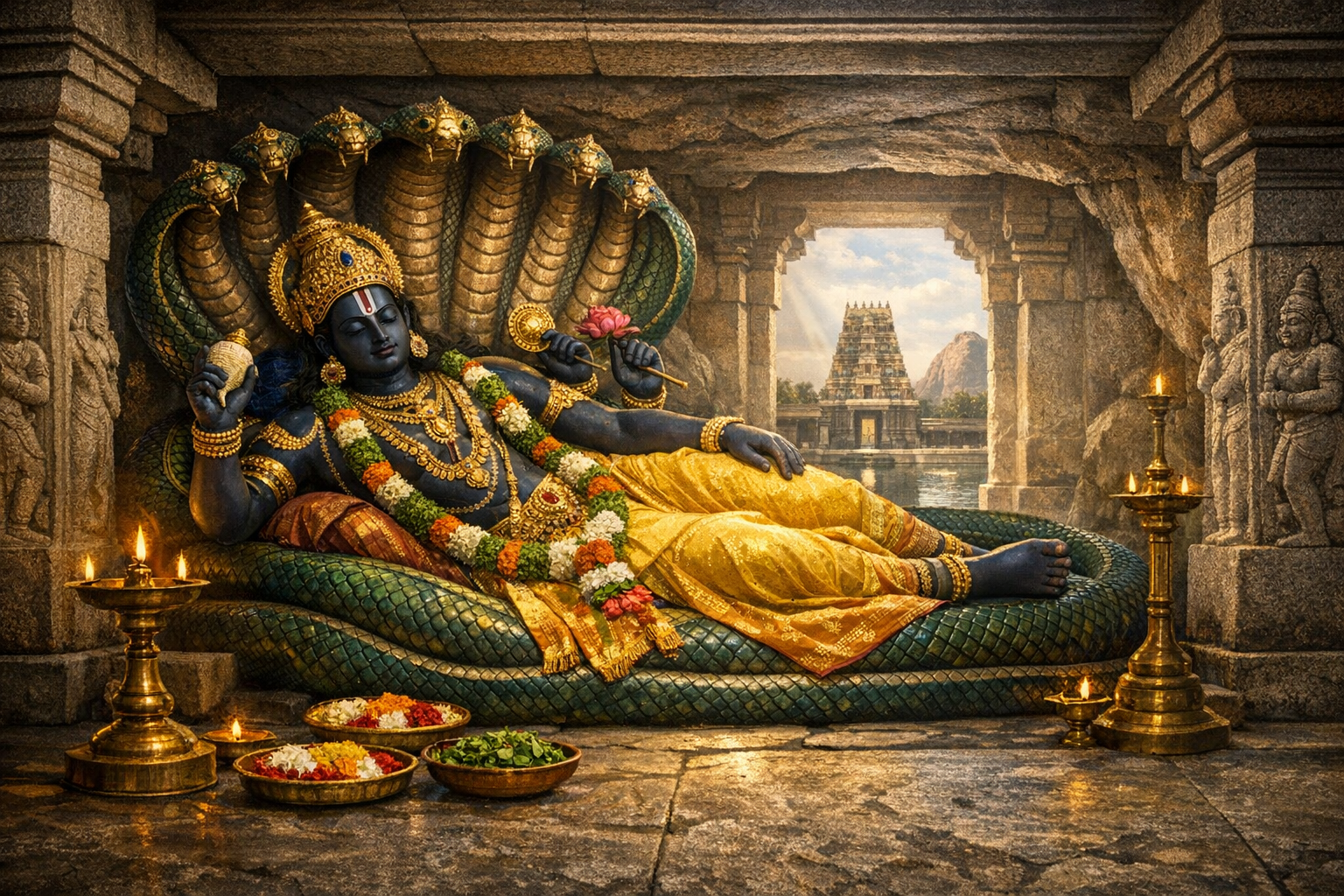
At the Namakkal Ranganatha Swamy Temple in Tamil Nadu, the presiding form of Vishnu reclines in a rare Karkotaka Sayanam—divine repose upon the coils of the serpent-king Karkotaka. Revered as Lord Ranganatha, this image synthesizes classical Sri Vaishnava theology, Dravidian rock-cut artistry, and a living ritual ecosystem, making the sanctuary a vital node in the cultural and spiritual heritage of South India.
Situated in Namakkal, Salem district, and encircling a commanding granite monolith popularly known as the Namakkal Rock Fort, the temple is embedded in a broader sacred landscape that has shaped pilgrimage culture for centuries. The town’s spatial rhythms—shrines, ceremonial routes, and water bodies—accommodate processions and festivals that animate the urban fabric through the ritual calendar.
The Namakkal sacred cluster typically comprises three interconnected shrines: the hill-facing rock-cut Namakkal Narasimha Swamy Temple, the cave sanctuary of the Namakkal Ranganatha Swamy Temple at the foothill, and the freestanding Anjaneyar Temple famed for its monumental Hanuman. Pilgrims often undertake these as a single liturgical circuit that narrates protection (Narasimha), service and devotion (Hanuman), and cosmic repose (Ranganatha) in a continuous, contemplative arc.
From an art-historical perspective, the complex belongs to the long trajectory of early-medieval rock-cut temple-making in Tamil Nadu, subsequently extended during Pandya, Vijayanagara, and Nayak phases. The combination of a cave sanctum, structural mandapa, and later gateways at Namakkal mirrors a pattern dispersed across the Kaveri basin, where sanctuaries evolved organically as patronage, population, and ritual requirements increased over time.
Epigraphic notices and stylistic comparison indicate sustained endowments for lamps, offerings, and structural care over several centuries. While fragmentary in places, such records corroborate liturgical continuity and highlight how agrarian and mercantile communities supported temple economies that, in turn, organized calendrical festivals and charitable feeding, reinforcing the temple’s role as a social as well as spiritual institution.
Local sthala purana traditions foreground the serpent-king Karkotaka, a renowned Naga in Sanskrit literature associated with moral testing and transformation. In Namakkal, devotion culminates in Karkotaka becoming the divine couch for Vishnu’s yogic repose, yielding the epithet Karkotaka Sayanam. Interlinked narratives relate the hilltop presence of Lakshmi-Narasimha and the vigilant Hanuman nearby, together portraying protective grace, steadfast bhakti, and universal shelter under Vishnu’s compassion.
Iconographically, Lord Ranganatha reclines in bhujanga sayana upon layered serpent coils, with the multiple hoods forming a protective canopy that functions as a living prabhavali. The four arms typically bear shankha (conch), chakra (discus), gada (mace), and padma (lotus), while the countenance remains serene and half-lidded, embodying yogic inwardness. A separate shrine for Ranganayaki Thayar accords with Sri Vaishnava temple grammar, emphasizing the complementary, ever-present grace of Lakshmi.
The image coheres with Shilpa Shastra canons prescribing proportions (tala-mana), limb articulation, and serpent-hood geometry for reclining Vishnu forms. The serpent’s rhythmic coils establish a calibrated visual base-line, while a subtle torsion through the Lord’s torso introduces stillness without rigidity. This measured aesthetic—soft repose framed by vigilant guardianship—produces the distinctive experience that devotees recognize as the Karkotaka Sayanam at Namakkal.
Architecturally, the Namakkal Ranganatha Swamy Temple integrates a rock-cut garbhagriha with a later-period pillared mandapa and circumambulatory passage. The complex reflects the Dravida typology’s emphasis on axial clarity, orthogonal bays, and progressively elaborated thresholds, often concluding in a modest gopuram oriented to a processional street. A temple tank in the vicinity, integral to purification rites and seasonal observances, supports the water-intensive liturgy of daily abhisheka and festival cycles.
Ritually, the temple follows the Sri Vaishnava agamic tradition, with nitya puja cycles punctuated by major observances such as Vaikunta Ekadashi, Panguni Uthiram, and the annual Brahmotsavam. Vedic recitation is frequently interwoven with the Tamil Divya Prabandham, sustaining the region’s bilingual sacred soundscape. Theologically, Lord Ranganatha’s repose symbolizes cosmic equipoise—Dharma at rest yet alert—sustaining creation between cycles and assuring devotees of enduring protection.
Pilgrims regularly describe a palpable hush upon entering the cool, shadowed rock-cut sanctum, where stone, serpent, and sanctity converge into a single field of perception. Many traverse the triad circuit—Narasimha on the hill, Anjaneyar in vigilant stance, and Ranganatha in repose—moving experientially from protective ferocity to disciplined devotion and finally to contemplative rest. Repeated across generations, this practice functions as pedagogy by pilgrimage, encoding ethical courage, service, and mindful calm.
Within the wider Ranganatha tradition—from the monumental Srirangam to numerous sanctuaries across the Kaveri delta—Namakkal’s Karkotaka Sayanam stands out for explicitly invoking Karkotaka in place of the more commonly referenced Adishesha. Rather than a departure, this specificity signals a local intensification of Naga devotion embedded in Tamil sacred geography, demonstrating how living Hindu temple forms remain regionally expressive while remaining aligned with canonical boundaries.
Serpents in the Indic imagination connote both latent energy and protective enclosure, at once ring-fencing sanctity and bridging terrestrial and aquatic worlds. As Vishnu reclines upon Karkotaka, the coils become a visual metaphor for containment and continuity, while the hooded canopy evokes shelter and sovereignty. In theological terms, the image unites yoga (interiority), kshema (protection), and shanti (equipoise), translating metaphysical insight into graspable stone and daily ritual.
Naga symbolism is shared widely across dharmic traditions. Buddhist and Jain art in South Asia likewise deploy serpent motifs for protection, memory, and the threshold between the human and elemental. Viewed through this lens, the Karkotaka Sayanam at Namakkal becomes not only a Sri Vaishnava treasure but also a locus for inter-dharmic appreciation, where Hindus, Buddhists, Jains, and Sikhs may recognize converging values of compassion, discipline, and service to the common good.
From a heritage standpoint, the complex invites meticulous conservation of rock surfaces, inscriptions, and sculpted details that can be vulnerable to moisture, soot, and over-cleaning. Sustainable visitor management—regulated oil use, calibrated lighting, and informed signage—helps preserve the icon’s polished planes and the cave’s microclimate. Documenting oral histories among temple functionaries and local families further protects the intangible heritage that animates the site.
For researchers, the Namakkal Ranganatha Swamy Temple offers a compact case-study in South Indian temple evolution: rock-cut origins, layered patronage, resilient ritual economies, and narrative plurality. For pilgrims, the triad of Narasimha, Anjaneya, and Ranganatha encodes a contemplative grammar—protection, service, and rest—articulated through three proximate shrines. For all, the Karkotaka Sayanam remains an exceptional visualization of Lord Ranganatha’s cosmic rest, inviting the gaze to linger and the mind to become still.
Inspired by this post on Hindu Blog.




Leave a Reply
You must be logged in to post a comment.