
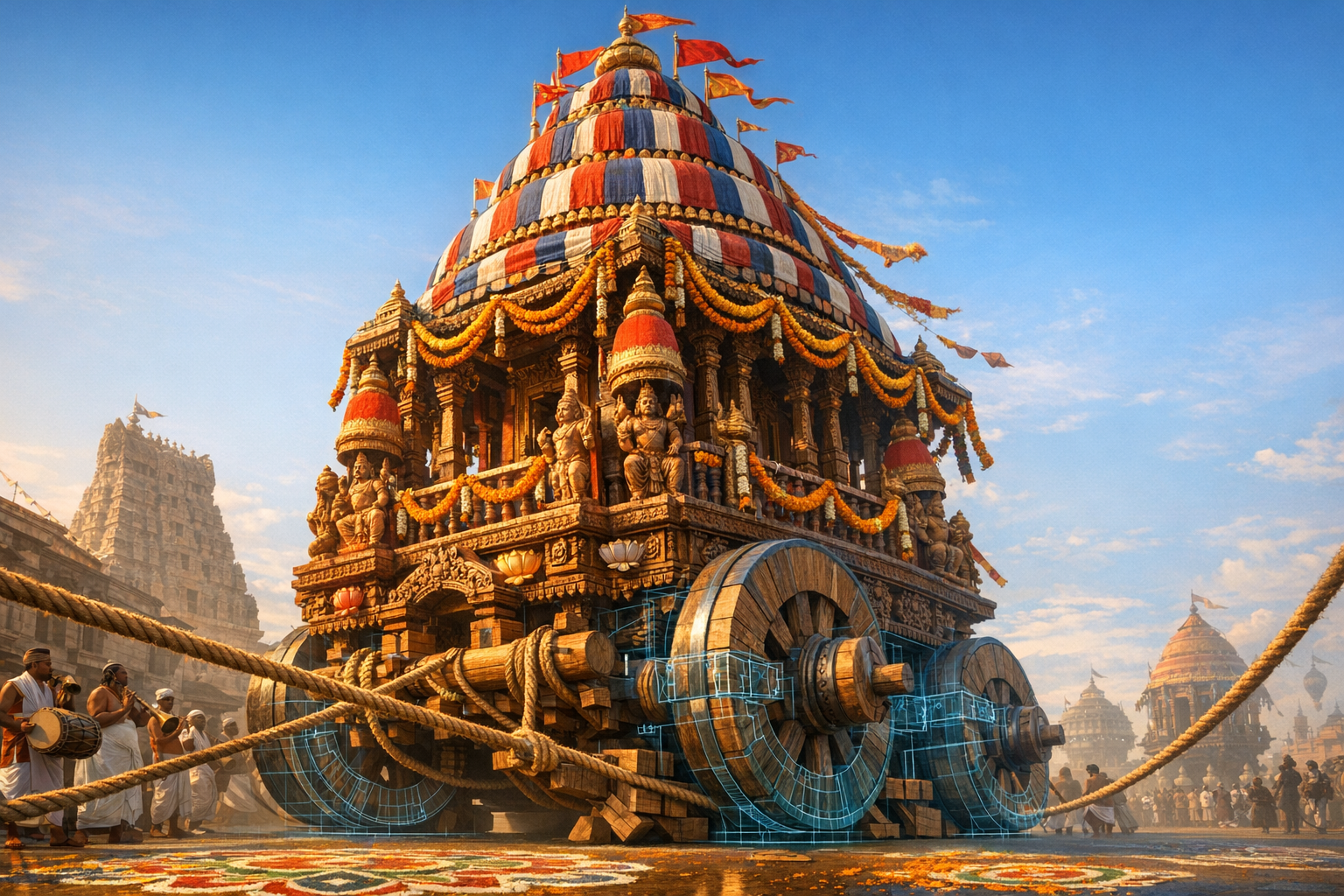
Among the most stirring sights in Hindu temple traditions is the sacred chariot, the ratha, rolling through streets crowded with devotees, musicians, and priests. In Hindu temples across India and the diaspora, processional chariots transform towns into ritual space, extend the sanctity of the garbhagriha into the wider community, and create a moving axis between temple and world. Far from being a relic of the past, the ratha remains a living institution—an intersection of theology, temple architecture, festival logistics, and community identity that continues to evolve with modern urban life.
Within the ritual calendar of Hindu temples, the ratha serves as the principal vehicle for utsava-murtis (festival images) during rathayatra or rathotsava, allowing public darshan beyond temple walls. This outward movement reflects a theological gesture: the deity visits devotees, blessings are shared with all, and the sacred and civic realms are consciously intertwined. Such processions embody a Sanatana Dharma ethos of inclusivity, in which devotion, aesthetics, and social cohesion converge through shared celebration.
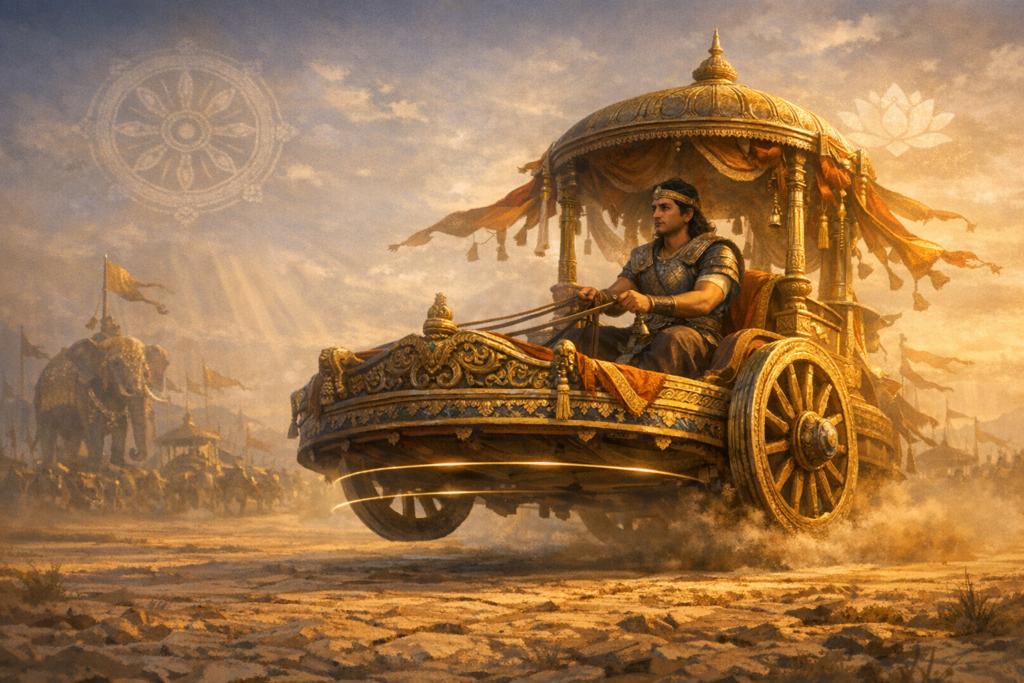
The symbolic foundations of the ratha are deep and pan-Indic. The Katha Upanishad famously employs the chariot metaphor to describe the human condition: the body is the chariot, the atman (Self) is the passenger, the intellect (buddhi) acts as charioteer, the mind (manas) serves as reins, the senses are horses, and the sense-objects are the roads. In this interpretive lens, the ratha symbolizes disciplined movement toward moksha, guided by discrimination and restraint. When a temple’s ratha moves, it re-enacts this journey in public form, reminding communities that ethical self-mastery, devotion, and right understanding are essential to spiritual progress.
Textually and ritually, the chariot motif pervades Hindu scriptures and temple practice. Vedic and Puranic imagery abounds with divine chariots, from Surya’s seven-horsed ratha that illuminates cosmic time to the epic chariots of the Mahabharata that stage the moral drama of dharma-yuddha. Temple rathas translate this imagery into lived tradition, making theological ideas tangible through wood, rope, wheel, and motion.
Nowhere is the living vitality of rathayatra more evident than in the annual procession of Jagannath at Puri. Although the specifics vary by region and era, the Puri Srimandir rathayatra is widely recognized for its scale and devotional intensity. Distinct chariots are prepared for Jagannath, Balabhadra, and Subhadra; they are newly constructed each year by hereditary artisans using traditional hardwoods and joinery. Over several days, the deities travel along the Badadanda to the Gundicha Temple and return, with lakhs of devotees participating. The chariots’ towering superstructures, canopies, and iconographic details encode layers of Vaishnava symbolism while anchoring Odisha’s cultural heritage.
In Gujarat, the Jagannath Temple at Ahmedabad conducts a major ratha yatra that threads through the city’s historic neighborhoods, sustaining a centuries-old bond between temple and town. In coastal Karnataka, Udupi’s Sri Krishna Matha organizes grand chariot processions linked to the Paryaya cycle, bringing the utsava-murti to devotees amidst bhajans and Vedic chanting. Each instance reveals how the ratha unifies place, pilgrimage, and participation.
South India preserves a vast repertoire of temple car festivals—Ther or Theru (Tamil), Therotsavam, and Rathotsava (Kannada/Telugu)—whose monumental wooden chariots are triumphs of sacred engineering. The famed ther of Tiruvarur Tyagaraja Temple, the car festivals of Kanchipuram’s Varadharaja Perumal and Ekambareshwarar Temples, and the chariot day within the Tirumala Tirupati Devasthanam (TTD) Brahmotsavam all exemplify how design, ritual sequence, and community volunteering converge. In many towns, the annual “car festival” is as defining of civic identity as it is of religious devotion.
At Tirumala, the Brahmotsavam’s processional cycle places the deity on a variety of vahanams across days, culminating in the ratha’s sacred pull. The ratha here is both an independent ritual object and a complement to the broader vahana symbolism that maps a cosmic bestiary to divine attributes. Whether Garuda Seva in Vaishnava contexts or Nandi for Shaiva temples, the processional paradigm weaves theology into the streetscape, with the ratha as the apex of popular participation.
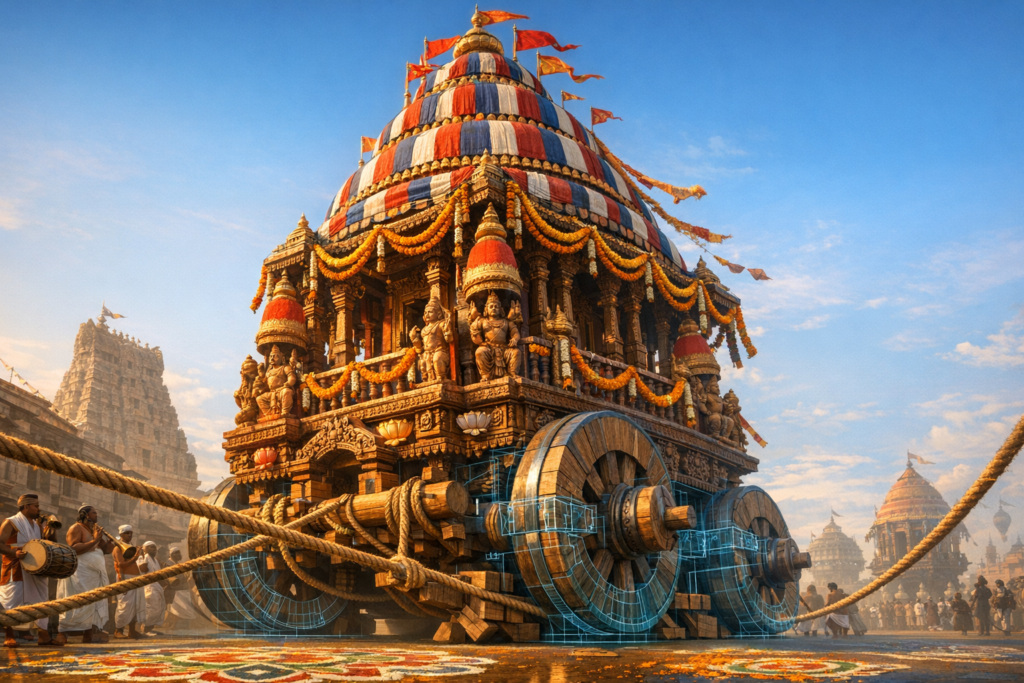
The ratha’s architectural logic reflects a sophisticated craft ecosystem. Traditional chariot building relies on robust hardwoods, mortise-and-tenon joints, rope lashings, and modular superstructures that can be assembled, inspected, and repaired. Master carpenters and sculptors articulate iconographic panels, guardians, and auspicious motifs on the yoke, axle housings, and canopies. Painters apply prescribed color schemes that signal deity, lineage, or regional style. The geometry of wheel diameter, axle placement, and platform stability is matched to route gradients, turning radii, crowd density, and local road conditions.
Rope systems—traditionally twisted from natural fibers—are engineered to distribute load, moderate acceleration, and permit coordinated pulling by large groups. Contemporary teams integrate additional safety elements such as chocks, wedges, stabilizers, and spotter-calls to manage descent on slopes or tight turns. Even where electric lines and urban furniture complicate routes, careful height calculations and route planning preserve ritual integrity while ensuring public safety.
Material stewardship and sustainability accompany ritual design. In many regions, rathas are maintained for decades through documented cycles of refurbishment; in others, select components are newly built each year and repurposed afterward in accordance with temple guidelines. This resource ethic—minimizing waste while maintaining sanctity—embodies a dharmic approach to environmental responsibility woven into festival practice.
Beyond mechanics, the ratha encodes a theology of movement. The journey from sanctum to street mirrors the cosmic yatra of the divine through time and space. It also functions as a civic sacrament: homes are sprinkled with sanctified water, streets are purified, and marketplaces become processional corridors. Public darshan extends temple grace to all—residents, visitors, and those unable to enter the garbhagriha—affirming the Hindu temple’s role as a social and spiritual commons.
The ratha as a symbol further resonates with the philosophical triad of jnana, bhakti, and karma. The chariot’s structure and iconography instruct (jnana); its image and soundscape inspire devotion (bhakti); and the communal labor of pulling, cleaning, decorating, and organizing constitutes sacred service (karma). The whole festival therefore becomes an integrated yoga of knowing, loving, and doing, performed collectively.
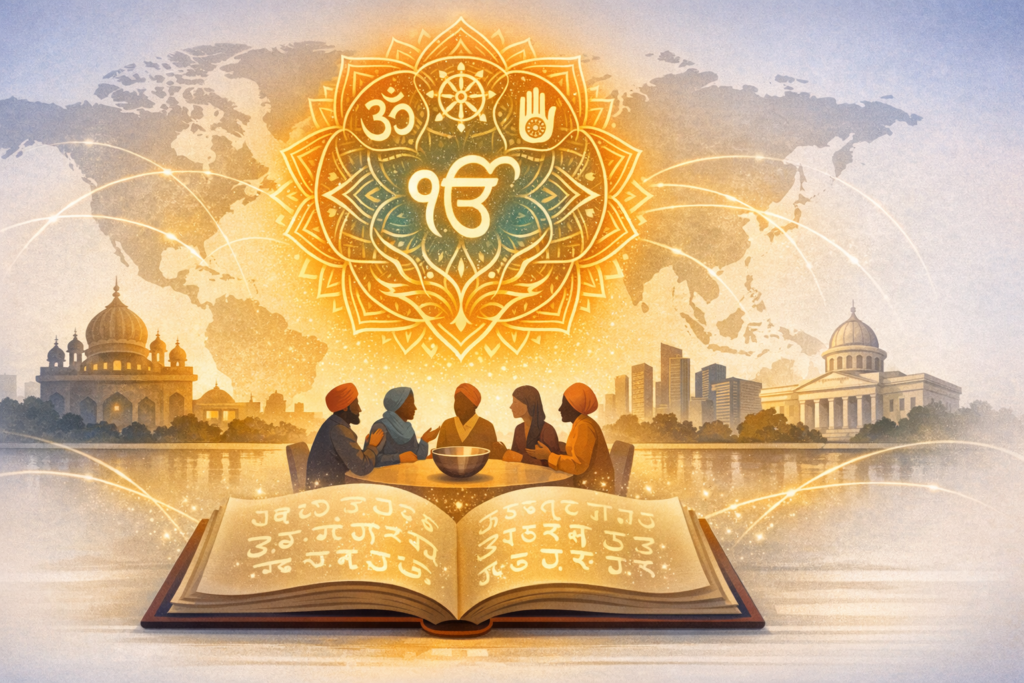
Across the broader dharmic family, parallel processional traditions reinforce shared values of community service, ethical living, and reverence for the sacred in public life. Jain communities organize rath yatra on Mahavir Jayanti, gracefully drawing the images of Tirthankaras through city streets with kirtans and ahimsa-centered messaging. Sikh Nagar Kirtan processions, while musically led rather than chariot-centric, often include decorated floats carrying symbolic representations of the Guru Granth Sahib’s teachings, radiating seva, equality, and courage. In many Buddhist regions, grand processions—such as Sri Lanka’s Esala Perahera—carry sacred relics with disciplined pageantry, honoring the Buddha’s dhamma in the civic sphere. These traditions, while distinct, echo a common dharmic impulse: to sanctify public space through collective remembrance and moral uplift.
In the global diaspora, the ratha has become an ambassador of Hindu culture and interfaith friendship. The Hare Krishna Festival of Chariots organized by ISKCON in cities such as London, New York, and Sydney brings the spirit of rathayatra to diverse audiences, introducing temple arts, vegetarian prasadam, kirtan, and workshops that illuminate the Vedic worldview. London Rathayatra, among the city’s notable street festivals, demonstrates how ritual movement can harmonize with modern urban rhythms while retaining theological depth.
Contemporary governance and heritage frameworks increasingly recognize rathas as expressions of intangible cultural heritage. Municipal coordination addresses traffic management, crowd safety, and route preservation; cultural bodies and temple trusts document craft lineages, painterly canons, and regional styles; academicians record terminologies, joinery techniques, and ritual sequences for posterity. Digitization—through high-resolution imaging, 3D scanning, and archival metadata—supports conservation while making festival knowledge accessible to younger generations and global learners.
The visual language of the ratha synthesizes multiple disciplines. Temple architecture informs its base proportions; sculpture contributes iconographic panels; textile arts crown the superstructure with canopies, flags (dhvaja), and festoons; music and dance animate the procession; Sanskrit and regional liturgies supply mantras, stotras, and narrative recitation. In this sense, the ratha is a moving Gesamtkunstwerk—an integrated artwork—where every sensory register is engaged in service of darshan and remembrance.
The chariot’s passage is experienced not merely as spectacle but as moral instruction in motion. As the ratha pauses at neighborhood shrines, water tanks, or crossroads, audiences encounter short homilies on dharma, environmental care, mutual respect, and civic duty. The children who pull small practice-ropes nearby learn teamwork and restraint; elders transmit stories of past festivals, temple restorations, and miracles linked to the deity’s grace. Emotional connection grows from participation, and belonging is reinforced through the rhythm of seasonal return.
Technical planning undergirds this devotional experience. Core considerations include wheel tread and wear, axle lubrication, rope tensile strength, load distribution, slope management, emergency stop protocols, volunteer training, medical stations, and communication systems between priests, marshals, and municipal authorities. In hilly towns or narrow medieval streets, precise turning templates and protective padding for heritage facades are devised well in advance.
Iconographic features vary widely across regions, yet certain conventions recur: guardians at the corners, reliefs depicting Puranic episodes, auspicious geometries inscribed on platforms, and emblematic motifs signaling the temple’s sampradaya. Vaishnava rathas may foreground Garuda, Shaiva chariots may emphasize Nandi and ganas, and Shakta processions may highlight protective mother-goddess imagery that spiritually “clears” the route before the deity passes.
Community roles are hereditary in some locales and volunteer-based in others. Artisans, carpenters, and chitrakar painters inherit technical repertoires; priests (archakas) and ritual specialists coordinate sanctification of the chariot and the movement of utsava-murtis; neighborhood associations manage flower offerings, water distribution, and crowd pathways; musicians, bhajan mandalis, and dance troupes frame the auditory and visual aesthetic. This distributed stewardship ensures continuity even as towns grow and demographics shift.
Environmental sensibilities now inform material choices, paints, and maintenance practices. Where feasible, traditional natural pigments and plant-based finishes are revived; timber procurement follows community oversight to protect local forests; and post-festival materials are inventoried for reuse or ritual-appropriate recycling. The dharmic principle of restraint aligns naturally with contemporary sustainability goals.
The temporality of rathayatra—its cyclical return—creates a calendar of anticipation and preparation. In many towns, months of carpentry, weaving, painting, and volunteer mobilization culminate in a few transformational days when the deity “meets” the city. This rhythm anchors social memory and economic activity, supporting guilds, local markets, and ritual specialists whose livelihoods are intertwined with the temple’s festival economy.
Scholars often note that the ratha also functions as a pedagogical device. Material culture makes doctrine legible: the eye learns what the ear hears in temple teachings. The measured pace of the chariot dramatizes the notion that spiritual advancement is steady, supervised, and supported by community. In a time of rapid change, the ratha’s deliberate movement becomes a counter-symbol of patience, harmony, and responsible progress.
Urbanization has not diminished the ratha’s relevance; instead, it has amplified its integrative role. Large cities adapt routes, timing, and safety layers without diluting sanctity. Collaborations between temple boards, cultural NGOs, and city administrations show how living heritage can shape inclusive public space where diverse communities share in celebration and respectful curiosity.
Across Hindu temples, the ratha remains a universally comprehensible symbol: a vehicle that makes the divine accessible, a reminder of inner mastery articulated in the Upanishads, and a civic forum for ethical renewal. When considered alongside Jain rath yatras, Sikh Nagar Kirtans, and grand Buddhist processions, it forms part of a broader dharmic tapestry that values devotion, wisdom, and service—different paths converging in the shared aspiration to uplift society.
In essence, the modern-day ratha is both sacred instrument and cultural heartbeat. It carries the deity through lanes and lifeworlds, instructs through motion and metaphor, sustains artisanal knowledge, and convenes communities in mutual care. Its wheels keep turning not only on stone and asphalt, but also in the moral imagination—guiding the collective chariot of society toward compassion, unity, and the timeless ideals of Sanatana Dharma.
Inspired by this post on Hindu Blog.








Leave a Reply
You must be logged in to post a comment.