
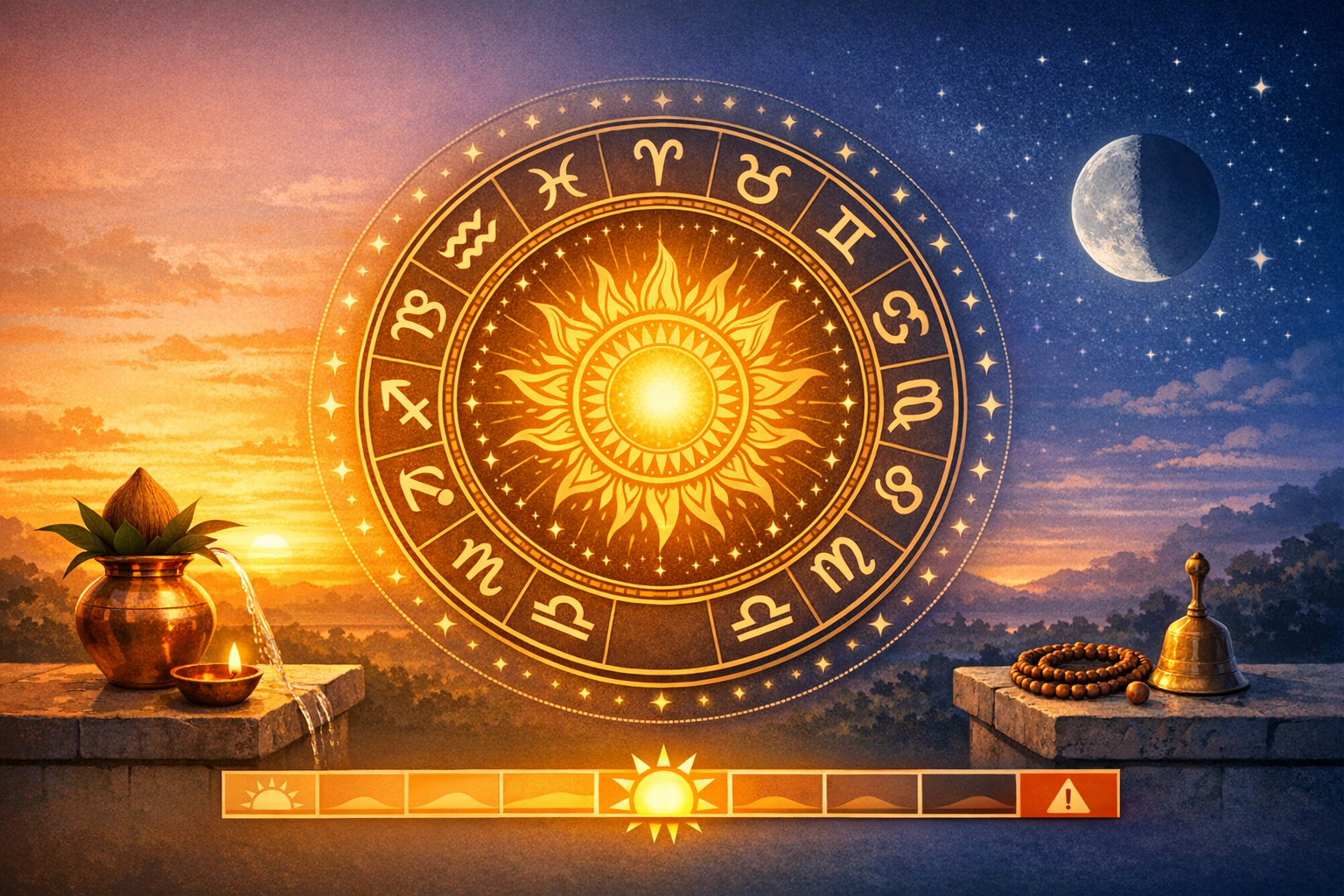
On Sunday, June 21, 2026, the Hindu Panchang for most regions records Shukla Paksha Saptami (the seventh lunar day of the bright fortnight) until approximately 7:47 PM, after which Shukla Paksha Ashtami begins. This June 21 2026 Tithi transition shapes the rhythm of the day for worship, personal observances, and time-sensitive activities, and it remains the primary anchor for determining a practical and spiritually aligned schedule.
In the Hindu Calendar and Panchang framework, a Tithi measures the longitudinal separation between the Sun and Moon in 12-degree increments. As the Shukla Paksha advances, the visible Moon waxes, symbolizing growth, consolidation, and progressive action. Saptami therefore often supports outward-facing endeavors and purposeful momentum, while the onset of Ashtami in the evening invites reflective strength, focus, and refinement.
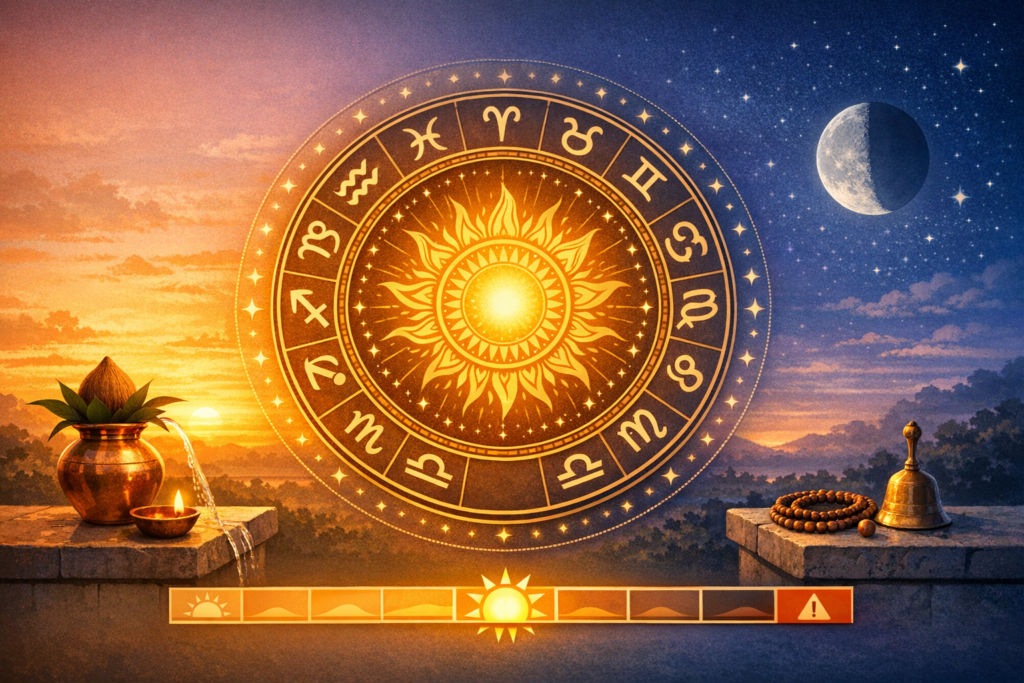
Shukla Paksha Saptami carries a classical association with Surya (the Sun). Many households mark the morning with Surya Arghya, mindful Surya Namaskara, and recitation of Aditya Hridayam, cultivating clarity and vitality. While Ratha Saptami is specifically the Magha Shukla Saptami festival and does not fall on this date, the general Saptami principle of honoring the life-giving light of Surya remains relevant. Families often experience a quiet sense of renewal through these practices, building steadiness that carries into the workweek.
From around 7:47 PM onward, Shukla Paksha Ashtami prevails. Textual traditions describe Ashtami’s affinity with disciplined resolve, devotion, and inner alignment. Evening japa, meditation, or brief Devi upasana may be chosen to close the day with poise. Although major Ashtami observances (such as Maha Ashtami in Ashwin) occur elsewhere in the calendar, this weekday Ashtami still supports simple, sincere saadhana and ethical intention-setting.
Good Time (Shubh Muhurat) selection on this date benefits from the Panchang’s five limbs—Vara (weekday), Tithi, Nakshatra, Yoga, and Karana—plus daily filters such as Rahu Kaal, Yamaganda, Gulika Kaal, and the midday Abhijit Muhurta. Because Panchang is sunrise- and longitude-dependent, all finer timing must be localized. The Saptami-to-Ashtami transition itself is pan-Indic in character for June 21, but precise windows for action are best validated using a reliable local almanac or a drik (observation-based) Panchang for one’s city.
Abhijit Muhurta is the well-known midday auspicious interval centered on local solar noon. It is frequently used for tasks requiring decisiveness and clarity when a dedicated, event-specific muhurta is not available. In many traditions, Abhijit Muhurta is not recommended for solemn samskaras like vivaha unless otherwise guided by a competent priest, but it remains a broadly favorable daily slot for general undertakings. On June 21 (the date of the northern solstice in many time zones), connecting with this midday luminosity harmonizes with the Surya-aligned spirit of Saptami.
Rahu Kaal, Yamaganda, and Gulika Kaal are avoidance periods derived by dividing daylight (sunrise to sunset) into eight equal parts and mapping weekday-specific segments. On Sundays, Rahu Kaal corresponds to the eighth segment of daylight, Yamaganda to the fifth segment, and Gulika Kaal to the seventh segment. To compute these locally: determine the exact sunrise and sunset for the location, divide the interval by eight, and then mark the relevant segments. Avoid initiating important tasks during these intervals; instead, place new beginnings or signature actions in Abhijit Muhurta or other clean windows free from these doshas.
Practically, this means that if one calculates eight equal daytime parts for June 21, 2026 at a given location, the final eighth part is Rahu Kaal on Sunday. Because the eighth part lies near sunset, Sunday evenings often include a short do-not-start window. Placing new initiatives earlier in the day—ideally in an auspicious Panchang-compliant slot—supports a smoother start. Localization remains essential; even a small change in latitude, longitude, or daylight length can shift the precise clock times.
Choghadiya offers another simple day-planning lens, dividing day and night into roughly 90-minute blocks that cycle through auspicious and inauspicious qualities. While the sequence and the start block depend on weekday and day/night status, the preference hierarchy is common: Amrit, Shubh, and Labh are chosen, Char is acceptable for travel/logistics, whereas Kaal, Rog, and Udveg are avoided. For accuracy on June 21, 2026, use a city-specific Choghadiya to pair Saptami–Ashtami considerations with block-level granularity.
Nakshatra and Rashi (the Moon’s star and sidereal sign) further refine the day’s picture. Because these depend on the Moon’s sidereal longitude at a given time and place, local computation is essential. The standard method is technical yet straightforward in principle: subtract the chosen ayanamsa (commonly Lahiri/Chitra) from the tropical lunar longitude to obtain the sidereal longitude; Nakshatra is the integer index of this longitude divided by 13°20′ (360°/27), and Rashi is the integer index of the same longitude divided by 30° (360°/12). This ensures that anyone, anywhere, can align the day’s Tithi with the actual lunar backdrop overhead.
Personalization through Tarabalam and Chandrabalam strengthens muhurta selection. Tarabalam assesses harmony between the day’s Nakshatra and one’s Janma Nakshatra by counting forward and classifying the relationship into groups traditionally known as Janma, Sampat, Vipat, Kshema, Pratyak, Sadhana, Naidhana, Mitra, and Parama-Mitra; the auspicious groups (Sampat, Kshema, Sadhana, Mitra, and Parama-Mitra) are generally preferred. Chandrabalam evaluates the Moon’s sign relative to one’s Janma Rashi; for certain actions, the Moon placed in supportive houses from the natal Moon is desirable. These checks help translate the collective Panchang into individually resonant timing.
Yoga and Karana (the remaining two limbs of the Panchang’s pancha-anga) provide additional nuance. Yoga is derived from the sum of the sidereal longitudes of the Sun and Moon partitioned into 27 segments, each indicating a specific day-quality for posture, tone, and conduct. Karana, a half-Tithi segment, guides micro-timing for starts and stops; movable Karanas (such as Bava, Balava, Kaulava, Taitila, Garija, Vanija, and Vishti/Bhadra) cycle through the day. Because June 21, 2026 includes a Tithi change, multiple Karanas may operate; a localized Panchang will detail their exact spans.
Regional almanac practices can yield small variations. North India typically follows the Purnimanta lunar month naming, while much of South India follows Amanta; different schools may use slightly different sunrise conventions or ayanamsa values (for example, Lahiri versus Raman). Drik (observation-based) Panchang computations are widely adopted in contemporary practice, but the underlying principle remains the same: apply local celestial positions to the five-limbed Panchang and the daily do/don’t filters to arrive at a clear, faithful schedule.
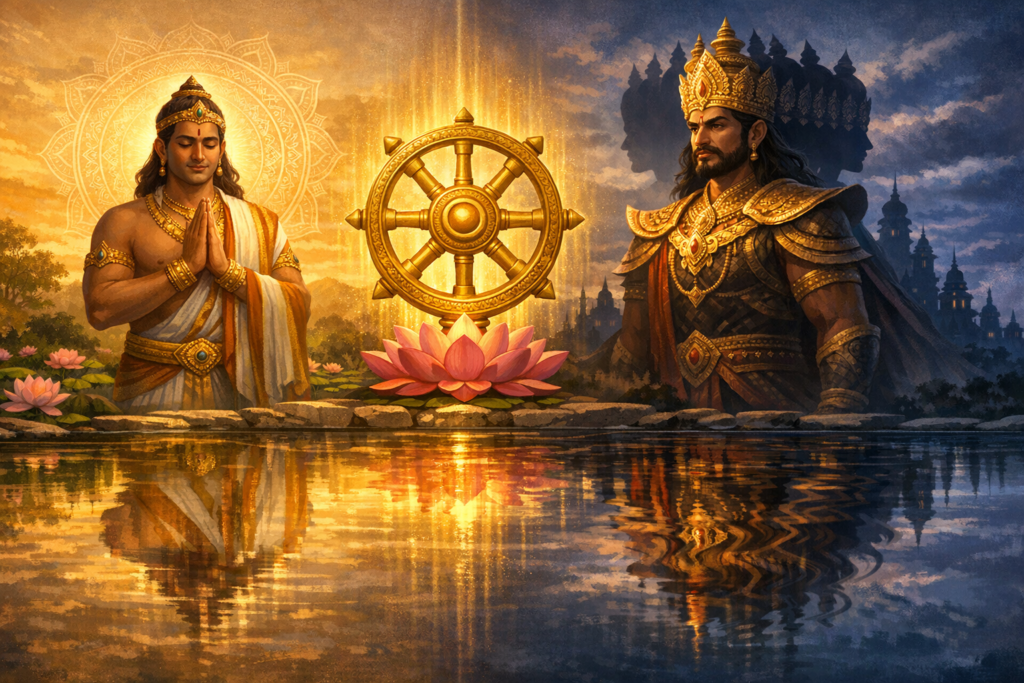
Across the broader dharmic family, the lunar day encourages shared ethical intent and practice. In Buddhism, Uposatha observances traditionally align with lunar phases and foster mindfulness and discipline. Jain households often give special attention to fasts and vows on Tithis such as Ashtami and Chaturdashi, emphasizing ahimsa and self-restraint. Sikh practice centers on Nitnem, seva, and remembrance of the Divine maintained consistently across the year; periodic note of Pooranmashi in some communities reflects a cultural appreciation of the Moon’s cycle. Together, these living traditions affirm unity in spiritual purpose while honoring diverse methods of practice.
June 21 is also the date of the June solstice in many parts of the world, a moment that highlights the Sun’s path and harmonizes naturally with Saptami’s Surya-aligned ethos. For practitioners, acknowledging this astronomical milestone can deepen gratitude for the cyclic balance of light and time. Quiet morning devotions to Surya, followed by mindful, ethical work and evening reflection as Ashtami begins, create a balanced arc for the day.
A practical approach for June 21, 2026 is as follows: plan initiations or signatures in clean windows that avoid Rahu Kaal, Yamaganda, and Gulika Kaal; leverage Abhijit Muhurta for generalized auspiciousness; and refine choices with Nakshatra, Rashi, Tarabalam, and Chandrabalam. Light Surya Arghya at sunrise, a short japa in the afternoon, and devotional quietude at night nourish steadiness across the Saptami–Ashtami transition. Everyday duties—studies, caregiving, seva, or creative work—gain focus when timed with this Panchang awareness.
Summary for practitioners and planners: Sunday, June 21, 2026 is Shukla Paksha Saptami until about 7:47 PM, then Shukla Paksha Ashtami. Choose Good Time (Shubh Muhurat) locally by referencing a city-specific Panchang, favoring Abhijit Muhurta and avoiding Sunday’s Rahu Kaal in the eighth daylight segment, with Yamaganda in the fifth and Gulika Kaal in the seventh. Enhance precision using Nakshatra, Rashi, Yoga, Karana, Tarabalam, and Chandrabalam. In spirit and in method, the day encourages both purposeful action and reflective devotion—an inclusive pathway that resonates with the shared ethical core of Hindu, Buddhist, Jain, and Sikh traditions.
Inspired by this post on Hindu Blog.



Leave a Reply
You must be logged in to post a comment.