
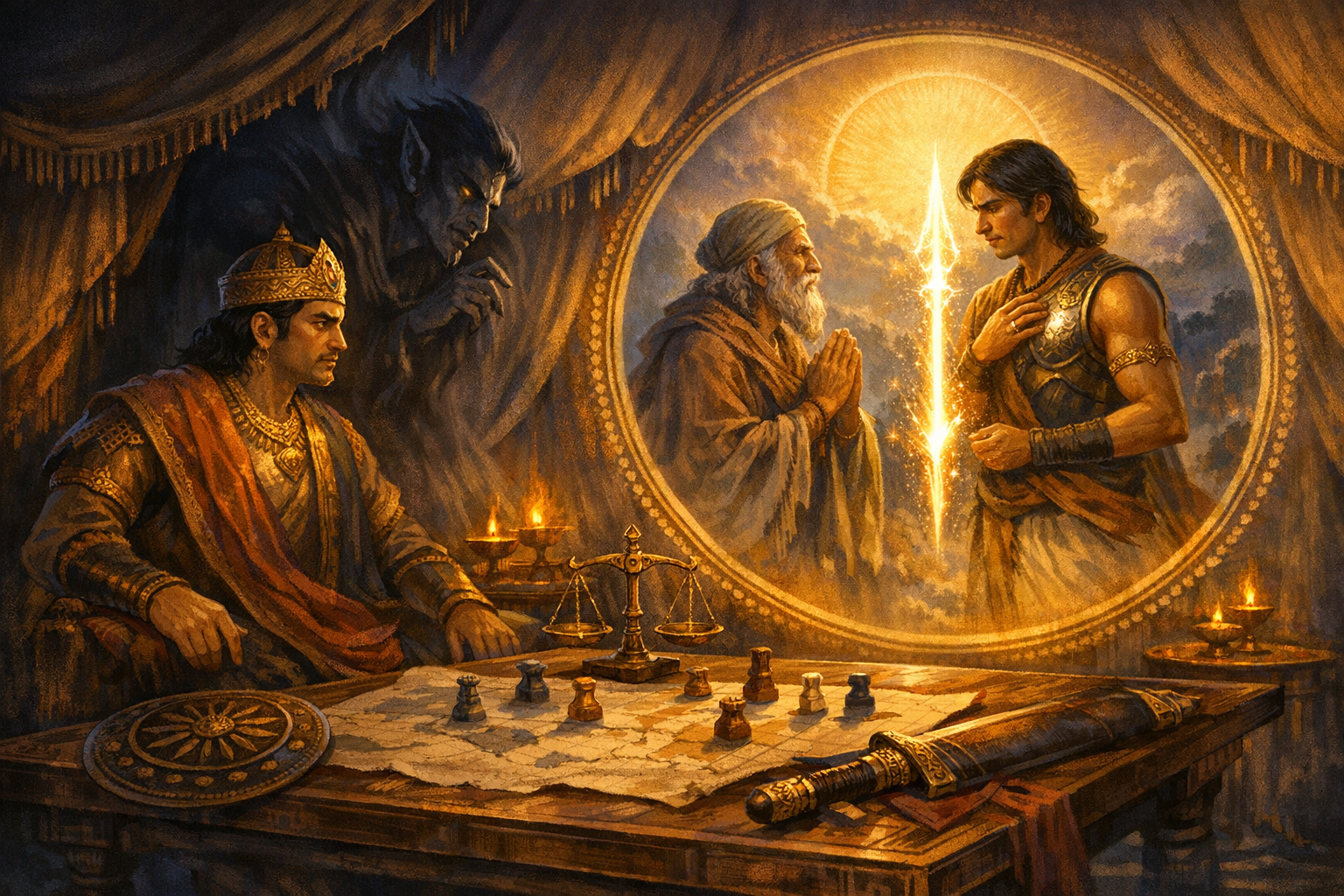
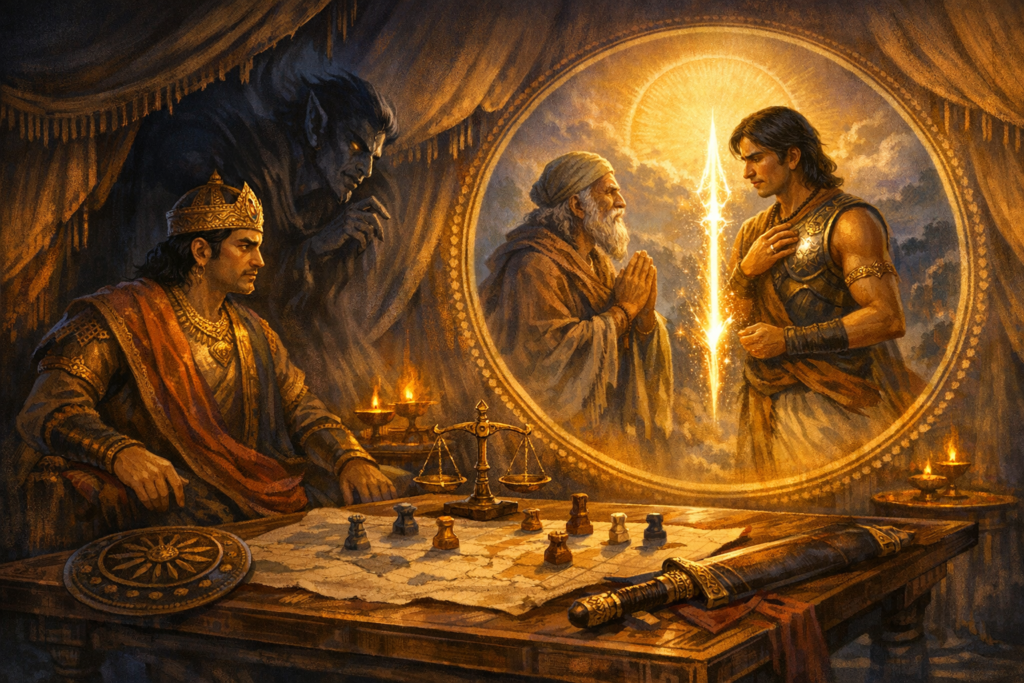
In the layered narrative of the Mahabharata, warnings often arrive from liminal beings rather than court preceptors; an arresting example recounts a Rakshas appearing before Duryodhana to forewarn him of Indra’s impending stratagem to deprive Karna of his Kavacha-Kundala. This moment compresses the epic’s central tensions—dharma versus expedience, human resolve versus divine design, and intelligence received versus intelligence heeded.
Within the core textual stream (Udyoga Parva), Indra is depicted approaching Karna in the guise of a mendicant to beg for the armor and earrings, while several retellings and regional oral traditions preserve an ancillary motif in which a Rakshas alerts Duryodhana in advance. The coexistence of these strands exemplifies the Mahabharata’s multivocal composition: one strand stresses divine deception countered by royal counsel, another foregrounds the sovereignty of personal vow even when forewarned.
Karna’s invulnerability derives from birth with Kavacha-Kundala, boons linked to Surya. These endowments make him the Kaurava coalition’s most formidable asset against Arjuna, Indra’s son. From a strategic standpoint, the removal of that protection is tantamount to shifting the Kurukshetra War’s expected equilibrium.
For Duryodhana, the Rakshas’s caution carries clear implications for kshatra-dharma and campaign planning: preserve Karna’s survivability at nearly any cost. Yet the decision space is bounded by Karna’s self-imposed dana-vrata, his vow never to refuse a suppliant, which functions in the epic not merely as personal virtue but as a constitutional principle of character.
In many narrative tellings, Duryodhana, having heard the Rakshas, attempts to dissuade Karna from acceding to the anticipated request. Karna’s reply consistently elevates dana and satya above tactical advantage: honor is indivisible, and a vow once made binds even when the petitioner is a deva in disguise.
Indra’s approach unfolds accordingly. Disguised as a brahmana, he petitions Karna for the Kavacha-Kundala. Forewarned but unmoved, Karna yields the armor and earrings on one condition: a counter-gift in the form of an unfailing missile. Thus he receives the Vasavi Shakti—an irresistible but single-use spear—traded for his perpetual protection.
The exchange is a masterclass in epic statecraft. By sacrificing durable defense for a one-shot offensive asset, Karna effectively converts a strategic shield into a tactical sword. This calculus mirrors enduring questions in war studies about survivability versus decisive strike capacity.
The Rakshas’s role in this motif is analytically significant. As a being situated beyond the normative bounds of human polity, the Rakshas functions as a liminal intelligence node, a messenger from the wilderness of the epic cosmos where devas, asuras, and mortals intersect. Warnings issued from such margins dramatize the porous frontier between human decision-making and supernal intrigue.
Text-critical observations are in order. The Udyoga Parva’s widely attested version emphasizes Surya’s warning directly to Karna, while the Rakshas-to-Duryodhana alert circulates in later and regional sources and oral transmission. Rather than treating these as mutually exclusive, reading them together illuminates how the tradition contemplates both royal counsel and solitary ethical resolve.
Ethically, Indra’s ruse is uncomfortable yet purposeful. Disguise and deception occupy an ambivalent place in the Mahabharata’s discourse on dharma and adharma: they may be censured as adharma in isolation, yet in the epic’s broader moral geometry they operate as instruments to restore a cosmic balance tilted by overwhelming advantage.
The Kavacha-Kundala themselves invite a symbolic reading. As emblems of innate adhikara—birth-endowed authority and privilege—their voluntary relinquishment refigures Karna as an exemplar of radical dana. This virtue resonates across dharmic thought: buddhist dāna-pāramitā extols self-giving, jain aparigraha honors letting go of possessions, and sikh seva sanctifies self-offering for a higher cause.
Duryodhana’s leadership challenge in this scene underscores a broader governance lesson. Timely intelligence, even when accurate and alarming, cannot compel compliance if it collides with the inviolable cores of allied actors. Strategy succeeds not merely by collecting information but by aligning counsel with the ethical architectures of those who must act—lessons from the Mahabharata that remain durable across eras.
From the perspective of military science, Indra’s success exemplifies covert action coupled with HUMINT tradecraft: disguise, precise target selection, and moral leverage. The Rakshas’s disclosure constitutes counterintelligence that fails not through inaccuracy but through underestimation of a principal’s value hierarchy.
Operational consequences ripple through the Kurukshetra War. Karna later spends the Vasavi Shakti to fell Ghatotkacha, the Pandava night-raider whose rakshasic prowess was devastating Kaurava lines. That tactical victory becomes a strategic liability: with the Shakti expended, Arjuna, guided by Krishna, ultimately slays Karna on the seventeenth day.
The episode thus integrates the Mahabharata’s signature dialectic: dharma and adharma interpenetrate, and outcomes emerge from the interplay of personal vows, divine stratagems, and the contingencies of battle. Whether the warning voice is Surya or a Rakshas, the epic’s lesson remains consistent—ethical commitments carry real costs, yet they also confer a paradoxical, lasting dignity.
Read within the ecumene of dharmic traditions, the narrative converges on a shared moral horizon. It honors fearless generosity and disciplined restraint while recognizing the tragic weight of choosing principle over advantage. Such a frame fosters mutual respect among Hindu, Buddhist, Jain, and Sikh pathways that elevate integrity, self-mastery, and compassion as non-negotiable goods.
For readers seeking textual anchors, the core events center on the Udyoga Parva’s account of Indra’s petition to Karna and subsequent repercussions traced through Drona, Karna, and Shalya Parvas. Across these books, the epic sustains a consistent insight: even warned in advance—whether by Surya or a Rakshas—Karna elects to remain Karna.
The theology of exchange is equally salient. Dana in the Mahabharata is not mere charity but a transactive sacrality: gifts reconfigure the dharmic field by redirecting power (shakti). The name Vasavi Shakti itself signals an energy proceeding from Indra (Vāsava), establishing a ritually coherent swap—solar-born armor surrendered to a storm-god’s spear.
In comparative epic logic, such exchanges dramatize how boons and vows entangle heroes with devas in cycles of obligation. The result is not moral relativism but moral complexity: the gods pursue order through stratagem; the warrior upholds honor through renunciation; the king maneuvers within constraints defined as much by ethics as by arms.
Seen in this light, the Rakshas’s warning is less a thwarted alert than a narrative catalyst that reveals character. It tests Duryodhana’s prudence, clarifies Indra’s intent, and, above all, manifests Karna’s unwavering fidelity to dana and satya—virtues that, while costly, render his arc unforgettable within the Mahabharata’s civilizational memory.
Inspired by this post on Hindu Blog.










Leave a Reply
You must be logged in to post a comment.