
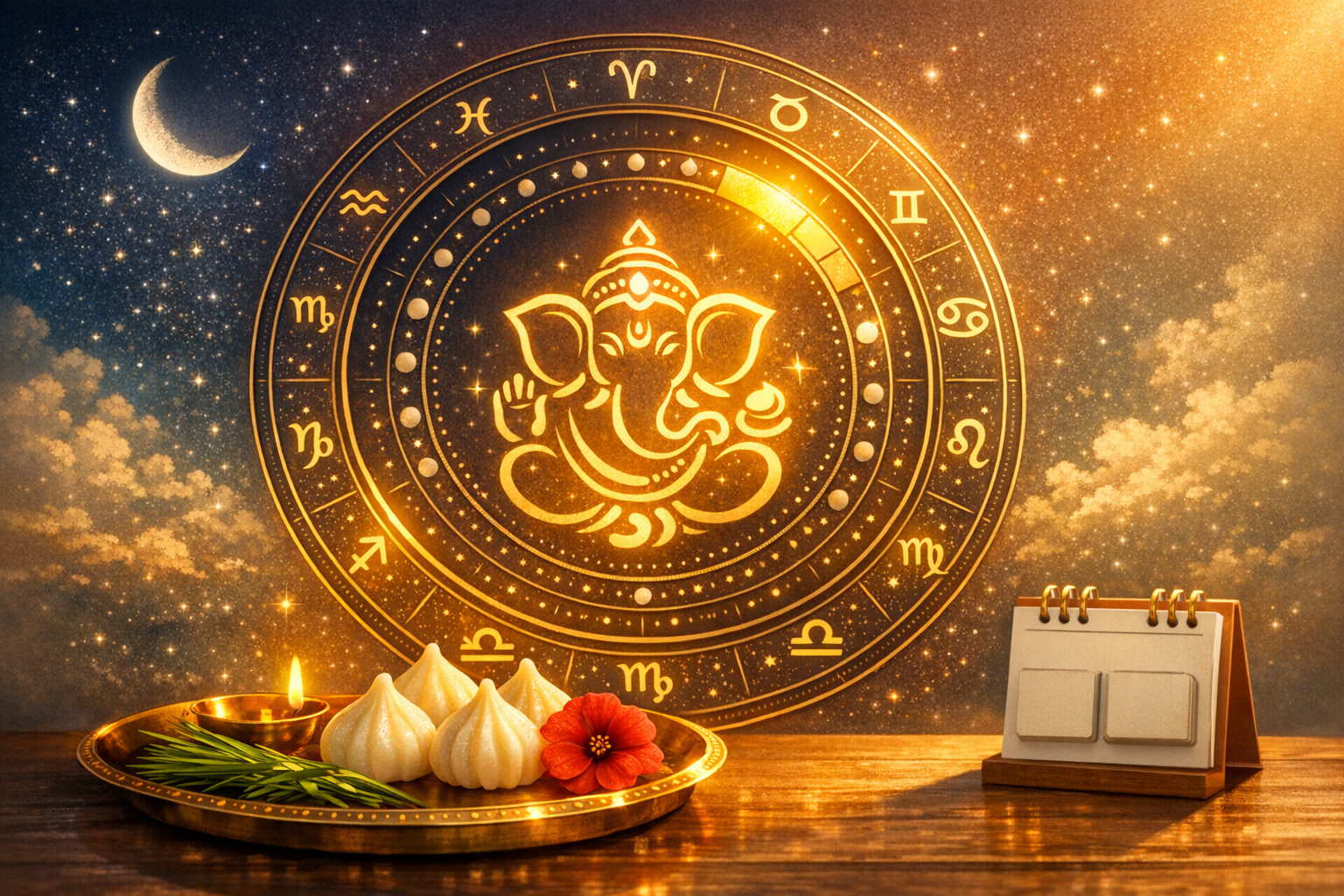
Thursday, June 18, 2026, in the Hindu calendar (Panchang) begins with Shukla Paksha Tritiya and transitions to Shukla Paksha Chaturthi at 01:40, after which Chaturthi prevails for the remainder of the civil day in most regions. Accordingly, the date is generally observed and planned as Shukla Paksha Chaturthi, with ritual preference given to the Chaturthi tithi for vrata, puja, and key household undertakings.
In technical terms, a tithi is a lunar day defined by the longitudinal separation between the Moon and the Sun, increasing in steps of 12 degrees (360°/30). Shukla Paksha denotes the waxing half of the lunation, and Chaturthi is the fourth tithi in this sequence. Because a tithi is an astronomical interval rather than a civil day, it can begin or end at any clock time, which is why Shukla Paksha Tritiya concludes at 01:40 on June 18 and Chaturthi becomes the governing tithi thereafter. This overlap explains why ritual decisions are anchored to the prevailing tithi rather than solely to the midnight-based civil date.
Shukla Paksha Chaturthi is widely revered as Vinayaka Chaturthi, an auspicious window for worship of Shri Ganesha, the remover of obstacles (vighna-vinashaka) and the patron of learning, clarity, and right beginnings. Many households center their day around a simple yet focused Ganesha-puja, finding that the act of offering durva grass, red flowers, and modaka creates a calm, purposeful cadence for the day. Families often report that even a brief recitation of the Ganesha Atharvashirsha or a few verses from Ganapati stotra steadies attention and fosters a collective sense of well-being before work or school.
Those observing Vinayaka Chaturthi vrata typically keep a daytime upavasa (fast) and perform puja while the Chaturthi tithi is in effect. Almanacs differ on the precise selection rulesome privilege Chaturthi’s presence at sunrise, others at madhyahna (midday)so adherence to local sampradaya and a trusted regional Panchang is prudent. Where possible, aligning the principal puja within the Chaturthi window brings the vrata, mantra-japa (such as “Om Gam Ganapataye Namah”), and sankalpa into a single coherent spiritual arc.
With respect to Good Time (Shubh Muhurat) on June 18, 2026, classical Panchang usage prioritizes avoiding inauspicious segments and leveraging universally favorable windows. Abhijit Muhuratcentered on local solar noonis often recommended for success-oriented undertakings when a bespoke muhurta is not available. Conversely, Rahu Kaal, Yamaganda, and Gulika are traditionally avoided for commencements; on Thursdays, Rahu Kaal typically falls in the afternoon (the exact span is location-dependent and derived from the sunrise-to-sunset division into eight equal parts). For region-specific optimization, many households supplement with Choghadiya, selecting Laabh, Amrit, or Shubh periods for short-duration tasks while steering clear of Rog and Kaal.
Beyond tithi and vara (weekday), Panchang assessment incorporates nakshatra, yoga, karana, and rashi for a nuanced view. Nakshatra is the Moon’s position against 27 equal stellar sectors of 13°20′ each; rashi segments the sidereal ecliptic into twelve 30° signs; yoga is computed by summing the longitudes of the Sun and Moon and mapping the result onto 27 divisions; karana denotes a half-tithi and refines the action-specific texture of time. Most modern Panchangs employ a sidereal framework with Lahiri (Chitrapaksha) ayanamsha; professional muhurta selection will therefore compute the Moon’s exact longitude for the locale before naming the nakshatra and rashi definitively.
Because the lunar month name differs by regional convention, the day’s placement in the cycle can be reported as either late Jyeshtha or early Ashadha depending on whether a Purnimanta (month from full moon to full moon, common in much of North India) or Amanta (month from new moon to new moon, common in Western and Southern India) system is used. Local almanacs resolve this naming consistently for the community they serve, while the underlying astronomyand thus the tithi, nakshatra, and rashiremains the same.
Thursday (Guruvara) is consecrated to Brihaspati (Guru) and is esteemed for study, teaching, satsanga, and acts of dana (charity), particularly to institutions that support learning and spiritual guidance. Combining Guruvara with Shukla Paksha Chaturthi is seen as doubly supportive for educational endeavors, examinations, music and mantra practice, and for initiating study of scriptures such as the Bhagavad-Gita or the Upanishads. Many families experience a tangible lift in focus by starting the morning with a brief Ganesha-puja and reserving the late morning or Abhijit Muhurat for core tasks.
A broader dharmic perspective highlights a shared lunar cadence across traditions. While Vinayaka Chaturthi is rooted in Hindu practice, Buddhist communities structure Uposatha around full-moon, new-moon, and quarter-lunar days; Jaina communities align vrata and pratikraman with specific tithis through the fortnight; Sikh households often acknowledge Puranmashi and Masya in community rhythms although the Nanakshahi calendar is solar. These convergences affirm a unifying insight: disciplined attention to the lunar cycle can harmonize mind, community, and conduct across the dharmic family.
Practical planning for June 18, 2026 may therefore proceed as follows: anchor household or temple Ganesha-puja within the Shukla Paksha Chaturthi tithi; favor Abhijit Muhurat or other locally indicated auspicious windows for initiations; avoid Rahu Kaal and Yamaganda for new undertakings; reserve reflective activitiesscripture reading, stotra recitation, or silent japafor calm early-morning or evening segments. Sharing modaka as prasad and engaging children in a simple stotra often transforms the observance into a treasured family memory.
For precision, local sunrise and geolocation must be applied to compute nakshatra, rashi, yoga, and karana, as well as to segment the day for Rahu Kaal, Yamaganda, Gulika, and Choghadiya. Reputable regional Panchangs and temple almanacs account for daylight length, longitude, and latitude, and they state transition timings as “paryanta” (tithi end) to minimize ambiguity. The present note records the key transition for the civil dateShukla Paksha Tritiya until 01:40, then Shukla Paksha Chaturthiso that vrata and puja align with the prevailing tithi in most regions.
In sum, Thursday, June 18, 2026 is best understood and lived as Shukla Paksha Chaturthi in the Hindu calendar: a day for invoking Shri Ganesha, aligning with auspicious muhurat, advancing learning and clarity under the grace of Guruvara, and recognizing the shared lunar heartbeat that connects Hindu, Buddhist, Jaina, and Sikh communities in a spirit of harmony.
Inspired by this post on Hindu Blog.
