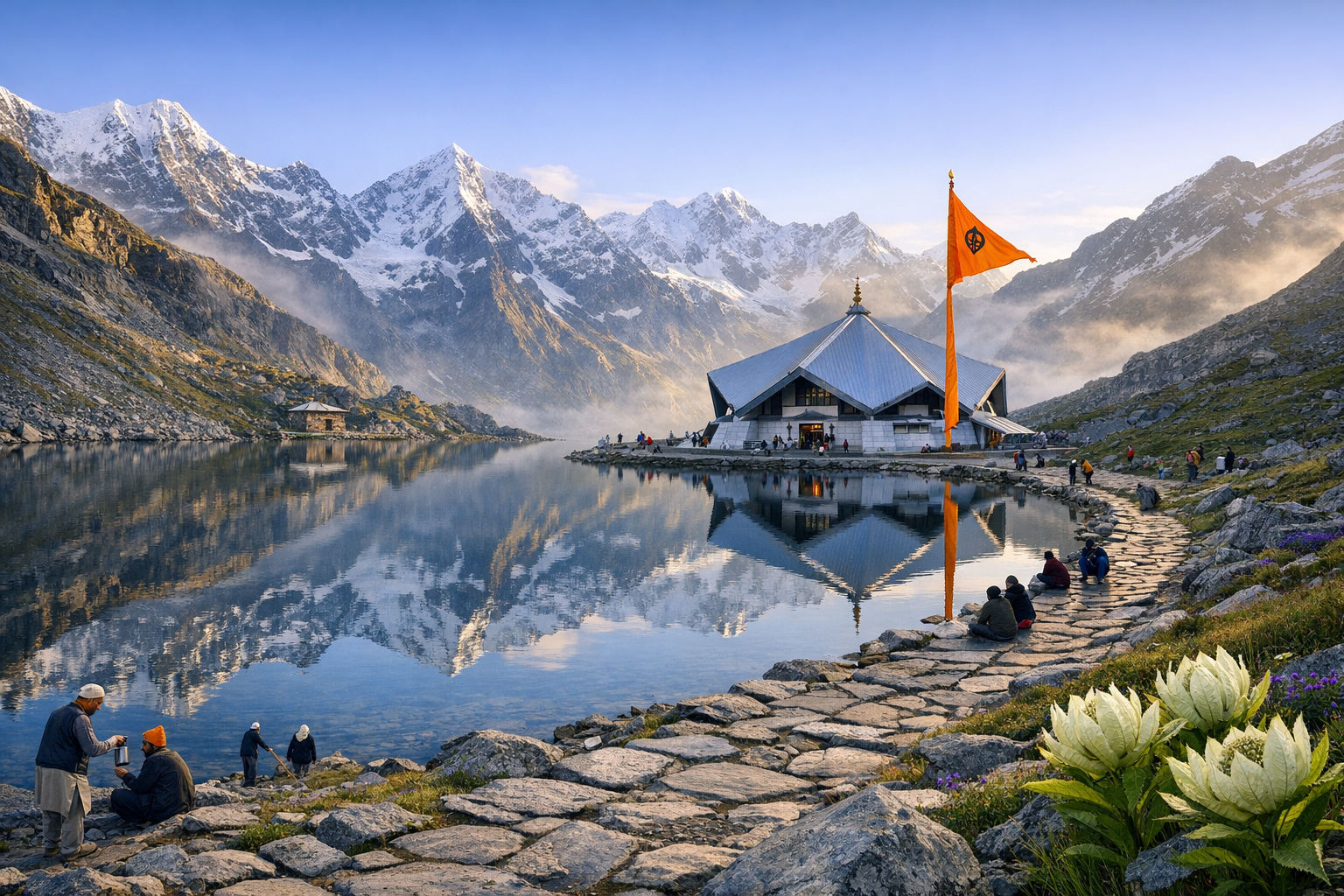
Gurdwara Hemkund Sahib stands at approximately 4,329 meters (14,200 feet) in the Garhwal Himalaya of Uttarakhand, India, where a mirror-like glacial lake meets seven encircling peaks. Revered as a locus of Faith, History, Sacrifice, Pilgrimage, and Unity, it is among the most physically demanding and spiritually resonant Sikh pilgrimage destinations, while also welcoming seekers across dharmic traditions to a shared space of contemplation and service.
The name Hemkund (also written Hemkunt) derives from hem (snow) and kund (lake), reflecting the site’s geography: an ice-fed tarn ringed by snowfields and rock. The star-like plan of the gurdwara and the ever-present Nishan Sahib arise against an austere alpine skyline, underscoring the union of devotion and discipline central to the spirit of the Khalsa.
The textual foundation for Hemkund Sahib is rooted in Guru Gobind Singh’s Bachitra Natak within the Dasam Granth, where a “Hemkunt parbat” surrounded by “sapt sring” (seven peaks) is evoked as a place of intense tapas (austerity) associated with the Guru’s pre-ordained mission. Scholarly readings emphasize how the imagery of seven peaks aligns with the site’s distinctive topography and symbolizes spiritual ascent through layered effort and grace.
Modern identification of the site emerged through the confluence of scriptural inquiry and field exploration. Nineteenth-century hermeneutics by scholars such as Pandit Tara Singh Narotam situated Hemkunt’s sacred geography in the Badrinath region. In the 1930s, Sant Sohan Singh and Baba Modan Singh, encouraged by the literary and devotional impetus of Bhai Vir Singh, helped locate, mark, and gradually make the site accessible. Subsequent decades witnessed organized sewa, improved trails, and sustained community stewardship that transformed a remote Himalayan basin into a carefully managed seasonal yatra.
The gurdwara’s form, framed by a sloped, pyramidal roof, stands adjacent to the high-altitude lake whose clarity reflects seven flanking summits. Inside, the sanctum’s devotional rhythmshabad kirtan, paath, and ardaasblends with the circadian realities of high-mountain weather, reminding pilgrims that reverence here is inseparable from responsibility to the environment and to fellow travelers.
Ritual life at Hemkund Sahib centers on ardaas and disciplined remembrance, accompanied by sewa that sustains the body and uplifts the spirit. Langar arrangementsadapted to altitude, logistics, and weatherprioritize simplicity, frugality, and hygiene. The ethic of collective service is visible along the path as volunteers clear snow and litter, offer hot tea, and coordinate safe movement near steep sections and bridges.
Intertwined with the gurdwara is a nearby Lakshman Mandir, a feature that makes the site an emblem of dharmic unity. Pilgrims from Sikh, Hindu, Buddhist, and Jain backgrounds often converge on the same day’s path, embodying Vasudhaiva Kutumbakam and Sarbat da Bhala in practice. The shared codes of modesty, non-harm, and compassioncommon to these traditionsfoster a climate of mutual respect above the tree line.
Access typically follows the Rishikesh–Joshimath–Govindghat corridor. From Govindghat, pilgrims proceed to Ghangaria (also called Govind Dham), historically a 13-kilometer trek with options for porters, pack animals, and seasonal helicopter services to reduce exposure. From Ghangaria, a steep, approximately 6-kilometer ascent gains more than 1,200 meters in elevation to the lake and gurdwara, making acclimatization and pacing crucial.
The pilgrimage season is shortgenerally from late spring or early summer until early Octoberdepending on snowfall and the onset of winter storms. Daily darshan windows mirror mountain daylight and safety conditions; nights are spent at lower altitude in Ghangaria, as no overnight stays are permitted at the lake. Start times at dawn are common to avoid afternoon weather shifts.
High-altitude considerations warrant particular care. The gradient from Ghangaria to Hemkund will challenge even active walkers. Recommended practices include gradual ascent, ample hydration, layered clothing, sun and wind protection, and evidence-based awareness of acute mountain sickness symptoms (headache, nausea, dizziness, unusual fatigue). Turning back promptly at the first signs of distress is an act of prudence, not lack of devotion.
Transport and trail logistics have improved due to coordinated efforts by local communities, sewa groups, and state agencies. Still, the route remains a true mountain path, subject to monsoon-driven erosion and snowmelt dynamics. Reliable footwear, trekking poles, and waterproof outerwear reduce risk on wet rock and near meltwater crossings.
Weather is changeable. Even in peak season, morning sun can yield to mist and sleet by midday. Temperatures near the lake may hover close to freezing, and wind chill can be significantespecially when clouds descend. Carrying thermal layers, gloves, and a weatherproof shell is sound practice.
Ecological sensitivity is integral to the yatra. Hemkund sits on the edge of the Nanda Devi Biosphere landscape and near the UNESCO-listed Valley of Flowers National Park. Pilgrims are encouraged to minimize waste, avoid plastics, pack out all litter, respect waymarked trails, and consider the cumulative impact of high footfall in a fragile alpine ecosystem.
The region’s flora includes the celebrated Brahma Kamal (Saussurea obvallata), Uttarakhand’s state flower, which blooms in certain months at altitude. Alpine meadows, mosses, lichens, and hardy shrubs anchor thin soils and capture moisture; trampling off-trail can take entire seasons to heal. Gentle conduct is a form of sewa to the mountains themselves.
Community institutions coordinate with the Hemkund Sahib Management Trust and local Garhwali stakeholders to align safety, sanitation, and shelter in Ghangaria. Seasonal employment, muleteering, porterage, and lodge-keeping strengthen village economies, while also expanding responsibilities for waste management and resource conservation.
Collective memory in the region still recalls the 2013 Uttarakhand floods, after which access infrastructure required careful restoration. The episode sharpened attention to emergency planning, landslide watch, riverine behavior, and early-season reconnaissance, embedding resilience into the management template for subsequent yatras.
The presence of pilgrims across ages and abilities underscores inclusive planning. Older travelers or those with knee or back sensitivities may benefit from a rest day at Ghangaria, targeted physiopreparation before travel, or assisted options such as dandi or kandi services where available and safe. Shared pacing“slow is steady, steady is fast”reduces accidents and ensures that devotion remains sustainable.
For many, a well-sequenced itinerary enhances both safety and contemplation: arrival and rest at Rishikesh or Joshimath; transfer to Govindghat; trek or fly to Ghangaria; day ascent to Hemkund Sahib; and, if time allows, a visit to the Valley of Flowers on a separate day to avoid overexertion. Spreading exertion over multiple days supports acclimatization and deepens the reflective cadence of the journey.
Digital connectivity is intermittent beyond Joshimath, and power supply can be weather dependent. Carrying spare batteries, storing offline maps, and informing family about flexible return windows are simple, effective safeguards. Local advisories, posted at Govindghat and Ghangaria, should be consulted daily for weather, trail, and timing updates.
From a scholarship perspective, Hemkund Sahib’s interpretive arcmoving from scriptural metaphor to topographic identificationillustrates how sacred geography takes shape through layered hermeneutics, community memory, and field verification. The phrase “sapt sring” exemplifies a textual cue that invites exploration, correlating cosmology with the concrete physiography of ridge, cirque, and peak.
Etiquette remains the cornerstone of the experience. Head coverings are expected within the gurdwara precincts; footwear is removed before entry; photography is respectful and non-intrusive; and silence near the sarovar (lake) honors its sanctity. Immersions, where permitted and conditions allow, must be brief and undertaken with ecological and personal safety in mind.
Pilgrims frequently describe the moment of ardaas at the lakeside as a union of sound and stillnessthe recitation carrying across water while clouds eddy among the summits. The austerity of altitude opens into clarity of intention: sewa over self, forbearance over haste, and fraternity over difference, all held within the larger horizon of compassion.
Above all, Hemkund Sahib functions as a living bridge among dharmic traditions. The Sikh commitments to sewa and sarbat da bhala resonate with the Hindu reverence for teertha, the Jain ethic of ahimsa, and the Buddhist cultivation of karuṇā. In this convergence, unity is not uniformity; it is the disciplined practice of honoring many paths while walking one shared mountain trail.
In summary, Gurdwara Hemkund Sahib embodies a rare synthesis: rigorous high-altitude trekking, carefully managed pilgrimage logistics, robust ecological stewardship, and an ethos of interfaith harmony. Approached with preparation and humility, it becomes not only a destination but a durable inner milestonewhere faith matures into responsibility and unity is experienced as lived, daily conduct.
Inspired by this post on SikhNet – News.