
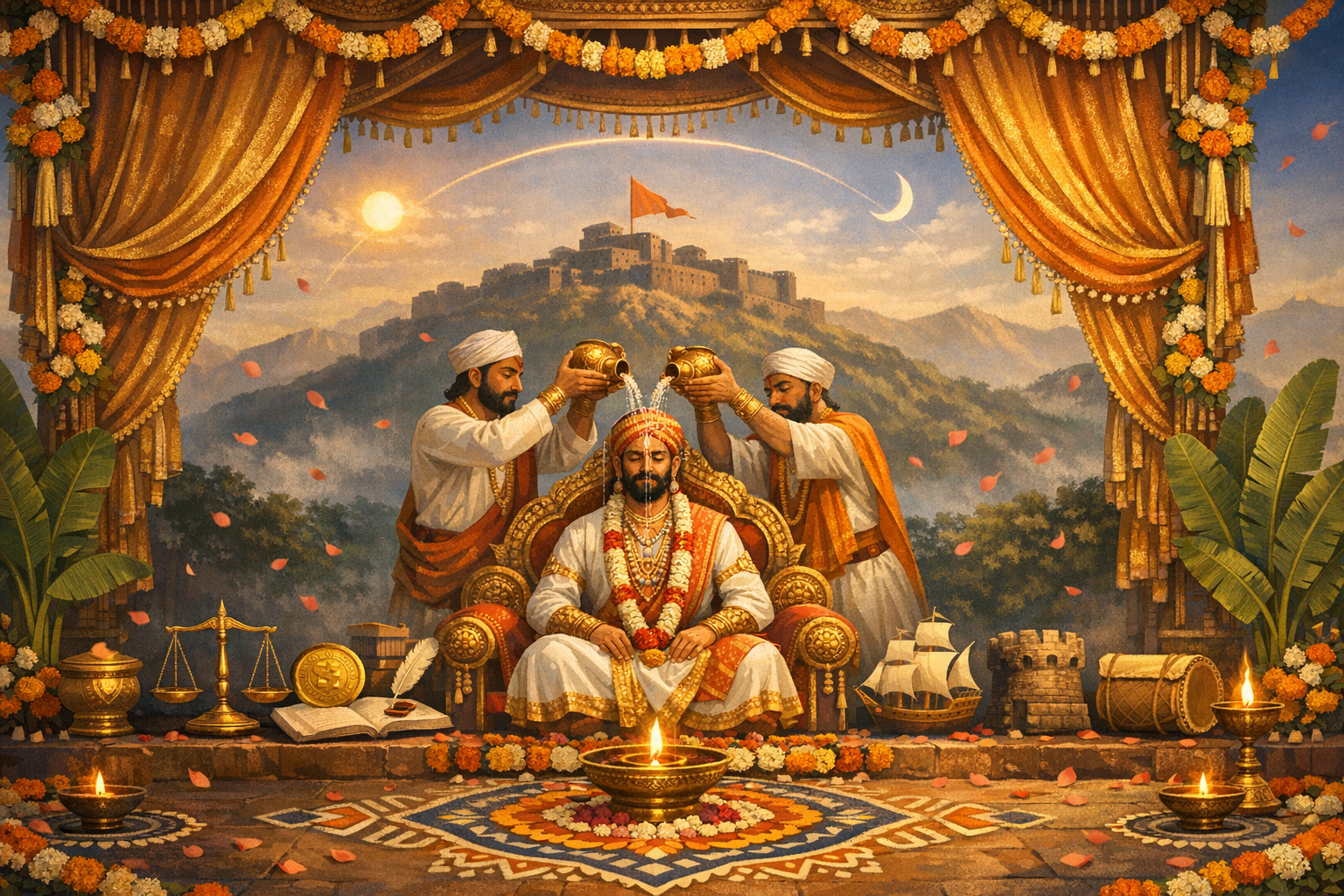
Shivrajyabhishek is the coronation day of Chhatrapati Shivaji Maharaj and is observed annually on Shukla Paksha Trayodashi in Jyeshta Month as per the Marathi calendar. In 2026, Shivrajyabhishek Divas falls on June 27, and it marks the beginning of Shivraj Shaka 353. Some public commemorations, including those coordinated by the Shivrajyabhishek Samiti, are scheduled on May 31, 2026, by the Gregorian calendar, reflecting an outreach-friendly date selection distinct from the lunar tithi observance.
Historically, the coronation (Rajyabhishek) took place at Raigad in 1674, when Shivaji assumed the title “Chhatrapati” after a meticulously performed Vedic rite traditionally associated with the duties of righteous statecraft (rajadharma). Accounts preserved in early chronicles emphasize the presence of learned officiants, the sanctifying abhisheka with sacred waters, and the formal investiture that affirmed sovereignty and the protection of subjects. Beyond a ritual milestone, the coronation publicly declared the consolidation of Swarajself-rule grounded in justice, security, and welfare.
The annual date varies in the Gregorian calendar because it is fixed to a lunar tithi, not a solar date. Shukla Paksha Trayodashi refers to the thirteenth lunar day in the bright fortnight of Jyeshta Month. The Marathi calendar follows the amanta convention of month reckoning, and tithis are determined by the angular distance between the Sun and Moon. Consequently, the 2026 observance aligns with June 27 for the tithi, while some civic programs occur on May 31 to facilitate wider community participation. Both reflect a shared intent to honor the coronation’s historical and ethical significance.
The term Shivraj Shaka denotes the era counted from Shivaji Maharaj’s coronation, functioning as a regnal reckoning distinct from Shaka Samvat (78 CE) and Vikram Samvat (57 BCE). With 2026 inaugurating Shivraj Shaka 353, communities emphasize continuity with the ideals articulated at Raigadupright governance, the safeguarding of cultural heritage, and social responsibility. The use of this era in commemorative contexts underlines a living connection to a moment that redefined polity and identity across western India and beyond.
Commemorations commonly include puja and abhisheka in temples, educational programs on Shivaji’s statecraft, and cultural events recounting episodes from the rise of the Maratha Empire. Families and student groups often revisit primary and classical referencesroyal edicts, later chroniclers’ “bakhar” literature, and scholarly synthesesto reflect on how coronation ideals translated into administrative practice. These engagements build a tangible bridge between history and contemporary civic ethics.
Shivaji’s coronation is best understood in light of his institutional innovations and strategic vision. The ashtapradhan mandal (council of eight) distributed responsibilities for finance, justice, foreign affairs, and military affairs. Maritime fortifications and a purposeful coastal policy strengthened trade and defense, while inland forts formed a resilient network of security. Policies emphasizing fairness in revenue and respect for diverse communities further embedded legitimacyattributes repeatedly highlighted in modern historical research on early modern Indian governance.
Anchored in dharmic principles, the coronation resonates across Hindu, Buddhist, Jain, and Sikh traditions that all value ethical rule, compassion, and duty. The celebration frames rajadharma as serviceupholding nyaya (justice), raksha (protection), and lokasangraha (welfare of society). Parallels are often drawn to the Sikh articulation of miri-piri (temporal and spiritual responsibility), the Buddhist emphasis on dhamma-guided rulership, and the Jain ideal of ahimsa-informed leadership. The day thus becomes a shared civilizational remembrance that strengthens unity among dharmic communities.
For households and community groups, Shivrajyabhishek 2026 offers an opportunity to study leadership through reliable scholarship and lived tradition. Engaging with the works of historians such as Acharya Jadunath Sarkar, revisiting bhakti-era texts associated with Maharashtra’s devotional ethos, and discussing ethical governance with youth can turn remembrance into practice. Communities frequently report that these dialogues foster pride, moral clarity, and intergenerational continuityoutcomes that mirror the coronation’s original intent to align power with principle.
In 2026, those observing according to the tithi can mark June 27 for puja, study, and service activities, while also noting broader civic commemorations on May 31. Local panchang guidance may be consulted to identify auspicious windows for home and temple rituals. Regardless of the date chosen, the essence remains constant: celebrating a coronation that fused spiritual sanction with responsibility to the people, and renewing a collective commitment to ethical public life.
Shivrajyabhishek 2026 therefore stands as both historical remembrance and living pledge. By honoring the coronation and the advent of Shivraj Shaka 353, communities reaffirm a shared heritage of inclusive statecraft and cultural resiliencevalues that continue to inspire constructive action across India and the global diaspora.
Inspired by this post on Hindu Pad.
