The well-known Vedic assertion that the worldgalaxies, universe, and all phenomenais an illusion often seems counterintuitive, especially when daily life and scientific observation feel undeniably real. Vedic scriptures resolve this tension not by dismissing the world as non-existent, but by introducing a technical understanding of illusion that refines what “real” means. In Advaita Vedanta, the statement “Brahma satyam jagan mithyā, jīvo brahmaiva nāparaḥ” is central: Brahman alone is absolutely real; the world is mithyā (conditionally real, dependent reality); the individual self is not other than Brahman. This is not nihilism; it is a rigorous, layered ontology.
Two scriptural strands converge here. First, the Upanishads repeatedly affirm the all-pervasiveness of the Absolute: “Īśāvāsyam idaṁ sarvam” (Isha Upanishad) and “sarvam khalvidam brahma” (Chandogya Upanishad). Second, the Bhagavad Gita clarifies the boundary between the changing and the changeless: “nā sato vidyate bhāvo nābhāvo vidyate sataḥ” (2.16)the truly Real never ceases to be, while the unreal never truly is. The world appears and functions, yet does not enjoy independent, absolute reality apart from its ground, Brahman.
To articulate this, Advaita Vedanta distinguishes three orders of reality. Paramārthika-sattā is Absolute reality (Brahman), unconditioned, non-dual, and changeless. Vyāvahārika-sattā is empirical reality, the shared world of experience, science, and ethical actionvalid for all practical purposes. Prātibhāsika-sattā is apparent reality, such as dream or mirage, which operates for an individual until knowledge corrects the error. Calling the world “illusion” means it is not ultimately real (not paramārthika), yet it is experientially and transactionally real (vyāvahārika) and thus not to be denied or neglected.
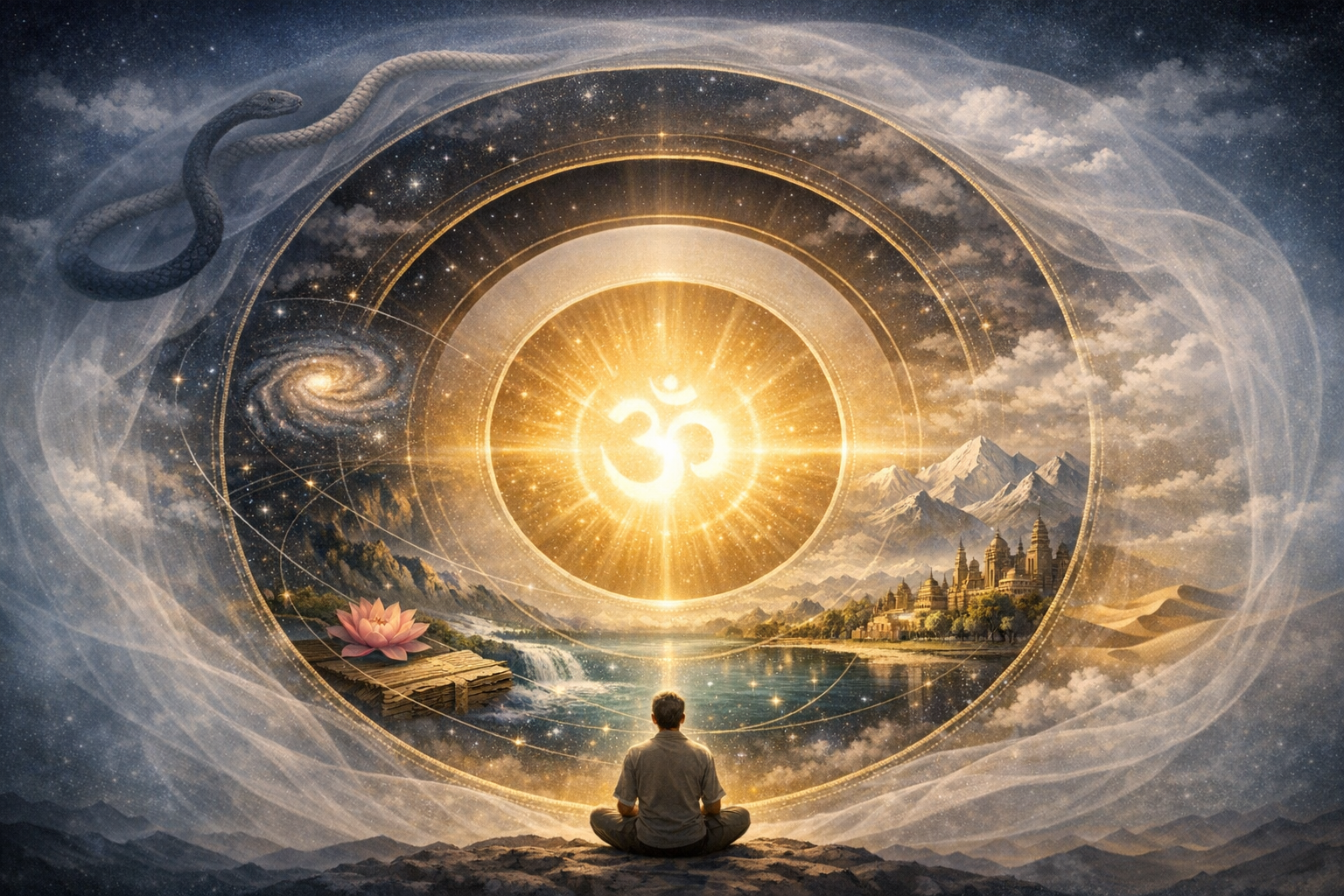
Classical examples clarify the point. Mistaking a rope for a snake in dim light does not mean no rope exists; rather, an error (adhyāsa, superimposition) overlays a snake-appearance on the rope-substratum. When corrected by light (knowledge), the snake vanishes, but the substratum remains. Similarly, waking from a dream cancels the dream’s facts, though the dream had its own compelling logic while it lasted. In both cases, a dependent appearance is sublated by a higher-order truth. The universe, according to Advaita, is a dependent appearance upon Brahman, sustained by māyā and avidyā.
Māyā is not mere trickery; it is a precise term denoting the power by which the one non-dual reality appears as many, time-bound, and changing. Avidyā (ignorance) at the individual level sustains the misidentification with body-mind and the reification of the world as absolutely separate. When knowledge (vidyā) dawnsthrough the Upanishads (śruti), reasoning (yukti), and direct contemplative insight (anubhava)the non-dual ground is recognized, and the status of the world is recalibrated from absolute to dependent.
This framework neither contradicts nor diminishes empirical inquiry. Astronomy, physics, and biology operate squarely within vyāvahārika-sattā. The claim is metaphysical: the cosmos does not have independent existence apart from the one reality. The insight parallels, but does not collapse into, modern observations about impermanence, emergence, or quantum indeterminacy. Scientific models track patterns within experience; Vedanta asks what the existence of any pattern presupposes and ultimately finds the unconditioned as the only self-established reality.
Upanishadic teaching methodologies are equally rigorous. Listening to the mahāvākyas (śravaṇa), resolving doubts by inquiry (manana), and stabilizing insight through contemplative assimilation (nididhyāsana) form a tested epistemic pathway. Alongside, the preparatory disciplines known as sādhana-catuṣṭayadiscrimination (viveka), dispassion (vairāgya), ethical integration (śamādi-ṣaṭka-sampatti), and single-pointed commitment (mumukṣutva)make the mind a fit instrument for subtle knowledge. Far from escapist, this training refines attention, clarifies values, and deepens compassion.
Because the world’s status is mithyā rather than asat (non-existent), dharma retains full force. Duties, relationships, and ethical responsibilities are not negated; they are pursued with greater wisdom, recognizing interdependence while not losing the unshakable center. The Bhagavad Gita’s synthesisKarma Yoga, Bhakti, Dhyāna, and Jñānaensures that realization and responsibility mature together. In practical terms, seeing the world as dependent reality reduces fear and possessiveness, enabling steadiness in adversity and humility in success.
Dharmic traditions converge on this insight from distinct angles, underscoring unity in diversity. Buddhism emphasizes anattā (non-self) and śūnyatā (emptiness), clarifying that phenomena lack independent, intrinsic essence and arise in dependent origination (pratītya-samutpāda). This maps closely to the Vedantic deconstruction of separateness and is in deep dialogue with it, even where metaphysical articulations differ. The practical upshot is the same: loosening of clinging, cultivation of wisdom and compassion, and liberation from suffering.
Jainism’s Anekāntavāda complements this by showing that reality is complex and multi-faceted; any single absolute claim about a conditioned object is incomplete. Syādvāda (“in some respect”) fine-tunes discourse, training the mind to hold multiple perspectives without contradiction. This temperament guards against dogmatism and harmonizes with the Vedantic claim that empirical assertions are context-bound within vyāvahārika-sattā while the unconditioned is paramārthika.
Sikh teachings articulate a parallel vision through remembrance of the OneIk Onkar, Satnamand caution against entanglement in māyā. The way out is Nāam Simran, righteous living (kirat karni), and service (seva). As in Vedanta, liberation does not reject the world; it reorients life around the Real, making honest work, ethical action, and devotion expressions of the One pervading all.
Within Hindu darśanas themselves, diversity of view is honored. Advaita foregrounds non-dualism and the mithyā status of the cosmos; Viśiṣṭādvaita and Dvaita ascribe a robust reality to the world as dependent on and permeated by the Divine. Rather than contradiction, this spectrum can be read as pedagogical: different starting points and temperaments receive teachings calibrated to lead from attachment and confusion to devotion, clarity, and eventual realization. The shared aimMokshaanchors the unity of Sanatana Dharma despite doctrinal nuance.
Several common doubts are worth addressing. If the world is an illusion, why is pain felt so vividly? Within vyāvahārika-sattā, pain and pleasure arise with lawful regularity; their sting is real at that level and demands compassion and wise response. The teaching’s purpose is not to dismiss suffering but to end its rootmisidentification. As insight deepens, one cares more skillfully, not less, because the boundary between “self” and “other” softens in the light of the One.
Another concern: does calling the cosmos mithyā negate devotion to God? In Advaita, Īśvarathe Lord as creator, sustainer, and dissolverpresides over the empirical order. Devotion to Īśvara purifies the mind, aligns action with dharma, and prepares for knowledge. When non-dual understanding dawns, devotion matures into abiding recognition of the Divine in all; worship continues as spontaneous reverence for the One manifesting as the many.
Scriptures also draw a fine distinction between Īśvara’s manifestation (Īśvara-sṛṣṭi, the lawful order) and the individual’s projections (jīva-sṛṣṭi, personal overlays of fear, craving, and bias). Liberation primarily dissolves jīva-sṛṣṭi, allowing one to live in harmony with Īśvara-sṛṣṭi. From this clarity, the world is engaged with care and courage, yet without existential grasping.
Beyond philosophy, contemplative practice makes this directly experiential. When attention stands as the witness of thoughts, emotions, and sensations, it becomes evident that experiences arise and subside within awareness. This shiftsubtle yet profoundloosens the tyranny of narratives and reveals an inner freedom that was never absent. The “seer–seen” discernment (dṛg–dṛśya viveka) trains attention to recognize what changes and what does not; over time, the changeless ground shines as self-evident.
Day-to-day life becomes a field for this inquiry. In moments of stress, one can notice how a storyline magnifies fearthen rest attention in the aware presence in which the storyline appears. In joy, one can see that even delight is a wave rising and falling in the same presence. Repeated recognition stabilizes freedom amidst change. Nothing of value is lost; rather, the Good, the True, and the Beautiful are appreciated as expressions of the One.
This understanding does not demand abandoning science, relationships, or responsibilities. It reframes them. Astronomy may model galaxies; ethics may guide civic life; arts may celebrate meaning. Vedanta simply clarifies that their being and intelligibility depend on the one non-dual reality. When this is seen, fear of loss wanes, intolerance softens, and a natural reverence for all life grows. That is why the sages insisted that grasping mithyā is not world-denial but wisdom that enables fearless love.
Seen through this lens, the Vedic statement that “the whole world is an illusion” becomes precise, liberating, and unifying. It dissolves absolutism without erasing empirical truth, invites deep practice without denigrating worldly duties, and affirms a shared purpose across Hinduism, Buddhism, Jainism, and Sikhism: to know the Real, to reduce suffering, and to live in compassion and clarity. The many paths of Sanatana traditions thus converge in one visionOne reality, many expressions, and freedom available here and now.
Inspired by this post on Hindu Pad.