
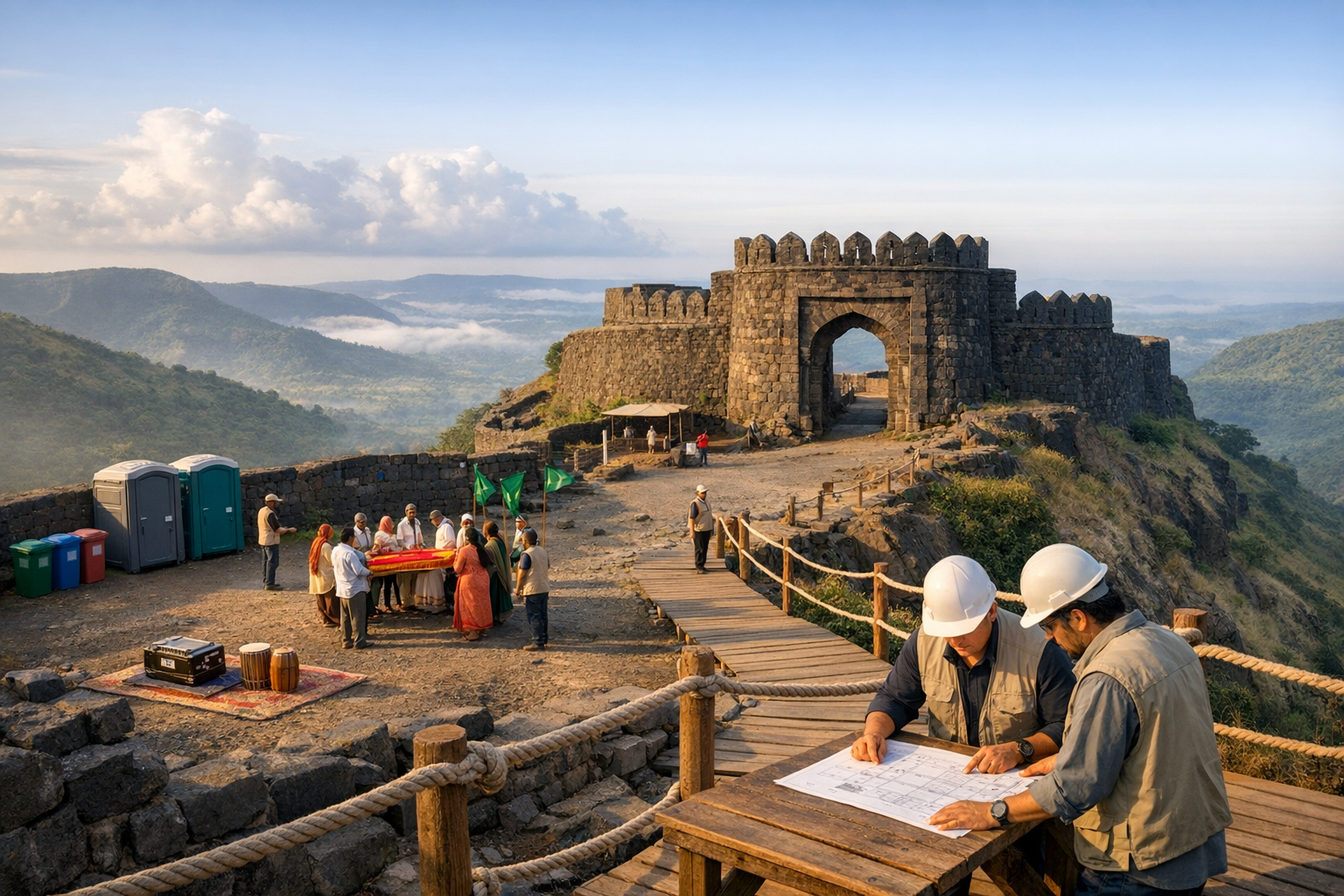
The long-running Vishalgad Urus Dispute resurfaced in Kolhapur, Maharashtra, as local Hindu organisations, including elements associated with the Gad-Durg Rakshan Samiti, renewed calls to halt the annual Sufi Urus festival within or adjoining the Vishalgad Fort precincts. The episode has revived a recurring policy question in India’s cultural heritage governance: how to reconcile the protection of fragile Maratha-era architecture with the lawful continuation of long-standing religious customs. Framed constructively, the dispute is less a zero-sum contest and more a test of India’s capacity to uphold heritage preservation, religious harmony, and constitutional rights in tandem.
Vishalgad Fort—historically known as Khelna—occupies a singular place in Maratha history and collective memory. Its association with Chhatrapati Shivaji Maharaj, the Deccan hill-fort tradition, and the wider defensive chain of gad-durg structures across Maharashtra has made it emblematic of regional identity and valor. As with many Deccan forts, the site’s sacral geography is layered; shrines and commemorative spaces reflecting varied traditions often coexist around or within defensive architecture. This intricate palimpsest requires careful stewardship, particularly as age, weathering, and visitor pressure impose mounting conservation demands.
The Urus (or Urs) festival marks the death-anniversary commemoration of a Sufi saint, observed as a spiritual union with the Divine. Across Maharashtra and the subcontinent, Urus gatherings commonly feature devotional music, recitation, charitable food distribution, and prayer. Historically, such observances have been frequented by diverse local communities, reflecting the porous and shared nature of sacred landscapes in the Deccan. At Vishalgad, reports indicate that the festival’s customary observance has, at times, overlapped with heritage-sensitive zones, catalyzing periodic friction between heritage managers and devotees.
Contemporary calls by certain Hindutva groups to permanently prohibit the Urus at the Maratha heritage fort are primarily articulated through concerns about structural safety, crowd management, and cultural integrity. Community representatives and devotees, conversely, emphasize customary use, intergenerational continuity, and the constitutional guarantee of religious practice. Between these positions lies a practical policy space: structured, evidence-based regulation that protects the fort’s fabric while enabling peaceful and lawful religious observance compatible with public order, health, and safety.
A balanced approach is firmly grounded in India’s constitutional and statutory framework. Article 25 ensures freedom of conscience and the right to freely profess and practice religion, subject to public order, morality, and health; Article 26 protects the right to manage religious affairs, likewise subject to similar limitations. Heritage-related statutes—whether the central Ancient Monuments and Archaeological Sites and Remains (AMASR) regime for centrally protected monuments or the Maharashtra Ancient Monuments and Archaeological Sites and Remains Act for state-protected sites—mandate safeguards against activities that threaten structural stability, archaeological integrity, or immediate regulated areas. Jurisprudence generally encourages proportionate restrictions based on demonstrable risk rather than blanket prohibitions grounded in identity.
From a conservation science perspective, Vishalgad’s load-bearing masonry, weathered parapets, and sloped approaches require rigorous preventive care. Large congregations, heavy staging, vehicular ingress, and unplanned processional routes can intensify vibration, concentrate loads in vulnerable spans, and accelerate micro-fracturing. Internationally recognized heritage standards (including ICOMOS charters and risk-based event protocols) recommend that ritual processions and gathering points be mapped against structural vulnerability indices, with sensitive zones either bypassed or protected via temporary decking, route staggering, or controlled footfall caps.
Effective resolution depends on collaborative governance. A multi-stakeholder mechanism should include the district administration, state archaeology and museums officials, local police, community elders, temple committees where relevant, waqf representatives where applicable, and civil society groups focused on heritage preservation and interfaith dialogue. Transparent minutes, publicly available decisions, and clear, time-bound review processes build trust and reduce rumor-driven escalation.
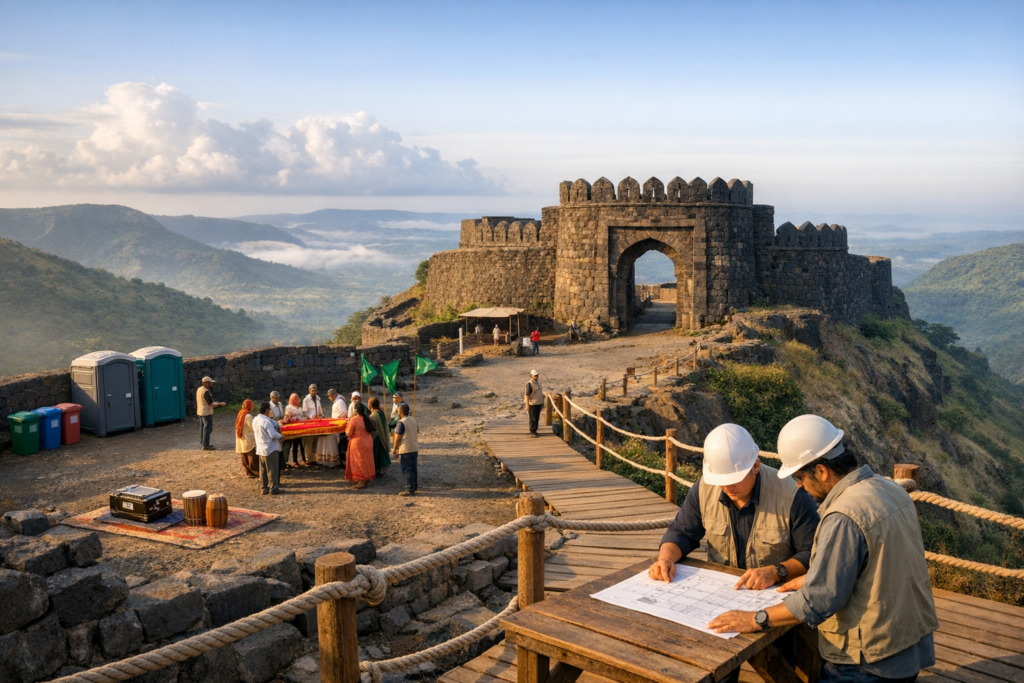
A practical pathway for Vishalgad could follow ten linked measures. First, commission an independent structural and conservation audit to establish a baseline risk profile and carrying capacity for different fort sectors. Second, undertake an Event Impact Assessment for the Urus, including crowd-flow simulation, emergency egress analysis, and medical response planning aligned with NDMA mass-gathering guidelines. Third, delimit ritual routes that avoid high-risk masonry and institute protective decking where unavoidable. Fourth, cap peak footfall with timed slots and decentralized congregation nodes in lower-risk buffer areas outside sensitive ramparts. Fifth, shift heavy infrastructure—sound systems, stages, generators—outside the fort walls, with noise and vibration managed through enforceable decibel thresholds. Sixth, institute zero-waste protocols, temporary sanitation blocks, and greywater management to prevent bio-deterioration of masonry. Seventh, create a co-authored Code of Conduct affirming non-violence, heritage respect, and religious harmony, communicated through multilingual signage (Marathi, Hindi, English). Eighth, ensure gender-sensitive amenities, first-aid posts, and trained volunteers for crowd stewardship. Ninth, deploy independent monitors to document compliance and publish post-event reports with incident data and conservation observations. Tenth, review annually with course corrections based on measured impacts rather than perceptions.
Implementation can be structured as a 30-60-90 day roadmap. In the first 30 days, complete the structural audit, route reconnaissance, and stakeholder mapping. By 60 days, finalize the Event Impact Assessment, Code of Conduct, and regulatory orders reflecting statutory mandates. At 90 days, publish the consolidated plan and open data footfall dashboard, ensuring the next observance is governed by predictable, consensus-based rules. This cadence anchors decisions in evidence and enshrines accountability.
Comparable precedents across India demonstrate that syncretic observances and heritage protection can coexist. At several forts and shrines in Maharashtra and beyond, authorities have relocated heavy stages to buffer zones, instituted route caps, and preserved ritual cores through careful choreography. Ajmer’s management practices for Urs observances and arrangements at other shared sacred sites offer operational cues: define what is essential to devotion and relocate what is logistically burdensome.
For a society committed to dharmic ideals of pluralism and compassion, the Vishalgad question is best seen through the prism of “Hindu-Muslim relations” embedded in a wider civilizational ethic that also honors the spiritual lineages of Buddhism, Jainism, and Sikhism. Sanatana conceptions of coexistence, echoed in the maxim Vasudhaiva Kutumbakam, favor dialogue (samvāda), mutual restraint, and the creative adaptation of practice to preserve both sacred meaning and material heritage. Policies that protect the fort and respect the Urus—as long as they remain within the bounds of law, safety, and conservation—embody that ethic.
In sum, safeguarding Vishalgad Fort is non-negotiable, and so is the principled commitment to peaceful, lawful religious traditions. A calibrated regulatory framework—rooted in conservation science, constitutional guarantees, and interfaith dialogue—can transform a recurring flashpoint into a model of Cultural Heritage stewardship. If executed with care, Kolhapur can demonstrate that protecting Maratha heritage and accommodating the Urus festival are not mutually exclusive goals, but complementary responsibilities of a mature, confident society.
Inspired by this post on Struggle for Hindu Existence.







Leave a Reply
You must be logged in to post a comment.