
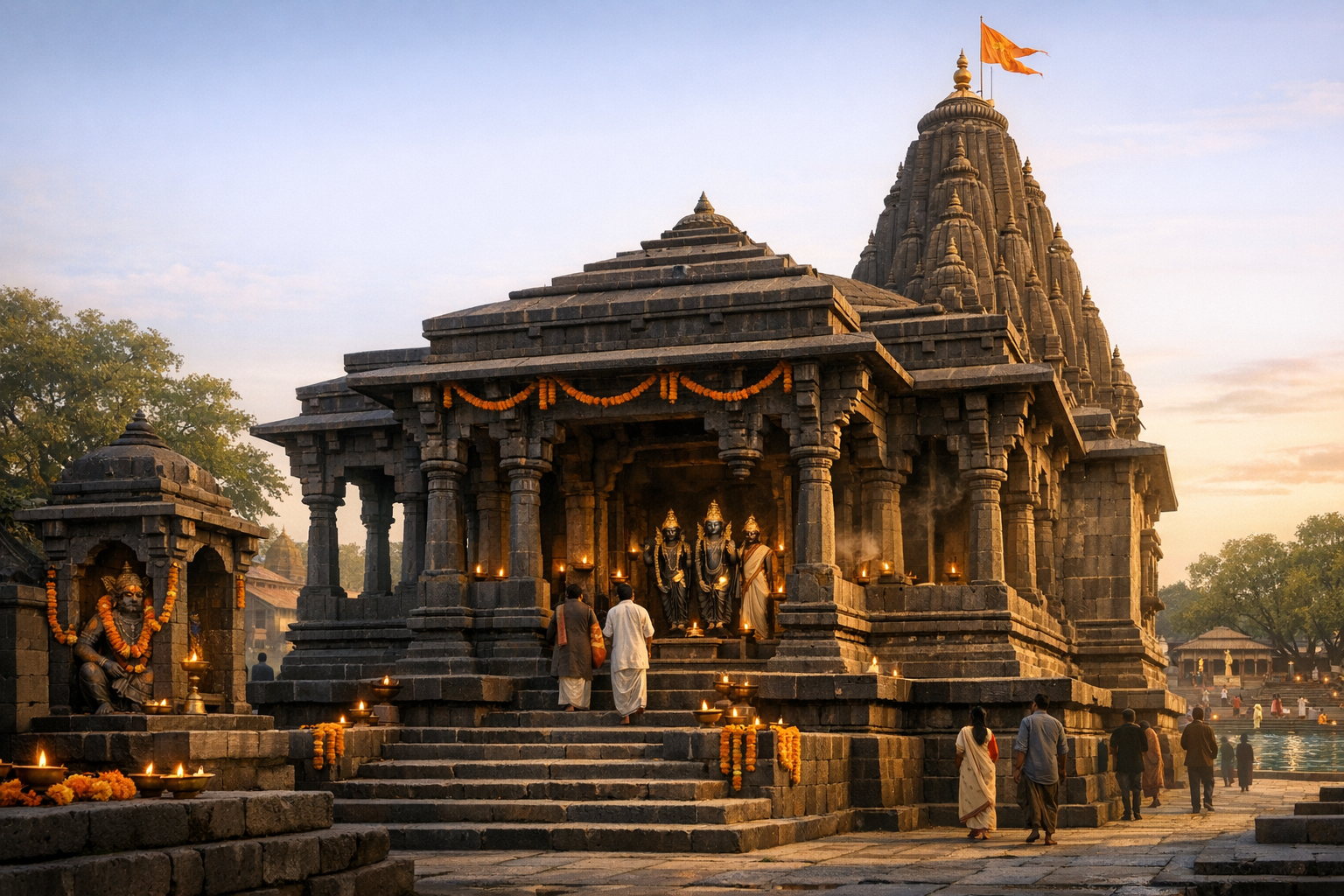
Kalaram Mandir in Panchavati, Nashik, is an ancient Hindu shrine dedicated to Bhagavan Sri Rama. Celebrated for its striking black stone murti of Bhagavan Ramaflanked by Mata Sita and Lakshmanathe temple anchors Nashik’s sacred geography and continues to shape the city’s devotional rhythm. Revered locally as a swayambhu manifestation, the deity embodies a living continuity of Ramayana memory, ritual practice, and cultural heritage in Maharashtra.
Historical tradition in Nashik holds that a Peshwa-era noble, Sardar Rangarao Odhekar, envisioned the deity in a dream and later recovered a black stone image from the Godavari at Panchavati. In response, Odhekar commissioned a grand temple in finely dressed basalt with community patronage. While precise inscriptional dates are scarce, the architectural typology and period records place the temple’s primary construction firmly in the late 18th century (c. 1780s–1790s), aligning it with the urban and religious redevelopment characteristic of the Peshwa period. In local remembrance, this moment marks the transition from river-found murti to an enduring public center of darshan and seva.
Panchavati itself is an epic landscape. Ramayana traditions identify the precinct as the site where Rama, Sita, and Lakshmana resided during vanvas. Proximate tirthas such as Ramkund on the Godavari (often called the Dakshin Ganga), Sita Gufa, and Tapovan structure a pilgrim circuit that links narrative, place, and practice. In this setting, Kalaram Mandir functions as a devotional and mnemonic hub: the black stone presence of Kala Ram offers a visual, tactile, and sonic continuity with daily recitation, kirtan, and seasonal yatras that keep the moral universe of the Ramayana vividly alive.
Architecturally, the complex reflects Peshwa-era sacred building in western India, with an emphasis on stone craftsmanship, axial alignment, and a balanced sequence from entrance to sanctum. The planorganized around the garbhagriha (sanctum), antarala (vestibule), and a pillared mandaparests on a well-proportioned stone plinth that negotiates the temple’s relationship with the street and the pilgrim flows that concentrate here during major utsavas. The masonrydark basalt blocks expertly drafted and jointedcreates a cool, acoustically resonant interior. Entrances from multiple directions integrate the surrounding lanes and ghats, while the rhythmic colonnade of pillars in the mandapa choreographs movement toward darshan.
Iconographically, the black stone (shyama) image of Bhagavan Rama is central to the temple’s identity and gives the shrine its name, Kala Ram. Rama is venerated with Mata Sita and Lakshmana as a triad, their forms and ornaments changing subtly with the ritual calendar. Devotees often describe an immediate stillness upon entering the mandapa: the dusky sheen of basalt, the gleam of oil lamps, and the cadence of Vedic mantras create a sensory field in which the Ramayana’s ethical and spiritual themes feel close at hand. A nearby shrine to Hanuman strengthens the Ramayana emphasis and supports the temple’s daily recitations and vow-based observances (vratas).
Ritually, Kalaram Mandir maintains a full liturgical cycle. Daily pujas typically begin at dawn, with suprabhatam, abhishekam (often with panchamrita), alankara, and archana establishing an unbroken rhythm of worship. The annual calendar peaks at Shri Rama Navami when Panchavati becomes a sea of lamps, flowers, and kirtan; processional events (palkhi or ratha, as locally organized) draw devotees from across Maharashtra. The temple’s Navaratri, Deepavali, Hanuman Jayanti, and Dussehra observances complement the Rama-centered cycle, sustaining a dense web of communal participation and transmission of sacred knowledge.
Social history also converges here. In 1930, Kalaram Mandir stood at the center of a major temple-entry satyagraha that accelerated statewide reflection on access and dignity in public worship. Remembered for its emphasis on equal darshan, this episode is now widely framed as a step toward realizing dharmic principles of fairness, compassion, and shared sacred space. In the decades that followed, the temple’s devotional life, community service, and educational initiatives aligned progressively with inclusive practicean evolution consistent with the larger ethical arc of Sanatana Dharma.
From a conservation perspective, the temple’s basalt fabric is both robust and demanding. Weathering patterns on external faces, footfall-induced polishing on thresholds, and the load-bearing behavior of the pillared mandapa require periodic assessment. Local stewardship by the temple trust, supported by civic engagement and heritage documentation efforts, has helped maintain ritual continuity while addressing structural needs. Best-practice preservation in living temples emphasizes minimal, reversible intervention; compatible materials and techniques; and sensitive integration of modern services without compromising the mandir’s historical character.
For those undertaking a Nashik pilgrimage, Kalaram Mandir sits within walking distance of Ramkund and Sita Gufa in the heart of Panchavati. Nashik Road railway station lies roughly 9–10 km away, and the city’s airport connects via regional flights. Visiting at dawn offers a serene darshan before the principal crowds gather; customary etiquette includes modest attire, silence in the garbhagriha queue, and clockwise circumambulation (pradakshina) where permitted. Every twelfth year, the Nashik Kumbh Mela magnifies the devotional field across the Godavari ghats, with Panchavati and its temples playing host to an extraordinary confluence of sadhus, scholars, and seekers.
Kalaram Mandir’s ethos resonates across the wider family of dharmic traditionsHinduism, Buddhism, Jainism, and Sikhismthrough shared values of compassion, self-discipline, service, and reverence for sacred places. The Ramayana’s moral grammardharma, satya, karuna, and maryadaspeaks to these traditions in complementary ways, inviting mutual respect and dialogue. In this spirit, the temple’s living practices model a hospitable sacred commons where diverse paths of contemplation and seva can thrive together.
As a convergence of history, architecture, ritual, and civic memory, Kalaram Mandir remains one of Nashik’s most compelling sacred landmarks. Its black stone presence anchors Panchavati’s Ramayana landscape; its Peshwa-era fabric testifies to a refined building tradition; and its festivals renew a powerful devotional current that draws pilgrims year after year. For students of Indian architectural history, for seekers inspired by Rama-bhakti, and for all who care about heritage preservation, Kalaram Mandir offers a clear, enduring window into the living legacy of Panchavati and the spiritual heart of Maharashtra.
Inspired by this post on Hindu Blog.










