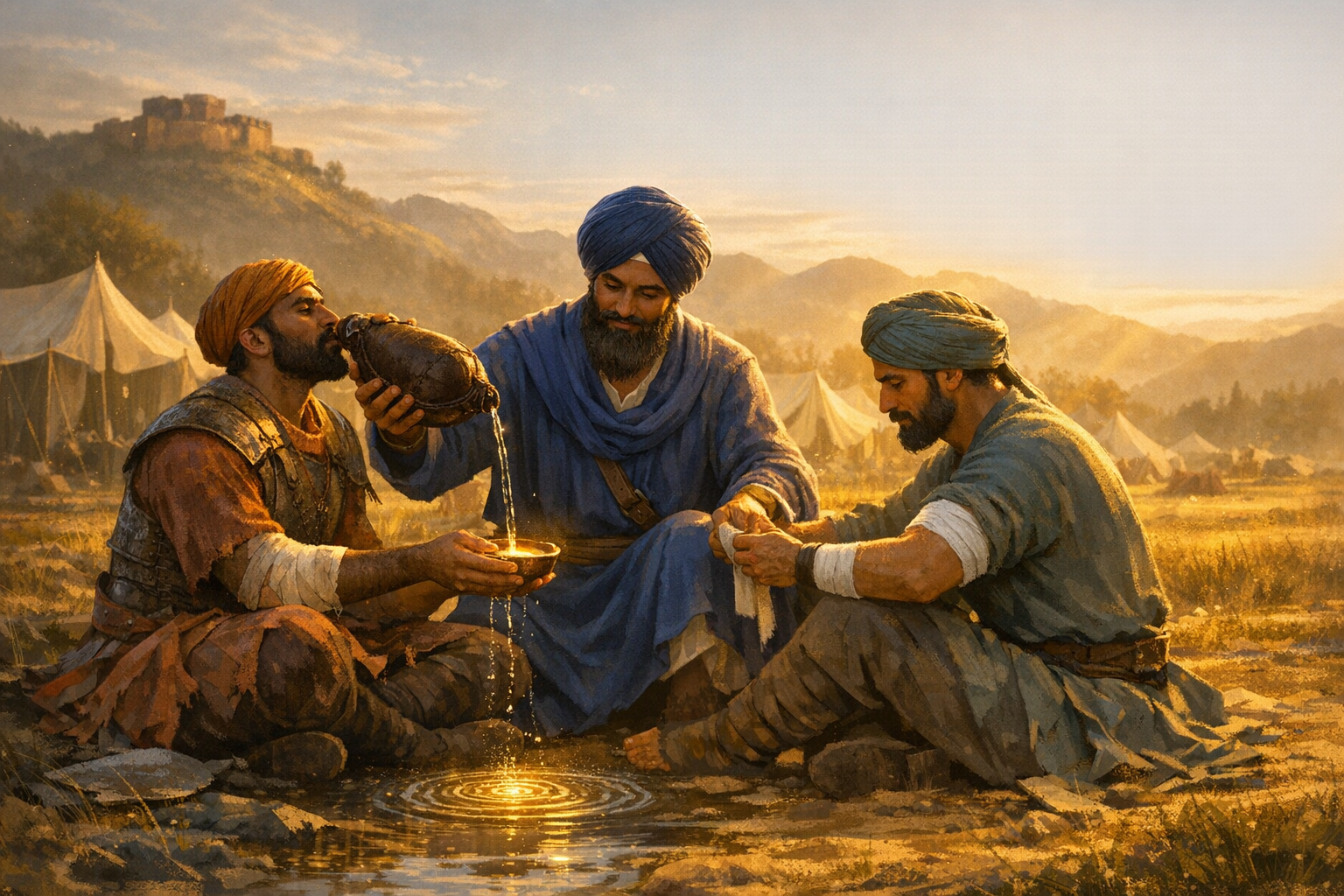
Among the most luminous ethical episodes remembered across the subcontinent is the Sikh account of Bhai Kanhaiya (often spelled Bhai Ghanaiya), the water bearer who served on battlefields with the disarming conviction that there was, in truth, no enemy before him. Moving steadily with a mashk (a traditional water-skin), he offered water and solace to all the woundedSikhs, Mughals, Afghansembodying a principle enshrined in the Sikh scripture: na ko bairi, naahi begana. This narrative is not merely hagiographic; it is a rigorously instructive case study in applied ethics, humanitarian neutrality, and dharmic universality, resonant with the shared values of Hinduism, Buddhism, Jainism, and Sikhism.
To appreciate the depth of this act, it is useful to situate it in the geopolitical and social turbulence of late seventeenth- and early eighteenth-century Punjab. The Khalsa, formally inaugurated by Guru Gobind Singh in 1699, faced repeated sieges and shifting coalitions of imperial and regional powers. Prolonged engagements around Anandpur created conditions of acute scarcity and suffering. In such theaters, clean water, basic first aid, and the simple act of acknowledging the dignity of the wounded became decisive humanitarian interventions. It was into this crucible that Bhai Kanhaiya stepped, transforming the meaning of servicesevafrom a noble ideal into a battlefield practice.
Tradition holds that Bhai Kanhaiya (1648–1718), born near present-day Wazirabad, absorbed the Sikh ethos of nishkam seva (selfless service) under the guidance of the Sikh Gurus, first in the circle of Guru Tegh Bahadur and then under Guru Gobind Singh. His commitment ultimately seeded what came to be known as the Sewapanthi orderan institutional expression of service that treated practical compassion as primary spiritual discipline. While exact biographical details are retold in varying ways across oral and written sources, the consistent throughline is his unwavering dedication to alleviating suffering without discrimination.
The most cited incident occurs during the extended conflicts around Anandpur in the early 1700s. As fighting ebbed and surged, Bhai Kanhaiya carried his mashk from one injured combatant to another, sometimes kneeling between adversaries still divided by fresh violence. Fellow Sikhs, alarmed, reported to Guru Gobind Singh that he was reviving enemy soldiers who might soon return to the fray. Summoned before the Guru, Bhai Kanhaiya explained with serene clarity that he perceived no Sikh, no Mughalonly the Divine Light in every being. The response was decisive and pedagogical: Guru Gobind Singh commended him and provided ointments and bandages, asking him to tend wounds as well as thirst.
This moment can be read as leadership clarifying organizational ethos. The Khalsa was formed as a sant-sipahi (saint-soldier) community, morally disciplined and martially capable. By endorsing impartial care for the wounded, the Guru signaled a critical boundary: while the Khalsa would resist oppression, it would not violate the fundamental sanctity of suffering life. Any apparent paradox dissolves when seen through Sikh praxis: seva is not an optional ornament to valor but its ethical spine, ensuring that courage remains tethered to compassion.
From a philosophical standpoint, Bhai Kanhaiya’s act demonstrates an aretaic (virtue-centered) ethics anchored in vision. Perceiving Ik Oankarthe Oneness of the Divinereframes the other not as an enemy but as a bearer of the same Light; karuna (compassion) then becomes a rational and necessary response. In this sense, seva is not simply a duty (deon) imposed from outside but a flowering of inner insight (prajna) into the nature of reality. The battlefield is thus transformed into a field of sadhana, where the self trains to recognize divinity through the discipline of service.
Viewed across dharmic traditions, the episode aligns with kindred principles. Hindu thought invokes Vasudhaiva Kutumbakamthe world as one familyto affirm universal kinship. Buddhism emphasizes karuṇa and mettā as skillful means to end suffering. Jainism advances ahimsa and anekantavada, the latter urging humility in judgment by acknowledging many-sided truth. Sikhism unites these resonances within its distinct emphasis on sarbat da bhala (welfare of all), enshrined in the daily ardas. Together, these streams nourish a shared civilizational commitment: in moments of extremity, the measure of righteousness is the protection of life and dignity.
There is also a robust legal-historical insight here. Centuries before modern codifications such as the Geneva Conventions articulated the neutrality, impartiality, and humanity that define contemporary humanitarian law, Bhai Kanhaiya modeled these principles in practice. In the wider Indic canon, the Mahabharata’s discourse on dharma-yuddha already circumscribed violence by proscribing harm to noncombatants and the incapacitated. Sikh memory adds a concrete, operational resolution: treat the wounded as patients, not partisans. The consistency across time suggests that humanitarian norms in South Asia were not theoretical abstractions but living codes, periodically reaffirmed in crisis.
The symbolism of water intensifies the teaching. In Indic cultures, jal is life-sustaining, purifying, and relational; it binds communities through wells, rivers, and ritual. To offer water is therefore to recognize the other’s right to breathe, to returnif only brieflyto wholeness. In Sikh praxis, langar universalizes this impulse through food; jal-seva universalizes it through water. Both enact an ontology of equality, dissolving hierarchy at the point of need.
Technically, battlefield relief in the early 1700s demanded courage, method, and minimal kit: a mashk for water, cloth for dressings, simple balms to prevent infection, and a practiced calm under duress. Triageprioritizing the most urgent caseswould have been intuitive rather than codified, yet the underlying logic is recognizable to modern medics: restore breath, stem bleeding, soothe pain, and stabilize. In environments of scarcity, moral clarity about who is servedeveryone, without discriminationbecomes the decisive algorithm.
Organizationally, the Guru’s endorsement of Bhai Kanhaiya’s seva also neutralized in-group bias. Complaints against him were not silenced but educated; compassion was not made sentimental but operational. This is a repeatable leadership pattern: convert moral perplexity into a teachable doctrine by equipping the exemplarhere, with ointments and a mandateso the community sees the ethic at scale. The saint-soldier ideal is thus safeguarded against both cruelty and naïveté, cohering around a disciplined compassion.
For plural societies today, the lesson is precise. Communal harmony and interfaith relations do not thrive on abstract tolerance alone; they require practices that reduce suffering across boundaries. In disaster relief, public health, or conflict mitigation, protocols modeled on impartial seva lower the social temperature and build trust. When institutions transparently serve allechoing sarbat da bhalathey reinforce the rule of law and counteract polarizing narratives.
Applied to everyday life, the bhavna (disposition) of “seeing no enemy” is neither passivity nor denial of harm. It is a training regimen for perception and response: recognize the common light first, confront injustice firmly, and refuse to dehumanize. Digital discourse, civic disagreements, and neighborhood tensions all benefit from this triadcompassionate vision, principled action, and dignifying speech.
Potential objections deserve sober treatment. Does aiding a wounded adversary risk prolonging conflict? The dharmic reply distinguishes between the cessation of breath (where help is categorical) and the continuation of enmity (which is addressed by just means, proportionate force, and lawful restraint). Humanitarian relief does not underwrite aggression; it affirms a boundary beyond which strategic aims may not trample human dignity. Historically, such boundaries preserve the soul of a community even as it defends itself.
The legacy of Bhai Kanhaiya thus endures in both spirit and institution. Sewapanthi lineages, gurdwara-based medical camps, and the universal kitchen of langar carry forward an infrastructure of compassion. The idiom of sarbat da bhala remains the ethical North Star of Sikh prayer, while comparable currents in Hindu, Buddhist, and Jain communitiesannadāna, maitrī, ahimsaconverge in a civilizational grammar of care. The unity is not superficial; it rests on shared commitments to relieve suffering without erasing principled resistance to injustice.
Ultimately, the water bearer who saw no enemy challenges contemporary readers to adopt a high-fidelity ethic: to act with the courage of a soldier and the tenderness of a healer. In the annals of South Asian history, few images are as enduring as the figure who, amid the clamor of war, kneels with water and balm. That kneeling is not capitulation; it is a declaration that the worth of life is nonnegotiable. The Indic visionVasudhaiva Kutumbakam in spirit, sarbat da bhala in practiceoffers a credible path to unity across Hinduism, Buddhism, Jainism, and Sikhism: serve first, and let compassion lead truth to victory.
Inspired by this post on SikhNet – News.