“When Shiva bled” is among the most arresting phrases in Hindu sacred narrative. In the Vamana Purana’s account of Andhaka’s defeat, it does not imply mere corporeality but a thunderous release of divine powerShaktithrough which protective forces arise to restore order. The episode explains both the cosmological origin and the ethical rationale of the Ashta Bhairavaseight fierce guardians who ring the directions as kshetrapalaswhile situating the asura Andhaka as a paradigm of blindness, desire, and the peril of unknowing. Read through a dharmic lens, the story becomes a map for transforming inner darkness into awakened guardianship of the self and society.
The Vamana Purana foregrounds this drama with narrative economy and symbolic density. Andhaka’s assault on cosmic order provokes Shiva’s fierce compassion, whose outpouring generates the Eight BhairavasAsitanga, Ruru, Chanda, Krodha, Unmatta, Kapala, Bhishana, and Samharaas directional sentinels. Cross-references in the Shiva Purana and Skanda Purana, along with allied Shakta material on the Saptamatrikas, reinforce the thematic cluster: chaos multiplies through unexamined desire, and dharma prevails when wisdom channels power with precision.
In Hindu stories and Puranic literature, Andhaka occupies a distinctive place. Born blind, he is reared by the asura king Hiranyaksha and matures into an embodiment of tamas and insatiable kama. Several Puranic recensions note that Andhaka ultimately desires Parvati, not knowing his deeper bond to Shiva’s householdan ignorance that stands at the heart of the tragedy. The etymology of his name”one who brings darkness”is not incidental; it encodes the central philosophical claim that avidya (not seeing) begets adharma.
Boon-bearing deities magnify the stakes. Having secured protections that make him nearly invincible, Andhaka mounts an assault on Kailasa. In doing so, he violates dharmic boundaries both familial and cosmic, and the narrative signals that restoration cannot be achieved by brute force alone. The ethical subtext is as clear as it is universal: power without insight generates self-replication of harm, and each drop of misplaced energy begets more of the same.
The battle that follows, preserved with variations in Vamana Purana and related texts, pivots on a terrifying device: every fall of Andhaka’s blood to the earth yields new replicas of the asura. This literary motif is kin to the Shakta account of Raktabija in the Devi corpus and is crucial to understanding the birth of auxiliary divine forces. When harm proliferates by contact, victory demands preventing that contact altogether; hence the emergence of divinities who drink blood before it reaches the ground.
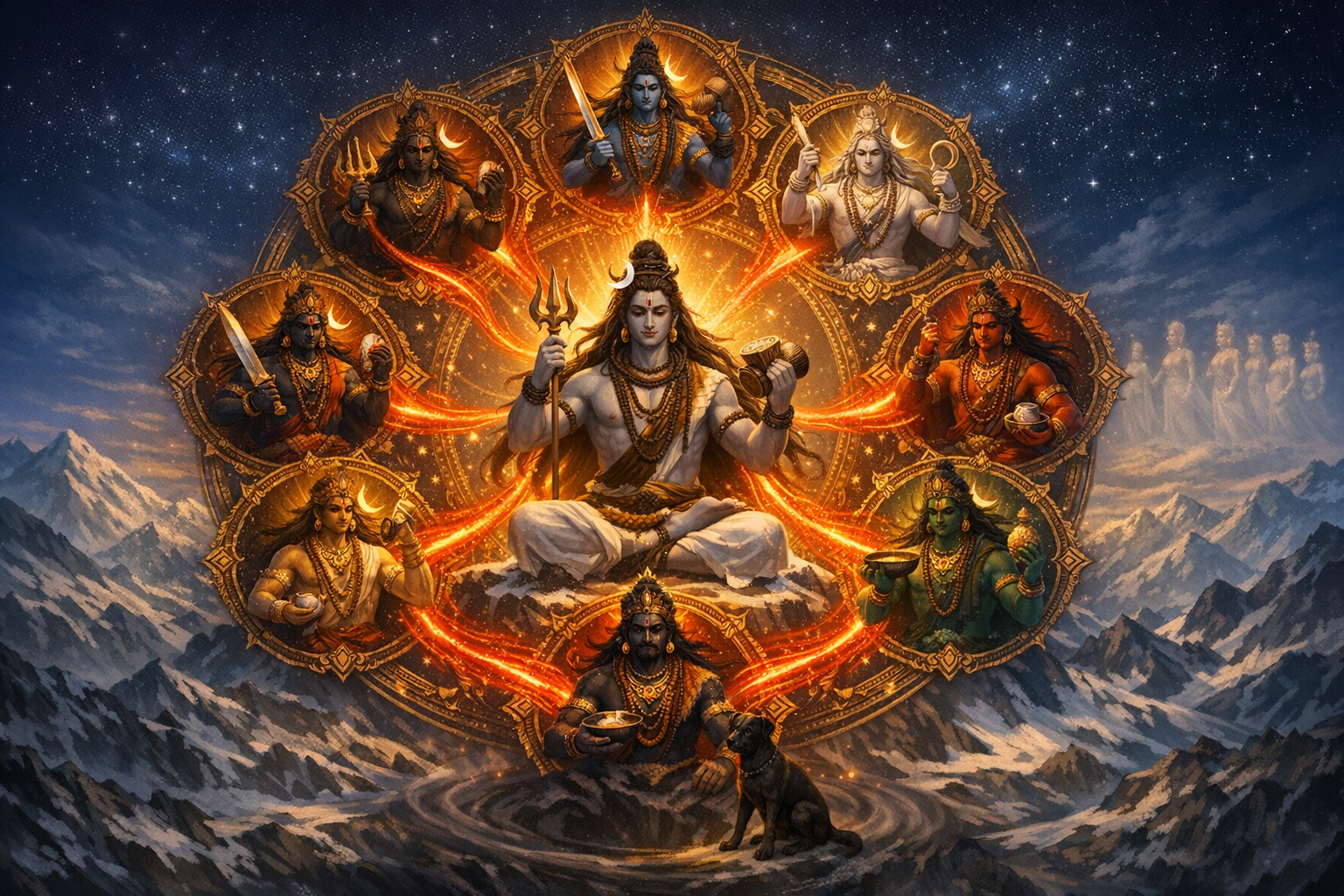
At the crisis pointin a dramatic moment many traditions frame as “when Shiva bled”Shiva’s fierce radiance (tejas) externalizes as guardianship. Whether described as arising from his blood, his sweat, or his irresistible wrathful grace, the effect is the same: eight distinct Bhairavas appear, arrayed to guard the eight directions. Their task is to intercept the asura’s multiplying drops, drink them, and contain the contagion of chaos before it takes root.
The Ashta BhairavasAsitanga, Ruru, Chanda, Krodha, Unmatta, Kapala, Bhishana, and Samharaare widely acknowledged across Shaiva and Tantric sources as directional protectors. Tradition often presents them as emanations of Kala Bhairava (sometimes styled Mahabhairava), who presides as the lord of time and boundaries. While their precise attributes vary by region and text, the shared profile is clear: each embodies a calibrated form of Shiva’s power, optimized to seal a perimeter and correct a disorder.
Iconographically, the Bhairavas carry implements suited to both subjugation and sanctificationtrident (trishula), sword (khadga), noose (pasha), drum (damaru), and the skull-bowl (kapala). These are not random accoutrements; they encode functions. The trident cuts through the three knots of bondage, the drum heralds cosmic rhythm, the skull-bowl reminds worshippers of impermanence, and the noose binds what must be restrained until clarity returns. In many traditions Kala Bhairava is flanked by a dog, signifying fidelity and threshold vigilance; as Kotwal of Kashi, he symbolizes lawfulness in service of liberation.
Complementing the Bhairavas in several Puranic tellings are the Saptamatrikas, the Seven Mothers, who also drink the asura’s blood. This Shakta-Shaiva synergy recurs throughout the story-worlds of the Puranas and is a hallmark of India’s civilizational pluralism. Far from competing claims, the Matrikas and Bhairavas enact a choreography of containment and compassionpreventing new harm while transforming the residue of old harm into material for insight.
With the field secured, Shiva pierces Andhaka with the trident and holds him aloft while the guardians complete their task. Crucially, Andhaka’s defeat is not annihilation but conversion; in several accounts he is purified of blindness and integrated as a devotee or attendant within Shiva’s retinue. The moral is unmistakable and widely resonant across dharmic traditions: the proper end of punishment is restoration, and the fiercest forms of divinity ultimately protect, refine, and reintegrate.
Textually, the Vamana Purana concentrates this arc with emphasis on the guardians’ birth. The Shiva Purana (Rudra Samhita) and Skanda Purana furnish allied variants, often elaborating the role of the Matrikas. Tantric and Agamic materials, especially those cherished in Kashmiri Shaivism, philosophically elevate Bhairava as ultimate consciousness itselflimitless, self-luminous awareness that appears wrathful only to the obscurations that limit freedom. Within this higher reading, “when Shiva bled” becomes an upaya (skillful means): intense compassion shaped as necessary severity.
The etymology of “Bhairava” is itself instructive. While popularly glossed as the fearsome one, exegetes often prefer the sense “he who removes fear”the one in whom the triad of primordial fears (of birth, death, and time) dissolve. Kala Bhairava, lord of time, thus becomes a teacher rather than a terror, commanding boundaries not as denial but as pedagogy. The eight Bhairavas he emanates are curriculumlessons in focused courage and discriminating compassion.
Ritually and geographically, the Bhairava cultus is pan-Indian. In Kashi, Kala Bhairav is honored as the city’s Kotwal, an officer-guardian whose jurisdiction secures a pilgrim’s sojourn. In Ujjain, the Kaal Bhairav temple sustains a living tradition of offerings that recall the deity’s role as a vigilant boundary-keeper of sacred space. In parts of South India, lineages celebrate circuits of Ashta Bhairava shrines, each associated with a directional function and specific vows (vrata) governing right speech, right livelihood, or right conduct at thresholdsdomestic and cosmic alike.
Devotees and scholars frequently observe how these practices shape inner experience. Accounts from pilgrims in Kashi and Ujjain describe a palpable sense of guardedness that allows deeper surrender in worshipan experiential confirmation of the myth’s logic: only when boundaries are secure can the heart open without fear. For many households, a simple salutation to Bhairava at a doorway or crossroads serves as a daily reminder to cross from heedlessness to heedfulness.
Interpreting Andhaka through a psychological lens enriches the ethical yield of the narrative. Andhaka’s blindness is not a condemnation of disability but a metaphor for avidya, the refusal or inability to recognize truth; his multiplying blood is a symbol of how unexamined impulses replicate themselves through thought, speech, and action. The Ashta Bhairavas, then, visualize eight practical guardrailsattention, restraint, courage, clarity, humility, accountability, remembrance, and compassioneach a way to catch the “drop” before it seeds further suffering.
Cross-dharmic resonances strengthen the unity-of-purpose that defines India’s spiritual tapestry. In the Devi traditions, the Saptamatrikas’ blood-drinking echoes the Bhairavas’ containment, underscoring a shared method for handling proliferating harm. In Buddhist Vajrayana, Yamantaka (Vajra Bhairava) subdues the lord of death as a wrathful manifestation of wisdom; the thematic proximity to Kala Bhairava’s mastery of time is striking. Jain communities often recognize Bhairava as a local kshetrapal near tirthas, emphasizing protection of sanctity without compromising core Jain ethics. In Sikh thought, the saint-soldier ideal (sant-sipahi) intertwines compassion with principled strength, a contemporary analog to the guardianship that Bhairava emblematizes. These parallels advance a shared dharmic vision: fierce compassion that defends truth while dignifying life.
From a historical perspective, Bhairava iconography traverses multiple strata of art and ritual: Gupta and post-Gupta reliefs, medieval temple programs that integrate Matrikas and Bhairavas, and regional liturgies shaped by Agamic and Tantric manuals. As the Ashta Bhairavas diffuse through practice, local texturesnames, vehicles, weaponsshift without severing the canonical core. This plasticity sustains continuity: protect the threshold, honor time, remove fear, and restore the errant without hatred.
The narrative’s closing movementthe purification and reintegration of Andhakaoffers a final dharma lesson. Justice in the Puranic imagination is corrective, not merely retributive. The same trident that halts harm also anchors a process of recognition and return. In many households, this fuels an ethic of disciplined forgiveness: one must first stop what injures, and then work to re-educate itwithin oneself, one’s family, and one’s community.
Read in the present tense, the story provides a method for handling complexity. Where falsehood multiplies quicklyin rumor, outrage, or algorithmic amplificationcommunities need Matrika-Bhairava strategies: intercept harmful flows, deny them ground, and convert their energy into learning. At the individual level, the practice translates into mindful vows at daily thresholds: before entering work, before speaking, before sending a message. Such disciplines make the myth practical without diminishing its sacred force.
In sum, the Vamana Purana’s account of “when Shiva bled” does not revel in violence; it sanctifies vigilance. The Eight Bhairavas arise as medicine precisely fitted to the malady of proliferating harm, restoring alignment between power and responsibility. Placed alongside Skanda Purana and allied Shakta materials, the episode becomes a civics of the sacredhow a plural society, inspired by dharmic ideals, can guard what is holy in every tradition while welcoming the errant back into integrity.
For readers of Hindu stories and seekers across dharmic pathsHinduism, Buddhism, Jainism, and Sikhismthe benefit of this tale is immediate and shared. It teaches that thresholds matter, that fear can be removed rather than merely endured, and that the fiercest guardianship is finally a form of love. The Ashta Bhairavas, born from Shiva’s uncompromising compassion, remain relevant wherever courage must be disciplined by wisdom.
Inspired by this post on Hindu Blog.