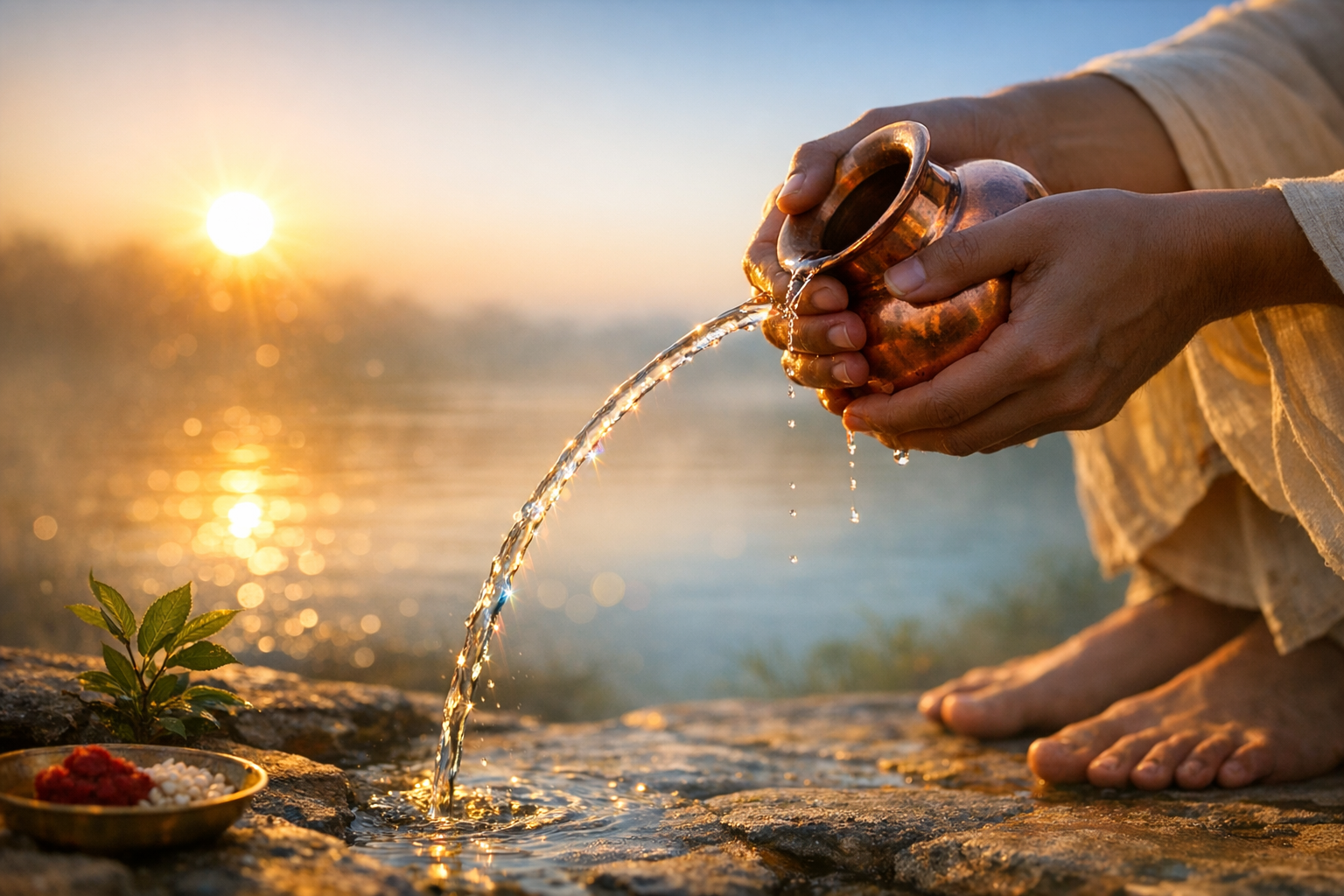
Arghya to the rising Sunpouring a thin stream of water toward the first light of dayis among the most enduring expressions of gratitude in the Vedic tradition. Revered as Arghya Mahatmya, this practice appears across diverse regions and lineages, continuing to anchor daily rhythm, ethical intent, and contemplative poise. In many homes, the stillness of dawn, the shimmer of water, and the quiet recitation of mantras combine to create a simple, universal gesture of reverence: acknowledging Surya as pratyaksha devata, the immediately visible source of life.
Arghya literally denotes a respectful offering. In household and temple ritual, water has long served as the first medium of welcome and honoroffered to guests, to deities, and to teachers. The act unites body, breath, and attention: hands steady the vessel, breath slows to a mindful cadence, and gaze rests upon the stream of water as it catches the Sun’s rays. Contemporary expositions, including those by Sri Sri Ravishankar, often emphasize the emotive core of the rite: in Sanskrit usage, ‘āp’ (Apa) denotes water, and in traditional thought water is associated with nurturance, tenderness, and the affective warmth that undergirds devotion.
Textual roots for the reverence of the Sun stretch through the Rigveda’s hymns to Sūrya and Savitṛ (e.g., RV 1.50; RV 3.62.10), classical Smṛti injunctions, and the Gṛhya-sūtras that shape daily domestic worship. In many lineages, Arghya forms an integral component of Sandhyāvandanaa tri-daily discipline at dawn, noon, and dusk that interweaves mantra recitation, breath regulation, and water offerings. Later devotional literature, including the celebrated Aditya Hṛdayam of the Rāmāyaṇa tradition, extols the Sun as a bestower of clarity, vigor, and discernment.
Why is water offered to the Sun? Vedic symbolism pairs the luminance of tejas (fire principle) with the life-sustaining matrix of jala (water). As light filters through a steady, translucent stream, devotees perceive a union of warmth and compassion, radiance and receptivity. The visible arc of light caught within water becomes a contemplative focusan external reflection of inner alignmentencouraging one-pointedness and gratitude at the day’s point of origin.
Time and direction. The most widely observed moment is sunrise, near the cusp of night and day. Practitioners stand facing east, ideally barefoot on a natural surface, at or just after Brahma-muhūrta and morning ablutions. Some traditions also include noon and sunset Arghya, facing the Sun’s direction at those times. If circumstances demand, a balcony, window, or quiet courtyard serves perfectly well; the constancy of intention outweighs the grandeur of setting.
Materials. A small copper lota or kalasha is customary, though any clean vessel is acceptable. Water should be fresh and clear. Depending on lineage, a few akshata (unbroken rice grains), a pinch of red sandal, or sesame (til) may be added. The vessel is held at chest level, and water is poured slowly through a ring formed by the thumb and index finger, allowing a fine, continuous stream to refract the light.
Intention (saṅkalpa). Before beginning, it is common to articulate a quiet resolve: to live the day with clarity, compassion, and steadiness; to dedicate one’s work to the welfare of all beings; and to align thought, speech, and action with dharma. In some households, the formal saṅkalpa also includes place, date, and lineage identifiers; in others, a sincere mental offering suffices.
Mantra recitation. A concise form invokes the Sun with “Om Sūryāya Namaḥ” one to three times as water flows. Many traditions chant the Dvādaśa Āditya namesMitra, Ravi, Sūrya, Bhānu, Khaga, Puṣan, Hiraṇyagarbha, Marīci, Āditya, Savitṛ, Arka, and Bhāskaraeach saluted with Namaḥ as an offering is made. Some recite the Gāyatrī Mantra to Savitṛ (RV 3.62.10) or employ the bīja mantra “Om hrām hrīm hraūm saḥ sūryāya namaḥ.” Those who have learned Sandhyāvandana follow its structured sequence, including three Arghyas, prāṇāyāma, and Gāyatrī-japa.
Completion. After the final libation, hands are joined in añjali; some gently touch the eyes and crown, symbolically receiving light and clarity. The remaining water, if any, is respectfully returned to the roots of a plant or the soil, completing a cycle of reciprocity with the living world.
Regional and festival expressions. Daily Surya Arghya appears in varied forms across India and the broader Indic world. In the eastern Indo-Gangetic plain and parts of Nepal, the multi-day Chhath Puja culminates in collective sunrise and sunset Arghya with water and milk, accompanied by folk hymns (sohar, kirtan) that blend devotion with ecological reverence. In southern traditions, Arghya is embedded in Sandhyāvandana and Aditya worship; in western regions, morning offerings to Sūryanārāyaṇa are often paired with simple Surya Namaskāra sequences. While externals differ, the core gesture of gratitude to the life-giving Sun remains constant.
Symbolism of Apa and love. In Sanskrit usage, ‘āp’ (Apa) signifies water; traditional hermeneutics link water with nurturance, cohesion, and the affective quality often glossed as “sneha.” As a metaphor, water’s yielding yet life-sustaining nature mirrors the ethical stance sought by the practitioner: firm in responsibility, gentle in conduct. Offering water to light becomes, then, a vow to embody care illuminated by discernmenta union of compassion and clarity.
Shared dharmic resonances. Although forms of worship differ across Hinduism, Buddhism, Jainism, and Sikhism, dawn is widely honored as a liminal hour for contemplation, gratitude, and moral resolve. Many Buddhist communities orient meditation to the quiet of early morning; Jaina samayika is traditionally observed at sunrise, noon, and dusk to stabilize equanimity; Sikh practice extols Amrit Vela, fostering remembrance (simran) and ethical action at daybreak. Arghya thus participates in a wider dharmic intuition: begin the day by aligning inner intention with the welfare of all beings.
Physiological and psychological dimensions. Early morning light engages intrinsically photosensitive retinal ganglion cells (ipRGCs) and entrains the circadian clock, supporting stable sleep-wake cycles, mood regulation, and daytime alertness. Gentle UVA and visible light at sunrise, viewed indirectly and safely, help set the “time signature” for hormones and body temperature rhythms. Simultaneously, the slow cadence of Arghyasteady hands, lengthened exhale, and a tranquil visual focusfunctions as a brief mindfulness practice that may reduce stress and enhance attentional stability.
Breath and attention. Many households pair Arghya with a few rounds of quiet prāṇāyāmacomfortable nasal breathing with a relaxed emphasis on exhalation. When combined with mantra, breath synchrony can deepen one-pointedness (ekāgratā), creating a felt sense of coherence between body, breath, and intention. Even in a brief, two- to five-minute practice, the quality of awareness often shifts from reactive to receptive.
Ecology and care for water. Traditional guidance encourages minimal, respectful use of water and its return to the living earth. Copper has antimicrobial properties and long cultural use, yet any clean vessel suffices; what matters most is the ethic behind the actgratitude without waste, reverence coupled with responsibility. In urban settings, watering a small plant or planter box after Arghya enacts the same principle of reciprocity that the rite celebrates.
Inclusivity and accessibility. Arghya is not restricted by gender or age; it is a household gesture open to all who undertake it with sincerity. If mobility is limited, the offering can be performed seated. If the horizon is obscured by buildings or cloud, one simply faces east and offers with the same intention; the rite observes the cycle of light even when the Sun is veiled.
Urban adaptations. A small balcony or window that admits dawn light is sufficient. Many practitioners keep a modest tray with a copper lota, a small bell, and a cloth ready each morning to reduce friction. Where outdoor offering is impractical, the stream may be poured into a shallow bowl placed on a planter; the light’s glint upon the water remains a valid contemplative anchor.
On mantras and melody. The Dvādaśa Āditya salutations remain a succinct, classical choice. Others may recite Aditya Hṛdayam verses, the Gāyatrī, or simple nāma-japa such as “Om Sūryāya Namaḥ.” The choice should align with one’s tradition and capacity; clarity of attention is more important than the number of syllables uttered. A short, sincere litany consistently practiced often proves more transformative than an ambitious, irregular routine.
Common questions answered. If Arghya cannot be offered at sunrise due to work shifts, a pared-down form at noon or sunset still holds value. If illness prevents outdoor practice, facing a well-lit eastward window suffices. If only a single offering is feasible, one deliberate libation with full attention fulfills the spirit of the rite. Consistency, not complexity, deepens its effect.
Safety considerations. Avoid looking directly at the Sun once it rises to an intense brightness above the horizon; instead, let the gaze rest gently on the stream of water or on the luminous periphery. Those with ophthalmic or dermatological concerns should follow medical guidance, limit exposure to low-angle morning light, and use protective measures as needed. The practice honors life; it should be undertaken in a way that safeguards it.
Beyond ritual: ethical imprint for the day. Arghya’s deeper import lies in the ethical and emotional texture it seeds at sunrise. The act cues gratitude (for light), humility (in the posture of offering), and responsibility (toward water, earth, and community). Many find that the day’s choiceshow to speak, when to pause, where to lend supportquietly trace back to that first moment of stillness.
Convergence with yoga and daily discipline. In several households, Surya Namaskāra precedes or follows Arghya, uniting movement, breath, and mantra. Others pair the rite with a brief japa or a few minutes of seated meditation. Whether enacted alone or with family, the continuity of practice is what weaves a personal rhythm into the larger Vedic cadence of the day.
Terse practice outline for beginners. Wake before sunrise; bathe or at least wash hands, face, and feet. Stand facing east with a small vessel of clean water. Form a ring with thumb and index finger and pour a thin stream while chanting “Om Sūryāya Namaḥ,” or the Dvādaśa Āditya names, one to three times. Join hands in gratitude and return remaining water to the soil. Let the breath and voice be soft; let the intention be firm.
Continuity with the broader Indic heritage. While Hindu practice codifies Arghya with particular mantric and procedural detail, its inner gesturewelcoming the light with gratitude and renewing a commitment to compassionate actionresonates with the dawn disciplines cherished in Buddhism, Jainism, and Sikhism. The shared esteem for daybreak as a time of clarity and ethical resolve underscores a common dharmic thread: harmony with cosmic rhythms expressed through care for all beings.
In sum, the significance of Arghya lies in both its metaphysical subtlety and its practical simplicity. It is Vedic in lineage and universal in sentiment; technical enough to anchor Sandhyāvandana, accessible enough for a child to learn; reflective of cosmic principles yet immediately relevant to the day’s first decision. Offered with steadiness, it becomes what it has always promised to be: a meeting of water and light that illuminates the heart and clarifies the path.
Inspired by this post on Hindu Pad.