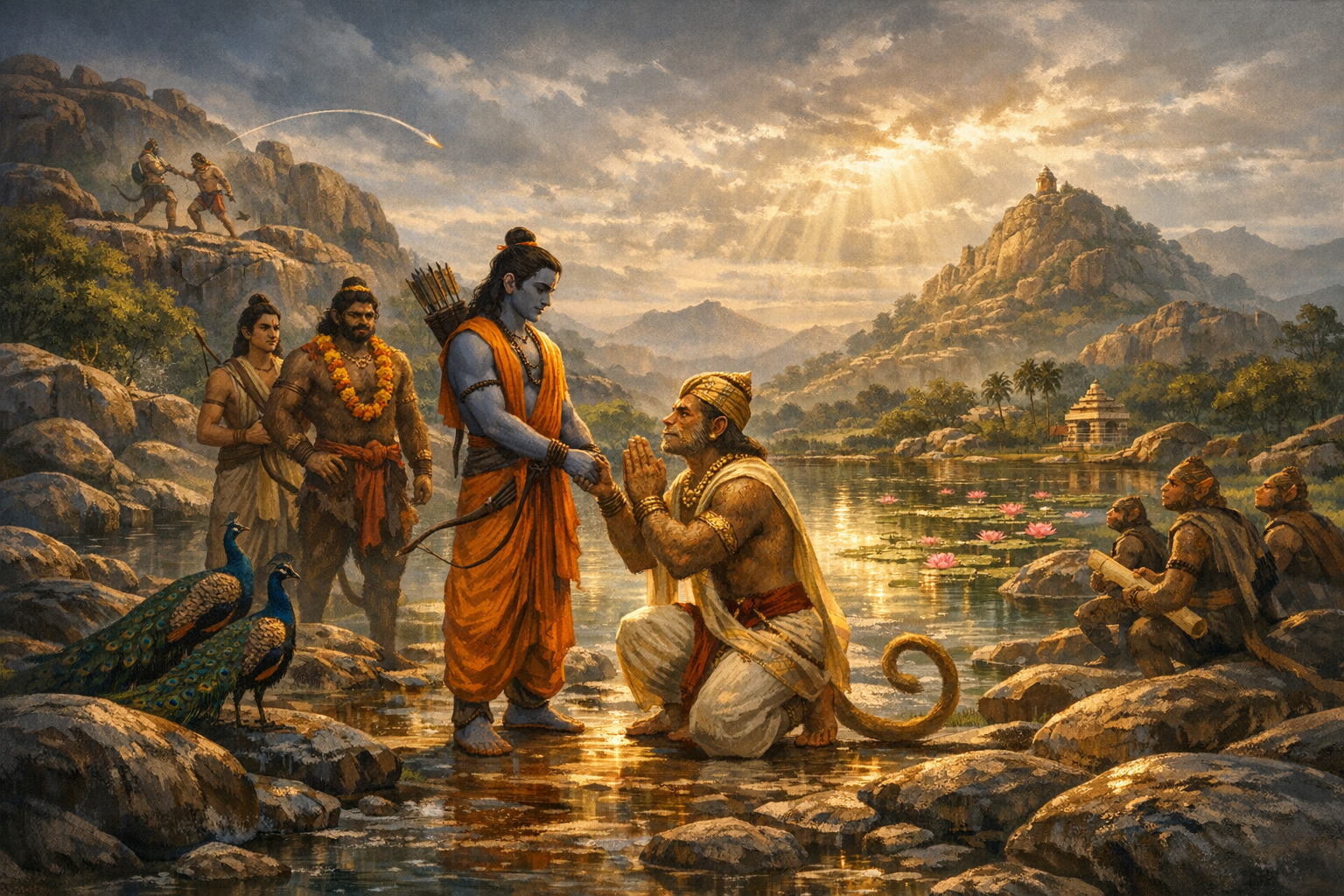
Kishkindha Kanda, the fourth book of the Valmiki Ramayana, marks a decisive pivot in the epic from the grief of separation to the discipline of alliance-building and purposeful action. It narrates how Rama and Lakshmana encounter the Vanaras, forge a solemn pact with Sugriva, overthrow the formidable Vali, and orchestrate a continent-spanning search for Sita. Tradition locates ancient Kishkindha in the granite-sculpted riverine basin around present-day Hampi–Anegundi in Karnataka along the Tungabhadra, a sacred geography that continues to shape devotional memory and cultural practice.
As a textual unit within the Ramayana’s sevenfold structure, Kishkindha Kanda functions as both a political treatise and a spiritual map. It comprises numerous sargas (chapters) in different recensions and is prized for its highly aesthetic monsoon descriptions (varsha-ritu varnanam), its probing ethical debates on kingship and justice, and its narrative artistry in awakening Hanuman’s latent shakti at the threshold of Sundara Kanda. Its themesdharma, righteous sovereignty (rajadharma), friendship under oath, and disciplined serviceresonate across Hindu, Buddhist, Jain, and Sikh traditions as facets of the broader Dharmic ethos.
The epic’s place-world correspondence in this kanda is unusually vivid. Rishyamukha mountain, Pampa Sarovara, Matanga Parvata, and Anjanadri (often revered as Hanuman’s birthplace) are remembered in and around Hampi. The stony tors, caves, and boulder-strewn escarpments align closely with the Ramayana’s descriptions of a terrain ideal for refuge, reconnaissance, and trial by single combat. While historical identifications are matters of faith and cultural memory rather than archaeological proof, the convergence of toponyms and ritual sites underscores why this landscape is cherished as Kishkindha’s living archive.
The narrative begins with Rama and Lakshmana arriving at Pampa, where their encounter with Hanuman becomes a watershed moment. Hanuman, approaching in the guise of a mendicant envoy, speaks with refined clarity and measured humilityqualities that Rama immediately praises as signs of cultivated intellect and moral training. This first meeting is celebrated not only for its literary brilliance but also for modeling how trust can be built through truthful speech, careful listening, and discernmentan ethical triad that guides the remainder of the kanda.
Hanuman leads the brothers to Sugriva, who is in exile on Rishyamukha. The mountain is described as a sanctuary that Vali cannot enter due to the curse of sage Matanga, an important narrative device that explains Sugriva’s survival and the political stasis in Kishkindha. Sugriva recounts the rupture with Vali: the pursuit of the demon Mayavi into a cave, the long wait outside, the ominous flow of blood, the sealing of the cave out of fearful misjudgment, and Vali’s eventual return convinced of betrayalfollowed by Sugriva’s banishment and the seizure of his wife Ruma. The account frames the conflict as a tragic breakdown of fraternal trust compounded by rash inference and unrestrained sovereignty.
Rama and Sugriva seal a solemn alliance, each binding himself to a work of dharmaRama to restore Sugriva’s rightful throne and honor, and Sugriva to mobilize the Vanaras to search for Sita. The compact is treated in the text as grave and sacral, with ritual presence and witnesses, underscoring that political agreements in the epic are not merely transactional but sacramentally charged pledges to uphold order and justice.
Before the duel with Vali, Sugriva seeks assurance of Rama’s power. The kanda preserves remarkable demonstrations of prowess: in one tradition, Rama’s single arrow pierces a row of sala trees and returns to his quiver; in another, Rama moves or propels the massive remains of the demon Dundubhi with the lightest touch. Though details differ across retellings, the motif is constantRama’s strength is at once incomparable and precisely disciplined, signaling that the coming act is a judicial intervention rather than an assertion of brute force.
The first challenge to Vali fails because Vali and Sugriva are nearly indistinguishable in appearance. The second challenge proceeds only after Sugriva is marked with a floral garland for clear identification. Rama’s arrow, loosed from concealment, fells Vali mid-combat. What follows is one of the Ramayana’s most searching ethical colloquies. Vali questions the justice of being struck while dueling another, and from cover. Rama replies as a king-in-exile: the seizure of a brother’s wife is a grievous breach of dharma; rajadharma mandates the punishment of such transgression; and a just ruler’s jurisdiction extends to the protection of moral order, not merely to territorial borders. Traditional exegesis thus reads the act as the upholding of public law, though later retellings also introduce the idea of Vali’s boon that made frontal combat tactically unsound. The passage invites patient reflection on sovereignty, means, and endsissues that remain philosophically pertinent.
Tara’s lament for Vali, among the epic’s most poignant voices, quickly turns to statesmanship. She counsels prudence, accepts the verdict of dharma, and secures loyalty to the lawful successor. Vali, reconciled to Rama’s reasoning and aware of his own failings, urges his son Angada to be steadfast under Sugriva. With the last rites performed, Sugriva is crowned, restoring the moral and political order of Kishkindha.
With the advent of the monsoon, the narrative lingers over resplendent descriptions of cloud, thunder, peacocks, and rain-swollen rivers. This seasonal intermezzo is not ornamental alone; it mirrors Rama’s interior discipline during a season unfit for campaigning, and it records the epic’s ecological attentionlandscape is not a backdrop but a participant shaping the moral tempo of action.
When the rains abate and Sugriva delays the promised mobilization, Rama counsels Lakshmana to proceed to Kishkindha as envoyfirm yet measured. The episode is a study in conflict resolution. Lakshmana’s righteous indignation is tempered by Tara’s diplomacy; Sugriva, reminded of his oath, swiftly atones with action. The scene underscores the Ramayana’s pedagogy: anger is to be transmuted into efficacy, and correction is most fruitful when guided by compassion.
Soon the Vanara-sena is assembled in their thousands. Sugriva displays remarkable administrative acumen, dividing scouting parties to the four quarters of the subcontinent with clear reporting lines, deadlines, and geographic briefs. The east, west, north, and south teams are named and provisioned, testing a federated intelligence model that anticipates the logistical thinking celebrated in later statecraft literature.
The southern partyled by Angada and comprising Hanuman, Jambavan, Nala, Nila, and othersreceives the heaviest mandate, given the likelihood that Sita was taken southward from the Dandaka forests. Their itinerary traverses forests, mountains, and a fearsome cavern traditionally known as Rikshabila, where perseverance under uncertainty becomes a central virtue. The team dynamic in this segment prefigures Sundara Kanda, highlighting how intergenerational wisdom (Jambavan), youthful initiative (Angada), and dormant divine capacity (Hanuman) are harmonized in service of a single aim.
Despondency deepens when the mandatory deadline nears, but the discovery of the vulture-ascetic Sampatielder brother of the fallen Jatayureorients the mission. From his far-seeing vantage, Sampati identifies Lanka as Sita’s location, thereby transforming scattered pursuit into a precise objective. In many tellings, the blessing he confers restores his own diminished strengtha narrative reciprocity that links truth-telling, gratitude, and renewal.
At this hinge, Jambavan delivers a celebrated exhortation to Hanuman, reminding him that a childhood curse had veiled his awareness of his own powers until the right moment. The speech accomplishes more than motivation; it articulates a theology of service in which shakti belongs not to the self but to the vow one serves. As Hanuman’s confidence returns, Kishkindha Kanda yields to Sundara Kanda, where his leap to Lanka becomes the epic’s emblem of fearless, disciplined devotion.
Several interpretive insights arise from a close reading of Kishkindha Kanda. First, the Vanaras are not caricatured; they are a complex society with rulers, counselors, engineers (Nala and Nila), scouts, and diplomatsan instructive portrait of forest polities that mediates between human settlement and wilderness. Second, the kanda’s legal-ethical debates insist that means and ends be weighed together; justice in the Ramayana is restorative and public, not private and vengeful. Third, speechtruthful, measured, and timelyemerges as a cardinal dharma: Hanuman’s eloquence, Tara’s mediation, and Rama’s instructions to Lakshmana all model ethical communication under pressure.
The sacred geography of Kishkindha around Hampi deepens these themes. Pilgrims recall Rishyamukha (linked to present Anegundi), Pampa Sarovara, Anjanadri Hill, and caves associated with Sugriva, mapping scripture onto landscape in ways that sustain living memory. The proximity of Vijayanagara’s medieval capital to this terrain illustrates a recurrent Indian pattern: political centers often situate themselves near sites of epic significance, drawing upon their moral capital and shared narratives.
Across Dharmic traditions, Kishkindha Kanda’s values are widely embraced. Hindu retellings foreground bhakti and rajadharma; Jain Ramayana versions refract the narrative through ahiṁsā and ascetic ideals; Buddhist tellings echo the ethical gravitas of right speech, right intention, and compassionate action; Sikh wisdom literature frequently invokes “Ram” as a name of the all-pervading Lord, honoring the divine virtues that the epic magnifies. Read in this inclusive spirit, Kishkindha Kanda becomes not a sectarian chronicle but a shared treasury of ethical reflection and spiritual resolve.
For contemporary readers, the kanda offers practical lessons. Alliance-building anchored in truth outlasts expedient bargains. Leadership requires the courage to accept counsel (as Sugriva does), the humility to correct course (as Lakshmana does), and the constancy to keep vows despite delay and distraction (as Rama does). Organizationally, the four-direction search illustrates goal clarity, distributed responsibility, and trust in diverse competenciestimeless patterns relevant to community work, ecological stewardship, and public service.
In sum, Kishkindha Kanda transforms the Ramayana’s emotional arc into disciplined action. It restores a kingdom, rights a grave wrong, maps a sacred landscape, andmost memorablyawakens Hanuman to the service for which he was born. By the time the southern party stands at the ocean’s edge and Jambavan’s words kindle Hanuman’s leap, the epic has already taught its central lesson: when truth, courage, and compassion are held together, even impossible distances become traversable.
Inspired by this post on Hindu Pad.