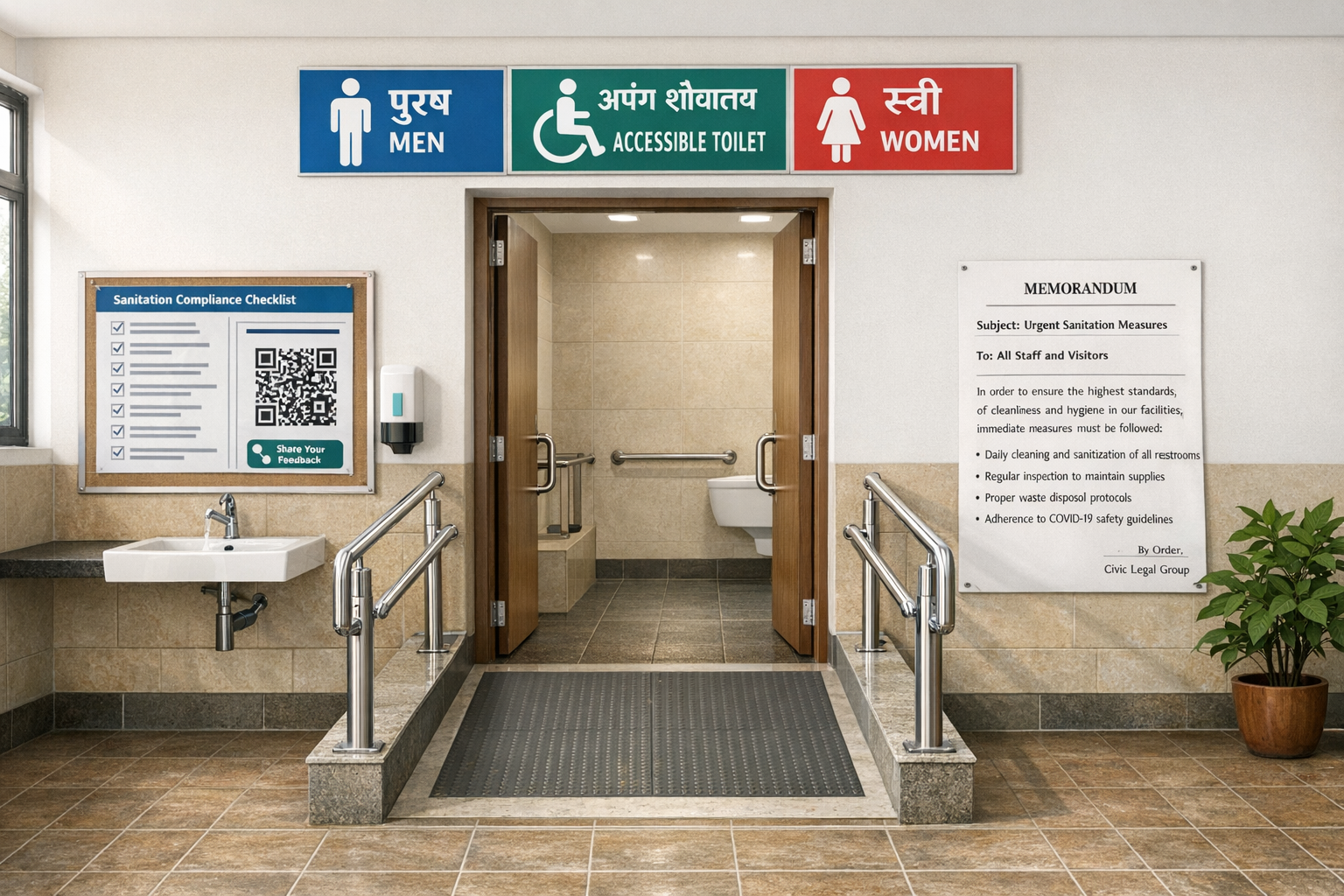
Hindu Vidhidnya Parishad has submitted a formal memorandum urging immediate corrective action on unhygienic public toilets within the Tehsildar office premises in Shahuwadi, Kolhapur (Maharashtra). The representation points to persistent lapses in sanitation, daily maintenance, and basic amenities, noting that a high-footfall public office cannot function without safe, clean, and accessible sanitation. The concern is not merely cosmetic; it implicates public health, gender equity, disability access, and fundamental dignity.
Public sanitation at government facilities is a core service-delivery obligation under India’s governance framework. Jurisprudence has repeatedly linked environmental sanitation and hygienic public spaces to the right to life under Article 21 of the Constitution. In Municipal Council, Ratlam v. Vardichand (1980), the Supreme Court directed local bodies to abate public health nuisances despite fiscal constraints, and in Virendra Gaur v. State of Haryana (1995) it affirmed that maintaining sanitation is integral to a healthy environment. Within this legal context, unhygienic toilets at a Tehsildar office represent a remediable governance gap that demands timely, standards-based intervention.
The public health implications are well established. Inadequate cleaning, intermittent water supply, poor ventilation, and the absence of soap or handwashing stations heighten the risk of fecal-oral disease transmission. In crowded government premisesoften visited by elderly citizens, women, children, and persons with disabilitieslocked, broken, or foul-smelling facilities deter use and increase dependence on unsafe alternatives. Beyond infection risk, poorly maintained spaces create psychological stress, reduce service uptake, and erode trust in public institutions.
Multiple national guidelines provide clear technical direction for public and community toilets. Under Swachh Bharat Mission (Urban and Gramin), service-level outcomes emphasize 24×7 water availability, soap and handwashing stations, lighting, ventilation, regular cleaning, safe fecal sludge management, and robust operation-and-maintenance (O&M) systems. The National Building Code of India (2016) sets baseline fixture and plumbing requirements for public buildings, including minimum fixture ratios by occupancy. Advisory documents from the Ministry of Housing and Urban Affairs (MoHUA) underscore the need for signage, universal access, menstrual hygiene management (MHM) provisions, janitor rooms, and preventive O&M protocols commensurate with footfall.
Universal accessibility is non-negotiable. The Rights of Persons with Disabilities Act (2016) and the Harmonised Guidelines (2021) call for barrier-free designramped access with appropriate gradients, wider doorways, grab bars, anti-slip flooring, accessible faucets and flush mechanisms, and adequate turning radii for wheelchairs. Gender-responsive design entails safe, well-lit women’s facilities, disposal mechanisms for sanitary waste, and MHM amenities. In a Tehsildar office, such provisions are not “value adds”; they are statutory and ethical imperatives.
Sound O&M is the defining success factor. Standards-based protocols typically require: defined cleaning frequencies tailored to peak hours; daily checklists and logbooks (water, soap, consumables, minor repairs); immediate rectification of broken fixtures; pest and odor control; adequate ventilation; periodic deep cleaning; and visible grievance redress mechanisms (QR codes, helpline numbers, or complaint registers). Clear signage in Marathi and English improves usability. Simple, low-cost measureslike consumables inventory control and duty rosters for housekeepersdramatically improve outcomes.
In Maharashtra, the administrative locus for such facilities commonly lies with the department that controls the premises (often the Revenue Department with Public Works Department support), under the overall oversight of the District Collector. Day-to-day upkeep is generally contracted to housekeeping vendors through service-level agreements. Even where jurisdictional overlaps exist (e.g., between line departments and local bodies), the office-in-charge retains responsibility for ensuring that public-facing facilities remain functional and hygienic during working hours.
Monitoring must be data-driven. Simple metricscleaning frequency compliance, user feedback scores, number and resolution time of complaints, and periodic third-party auditsenable administrators to detect lapses before they become systemic. Photo-based verification, QR-coded feedback at entry/exit points, and monthly inspection scorecards add transparency. Publishing a concise “Sanitation Compliance Note” on the district website can institutionalize accountability while reassuring citizens that the issue is being tracked.
Financing should prioritize lifecycle O&M over one-off capital fixes. Ring-fenced O&M budgets, annual maintenance contracts for fixtures, and performance-linked payments to vendors ensure sustained service quality. Framework contracts that bundle consumables, minor repairs, and manpowerbenchmarked against clear service levelsreduce administrative friction and help maintain hygiene standards. The costs of regular O&M are modest compared to the public health and reputational costs of failure.
Citizen experience illustrates the stakes. Visitors to a Tehsildar office often spend hours navigating multiple counters; in such settings, clean, unlocked, and well-signed toilets with running water and soap are essential. For an elderly pensioner, a lactating mother, or a person with mobility challenges, a hygienic toilet is not an amenityit is a prerequisite for dignified access to public services. Each interaction with a clean facility signals respect and care from the state.
The call for better sanitation also resonates with dharmic ethics shared across Hindu, Buddhist, Jain, and Sikh traditionsshauch (cleanliness), ahimsa (non-harm), and seva (service). Clean public toilets reflect compassion for fellow citizens and reverence for shared spaces. Advancing hygiene at a civic institution thus becomes a unifying, values-aligned endeavor that strengthens social trust while respecting India’s cultural diversity.
A practical 30-60-90 day roadmap is readily actionable. In the first 30 days, administrators can restore uninterrupted water supply, ensure soap and handwashing access, repair locks and flush systems, relight dark corners, deep-clean interiors, and activate daily O&M logs alongside QR-enabled feedback. By 60 days, minor civil and plumbing upgrades, standardized signage in Marathi/English, procurement of MHM bins, and vendor retraining on SOPs can lock in improvements. By 90 days, performance-linked contracts, monthly third-party audits, public disclosure of compliance, and periodic staff briefings embed a durable culture of cleanliness.
Grievance and accountability channels are established within India’s governance architecture. Citizens may escalate unresolved sanitation complaints to the office head and the District Collector, and where relevant, file service grievances through state or central portals such as CPGRAMS. Right to Information (RTI) requests can seek maintenance contracts, inspection reports, and O&M logs. Structured social auditswhere feasibledeepen transparency and provide administrators with constructive feedback loops.
Occupational safety for housekeeping staff is integral to compliance. Mechanized cleaning tools, personal protective equipment (gloves, masks, boots), safe storage for cleaning agents, and clear instructions against hazardous manual practices are essential. The Prohibition of Employment as Manual Scavengers and Their Rehabilitation Act (2013) must be observed in letter and spirit, and training should emphasize safe, humane, and mechanized methods for maintenance.
Environmental safeguards close the loop. Where toilets are connected to onsite systems, septic tanks require periodic, records-based desludging, with safe conveyance to authorized treatment facilities as per India’s National Faecal Sludge and Septage Management (FSSM) policy direction. For sewer-connected facilities, adherence to plumbing codes and prevention of blockages through user education and routine checks minimizes overflows and odors. Simple interventionslike labeled bins and clear user signagereduce misuse and extend system life.
The memorandum by Hindu Vidhidnya Parishad provides a timely opportunity to align the Shahuwadi Tehsildar office with national sanitation benchmarks and constitutional commitments. With clear SOPs, accessible design, reliable O&M financing, and transparent monitoring, the district administration can quickly transform a pain point into a model of citizen-centered governance. Clean, safe, and accessible public toilets in government premises embody the ethos of Swachh Bharat, uphold human dignity, and honor dharmic values shared across communities.
Inspired by this post on Hindu Jagruti Samiti.