
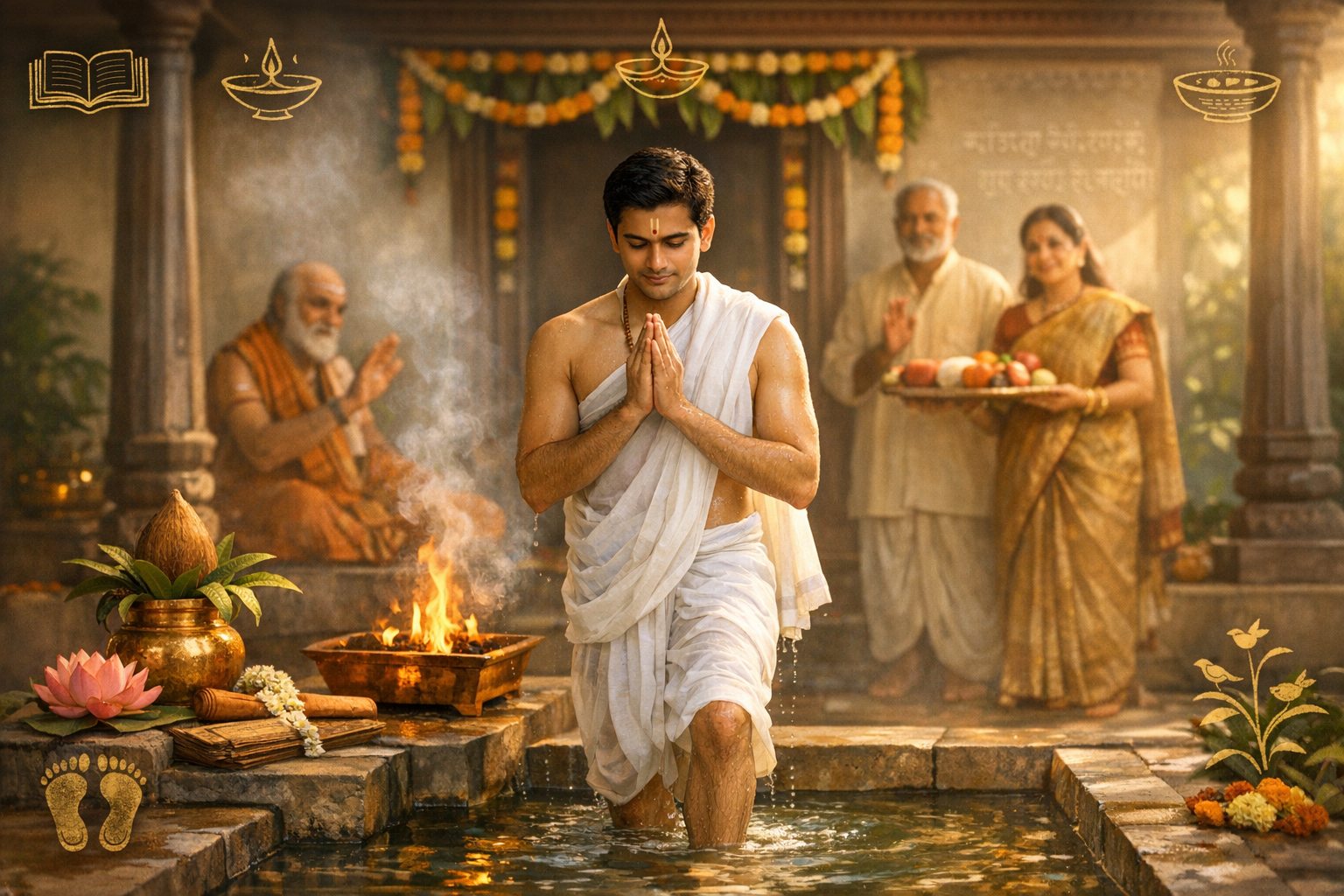
Samavartana, often translated as the rite of return, marks the formal completion of Brahmacharya and the threshold of entry into Grihastha within the classical Ashrama framework of Hindu Dharma. Rather than a mere graduation, it is a samskara that sacralizes a life transition: knowledge internalized in the gurukula is handed back to society through service, ethical living, and stewardship of family and community.
Within the four Ashramas—Brahmacharya, Grihastha, Vanaprastha, and Sannyasa—each stage confers duties and authorizations grounded in Vedic tradition and Dharmashastras. Samavartana closes the intensive discipline of student life and opens the life of the householder who sustains the other stages. By giving religious sanction to this passage, it turns personal attainment into public responsibility.
Etymologically, Samavartana connotes a turning back—returning to the parental home and to the world after Veda study. The person who completes it is designated a Snātaka, one who has ‘bathed’ and emerged from education. In many sources, Snātaka and Samavartana appear together, linking ritual bathing, ethical injunctions, and readiness for marriage (Vivāha) and livelihood.
Textual attestations span the Grihya Sutras (notably Āśvalāyana, Āpastamba, and Baudhāyana) and Dharmasutras, with codifications continued in later Smriti literature. A celebrated convocation address embedded in the Taittirīya Upaniṣad encapsulates the ethos imparted at this juncture, comprising injunctions such as “Satyam vada, dharmam chara,” “Mātṛdevo bhava, Pitṛdevo bhava, Ācāryadevo bhava, Atithidevo bhava,” and “Svādhyāyān-ma-pramadaḥ,” which situate truth, duty, reverence, hospitality, and lifelong learning at the center of civic and spiritual life.
Ritually, Samavartana is anchored by an auspicious muhurta, purification rites (punyāhavācana), and the Samāvartana-snana (ritual bath). The bath symbolizes shedding the liminality of studenthood and integrating knowledge with action. New garments are donned to signal renewal, and simple ornaments or sacred threads may be invested as locale-specific custom prescribes.
A homa is often performed, invoking Agni as witness to vows of conduct and continuity of learning (svādhyāya). Offerings are made with mantras from the Vedic corpus and associated Grihya Sutras. The act reinforces that education, in the Vedic sense, culminates not in possession but in consecrated duty.
Guru-dakṣiṇā forms the ethical core of the ceremony. Having received the inexhaustible gift of vidyā, the Snātaka offers what is within capacity—often cloth, cow, gold, or service—affirming the Guru–Śiṣya Tradition as the lifeline of knowledge transmission. The gesture enshrines gratitude and acknowledges that wisdom matures through humility.
At many Samavartana rites, the Taittirīya Upaniṣad’s convocation guidance is recited to the Snātaka, who receives blessings for a life of restraint and generosity: “Danena pramaditavyam,” “Kṛtyam na pramaditavyam,” and “Dharmān na pramaditavyam.” The communal asirvāda that follows compresses the social expectation of integrity into a shared hope for flourishing.
Upon completion, the Snātaka adopts codes of conduct called Snātaka-dharmas until marriage establishes the domestic sacrificial fires and household routines. These codes, detailed across the Dharmasutras and Smritis, balance freedom with discipline: truthful speech, decorum, avoidance of intoxicants, purity in resource use, reverence for elders, and self-restraint in consumption and desire.
Samavartana thus does more than license livelihood; it inaugurates civic ethics. The Snātaka is no longer bound to celibate gurukula routines but is not yet obligated to the full ritual life of a householder. The interstice calls for discernment, tact, and readiness to shoulder family and societal responsibilities.
The Grihastha stage that typically follows is the structural keystone of the Ashrama system. Classical texts affirm that the householder supports the other three stages through hospitality, almsgiving, and ritual economy. This support is codified in the pañca-mahāyajñas, a fivefold daily discipline that integrates learning, worship, memory, service, and ecological care.
Brahma-yajña grounds the household in svādhyāya—regular study and recitation of sacred texts, remembrance of teachers, and transmission to the next generation. In modern terms, it is lifelong learning oriented to wisdom rather than credentials, a value already stressed at Samavartana by “Svādhyāyapravacanābhyām na pramaditavyam.”
Deva-yajña extends reverence to devas through simple homa, lamp-offerings, or manasa-puja, maintaining the axis of gratitude that Samavartana establishes. Here the home becomes a micro-temple, and ritual becomes a pedagogy for humility, timing, and attention.
Pitṛ-yajña sustains ancestral memory through śrāddha and daily remembrance. The Snātaka’s return reweaves family bonds, and as Grihastha, continuity is honored not by nostalgia but by ethical inheritance—values applied to present dilemmas.
Manuṣya-yajña enjoins atithi-sevā, annadāna, and social generosity. The Snātaka’s new social agency is measured by hospitality across difference, mirroring “Atithidevo bhava.” In contemporary life, this extends to mentorship, neighborliness, and institutional seva.
Bhūta-yajña addresses non-human life through ahimsa, feeding creatures, and ecological responsibility. The Snātaka’s commitments mature here into responsible stewardship, recognizing interdependence as a spiritual and material fact.
Through these disciplines, Grihastha Dharma elevates the quotidian: earning becomes ethical livelihood; cooking becomes offering; lodging becomes sanctuary. Samavartana is therefore the hinge that swings private learning into public virtue, spiritual insight into social capital, and youthful promise into intergenerational trust.
Historical practice primarily records Samavartana among males educated in the gurukula system, but śāstric and historical evidence of women’s learning (including Vedarambha and scholarly exemplars) foregrounds a broader horizon. In contemporary communities, families increasingly adapt the rite for daughters, framing it as the consecration of any rigorous course of study and commitment to dharmic living.
Regionally, details vary. Some traditions highlight elaborate bathing and feast rites; others emphasize homa and the convocation address. The Grihya Sutras allow for such calibrated plurality, provided the rite’s intent—ethical adulthood and readiness for Grihastha—is preserved.
Across the wider dharmic family, resonances abound. Buddhism honors the householder path (gihi/gahapati) with ethical precepts and a social code vividly expressed in the Sigālovāda Sutta; Jainism articulates the Śrāvakācāra and anuvratas for laypersons as a disciplined yet accessible ethic; Sikhism explicitly sanctifies grihastha through “grihast mārga,” joining devotion, work (kirat), and service (seva). These convergences affirm a shared ethos: learning culminates in compassionate responsibility to the world.
Modern convocation ceremonies in India frequently echo Samavartana’s spirit—sometimes even the very mantras—when charging graduates to uphold truth, service, and lifelong learning. Whether conferred in a temple or a university hall, the ethical nucleus is the same: knowledge is accountable to society and to the highest ideals of dharma.
For families seeking to observe Samavartana today, a temple or home-based rite under the guidance of a qualified priest or acharya typically includes a brief sankalpa, purificatory rites and Samāvartana-snana, homa, recitation of the Taittirīya Upaniṣad’s convocation counsel, guru-dakṣiṇā, communal blessings, and a shared meal. The scale can be modest or elaborate; what matters is clarity of intent and sincerity of vow.
Those who did not undergo a classical gurukula curriculum can still meaningfully celebrate Samavartana at the completion of substantial study—whether Vedic, śāstric, or modern—by affirming its ethic: “Satyam vada, dharmam chara,” honoring parents and teachers, committing to svādhyāya, and pledging service to community and environment.
Samavartana is often followed promptly by Vivāha, which inaugurates the sacred domestic fires and completes the transition into Grihastha. When sequenced in this way, Samavartana articulates the values, and Vivāha establishes the vessel that will hold and express them daily.
In diaspora settings and diverse social contexts, the rite’s accessibility is strengthened by bilingual recitations, explanatory reflections for attendees, and inclusive participation that highlights unity among dharmic traditions. Such adaptations remain faithful to śāstra when they preserve the telos: maturation from learning for oneself to living for the good of all.
Ultimately, Samavartana is a covenant with the future. By pivoting from the inward discipline of Brahmacharya to the outward generosity of Grihastha, it forges a householder whose home becomes a sanctuary for study, worship, memory, service, and care for all beings. In that movement, Hindu Dharma’s civilizational insight becomes vividly practical: knowledge finds fulfillment as shared welfare.
Inspired by this post on Hindu Blog.







Leave a Reply
You must be logged in to post a comment.