Few public celebrations consistently merit planned closures of city streets; Ratha Yatrathe Festival of Chariotsdoes so with joyful inevitability. The Festival of Chariots 2026 ISKCON Brisbane marks the event’s eleventh year in the city, bringing an ancient Indian sacred journey into the civic heart of a modern, multicultural metropolis.
Ratha Yatra originates in the Jagannath tradition of Odisha, India, where the deities Jagannath, Balabhadra, and Subhadra are ceremonially drawn on towering wooden chariots for public darshan. The term couples ratha (chariot) with yatra (journey), signifying a theology of outreach: the Divine moves towards the people so that allregardless of backgroundreceive grace and hospitality in the public square.
Through the twentieth century, and especially since the late 1960s, the Hare Krishna Movement (ISKCON) translated this liturgy into a global civic idiom. Ratha Yatra festivals now animate streets across continents, adapting respectfully to local regulations while retaining the heart of Gaudiya Vaishnava practice: congregational chanting (kirtan), service (seva), and the distribution of sanctified vegetarian food (prasadam). Brisbane’s 2026 observance continues this living heritage in an accessible, family-friendly format.
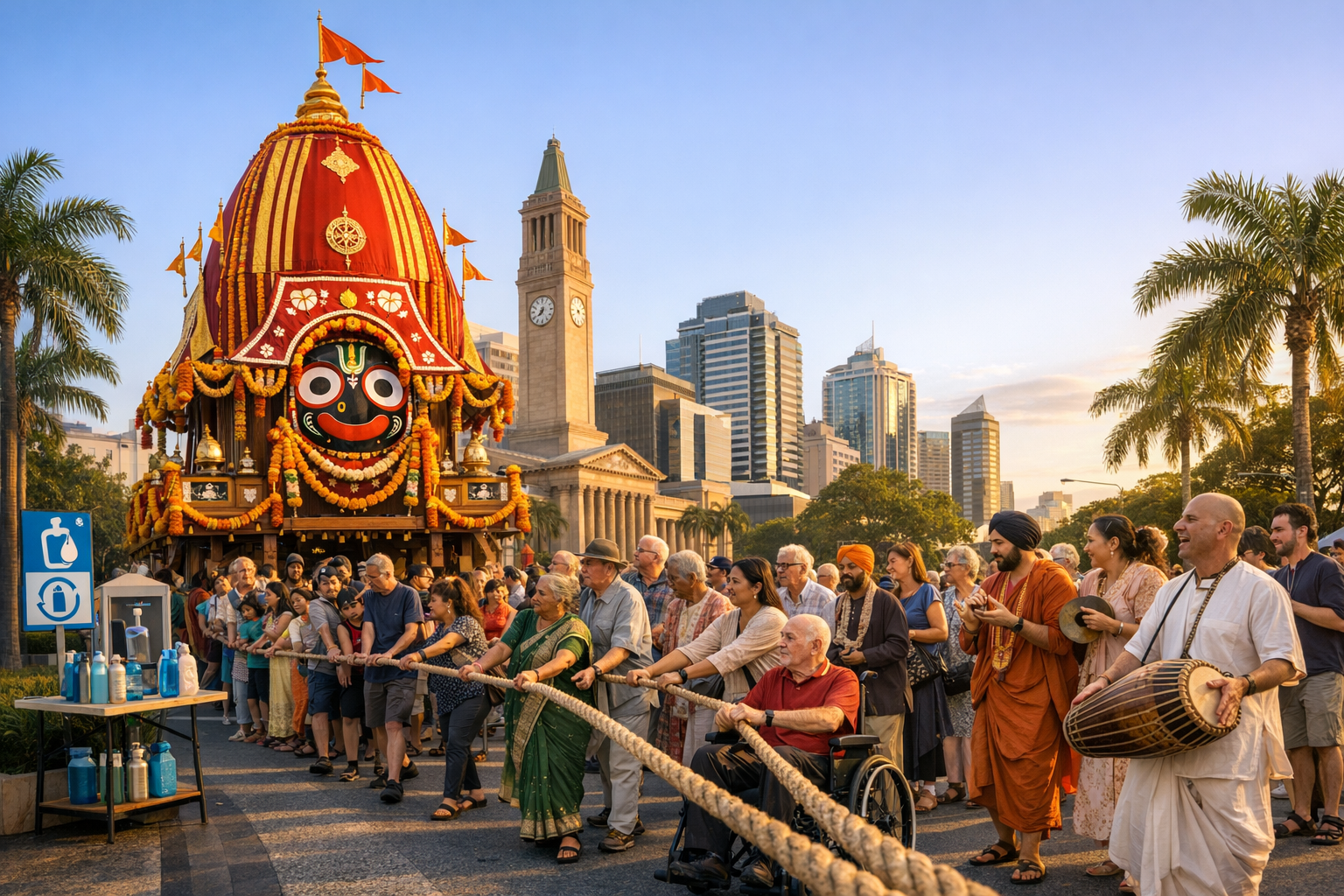
A standard Festival of Chariots sequence features kirtan-led processions, the pulling of the chariots with long ropes as a participatory vow of service, periodic arati offerings, and generous prasadam sharing. The soundscapemridanga drums, kartal cymbals, and call-and-response chantingcreates an inclusive, participatory rhythm that invites onlookers to walk, listen, or simply witness with reverence.
Families, students, and first-time visitors often describe a distinct moment when the ropes tighten, the chariot advances, and many footsteps synchronize; the sensation is one of collective uplift and calm resolve. Such experiences are not merely emotional; they reflect a carefully preserved ritual grammar that aligns movement, voice, and intention to express bhaktidevotional service embodied through community.
Classical Indian thought provides a complementary interpretive lens. The Katha Upanishad’s chariot metaphor frames the body as chariot, the intellect as charioteer, the senses as horses, and the self as passenger. While Ratha Yatra is a distinct ritual tradition, the shared imagery enriches interpretationpublic movement of the chariot can be read as an allegory for ethical and spiritual guidance within society.
Transforming a central corridor into a moving temple requires coordination with municipal authorities, transport planners, emergency services, and volunteer marshals. Crowd-flow design, clear signage, hydration points, shade, first-aid availability, and accessible viewing zones are widely adopted good practices that enhance safety and inclusivity for elders, children, and people with disabilities.
Chariot construction typically combines devotional symbolismcanopy, flags, and sacred emblemswith pragmatic engineering: sturdy frames, wheel and axle inspections, rope load management, and braking or steering controls suited to urban gradients. Symbolically, the rolling wheels evoke time and change, while the canopy suggests the protective presence of dharma that shelters all who walk beneath it.
Prasadam distribution is a hallmark of the festival. Vegetarian offerings prepared in a spirit of ahimsa and gratitude are shared freely, creating spontaneous community across cultural lines. The practice resonates with other dharmic traditions: it parallels the Sikh spirit of langar, the Jain ethic of non-violence, and Buddhist habits of mindful, compassionate livingshared values highlighted in Brisbane through welcome, dialogue, and service.
Because public devotion through processions is familiar across the dharmic familyNagar Kirtans in Sikh communities, rath yatras in Jain communities, and respectful image processions in many Buddhist culturesthe Festival of Chariots naturally becomes a meeting point. The Brisbane observance emphasizes unity in spiritual diversity, inviting Hindus, Buddhists, Jains, Sikhs, and well-wishers of every background to participate according to comfort and conscience.
Many contemporary Ratha Yatras integrate environmental stewardship: encouraging public transport, minimizing single-use plastics, providing refill water stations, and organizing post-event cleanups. Such practices align with the dharmic principle of responsible stewardship and strengthen the festival’s reputation as a model of joyful, low-impact urban celebration.
Educational exhibits and guided conversations often accompany the procession, explaining the Jagannath tradition, the meaning of kirtan, and the ethics behind prasadam. These touchpoints help newcomers read the festival’s symbols with clarity, turning spectacle into understanding and curiosity into respectful engagement.
Research in social psychology and music studies consistently associates group singing and synchronized movement with enhanced belonging and emotional wellbeing. Beyond devotion, therefore, the Festival of Chariots functions as a civic asset: it strengthens social cohesion, models intercultural respect, and showcases the living continuity of Cultural Heritage in the diaspora.
Ratha Yatra customarily coincides with the month of Ashadha in the Indian calendar; diaspora communities adapt dates to local climates and civic calendars while maintaining ritual integrity. Program elements often include kirtan ensembles, classical and folk dance, and opportunities for children to engage with the arts and stories of Jagannath in interactive, age-appropriate ways.
The ethic of Vasudhaiva Kutumbakam“the world is one family”is vividly expressed as the chariot moves among diverse communities and the festival space becomes a commons. At the rope, participation symbolizes equality; in shared meals, hospitality affirms dignity; in song, difference finds harmony. Such gestures make the event legible and welcoming to people of every faith and none.
In 2026, Brisbane’s eleventh annual Festival of Chariots is expected to feature a vibrant street procession followed by a family-friendly cultural program with kirtan, dance, and prasadam in a welcoming public venue. Attendees customarily bring sun protection, comfortable footwear, and reusable water bottles, and they follow volunteer and council guidance to keep the route clear and the atmosphere serene.
As an ancient ritual adapted for a contemporary, multicultural city, the Festival of Chariots 2026 in Brisbane offers more than a parade; it offers a shared civic meditation on compassion, service, and unity. Its chariots move through streets, yet its deeper journey is inwardtoward a society in which diverse spiritual pathways converge in mutual respect and joy.
Inspired by this post on Dandavats.