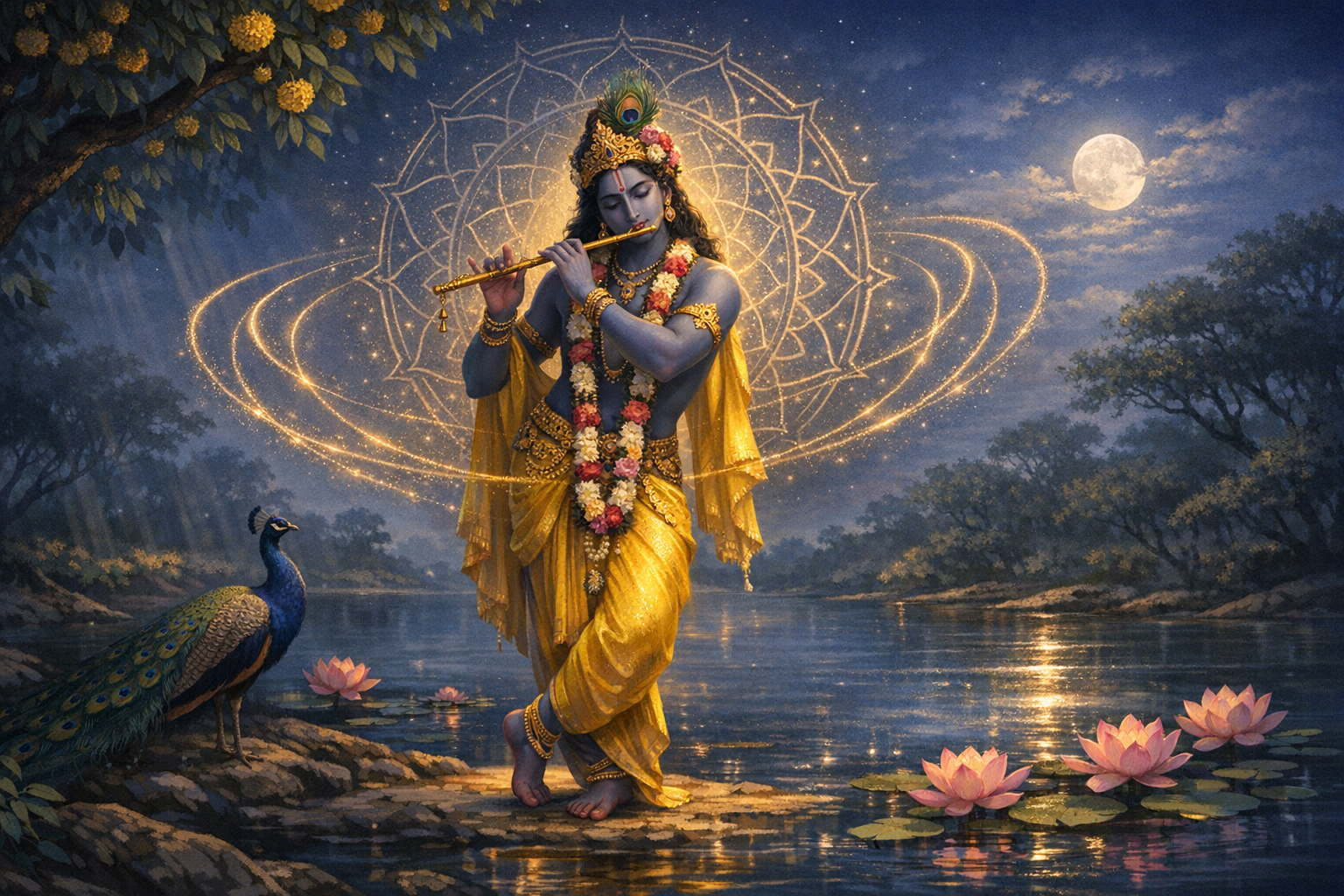
The sacred idea of Sringara Murti in Hindu tradition articulates how the divine assumes a form that illuminates the full register of human emotion and aesthetic beauty. In this theological vision, Bhagavan Sri Krishna stands as the most celebrated embodiment: irresistibly charming to the eye and inexhaustibly profound to the heart, he allows devotees to experience love, wonder, and tenderness as a direct pathway to transcendence.
Śṛṅgāra, the aesthetic mood of love and beauty in Indian poetics, is not merely decorative sentiment; it is a disciplined way of knowing. Murti, the consecrated form, is not an idol but a vivified presence that bears divinity in a mode humans can approach and adore. Sringara Murti therefore names a theological-aesthetic synthesis: the supreme appears in beauty so that love can become knowledge and intimacy can become liberation.
This synthesis is grounded in classical rasa theory. The Nāṭyaśāstra identifies śṛṅgāra as the rasa-rājathe sovereign among rasasbecause it refines attachment into attunement. Abhinavagupta’s theory of sādhāraṇīkaraṇa (universalization) explains why love portrayed in art or liturgy elevates rather than entangles: the individual’s private emotion is universalized into a transpersonal savoring. Devotional traditions extend this insight to worship, where beauty is not a distraction from God but a disciplined medium for realizing God.
Scriptural testimony anchors this vision. The Śrīmad-Bhāgavatam (particularly the Rāsa-pañcādhyāyī of the Tenth Canto, 10.29–33) narrates how Krishna’s flute summons the gopīs into a circle dance where divine and human affection interpenetrate without remainder. Jayadeva’s Gītagovinda unfolds the same śṛṅgāra as a sacred drama of separation and union, while the Āḻvārs of Tamil bhakti craft an emotive grammar that recognizes yearning (viraha) as a purifier of perception. Through these texts, śṛṅgāra becomes a contemplative map rather than a mere genre of feeling.
Across Vaishnava darśanas, aesthetic beauty is not an optional ornament but intrinsic to divine embodiment. Śrī Rāmānuja’s theology of the divya-maṅgala-vigraha holds that supreme reality freely manifests a form suffused with perfect auspicious qualities. Madhva emphasizes Krishna’s unassailable sovereignty expressed through accessible charm. In Gauḍīya Vaishnavism, the principle of acintya-bhedābheda (inconceivable oneness-and-difference) explains how the sweetness (mādhurya) of Krishna’s beauty coexists with the majesty (aiśvarya) of his divinity without dilution.
Rūpa Gosvāmin’s Bhakti-rasāmṛta-sindhu systematizes devotion into stable emotions (sthāyī-bhāvas) and their embellishments (vibhāvas, anubhāvas, sañcārī-bhāvas, and saṭṭvika-bhāvas), crowning mādhurya-rasathe amorous devotion to Krishnaas the most intimate channel to the Absolute. Here śṛṅgāra is not eros laid at the feet of theology; it is eros transfigured into prema, a love that knows by becoming.
Iconography gives this theology a precise visual grammar. In the tribhaṅga stance, Krishna’s three graceful bends create a visual cadence that mirrors the pliancy of love. The flute (veṇu) signals the call that turns attention inward even as it enchants outwardly. The peacock feather suggests cosmic play and layered perception; the yellow garment (pītāmbara) connotes earth’s ripeness touched by divinity. Temple śāstras on proportion and tāla-measure ensure that beauty is disciplined into revelation, not indulged as whimsy.
No account of Sringara Murti is complete without Śrī Rādhā. Gauḍīya texts present Rādhā as the hlādinī-śaktithe bliss potency of the Absolutethrough whom love experiences itself fully. Rādhā-Krishna thus names a theophany in duet, where the relational field is itself divine. Theologically, this guards against reducing śṛṅgāra to sentiment by showing that relationalitygiver, receiver, and the act of givingis the luminous structure of reality.
Temple practice makes this vision tactile. The daily cycle of abhisheka, alankāra (ornamentation), naivedya (offering), ārati (waving of lights), and śayana (rest) choreographs time as devotion. Seasonal festivals such as Jhulan Yatra, Chandan Yatra, and Rāsa-līlā pageants in Vṛndāvana and elsewhere ritualize love’s play across the year. Devotees often attest that the moment of darśanameeting the Murti’s gazesoftens the breath and steadies the mind, as if beauty were instructing the nervous system in trust.
The arts amplify this instruction. Odissi and Kathak render Krishna’s līlā through arcs of gesture and rhythmic footwork, while Hindustani compositions in rāgas like Yaman and Khamāj voice the tenderness and longing of sacred love. Miniature paintings from the Pahari and Rajasthani schools translate mādhurya into color-fields where night, moonlight, and monsoon become allegories of the seeker’s heart. In each medium, śṛṅgāra is disciplined by form so that emotion can ripen into insight.
This disciplined emotion also guides spiritual method. Devotional manuals distinguish anusaraṇa (following) from anukaraṇa (imitation): one cultivates the bhāva of devotion without superficially reproducing historical scenes. Practices like nāma-japa (repetition of the divine name), smaraṇa (loving remembrance), and rāgānugā-bhakti (spontaneous, love-led devotion) channel affect into contemplative stability. The result is not escape from feeling but freedom within feeling.
Ethically, Sringara Murti asks for discernment. Tradition is explicit that śṛṅgāra becomes sacred only when it is tethered to dharma, humility, and self-restraint. Acharyas warn against sensationalizing Krishna’s līlā or collapsing transcendence into mere romance. The hallmark of authentic engagement is increased compassion, truthfulness, and steadinessvirtues that blossom when love’s heat is tempered by wisdom’s light.
Sringara’s relevance extends across the dharmic family. Jain aestheticians like Hemacandra in the Kāvyānuśāsana engage rasa theory while affirming ethical clarity; Buddhist and Hindu thinkers together shaped Sanskrit poetics, as seen in the shared conversations culminating in Ānandavardhana’s Dhvanyāloka and Abhinavagupta’s Locana. In Sikh tradition, the musical-liturgical heritage of śabad-kīrtan and the presence of rāgas that express longing and union demonstrate how love-language refines awareness while honoring strict monotheism. These convergences show a civilizational intuition: beauty responsibly guided becomes a bridge to the Real.
From a psychological lens, the Sringara Murti of Krishna models affect regulation through devotion. Many practitioners report that contemplating Krishna’s veṇu-mādhurya (the sweetness of the flute) or the serene balance of the tribhaṅga stance slows breath, reduces rumination, and awakens a prosocial orientation. Contemporary scholars of contemplative studies note that such practices harness attention, memory, and emotion in mutually reinforcing loops, making devotion a rigorous cognitive-affective training.
Historically, this aesthetic theology also organized sacred space. Vṛndāvana’s rāsa-sthānas (sites associated with the dance) and the temple ecologies of Govind Dev Ji (Jaipur), Banke Bihari (Vṛndāvana), and Jagannath (Puri) map love onto geography. Pilgrimage thereby becomes an embodied commentary on scripture: walking the landscape instructs perception, and perception in turn sacralizes the landscape.
Within households, simple practices sustain the vision: offering a flower, lighting a lamp, singing a stanza from the Gītagovinda or a pada of the Āḻvārs. Families often recount how such gestures transmit a feeling-tone of trust and affection across generations. In this way, Sringara Murti is not confined to temple sancta; it becomes a pedagogy of tenderness at home.
Philosophically, Sringara Murti refutes the false choice between transcendence and immanence. Krishna’s beauty does not diminish his absoluteness; it discloses that the Absolute is generous enough to be intimate. This is why the epithet Śyāma-sundara matters: the dark, all-containing reality shows itself as lovely, inviting a response that integrates head, heart, and hand.
For scholars of religion and aesthetics, the concept offers a rich analytic matrix linking poetics, ritual studies, art history, and theology. Rasa theory supplies the method, scripture provides the content, iconography encodes the message, and performance traditions carry it forward. Together they show how Hindu aesthetics is not peripheral embellishment but a primary epistemology of the sacred.
For interfaith and inter-tradition dialogue across Hinduism, Buddhism, Jainism, and Sikhism, Sringara Murti models a principle of unity-in-diversity. Each tradition refines emotion toward wisdom using its own doctrinal guardrails and liturgical languages, yet all affirm that well-guided love ennobles human life. Recognizing these shared intuitions fosters mutual respect and collaborative learning without erasing distinctives.
In contemporary practice, Sringara Murti remains vibrant in global diasporas. Community festivals, classical recitals, and digital darśana bring the grammar of sacred love to new audiences while maintaining scriptural fidelity. Artists, scholars, and practitioners frequently collaborate so that innovation grows from continuity rather than rupture.
In sum, Krishna as Sringara Murti reveals an elegant thesis: emotions, disciplined by aesthetics and oriented by scripture, can become vehicles of realization. Beauty educates attention; attention ripens into devotion; devotion clarifies understanding. When pursued with humility and ethical care, this path turns the felt life into a sanctuarymaking love an instrument of knowledge and delight an instrument of liberation.
Inspired by this post on Hindu Blog.