Why does Karthikeya have six heads? The question recurs wherever Hindu iconography is studied or lived in temple practice. Known interchangeably as Skanda, Subrahmanya, Murugan, Kumara, and Shanmukha (Shadanana; Arumugan in Tamil), this youthful commander of the devas (Devasenapati) appears with six faces not as an artistic excess but as a layered statement that unites narrative memory, cosmology, philosophy, yoga, ethics, and living devotion.
Classical sources in Sanskrit and Tamil describe his birth and form with remarkable consistency. The Skanda Purana and the Shiva Purana provide the pan-Indic Puranic framework; the Tamil Kanda Puranam, together with devotional works such as Tiruppugazh and Skanda Sashti Kavasam, embeds the six-faced form in South Indian liturgy and pilgrimage. Courtly poetry such as Kalidasa’s Kumarasambhava helped shape the cultural imagination. Across these strata of text and tradition, explanations diversify while the six-headed icon endures.
The narrative ground is set by the Tarakasura episode. Granted a boon that made him nearly invincible, Tarakasura could be slain only by the son of Shiva. In many Puranic tellings, sparks of Shiva’s fiery energy are borne by Agni and Vayu, cooled in the Ganga, and finally deposited in the reed-filled lake Saravana (hence the epithet Saravanabhava). From these sparks arise six infants, discovered and nurtured by the six Krittikas (the Pleiades). When Parvati embraces them, the six infants conjoin into a single radiant child with six faces—thus Shanmukha—whose martial vocation is to restore cosmic order by defeating Tarakasura.
One narrative rationale for the six faces is maternal: having been nursed by six mothers (the Krittikas), the child assumes six mouths and faces so that each mother receives equal darshan and affection. This idiom of gratitude anchors the icon in a humanly intelligible ethic—reciprocity and inclusivity—thereby aligning filial love with cosmic purpose.
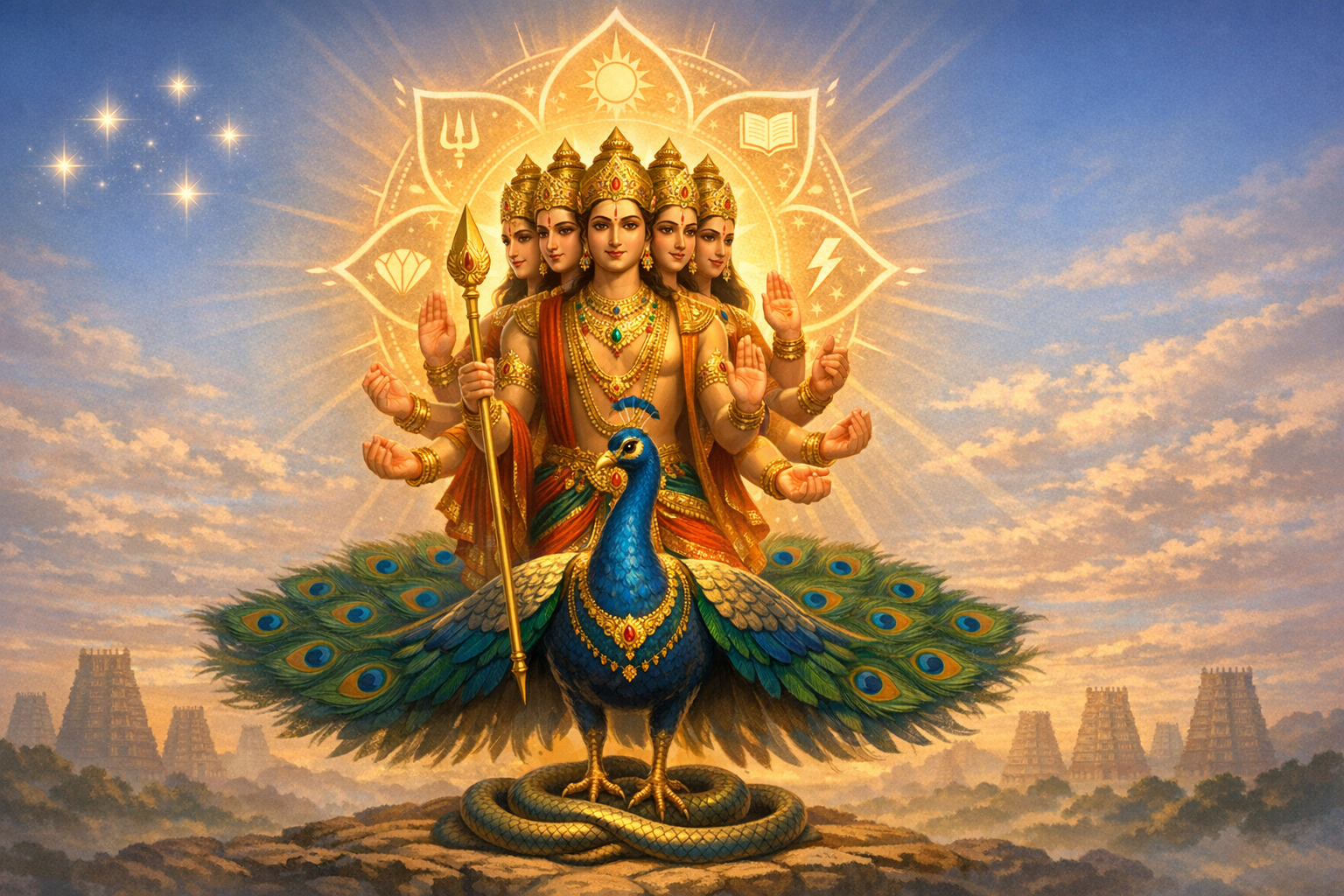
Another rationale, closer to Karthikeya’s role as a strategist and general, is perceptual and spatial. Six faces permit unbroken awareness across the six directions—east, west, north, south, zenith, and nadir. The god surveys every approach at once, embodying vigilance, anticipatory intelligence, and decisive action. Several agamic and iconographic manuals correlate the faces to directions, with the upward-looking face often linked to Ishana, the all-pervading principle of oversight and grace.
In liturgical usage, the six faces resonate with the six-syllabled mantra Saravana-bhava. Tamil traditions frequently map each syllable—sa, ra, va, na, ba, va—to a face of Shanmukha, so that mantra, form, and function converge. Devotees encounter this mapping in temples from Palani and Swamimalai to Thiruchendur and Tiruttani, and in community celebrations such as Skanda Sashti and Thaipusam.
An enduring interpretive strand links the six heads to the Shad Darshanas—the six classical schools of Hindu philosophy: Nyaya, Vaisheshika, Samkhya, Yoga, Mimamsa, and Vedanta. In this view, Karthikeya personifies synthesis—the capacity to perceive, reconcile, and “speak” the languages of distinct philosophical methods at once. A modern summary of this intuition appears as a memorable aphorism: the six heads exist “so that he can recite all the Shad Darshanas at once.” While pithy, the insight is serious: the icon invites unity without erasing methodological difference, mirroring the civilizational acceptance of many valid paths to truth.
Iconographers also correlate the six faces with six divine excellences frequently enumerated in classical discourse—jnana (knowledge), shakti (potency), bala (strength), aishvarya (lordship), virya (heroic energy), and tejas (radiance). Read this way, Karthikeya’s visage becomes a complete syllabus of leadership for a saint-general: clear discernment, disciplined power, resilient force, legitimate authority, courageous resolve, and luminous presence.
Yogic readings further deepen the symbolism. The epithet Guha—“the one hidden in the cave”—points to the cave of the heart, the locus of contemplative realization. Some traditions map the six faces to six inner supports (adharas) or chakras, suggesting that Shanmukha integrates the energies of the body-mind into awakened action. This integrative reading harmonizes with his vel, the spear of penetrating insight that cuts through confusion as much as through demonic threat.
The Tamil canon places Karthikeya in the geography of the Arupadai Veedu—the Six Abodes of Murugan—at Thirupparankundram, Tiruchendur, Palani, Swamimalai, Tiruttani, and Pazhamudircholai. Pilgrimage narratives align key episodes of his life to these shrines, so that the “sixness” coursing through birth, mantra, philosophy, and virtue is also walked as landscape and lived as practice.
Standard iconography complements the six heads with twelve arms, the vel (spear) as primary attribute, and the peacock (mayil) as vahana. The peacock’s subjugation of the serpent underfoot encodes mastery of pride and impulse—energies sublimated and harnessed, not denied. Together with the all-seeing faces, these motifs articulate a theology of awakened valor: knowledge guided by compassion, courage governed by clarity.
Regional and sectarian nuances enrich rather than fragment the picture. Somaskanda panels, for example, emphasize filial intimacy by depicting the child Skanda seated between Shiva and Parvati; in such contexts the single-faced infant expresses a particular theological mood, without displacing the six-faced warrior form that dominates martial and festival imagery. North Indian, South Indian, and Southeast Asian depictions differ in style yet sustain the central semantic load of the six heads.
Festivals circulate this meaning through time. Skanda Sashti dramatizes the six-day campaign culminating in the defeat of Surapadman; Thaipusam (associated with the moment Parvati bestows the vel) highlights the union of knowledge and disciplined power; Karthigai Deepam foregrounds Murugan’s connection to celestial fire and the Krittikas. In each, Shanmukha’s six-headed form functions as a script that communities collectively read, recite, and enact.
Seen through a broader dharmic lens, Karthikeya’s figure fosters unity-in-diversity rather than sectarian narrowing. In Sri Lanka, Kataragama deviyo is venerated across Hindu and Buddhist communities, demonstrating how the same deity can become a bridge for shared pilgrimage and values. Parallels of ethical emphasis—courage, self-restraint, and service—resonate with Sikh ideals of the sant-sipahi (saint-soldier), while Jain reflections on disciplined conduct and clarity of knowledge offer philosophical consonances without collapsing doctrinal distinctiveness. The six heads, then, become a visual grammar for civilizational dialogue: many vantage points, one integrated vision.
Contemporary seekers often return to the aphorism linking Shanmukha to the Shad Darshanas because it conveys a pedagogical promise. The icon does not privilege one epistemology or method; it legitimizes analytic rigor (Nyaya), empirical attentiveness (Vaisheshika), ontological clarity (Samkhya), transformative practice (Yoga), sacramental discipline (Mimamsa), and holistic synthesis (Vedanta). Where spiritual life fragments under specialization, Shanmukha exemplifies what integration looks like in action.
In summary, the six heads of Karthikeya are multi-valent. They honor six mothers and recall a stellar origin among the Krittikas; they secure omnidirectional awareness for a commander who protects the cosmic order; they embody a mantra’s six syllables; they signal six schools of wisdom and six excellences of divine leadership; they evoke inner yogic integration; and they map onto six sacred abodes that pilgrims traverse. Each layer of meaning coexists with the others, reinforcing a single, elegant thesis: wisdom and power are luminous and beneficent when integrated, inclusive, and vigilantly aware.
Thus, the six-headed Shanmukha stands not merely as a striking icon but as a comprehensive pedagogy. It teaches that genuine strength is inseparable from insight, that many disciplines deepen one truth, and that dharmic traditions flourish when diverse perspectives are welcomed into a larger, harmonizing vision.
Inspired by this post on Hindu Pad.