The Divine Clay Pot: Honoring Goddess Lakshmi Through Simple Bengal Traditions
The Sacred Simplicity of Lakshmi Ghot
Across Bengal, the worship of Lakshmi Ghot—an earthen pot (ghot/ghata/kalasha) sanctified as the living presence of Goddess Lakshmi—embodies a distinctive blend of theological depth, domestic devotion, and sustainable practice. The vessel, often adorned with a painted face of the goddess or a terracotta plaque, becomes a portable shrine of abundance and purity, affirming prosperity (śrī) as a value aligned with dharma rather than mere material gain.
As a ritual medium, the ghot is neither an ornament nor an afterthought; it is the rite’s center. In Bengal, its clay body symbolizes the earth element (prithvi), while the consecrated water within represents the sacred rivers. Mango leaves, grains, and a crowned coconut establish a microcosm of life’s fecundity. This compact grammar of symbols communicates a sophisticated theology: wealth must be clean, earned ethically, shared generously, and stewarded for family and community well-being.
The Bengal-specific emphasis on an earthen pot resonates with pan-Indic ritual literature. The purna-kalasha is widely attested in Grihya-sutra and Purana traditions as a vessel of wholeness, a locus where deities are invited to reside temporarily for worship. In Lakshmi Ghot practice, this classical symbolism is localized through Bengali aesthetics—alpona floor motifs in rice paste, Lakshmi’s owl (ulūka) emblems, and the gentle austerity of hand-shaped clay.
The principal festival context is Kojagari Lakshmi Puja on Sharad Purnima in the Ashwin Month, when households remain awake in a night of vigil. The very name “Kojagari” carries the question “Ko jagrati?”—“Who is awake?”—signaling attentiveness to grace. Although Lakshmi is adored throughout India during autumn, in Bengal the Kojagari observance foregrounds the ghot rather than elaborate icons, reinforcing the region’s reverence for sacred simplicity.
Beyond the full-moon celebration, many Bengali homes sustain weekly devotion to Lakshmi on Thursdays, maintaining a small ghot on a clean wooden pedestal. In these intimate settings, prosperity is ritualized as daily order: sweeping thresholds, lighting a lamp, drawing rice-paste footprints of the goddess entering the home, and offering seasonal fruits or homemade sweets.
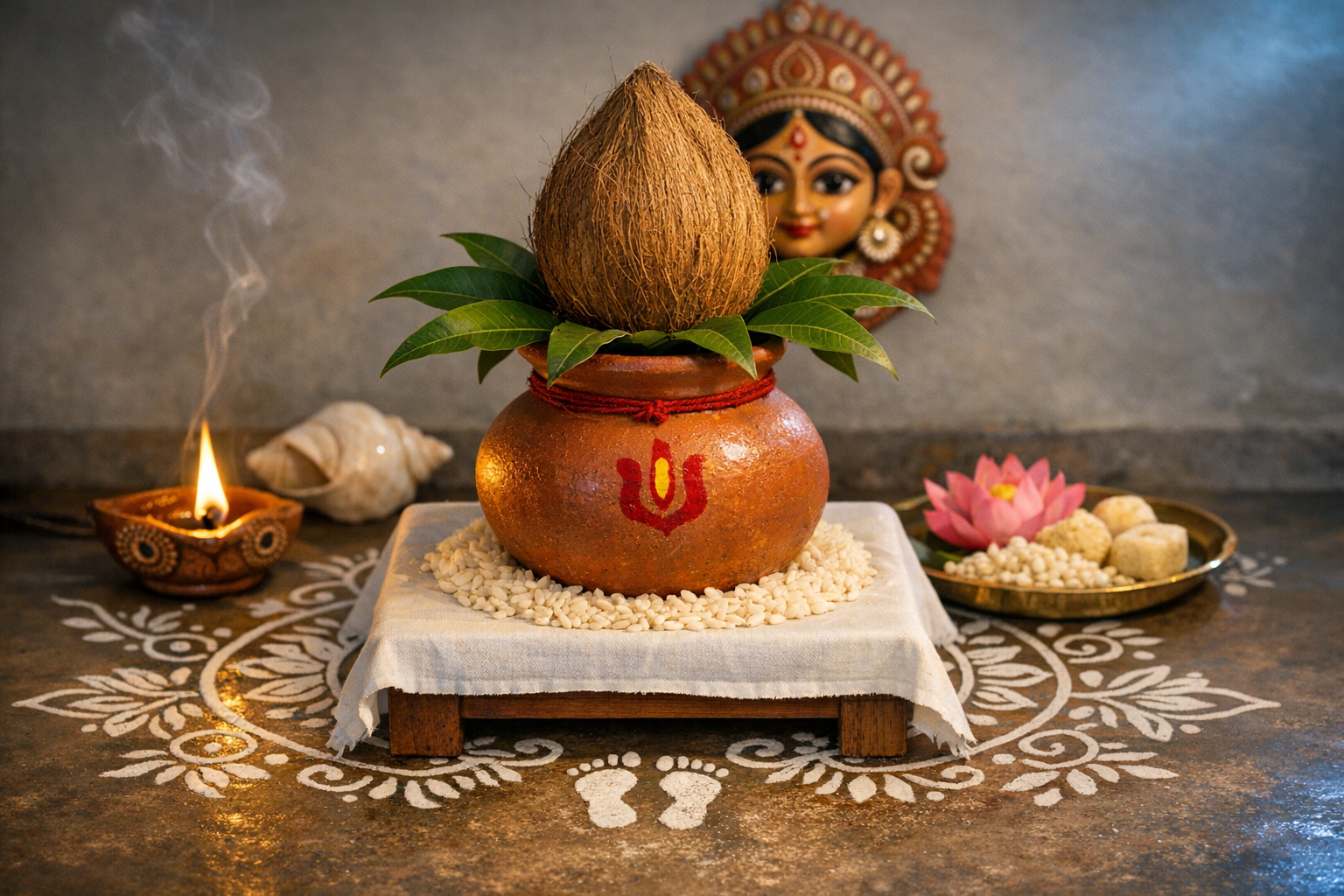
A typical Lakshmi Ghot uses a red or natural-clay earthen pot washed, sun-dried, and ritually purified. Water (ideally Ganga jal or clean potable water) is filled to a proportion that accommodates a ring of mango leaves. A crowned coconut, sometimes anointed with turmeric and vermilion, completes the kalasha. Many families paint the Śrī symbol or a swastika (an ancient Indian auspicious sign) on the pot and tie a protective red thread around its neck.
Local craft traditions enrich the practice. Terracotta “Lokkhi Shora” (painted earthen plaques showing Lakshmi’s visage) are widely produced across Bengal by kumor/kumhar communities. Some households position a Lokkhi Shora behind or before the ghot; others use a sculpted pot bearing the goddess’s face. This artisan ecology ensures the ritual remains eco-friendly, regionally distinctive, and economically supportive of hereditary craft lineages.
Ritual preparation begins with sanctifying the space. Floors are cleaned and dried; alpana motifs are drawn with diluted rice paste—lotus blooms, vines, and the iconic pair of tiny footprints leading from the door to the altar, signifying Lakshmi’s gracious entry. A low pidi (wooden seat) is covered with a fresh cloth and a bed of raw rice upon which the ghot is placed, signaling abundance rooted in food security (anna-lakshmi).
After lighting a lamp and incense, a concise sankalpa (statement of intent) situates the household in time and purpose, followed by the invocation of Goddess Lakshmi into the ghot. Families commonly recite Sri Sukta, Mahalakshmi Ashtakam, or the Bengali Lakshmi Panchali, blending Vedic and vernacular currents. The mantras articulate wealth as auspicious order, beauty, and nourishment, harmonizing artha (prosperity) under the guidance of dharma (ethical order).
Offerings are characteristically local and seasonal. In many homes, naivedya includes khichuri and labra (mixed vegetables), payesh (rice kheer), narkel naru (coconut laddoo), fruits, puffed rice (muri), and sandesh. Flowers—especially lotus where available—are offered alongside leaves and grains emblematic of harvest time. The simplicity of ingredients underscores the theological point that Lakshmi abides where food is clean, shared, and earned through honest labor.
Aarti with conch-blowing and uludhwani (women’s celebratory ululation) concludes the central sequence. Kalasha water is respectfully sprinkled across rooms and thresholds as a blessing for health, harmony, and livelihood. Prasada is then distributed to family and neighbors, embodying the outward movement of śrī as generosity and mutual care.
Bengal’s Lakshmi iconography often features the owl, Lakshmi’s vahana, signifying wisdom, wakefulness, and the capacity to see through darkness—apt for Kojagari’s night vigil. The owl motif commonly appears on Lokkhi Shora, clay lamps, and alpana designs, quietly educating children in the household about the moral conditions under which prosperity truly endures.
Where elaborate idols can sometimes overshadow meaning with spectacle, the Lakshmi Ghot keeps the rite intelligible and home-centered. The earthen pot functions as a theologically complete altar: the body (clay), life-waters (jal), vegetative vitality (mango leaves and grains), and cosmic axis (coconut) converge in a single, graspable form. The result is a ritual that is portable, resilient, and profoundly teachable.
Variations exist across districts and lineages. Some households emphasize a face-bearing ghot; others pair a plain vessel with a Lokkhi Shora; some add coins, five grains (pancha-shasya), or five leaves (pancha-pallava) inside the pot. A red cloth, turmeric-smeared betel nuts, and durva grass are common in many homes. These differences, while notable, remain coherent with the core grammar of the kalasha as a complete symbol of Lakshmi.
From a textual perspective, the purna-kalasha appears in numerous ritual manuals as a seat of deities during worship and sacralized beginnings. In Vedic and post-Vedic literature, the kalasha is linked with rivers, fertility, and plenitude; in temple and home rites alike, it signifies the concentrated presence of tirthas and prosperity. Lakshmi Ghot thus stands as a regionally tuned articulation of a widely attested Indic ritual principle.
Socially, the rite centers the household, with women’s ritual leadership especially prominent. The deliberate pace—cleaning, drawing alpana, preparing naivedya—calibrates attention away from haste toward care. Children learn by observation and participation, absorbing not only procedure but a civic ethic: prosperity is safeguarded by cleanliness, gratitude, sharing, and truthfulness in livelihood.
Economically, the Lakshmi Ghot sustains local craft ecosystems. Potters, painters, and sellers of flowers, leaves, and grains derive seasonal income from the practice. This embeddedness in community rhythms differentiates it from more extractive or disposable forms of ritual consumption and aligns with eco-devotion—reverence expressed through biodegradable materials and minimal waste.
The earthen pot’s sustainability has further significance in contemporary contexts. As cities address pollution from non-biodegradable idols and plastic decor, the Lakshmi Ghot offers an environmentally responsible alternative without sacrificing theological completeness or aesthetic beauty. Clay, rice paste, natural dyes, and seasonal botanicals ensure that sanctity and stewardship reinforce each other.
Across dharmic traditions, the sanctified vessel functions as a shared symbol. In Hindu practice, the kalasha is integral to Ghata Sthapana and home pujas; in many Buddhist lineages, the ritual vase (bumpa/kalasha) features in consecrations and blessings; Jain temple pratistha employs the kalasha as an auspicious emblem; Sikh Amrit Sanchar uses a sacred bowl (bata) to prepare amrit for initiation. The motif unites Hindu, Buddhist, Jain, and Sikh devotional grammars around purity, service, and ethical flourishing.
Ethically, Lakshmi Ghot worship interprets wealth through the lens of dharma. Readings from Sri Sukta and Lakshmi Panchali praise prosperity that supports learning, charity (dāna), non-violence (ahimsa), and service (seva). The rite internalizes a long-standing Indic teaching: artha must be sought and used in ways that elevate households and communities, never corrode them.
A practical home sequence can be envisioned in accessible phases. First, the altar is prepared with alpana and a clean cloth, and the ghot is set upon a rice bed. Next, the vessel is filled and adorned with mango leaves and a coconut, thread is tied, and auspicious signs are painted. Then, mantras are recited; offerings of flowers, grains, and seasonal foods are made; aarti culminates the rite. Finally, kalasha water is respectfully sprinkled for blessings, and prasada is shared.
Households in the diaspora often prefer the Lakshmi Ghot because it requires modest space and materials while preserving ritual integrity. A small clay pot, a few leaves, a coconut, and basic groceries suffice to recreate Bengal’s devotional ambiance, complete with alpana footprints drawn using rice flour. Children and elders alike can participate, making the rite a living archive of cultural memory.
In academic terms, Lakshmi Ghot practice illustrates how regional traditions refract pan-Indic symbolism through local languages, crafts, and ecologies. It also demonstrates ritual resilience: in times of migration or compressed urban living, a compact yet complete altar enables continuity without compromising meaning. Such adaptability is a hallmark of South Asia’s dharmic heritage.
The aesthetics of alpana warrant specific note. Created with liquid rice paste, these ephemeral drawings transform domestic floors into ritual canvases. Their whiteness connotes purity; their motifs—lotus, vines, grains, concentric circles—encode a cosmology where household order mirrors cosmic order. The footprints leading inward become a pedagogy of presence: Lakshmi’s arrival depends upon readiness, reverence, and right conduct.
Iconographic restraint is another defining feature. Many Bengali households forego anthropomorphic statues of Lakshmi during Kojagari, relying instead on the ghot’s completeness or on a simple Lokkhi Shora. This aniconic or minimally iconic approach protects ecological balance and keeps attention on the moral work of prosperity—gratitude, tidiness, generosity, and fairness in trade.
Where questions arise about procedure, the guiding principle is coherence rather than uniformity. Local parampara (lineage practice) should be honored. If a family custom includes specific grains, chants, or offerings, these should be retained, provided they align with the core intent of honoring Lakshmi as śrī—auspiciousness expressed through ethical prosperity, food security, and social harmony.
On Sharad Purnima’s moonlit night, Kojagari Lakshmi Puja in Bengal turns quiet homes into sanctuaries. Lamps flicker, conches sound, uludhwani rises, and an earthen pot becomes a universe of meaning. The rite’s enduring appeal rests in its clarity: a household that cultivates cleanliness, discipline, gratitude, and sharing becomes a vessel worthy of Lakshmi’s abiding presence.
In sum, Lakshmi Ghot worship unites theological precision with domestic grace. It is historically grounded in the kalasha’s venerable symbolism, culturally textured by Bengali craft and cuisine, ritually complete in a compact form, and environmentally thoughtful by design. As a living tradition, it also gestures beyond borders, echoing shared motifs across Hinduism, Buddhism, Jainism, and Sikhism, and reaffirming that prosperity and harmony flourish where unity of purpose guides diversity of practice.
Inspired by this post on Hindu Blog.