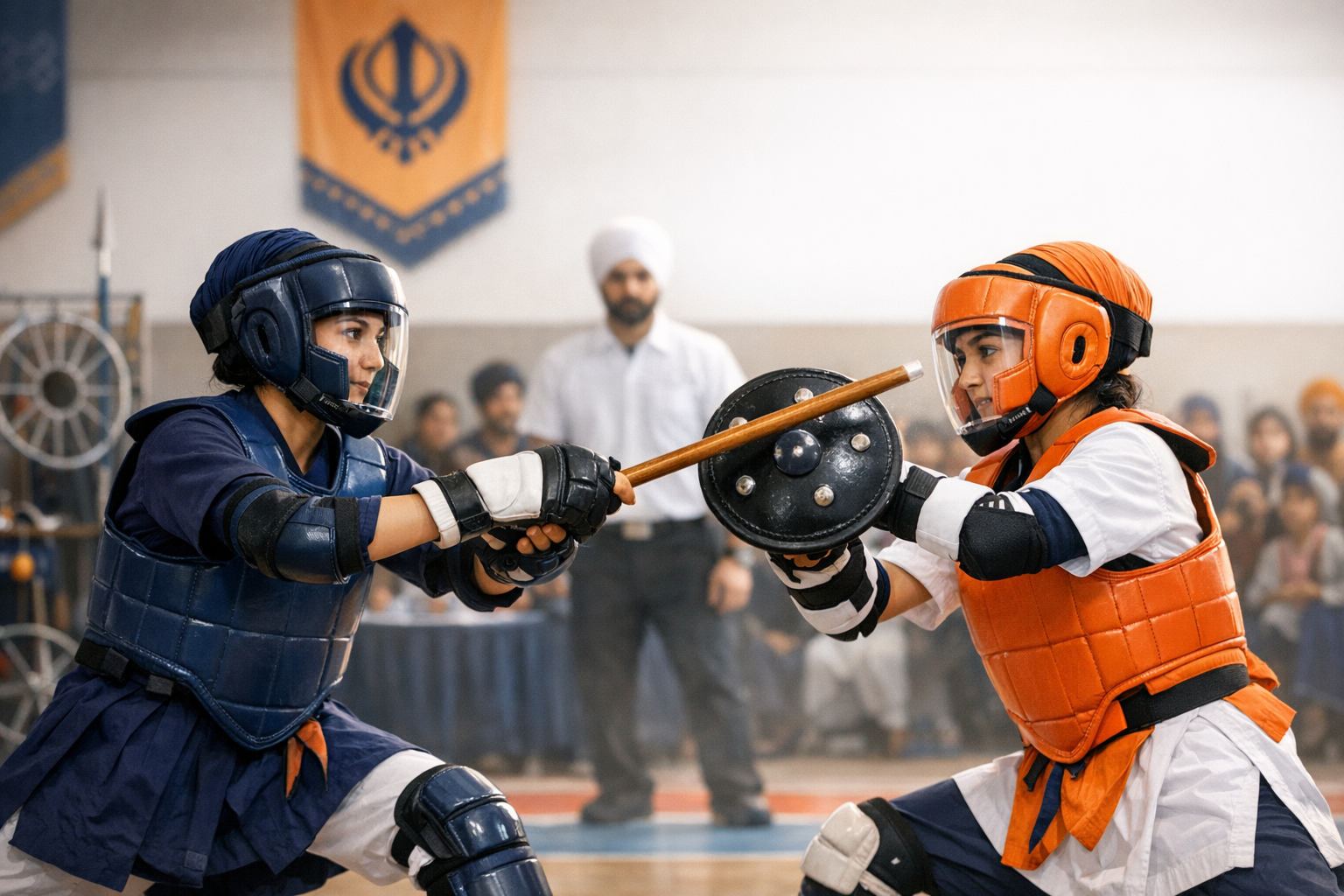
The 12th State Gatka Championship for Girls offered a compelling view into how an indigenous Sikh martial art continues to evolve as a disciplined, safety-first, and empowerment-oriented sport. Framed by a technical ruleset and guided by experienced officials, the championship highlighted the precision, composure, and strategic awareness that define competitive Gatka, while celebrating the deeper dharmic values of courage, self-restraint, and community service that run through the broader civilizational heritage of the subcontinent.
Gatka, rooted in the Sikh martial tradition of shastar-vidya, emphasizes ethical strength, situational awareness, and the integration of mind, body, and breath. In its contemporary sporting form, Gatka adopts standardized equipment, scoring, and safety protocols to create a fair, inclusive arena in which girls can demonstrate timing, distance management, and technical mastery. The 12th edition of this state competition underscored the maturing ecosystem around the sport, from coaching pipelines to officiating standards, and from injury-prevention measures to pathways that connect state-level athletes to national calendars.
What sets this championship apart is its clear articulation of purpose: to elevate girls’ participation in a culturally significant martial art while ensuring that competition advances learning, resilience, and leadership. The focus remained not only on who prevailed in bouts, but also on how athletes applied core principles such as balance, controlled aggression, and decision speed under pressurequalities that resonate across other Indian martial systems like Kalaripayattu and Thang-ta, thereby strengthening a shared dharmic ethos of disciplined self-development.
Competition formats typically combine point-sparring duels with judged technical demonstrations. In the dueling events, athletes engage in Soti–Farri exchanges that reward clean, controlled contact to approved target zones using a cane stick (Soti) and a small shield (Farri). Complementing the duels, demonstration segments showcase forms, synchronized team drills, and weapon-handling skills with traditional implements such as Kirpan (blunt training blade), Barcha (spear), and Chakkar, with scoring based on rhythm, coordination, difficulty, and execution quality.
Age-banding and experience-based pools are designed to ensure competitive parity and athlete safety. Organizers commonly stratify entrants into sub-junior, junior, and senior groups, with an optional novice bracket to support first-time competitors. This layered structure enables progressive skill acquisition and allows coaches to tailor training loads and tactical game plans to developmental stages, creating a coherent pathway for long-term athlete development in Gatka.
Safety remains paramount. Standard protective equipment includes a padded headguard with face protection, chest and rib guards, forearm and shin protection, gloves, and groin guards where appropriate. The Soti is typically a polished, flexible cane of regulated length and diameter, inspected pre-bout to ensure compliance and integrity. Strict prohibitions against thrusts to the face or throat, excessive force, or continuous uncontrolled swings are consistently enforced through immediate warnings, point deductions, or disqualification when warranted.
Scoring systems reward clarity and control. Clean strikes to designated target zones with visible tip or edge contact, maintained balance, and correct distance earn points; off-balance hits, illegal targets, or actions performed after a halt do not. Refereeing teams generally include a center referee, side judges, and a scoring table, with provision for time-outs, injury assessments, and equipment checks. In high-stakes bouts, optional video review can be used to resolve contentious exchanges and uphold competitive integrity.
Technical execution in girls’ Gatka emphasizes economy of motion, footwork precision, and tactical feints. Athletes who excel typically manage lines of entry and exit with light, reactive footwork, employ shield angles to deflect rather than absorb, and time counterattacks into openings created by an opponent’s reach extension. Rotational power, hip–shoulder sequencing, and consistent guard recovery form the core of high-quality exchanges, while hand transitions across shield and stick positions support deception and rapid re-targeting.
From a coaching perspective, structured periodization enhances performance and safety. Preparatory phases focus on base conditioning, joint mobility, and technical fundamentals under low fatigue; pre-competition phases emphasize speed–skill integration, tactical scenarios, and short, high-quality sparring rounds; competition phases stress recovery, reactive drills, and minimal load between bouts. Across all stages, injury-prevention routinesparticularly neck, shoulder, wrist, and ankle stability workhelp sustain readiness throughout multi-day championships.
Youth and adolescent athletes benefit from specific sports science considerations. Iron sufficiency, hydration strategies, and sleep regularity influence reaction time and decision quality. Menstrual-cycle-aware training, individualized for athlete comfort and medical advice, can stabilize perceived exertion and reduce the risk of soft-tissue strain. Warm-ups that combine dynamic mobility, light footwork patterns, and short reaction drills prime neuromuscular readiness for the quick, stop–start demands of Gatka duels.
Sports psychology plays a decisive role. Attentional controlalternating between narrow focus on the opponent’s shoulders, hips, and stick line, and broad situational awareness for spacingcan convert a balanced exchange into a scoring action. Breath regulation techniques cultivated in yogic and meditative traditions align seamlessly with pre-bout routines, lowering physiological arousal to an optimal band for timing and precision. Athletes who employ brief reset cues between exchanges often maintain more stable outputs under tournament stress.
Judged demonstrations supplement sparring by amplifying the artistic and pedagogical dimensions of Gatka. Scorers evaluate synchronization, weapon transitions, posture integrity, and hazard awareness during choreographed sequences. The best demonstrations embody the dharmic balance between kshatra (protective courage) and ahimsa-driven ethics of restraint, presenting martial skill as a disciplined capacity for safeguarding rather than aggression.
The cultural significance of a girls’ championship is profound. Figures such as Mai Bhago symbolize a historical lineage of valor and moral clarity in Sikh history, reminding contemporary participants that technical proficiency and character development belong together. The event also resonates with values found across the broader Indian traditionfrom the disciplined flows of Kalaripayattu in Kerala to the dynamic weapon work of Thang-ta in Manipuraffirming that India’s indigenous martial heritages can coexist and enrich one another.
Institutional momentum adds further credibility. Gatka has featured in the Khelo India Youth Games, signaling national-level commitment to indigenous sports that foreground cultural literacy alongside competitive excellence. This alignment creates clearer progression ladders, encourages standardized coaching education, and supports safer, more equitable competition frameworks for girls and young women across states.
Safeguarding and equity protocols remain central to responsible growth. Clear codes of conduct, background-verified coaching staff, athlete feedback channels, and medical presence at matside contribute to a culture in which girls can compete confidently. Transparent seeding, draw procedures, and timely publication of results reinforce trust among teams, officials, and families, while a zero-tolerance posture toward harassment or unsportsmanlike behavior protects the spirit of the sport.
Observers at the 12th State Gatka Championship for Girls repeatedly noted how matches often turned on superior distance judgment and shield usage. Athletes who controlled the “entry beat”the brief window when an opponent transitions into striking rangecould score with concise, vertical or diagonal lines, then exit without conceding a counter. Conversely, extended exchanges tended to favor the better-conditioned athlete with cleaner guard recoveries and fewer defensive lapses.
Equipment stewardship contributed to both fairness and learning. Routine post-bout inspections identified wear on stick tips and shield edges, and coaches used this feedback to refine grip choices, target selection, and parry angles. Where demonstration events involved Chakkar, Barcha, or blunt Kirpan work, pre-approved implements were verified for weight distribution and surface finish to ensure consistent scoring against the criteria for control, transitions, and artistic coherence.
The championship’s learning outcomes extended beyond the competitive floor. Girls who entered as relative novices left with a working vocabulary of spacing, guard mechanics, and tactical patience. Families and educators gained clarity on the cognitive and physical benefits of indigenous martial arts, from improved reaction time and bilateral coordination to enhanced confidence and emotional regulation, echoing the broader educational aims long associated with India’s knowledge traditions.
Inter-tradition dialogue emerged organically. Coaches and officials frequently referenced comparative methods across dharmic lineagessuch as the low, rooted stances in Kalaripayattu and the circular evasions in Thang-taas instructive analogies for Gatka footwork and angling. Framed respectfully, these comparisons reinforced unity rather than rivalry, aligning with a vision of cultural advocacy that honors diversity while foregrounding shared ethical and pedagogical principles.
From a development standpoint, the event pointed to concrete next steps: structured referee clinics for consistent rule interpretation, state-level coaching workshops on periodization for adolescent athletes, and data-informed injury surveillance to refine protective standards. Such measures would support not only future state championships but also a smoother bridge to national competitions and multi-sport festivals that recognize India’s indigenous martial systems alongside mainstream disciplines.
The narrative of empowerment at the championship was practical, not performative. Athletes navigated pressure, recalibrated tactics after early deficits, and demonstrated sportsmanship in handshake lines that mattered as much as a decisive point. Their progression underscored the premise that technical arts rooted in cultural memory can be taught, governed, and contested with rigor, modern safety, and an ethics-first framework that strengthens communities.
Parents and educators, in turn, encountered a grounded case for girls’ participation in Gatka. The sport’s total-skill demandsposture, breath, balance, and focusmap cleanly onto academic and personal development goals, while the communal environment connects participants to positive role models and service-oriented leadership. In this sense, the 12th State Gatka Championship for Girls functioned as both high-level competition and living classroom.
Ultimately, the championship’s significance lies in how it fused technical excellence with a wider vision of cultural stewardship and dharmic unity. By aligning safety, skill, and spirit, the event demonstrated a replicable template for indigenous sports: standardized rules, qualified officiating, robust safeguarding, and an educational narrative that elevates participants and spectators alike. In doing so, it reaffirmed Gatka’s place as a modern sport with ancient roots and a vital role in empowering girls through disciplined practice, ethical strength, and shared heritage.
Inspired by this post on SikhNet – News.