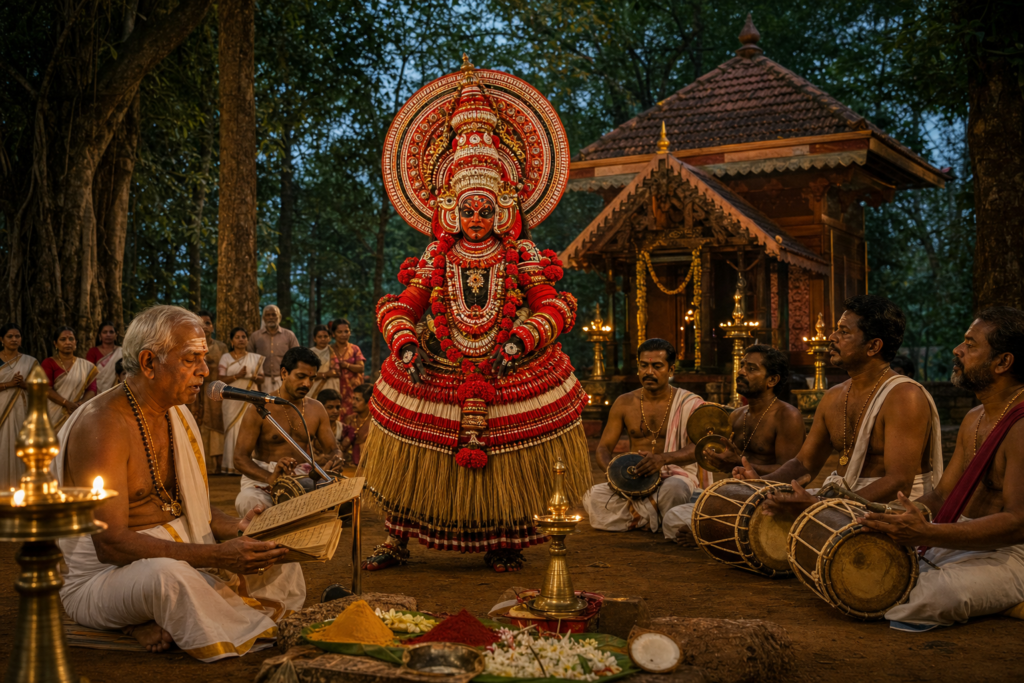
Across the pink-hued slopes of Wadi-Ratnagiri near Kolhapur in Maharashtra, Jyotiba is venerated as a radiant warrior-protector of the Deccan. Revered especially in Maharashtra and northern Karnataka, this guardian deity stands at the confluence of metaphysical luminosity and martial protection, binding community, memory, and landscape into a living sacred geography. The devotion that gathers on these hills is both regionally rooted and pan-Indic in spirit, reflecting a sophisticated theology that is at once intimate to place and expansive in meaning.
Theologically, Jyotiba is interpreted as a dynamic amalgamation of Lord Shiva and Surya, uniting the austere, destructive-regenerative power of Shiva with the life-giving radiance and cyclical order of the sun. This composite identity exemplifies Hinduism’s interpretive flexibility (Ishta devata), where the divine assumes forms resonant with community needs and ecological rhythms. Within the Deccan’s bhakti traditions, parallels are sometimes drawn with Khandoba at Jejuriunderstood as Martanda Bhairava in a Shiva–Surya continuumwhile maintaining the distinctiveness of Jyotiba’s cult, ritual grammar, and hilltop sanctity.
Jyotiba’s temple setting on Maharashtra’s sacred hills is itself a theological statement. As a kshetrapala (guardian of place), the deity presides over a nexus of agrarian plains, trade corridors, and forested uplands that have historically sustained regional livelihoods. The proximity to Kolhapur’s Mahalakshmi (Ambabai) Temple underscores an interdependent sacred geography in which Shakta, Shaiva, and solar motifs circulate, overlap, and reinforce one another. Through this interlinked landscape, the Jyotiba temple becomes a beacon in the Deccan’s spiritual cartography, situating the divine squarely within lived ecology and community well-being.
Local oral narratives portray Jyotiba as a divine protector who aids Mahalakshmi in subduing asuric forces and restoring dharma across the Deccan plateau. This warrior dimension is not a celebration of conflict but an ethic of protectionkshatra in service of righteousnesswhere strength is consecrated to the welfare of the vulnerable and the maintenance of cosmic and social order. In this view, Jyotiba’s martial symbolism functions as a moral archetype: courage yoked to compassion, luminosity tempered by responsibility.
The ritual calendar of the shrine culminates in the renowned Chaitra Purnima yatra, when pilgrims converge from across Maharashtra, northern Karnataka, and neighboring regions. The hill becomes a sea of gulal (vermilion-hued powder), an immediately recognizable visual signature that contrasts with the bhandara (turmeric) of Khandoba’s Jejuri. Throughout the yatra, devotees undertake vows, offer lamps (deepa), and participate in abhishekam, weaving personal petitions into collective praise. The yatra’s aestheticcolor, drumbeats, and conchmaterializes a theology of light, celebrating the sun’s cyclical assurance and Shiva’s transformative grace.
Pilgrimage practice at Jyotiba exemplifies how embodied devotion sustains communal bonds. Families ascend the hill together, elders retell older ballads, and children experience darshan amid drums and tutari calls. For many, the ascent doubles as a rite of passage: a return to ancestral kuladevata roots and a reaffirmation of moral commitments made in everyday life. The hill, the crowd, and the crimson gulal together generate a shared emotional archiveat once devotional and socialthat renews meaning with each passing season.
The temple complex reflects the sturdiness of Maratha-era hill shrines, with robust stonework designed for climate and crowd. Multiple sancta and associated shrines structure the devotee’s journey from outer mandapas to the core garbha-griha, where the experience of darshan is concentrated. Lamps and reflective metals amplify the motif of jyoti (light), transforming architectural volumes into ritual optics that dramatize the fusion of Shiva’s ascetic fire with Surya’s orderly brilliance. The site’s material culturebells, textiles, metal iconsforms a tactile theology, making abstract doctrine palpable through sound, color, and touch.
As a kuladevata for diverse agrarian, artisan, and trading communities, Jyotiba plays a pivotal role in social cohesion. Participation cuts across linguistic and regional linesMarathi, Kannada, and Konkani communities find common cause in the hill’s sanctitywhile men and women alike carry forward household vows, seasonal observances, and life-cycle rituals. The deity’s protective aura extends beyond the strictly religious: it affirms shared values of integrity, reciprocity, and stewardship integral to regional resilience.
The symbolic heart of Jyotiba’s cult is lighta theme that resonates across the broader dharmic spectrum. In Hindu thought, jyoti signals the inner witness and cosmic order; in Buddhist contexts, prabha and prajña evoke luminous awareness; in Jain traditions, kevalajyoti symbolizes the unobscured knowledge of the Siddha; in Sikh scripture and practice, jot denotes the divine light that pervades all beings. Read through this shared lens, Jyotiba’s fusion of Shiva and Surya becomes a unifying emblem of dharmic plurality, demonstrating how diverse paths converge upon ethical clarity, compassion, and disciplined self-cultivation.
For historians of religion, anthropologists, and heritage practitioners, Jyotiba offers a precise case study in how regional Hindu temples embed pan-Indic theology in local ecologies. The site’s pilgrimage economy, environmental setting, and ritual forms illustrate the interdependence of sacred geography and social life. Responsible heritage stewardshipmaintaining pathways, managing festival waste, and supporting local custodiansensures that devotional continuity aligns with ecological care, keeping the hill’s sanctity compatible with contemporary sustainability goals.
In sum, Jyotiba stands as a radiant guardian whose theological synthesisShiva’s transformative power with Surya’s life-giving lightgrounds a living tradition of protection, gratitude, and ethical action. Anchored in Maharashtra’s sacred hills and elevated by the devotion of communities across the Deccan, the temple and its yatra demonstrate how Hindu Temples function as centers of meaning, memory, and social renewal. The result is a compelling model of spiritual diversity in Hinduism that harmonizes with the wider dharmic ethos shared by Hindu, Buddhist, Jain, and Sikh traditions.
Inspired by this post on Hindu Blog.