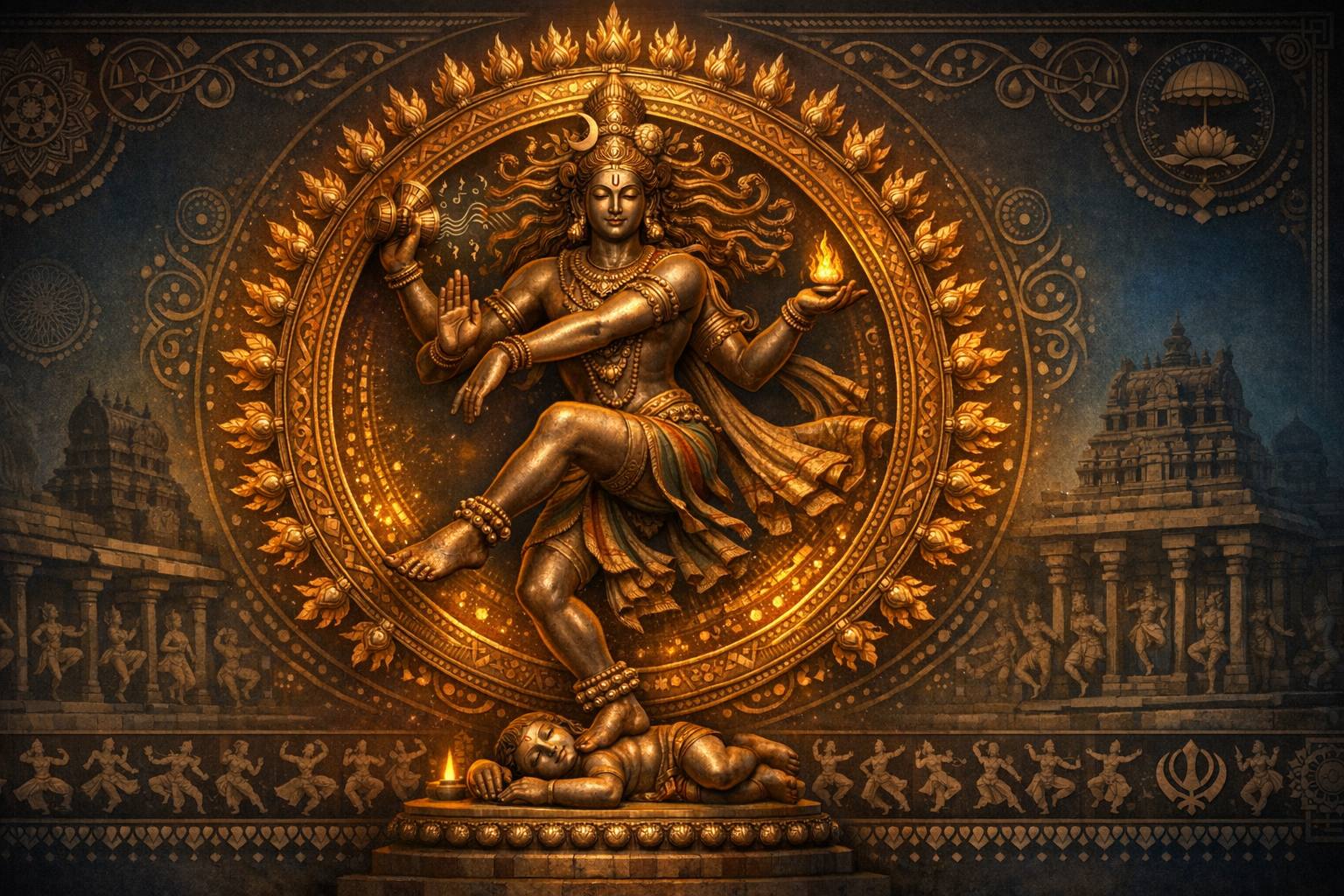
Across the dharmic traditions of Hinduism, Buddhism, Jainism, and Sikhism, embodied rhythm and sacred sound have long served as pathways to transcendence. Within this shared civilizational landscape, Shiva as NatarajaLord of Dancestands as a profound visual theology in motion, a symbol in which metaphysics, music, and movement converge to harmonize cosmos and consciousness.
Iconographically, the Nataraja murti encodes a complete philosophical system. The upper right hand plays the damaru (hourglass drum) that signals srishti (emanation or creation), while the upper left hand holds agni (fire), signifying samhara (dissolution). The lower right hand offers abhaya (fearlessness), and the lower left hand sweeps across the torso in gaja-hasta, gesturing toward the raised left footthe locus of refuge and anugraha (grace). The right foot presses upon Apasmara, the dwarf of forgetfulness and spiritual ignorance, while the prabhamandalathe aureole of fireencircles the dance with the energies of time, matter, and transformation.
This one image thus articulates the pancakritya, the fivefold divine operations celebrated in Shaiva Agamas: srishti (creation), sthiti (preservation), samhara (withdrawal), tirobhava/tirodhana (veiling), and anugraha (graceful revelation). The damaru’s beat intimates the pulse of becoming; the flame proclaims the world’s periodic return to subtlety; the uplifting gesture and raised foot reveal the salvific promise that transcends fear, while Apasmara’s subjugation displays the conquest of bondage by awareness.
The damaru also encodes a linguistic cosmology. According to a well-known tradition, the vibrations of Shiva’s drum yielded the fourteen Maheshvara Sutrasorganizing principles for the Sanskrit phonemic system. In this vision, sound (nada) precedes and patterns creation; movement and meaning are inseparable; and dance is both an aesthetic and ontological act that binds language, breath, and being.
Temple and textual lore celebrate divine attendantsNandikeshvara and the sage Tanduas bearers and transmitters of this dance-knowledge. Some traditions depict Nandikeshvara as holding or accompanying the damaru during Shiva’s cosmic performance, while others emphasize Tandu as the archetypal master of tandava, the vigorous mode of dance. Their names persist in the vocabulary of performance, bridging devotional myth, pedagogy, and practice.
Classical dramaturgy distinguishes tandava (dynamic, often fierce) and lasya (graceful, often gentle), a complementarity attributed to Shiva and Pārvatī. Within tandava, sources describe varied modesfrom the blissful ananda tandava to the formidable rudra tandavaeach a different modulation of cosmic energy. Lasya nuances bhava (emotive states) with tender micro-gestures, illustrating how power and compassion co-create a balanced aesthetic cosmos.
Bharatanatyam, as practiced today, draws on the Natya Shastra attributed to Bharata Muni and the Abhinaya Darpana attributed to Nandikeshvara. The 108 karanasdynamic units of movement described in the Natya Shastralink textual canons with corporeal technique. In pedagogy and performance, these karanas map the body to space, aligning limbs, gaze, and breath with rhythmic cycles (tala) and melodic frameworks (raga) to render metaphysics legible in motion.
South Indian temple architecture and sculpture preserve these grammars of movement in stone and bronze. Chola-period bronzes elevated the Nataraja image into an unparalleled synthesis of fluidity and form; simultaneously, temple walls at sites such as Thanjavur (Brihadeeshwara Temple) immortalized karanas in sculptural sequences. Space, sound, and sculpture merged into an ecosystem where ritual, music, and dance were never isolated arts but facets of one sacred science.
Regional liturgical geographies further embed dance in the sacred landscape. The canonical Panchasabha SthalasChidambaram (Kanaka Sabhai, the Golden Hall), Madurai (Rajata Sabhai, the Silver Hall), Thiruvalangadu (Ratna Sabhai, the Gem Hall), Tirunelveli (Tamra Sabhai, the Copper Hall), and Kutralam (Chitra Sabhai, the Painted Hall)each commemorate distinctive modes of Shiva’s dance, uniting pilgrimage, theology, and performative memory across Tamil Nadu.
Festival cycles culminate this imagination in lived experience. During Arudra Darshan (Margazhi Thiruvathirai), devotees honor the ananda tandava at Chidambaram and other Shaiva temples. Processions, deepa aradhana, and the sonority of nadasvaram and tavil create a total experience in which devotees often report a palpable synchronization between the beat of the drum and the cadence of breathan intimate recognition that the cosmic rhythm is also inwardly present.
For many communities, such moments are not mere spectacles but experiential theology. Accounts from pilgrims and practitioners frequently describe an affective arc: the initial awe before the aureole of fire, the reassurance of the abhaya mudra, the release felt when attention is guided toward the raised foot, and finally a quiet clarity as Apasmara’s subjugation is grasped as the overcoming of one’s own inertia and forgetfulness.
The sacred dance is not exclusive to a single deity-form. Krishna’s rasa-lila translates theological love into circular, communally embodied movement, while Nritya Ganapati celebrates Ganesha as patron of the arts. Pārvatī’s lasya refines tenderness into technique; Durga’s victory narratives conclude in celebratory performance; and Kali’s intensified energies reveal how even fierce modalities can be ritually harnessed toward renewal rather than chaos.
Kindred expressions appear across dharmic lineages. Vajrayana Buddhism maintains cham dances, where practitionersthrough precise costume, rhythm, and stepritually dismember negativities and protect the sangha. Jain processional traditions historically integrated music and stylized movement around the samavasarana, sanctifying space with ordered sound. Sikh gurbani kirtan saturates the sabha with raga-driven devotion, while gatka embodies disciplined, rhythmic motion as martial seva. Across these traditions, performance is both sadhana and shared cultural inheritance.
From a technical perspective, the dance arts unify breath (prana), rhythm (tala), and emotive flavor (rasa) into a coherent discipline of attention. Training coordinates drishti (gaze), angika (body), vacika (voice/chant), and sattvika (inner affect) abhinaya, cultivating one-pointedness (ekagrata) that is as therapeutic as it is devotional. In this frame, dance functions as a contemplative technologyan applied philosophy that refines perception and integrates body, mind, and meaning.
In sum, Nataraja’s dance is a civilizational emblem of dynamic balance: spirit in motion, order through rhythm, compassion shaped as form. Whether encountered in the bronze glow of a sanctum, the sonic arc of Arudra Darshan, the sculpted sequence of a temple wall, or the disciplined grace of Bharatanatyam, it invites renewed recognition that creation, preservation, transformation, veiling, and grace are not distant cosmic events but living cycles accessible within and among devoted communities across the dharmic world.
Inspired by this post on Hindu Pad.